
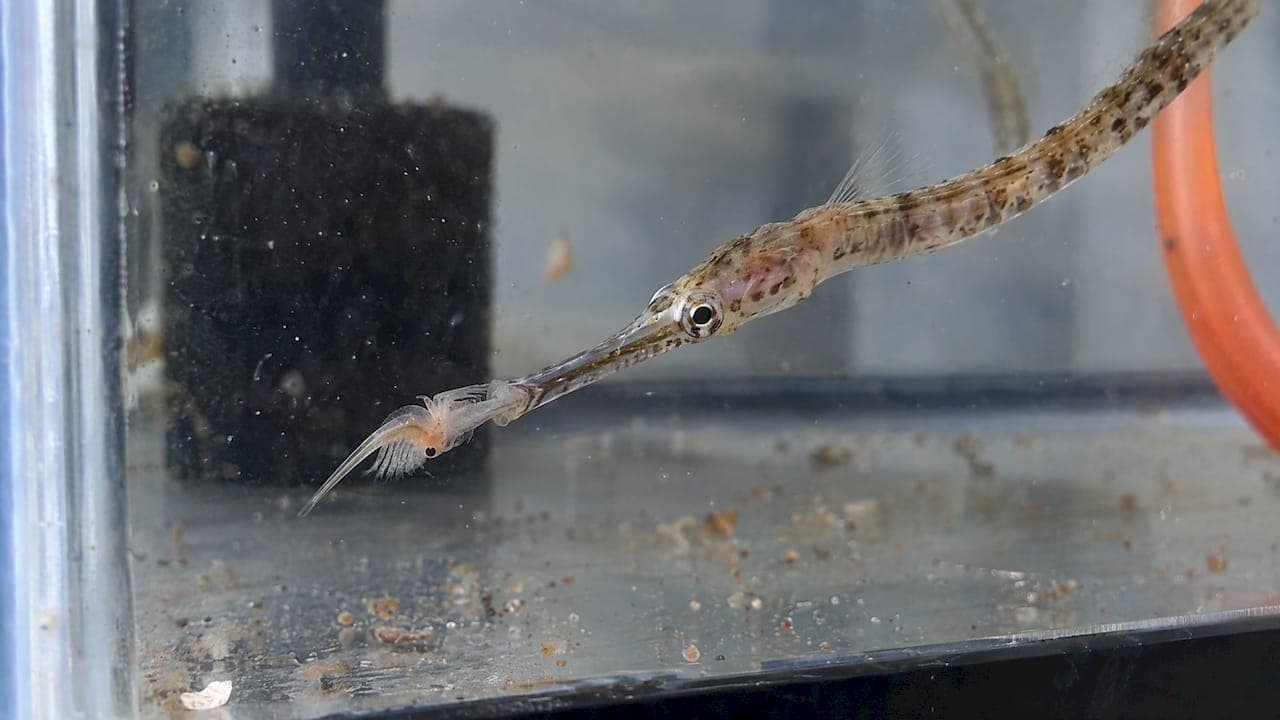
Pipefish fry can eat brine shrimp, but only if the shrimp are the right size, fed at the right moment and not the only thing on the menu. Newly hatched brine shrimp are a workable first food for some pipefish and too big for others. Even when they are accepted, brine shrimp alone tend to fall short over time. This guide covers size, hatching, enrichment, feeding frequency, water quality and the live foods that fill the gaps.
TL;DR
- Pipefish are small-mouthed, visual hunters that mostly want live, moving prey. Baby brine shrimp suit some species and are too large for others.
- Feed nauplii soon after hatching, and enrich them if you hold them longer. A freshly hatched first-stage nauplius cannot be enriched.
- Plan on two to three scheduled feedings a day for young pipefish, and siphon leftovers so uneaten shrimp do not foul the tank.
- Pipefish fed only Artemia often decline after a few months. Add copepods, rotifers, phytoplankton or mysis.
- Hatch your own cysts, or use farmed live brine shrimp when you want a steady supply without running a hatchery.
Table of Contents
- Can pipefish fry eat brine shrimp?
- Hatching brine shrimp for fry
- Timing: why freshness and enrichment matter
- How often and how much to feed
- Beyond brine shrimp: filling the nutrition gap
- Keeping the fry tank clean
- Our view: consistency beats cleverness
- Hatch or buy: a practical call
- FAQ
- Sources
Can pipefish fry eat brine shrimp?
Yes, with conditions. Pipefish do not chew or tear food. They suck prey whole through a narrow snout, so the prey has to fit that opening. This is why the question is never just "brine shrimp or not" but "which brine shrimp, at what age."
According to a pipefish FAQ on seahorse.org, very small-mouthed pipefish such as Corythoichthys need very small prey such as copepods or baby brine shrimp. Larger-mouthed pipefish may take adult enriched brine shrimp, small ghost shrimp or live mysids. Treat that as a starting point and watch your own animals: a fry that strikes and spits out the shrimp, or ignores it altogether, is telling you the prey is the wrong size.
Here is the catch with newly hatched shrimp. UF/IFAS notes that freshly hatched Artemia nauplii are about 450 micrometers wide, which is usually too large for most first-feeding marine fish larvae. Pipefish fry are born more developed than many marine larvae, which is why many can take baby brine shrimp, but the smallest species and the youngest fry may still need something smaller first. Rotifers, copepod nauplii and similar foods are the usual bridge.
A simple size check
Put a few shrimp in the tank and watch for ten minutes.
- If fry track the shrimp and strike, the size is working.
- If they follow but never commit, the prey is probably too big or too fast.
- If they ignore the shrimp completely, the problem may be feeding response, lighting or stress rather than size. Offer a known favorite, such as copepods, to find out.
A healthy fry that feeds will show a rounded belly within an hour or two. Pinched bellies after a day of "feeding" mean the food is not going in.
Hatching brine shrimp for fry
If you hatch your own, the process is simple, but small errors cost you most of the batch. The UF/IFAS publication on live feeds reports that Artemia cysts hatch in about 24 hours at 28°C (82°F). Optimal salinity is 15 to 35 g/L, although hatching can occur anywhere from 1 to 80 g/L. For a closer look at the numbers, see our guide to brine shrimp water parameters, and for temperature, our note on hatching and holding temperature ranges.
A practical routine:
- Mix saltwater in a clear container, aerate it hard enough to keep the cysts suspended, and keep it warm and lit.
- Add cysts at a modest density. Crowding drops oxygen and lowers the hatch rate.
- Wait roughly a day. Turn off the air for a few minutes so empty shells float and nauplii settle or gather toward a light.
- Siphon the nauplii from the bottom or from the light, not from the top where shells float.
- Rinse them in clean saltwater before feeding.
That last step matters for fry tanks. UF/IFAS advises removing shells and exoskeletons from the culture system, where they can deteriorate water quality. Shells carried into a fry tank also get swallowed, and nobody wants that in a pipefish's narrow gut. For a deeper walk-through of the hatching biology, see our Artemia nauplii guide.
Stagger your hatches
Fry need food every day, but a single hatch is only at its best for a short time. Run two or three containers started a day or half a day apart so you always have a fresh batch. Label them with the start time. It is a small habit that prevents the most common failure: feeding shrimp that are a day or two old and empty.

Timing: why freshness and enrichment matter
Nutritional value drops quickly after hatching. Per UF/IFAS, instar I nauplii develop within 24 hours after hatching and instar II within 36 hours. Instar I cannot be enriched, because the gut is not yet open and the animal is living off its yolk reserves. Later stages should be enriched. UF/IFAS adds that enrichment can raise nutrition temporarily, but fatty-acid levels end up inconsistent because Artemia do not take up enrichment evenly and metabolize some of it before they are eaten.
What this means at the tank:
- Feeding within hours of hatching gives you the nauplii at their largest energy content, but with the fatty-acid profile they hatched with, which is poor for marine fish.
- Holding them 12 to 24 hours with enrichment improves the profile, but the shrimp grow, which can push them past the size your fry can swallow.
That tension is the whole game with pipefish fry. If your fry take only the smallest prey, feed nauplii promptly and rely on other foods for nutrition. If your fish can handle slightly larger prey, enrichment becomes worthwhile.
Our article on the brine shrimp life stages and the feed window covers the stages in detail.
How to enrich
The CTSA publication on Artemia enrichment states that nauplii are commonly enriched for at least six hours before feeding, and that overnight enrichment followed by feeding the next morning is common practice. A public-aquarium pipefish husbandry survey likewise reports that Artemia, both juvenile and adult, should be soaked in nutrient-enrichment formulas before feeding.
Our protocols on brine shrimp enrichment timing and DHA to EPA ratios in live feed go further. In short: start enrichment once the nauplii have molted past instar I, use a marine-appropriate product, keep them aerated and rinse before feeding so you do not add enrichment slurry to the tank.

How often and how much to feed
The pipefish survey recommends two to three scheduled feedings per day for young pipefish, depending on their size. It also warns that overfeeding can stress the young and pollute the tank.
There is no universal quantity, because tank volume, fry count and species all change the answer. Use these rules instead:
- Offer a small amount, then watch. Fry should be able to find a shrimp within a few seconds of looking.
- If shrimp are still swimming around ten to fifteen minutes later, you gave too many. Cut the next portion.
- Feed at the same times each day. Pipefish learn the routine and come to the feeding spot.
- Use a shallow dish or a small, low-flow corner so prey stay concentrated near the fry rather than scattering into the filter.
Freshwater species of brine shrimp cannot live in marine water for long, and marine pipefish tanks are the opposite of what brine shrimp tolerate in some setups. In a true marine tank, live nauplii survive for hours and become a live-food supply that continues to be hunted. In brackish or freshwater pipefish setups, they die quickly and sink, so size your portions to what gets eaten fast. Our guide to brine shrimp for freshwater fish explains how that changes feeding.
Beyond brine shrimp: filling the nutrition gap
This is the part many guides skip. Brine shrimp are convenient, but they are not a complete diet for pipefish.
The husbandry survey states that pipefish fed only Artemia often deteriorate after a few months, even when the Artemia are enriched. UF/IFAS agrees on the underlying issue: Artemia are nutritionally deficient for most developing marine fish larvae, particularly in DHA, EPA and ARA.
So build a rotation:
| Food | Best for | Notes |
|---|---|---|
| Newly hatched brine shrimp | Pipefish fry whose mouths can take them | Feed fresh; low in marine fatty acids unless enriched later |
| Enriched brine shrimp | Larger fry and juveniles | Enrich after the first stage; rinse before feeding |
| Copepods | Smallest fry, and all ages | Mature tanks can grow their own populations |
| Rotifers and phytoplankton | Very young fry | The survey reports facilities raise these as primary feeds for young pipefish |
| Mysis shrimp and krill | Juveniles and adults | The survey reports pipefish can be trained to eat frozen versions |
The Ornamental Aquatic Trade Association notes that pipefish may require live mysis shrimp, brine shrimp or copepods, and that mature aquariums may develop copepod populations that can be supplemented with live or frozen copepods. If you keep a refugium, it can quietly supply some of that variety; our piece on brine shrimp in a refugium explains how to use it for food rather than as a colony.
A word on frozen food. The survey says pipefish can be trained onto frozen mysis and krill, and many keepers do it for convenience. Some keepers on hobby forums argue that training is more trouble than it is worth for pickier species. Either way, treat frozen food as a way to broaden the diet, not a substitute for live prey in the first weeks.
Keeping the fry tank clean
Live food that is not eaten becomes waste. The survey advises avoiding overfeeding and siphoning the tank bottom between feedings to prevent buildup. In a small fry tank, that matters more than anywhere else, because there is little water to dilute the mess.
A workable routine:
- Siphon visible debris after the last feeding of the day, using airline tubing so you do not suck up fry.
- Replace a small amount of water with matched saltwater, rather than large swings.
- Keep dead shrimp and shells out by rinsing before feeding.
- Check ammonia and nitrite if you ever see cloudy water or fry hanging at the surface.
Rinsed, fresh shrimp also help. Old or crashed hatches bring bacteria and smell along with them.
Our view: consistency beats cleverness
We raise brine shrimp on land in controlled systems, fed exclusively on Dunaliella microalgae, and we aim for at least 40% protein content. We built the process around one observation: the biggest problem in feeding small fish is variability. Wild-harvested shrimp swing with the season and can be starved when they are collected. Hatchery-hatched nauplii swing with the hatcher's timing.
For pipefish keepers, we think the lesson is this. Brine shrimp are a tool, not a diet. Their best use is as a reliable, moving, easy-to-store prey item in a mixed feeding plan with copepods, phytoplankton, rotifers and mysis. If you hatch, treat timing as everything. If you buy, buy from a source that tells you how the shrimp were raised and fed, because what the shrimp ate is part of what your fish gets.
We would also rather tell you plainly that no brine shrimp, ours included, replaces a varied marine diet for pipefish. Our job is to make one part of that diet consistent.
— Demeter
Hatch or buy: a practical call
Hatching suits you if you have space, a steady routine and a use for large quantities. Buying suits you if you keep a small tank, travel, or have fry that need a feed on days when your hatch is not ready. Our guide on hatching versus buying for reef tanks lays out the trade-offs, and the same logic applies to a pipefish setup.
A hybrid approach works for many keepers: hatch for fry, and keep a source of farmed live shrimp for days when the hatch fails or you need larger prey for juveniles.
Our farmed live brine shrimp ship from $17 to $35 per order, and our monthly membership is $25 per month for a recurring monthly shipment. For the phytoplankton side of the feeding plan, our live phytoplankton is $20.
If you are not sure which size or format fits your fry, start with a single order and compare it against your own hatch for a week. Our brine shrimp product page explains how the shrimp are raised, and local fish stores that want a steady supply can ask about our bulk store order.
FAQ
What size brine shrimp should I feed pipefish fry?
Start with newly hatched nauplii for fry with enough mouth to take them, and watch whether they strike and swallow. UF/IFAS puts a hatchling at about 450 micrometers wide, which some very young marine larvae cannot manage. If your fry refuse them, move to copepods or rotifers until they grow.
How soon after hatching should I feed the shrimp?
As soon as you can rinse and collect them. Instar I nauplii develop within 24 hours of hatching and cannot be enriched, so their value is in being fresh. If you wait for enrichment, expect the shrimp to grow larger.
Can pipefish live on brine shrimp alone?
Not well. A public-aquarium husbandry survey reports that pipefish fed only Artemia often deteriorate after a few months, even when the shrimp are enriched. Mix in copepods, mysis, rotifers or phytoplankton so the diet covers the fatty acids brine shrimp lack.
How many times a day should I feed?
Two to three scheduled feedings daily is the guidance for young pipefish, adjusted for their size. Give small portions, and siphon leftovers so they do not pollute the tank.
Will pipefish eat dead or frozen brine shrimp?
Most prefer live, moving prey, though the survey reports that pipefish can be trained to take frozen mysis and krill. Treat that as a later step, after the fry are feeding well on live food.
Sources
- UF/IFAS: Choosing an Appropriate Live Feed for Marine Fish Larvae (FA167)
- CTSA: Enrichment of Artemia for Use in Freshwater Ornamental Fish Production
- Pipefish husbandry survey of public aquariums
- Ornamental Aquatic Trade Association: How to care for seahorses and pipefish
- Seahorse.org: Seahorse FAQ