
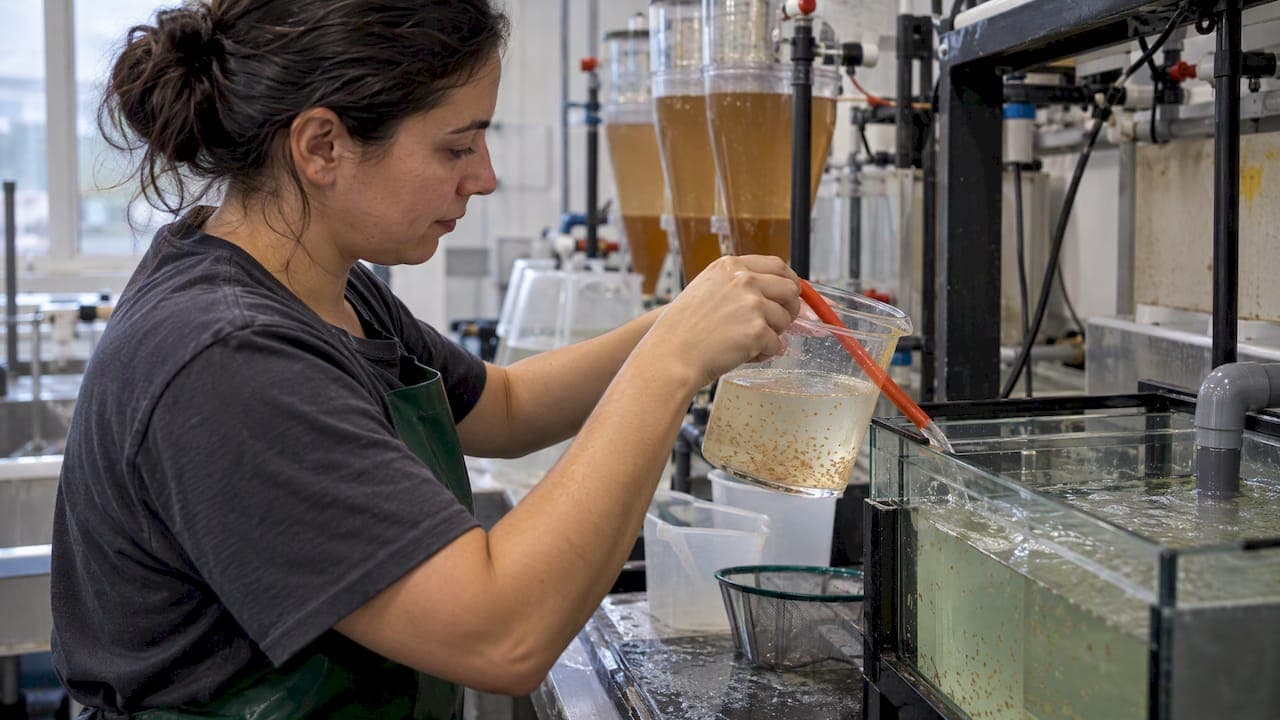
Brine shrimp develop through roughly 17 stages: a dormant cyst, a yolk-fueled nauplius (Instar I), about 15 subsequent larval molts, and finally an adult. Cysts typically hatch within 18 to 48 hours under the right conditions, and under ideal warmth and salinity, brine shrimp can reach adulthood in under 10 days. Here is what happens at each stage, and why the timing matters if you are feeding larval fish or just curious about the animal in your saltwater tank.
TL;DR:
- Hatch cysts with 25 to 35 parts per thousand salinity, water at 77°F to 86°F, adequate oxygen, and light, though strain affects timing.
- Instar I nauplii cannot eat, so feed them to larval fish within hours of hatching; Instar II begins filter feeding after 6 to 12 hours.
- If harvest must wait, cold store nauplii at temperatures 2°F to 10°F above freezing with aeration; their nutritional reserves last about 24 hours.
- From Instar II, brine shrimp filter feed on particles 1 to 50 micrometers; Dunaliella algae is consistently favored across developmental stages.
Table of Contents
- Cyst biology and the hatching process
- Nauplius and early larval instars: anatomy and behavior
- Larval development through molts to adulthood
- Feeding, nutrition, and stage-specific value
- Timing, growth rates, and lifespan under different conditions
- Practical hatchery and hobbyist notes on storage and safe feeding
- Why farmed, microalgae-fed Artemia matters
- Spotting each life stage by sight
- Environmental needs at each stage of growth
- Reproductive biology: mating and cyst formation
- Disease and vulnerability across life stages
- Matching microalgae to each growth stage
- Getting the timing right matters more than it seems
- FAQ
- Sources
- Authoritative manuals and extension resources
Cyst biology and the hatching process
A brine shrimp cyst is a tough, round capsule roughly 200 to 300 micrometers across, built to survive drought, freezing, and years of storage in a dormant state called diapause. Inside that shell sits a fully formed embryo that has essentially paused its metabolism, waiting for the right trigger to resume development.
Hatching depends on a combination of environmental cues working together:
- Hydration in salt water, typically 25 to 35 parts per thousand salinity
- Warm water, generally between 77°F and 86°F
- Adequate dissolved oxygen, since the embryo needs to respire as it resumes activity
- Light exposure, which many strains use as an additional hatching signal
Once hydrated, the cyst swells and the shell cracks open in what hatchery technicians call the "breaking" stage. The embryo then emerges still wrapped in a thin membrane, hanging below the empty shell in what is known as the "umbrella" stage, before breaking free entirely as a swimming nauplius. Depending on strain and water temperature, cysts generally hatch within 1 to 2 days, though decapsulated cysts (with the shell chemically removed beforehand) can hatch somewhat faster.
Nauplius and early larval instars: anatomy and behavior
The newly hatched nauplius, known as Instar I, is small but distinctive. Several features identify this first free-swimming stage:
- Size and color: roughly 400 to 500 micrometers long with a brownish-orange body, colored by the yolk reserves still inside it.
- A single red eye: a simple light-sensing organ (the nauplius eye) sits at the front of the head, helping the larva orient toward light.
- Three pairs of appendages: these drive swimming and basic sensory function before more limbs develop.
- No functioning gut: Instar I cannot feed. It survives entirely on yolk reserves carried over from the cyst.
This non-feeding period does not last long. Within 6 to 12 hours of hatching, the nauplius molts into Instar II, which has a functional digestive tract and begins filter-feeding on particles in the water, generally those between 1 and 50 micrometers across.
For anyone raising larval fish, this transition matters. A nauplius fed to fish while it still carries yolk reserves delivers more concentrated energy than one that has already burned through those stores filter-feeding on its own. That is why hatchery operators try to harvest and use nauplii within hours of hatching rather than letting them sit.
Larval development through molts to adulthood
Brine shrimp do not grow continuously. Like most crustaceans, they grow in steps, shedding a rigid exoskeleton and forming a new, larger one at each molt. Each molt marks a new instar, and the full sequence from hatch to maturity spans approximately 17 stages: the single nauplius stage, about 15 subsequent larval molts, and the adult form.
Across that sequence, a few milestones stand out:
- Early instars add thoracopods (the paired limbs used for swimming and filter-feeding) and develop compound lateral eyes alongside the original nauplius eye.
- Mid-stage instars shift the antennae from a swimming tool into a sensory and, in males, a clasping structure.
- Sexual differentiation becomes visible around instar 10, when developing structures reveal whether an individual will become male or female.
- The adult form, reached by the final molt, measures about 8 to 10 millimeters and carries 11 pairs of functional thoracopods used for both swimming and feeding.
Grouping the instars loosely helps with identification: early stages (roughly 1 through 5) are yolk-influenced and small, mid stages (6 through 10) show rapid limb and eye development along with the start of sexual differentiation, and late stages (11 through 15, plus the adult) refine body proportions and reproductive structures.
Feeding, nutrition, and stage-specific value
Feeding strategy changes sharply across these stages. Instar I runs on internal yolk and needs nothing from the water column. From Instar II onward, brine shrimp become obligate filter feeders, straining whatever is suspended in the water at a size their mouthparts can handle.
Pro Tip: Feed newly hatched nauplii to larval fish within the first few hours after hatching, while yolk reserves are still intact, to deliver the most concentrated nutrition per shrimp.
Not all food particles are equal. Research on selective grazing shows that brine shrimp preferences and grazing rates shift with developmental stage, and that Dunaliella-type microalgae are consistently favored across stages, likely because of particle size and digestibility. Stage-dependent grazing selectivity, with Dunaliella preferred across developmental stages, is one of the better-documented patterns in Artemia feeding studies, and it helps explain why microalgae choice affects growth outcomes in culture.
This is also why enrichment, feeding live brine shrimp a nutrient boost before they reach a fish tank, works best on a tight schedule. Lipids and proteins delivered through enrichment degrade over hours, so hatcheries time the harvest to capture nauplii at peak nutritional value rather than letting them age in holding tanks. Our guide to target feeding with microalgae covers practical feeding windows in more depth.
Timing, growth rates, and lifespan under different conditions
Development speed varies enormously with conditions. Under warm, well-oxygenated, optimal salinity conditions, brine shrimp can go from nauplius to reproductive adult in under 10 days. In less ideal settings, the same process can stretch across several weeks.
Several factors control that pace:
- Temperature: warmer water (within tolerable limits) speeds molting and growth
- Salinity: moderate salinity supports faster development than extremes
- Dissolved oxygen: low oxygen slows metabolism and growth
- Food availability: consistent microalgae supply sustains steady molting
- Strain differences: some Artemia populations mature faster than others regardless of conditions
Once mature, reproduction takes one of two paths. Under favorable conditions, females often give live birth to free-swimming nauplii (ovoviviparity). Under stress, such as low oxygen or crowding, females instead produce dormant cysts (oviparity), the same hardy capsules that start the cycle over.
Practical hatchery and hobbyist notes on storage and safe feeding
A few practices make the difference between wasted cysts and a reliable hatch:
- Store cysts cool and dry: an airtight container, ideally vacuum-sealed, in a cool location preserves viability for extended periods.
- Consider decapsulation: removing the outer shell chemically before hatching eliminates empty shells from the feeding tank and can shorten hatch time.
- Cold-store live nauplii when needed: holding hatched nauplii at roughly 2°F to 10°F above freezing slows their metabolism, preserving nutritional stores for up to about 24 hours with adequate aeration.
- Feed promptly: nauplii held too long, whether at room temperature or beyond that 24-hour cold-storage window, lose lipid and protein reserves that your fish never get to use.
Why farmed, microalgae-fed Artemia matters
Wild-harvested brine shrimp carry whatever nutrition their natural environment happened to provide that season, which means protein and fat content swings depending on conditions the shrimp cannot control. We raise our brine shrimp differently.
- We cultivate Artemia in controlled systems rather than relying on seasonal wild harvests.
- Our shrimp feed exclusively on microalgae, which supports a consistent protein content.
- That consistency matters for anyone running a repeatable feeding schedule for larval fish, since nutritional variability can affect growth outcomes.
If you want to see how that plays out in practice, our live brine shrimp products page walks through packaging and sourcing details, and our deeper nauplii biology guide covers hatching and feeding in more technical detail.
Spotting each life stage by sight
Identifying where a brine shrimp sits in its development comes down to a handful of visible traits. Instar I nauplii are small, orange-brown, and move in jerky swimming bursts powered by three pairs of appendages. They lack a visible gut, since nothing is passing through one yet.
By Instar II and the stages that follow, you start seeing a thin digestive tract running the length of the body, visible under magnification as food particles move through it. Compound eyes begin forming on either side of the original nauplius eye, eventually giving the animal stalked, laterally placed eyes distinct from the simple central eye it hatched with.
Mid-stage larvae develop paired thoracopods along the body, the limbs responsible for both swimming and filter-feeding, and these multiply and refine their shape with each successive molt. Segmentation becomes more pronounced as the body elongates. Around instar 10, reproductive structures start to differentiate, offering the first visible cues to sex.

By the time an adult molt is reached, the body has stretched to about 8 to 10 millimeters, carries 11 pairs of functional thoracopods, and shows clear sexual dimorphism: males develop enlarged second antennae used for grasping during mating, while females develop a brood pouch near the rear of the body used to carry developing embryos or cysts. These adult traits make mature brine shrimp easy to distinguish from any earlier instar at a glance.
Environmental needs at each stage of growth
Hatching conditions get most of the attention, but the environmental window stays important well past Instar I. Newly hatched nauplii tolerate a fairly wide salinity range, generally similar to hatching salinity around 25 to 35 parts per thousand, and do best in warm water consistent with hatching temperatures.
As larvae progress through the mid and late instars, their tolerance broadens somewhat. Juvenile and adult brine shrimp are famously hardy, able to survive in water saltier than seawater, in some cases several times standard ocean salinity, which is part of why they thrive in salt ponds and evaporation basins where few other animals can survive. That broad tolerance does not mean every salinity level is optimal for growth, though: faster molting and better survival rates generally occur within a moderate range rather than at the extremes the adults can merely tolerate.
Oxygen availability matters at every stage, with low oxygen slowing metabolism and extending the time between molts. Stable temperature also keeps molting on a predictable schedule, which is particularly useful in hatchery settings where consistent timing from one batch to the next simplifies feeding schedules for larval fish. Culturists aiming for fast, reliable cycles generally keep conditions closer to the hatching ranges throughout early development, loosening tolerance expectations only once shrimp reach the hardier juvenile and adult stages.
Reproductive biology: mating and cyst formation
Adult brine shrimp reproduce through direct mating rather than any external fertilization process. Males use their modified second antennae to grasp females, often riding attached to a female for extended periods before and during mating, a behavior visible to the naked eye in a dense culture tank.

After mating, a female's reproductive outcome depends heavily on her environment. Under stable, favorable conditions, with adequate oxygen, moderate salinity, and consistent food, she generally produces live nauplii directly, a reproductive mode called ovoviviparity, where embryos develop inside her brood pouch and emerge already swimming.
Under stress, such as crowding, low oxygen, or salinity spikes, the same female instead produces dormant cysts, switching to oviparity. These cysts are released into the water, where they float until conditions allow hatching, sometimes immediately and sometimes after years of dormancy. This dual reproductive strategy is part of what makes Artemia so resilient: a population can keep reproducing through good conditions and still leave behind a dormant generation that survives a drought, a freeze, or a pond drying out entirely.
A single female can produce broods repeatedly over her reproductive life, alternating between live young and cysts as conditions shift, which is part of why brine shrimp populations can rebound quickly once favorable conditions return to a salt pond or culture tank.
Disease and vulnerability across life stages
Brine shrimp are hardy by crustacean standards, but vulnerability is not evenly distributed across their life stages. The earliest free-swimming stages face the highest risk. Predator studies looking at interactions between Artemia and aquatic predators found predation rates fall more heavily on metanauplii than on older juveniles or adults, likely because smaller, slower larvae are easier targets and have fewer defenses.
Beyond predation, crowded or poorly aerated cultures create conditions where bacterial buildup can stress larvae already running on limited energy reserves. Nauplii in particular, since they are not yet feeding or are just beginning to feed, have little margin to recover from a stressful environment compared to a hardier adult.
Culture hygiene matters most during these early stages. Clean hatching water, appropriate salinity, and prompt harvest and use of nauplii all reduce the window in which fragile larvae are exposed to pathogens or oxygen-poor conditions. Adults tolerate a wider range of environmental stress and crowding, which is part of why hatchery operators concentrate monitoring and water-quality effort on the hatch and early larval stages rather than spreading attention evenly across the whole cycle.
Matching microalgae to each growth stage
Not every microalgae species suits every stage of brine shrimp development equally well, and getting this pairing right affects both growth speed and the nutritional value passed on to any fish eating the shrimp. Selective grazing research found that feeding preference and grazing rate both shift as Artemia move through their instars, with particle size tolerance widening as the animal grows.
Early filter-feeding stages, starting at Instar II, need microalgae small enough to pass through developing mouthparts, generally in the 1 to 50 micrometer range. Dunaliella-type algae fit that window well and were consistently preferred across stages in grazing studies, likely contributing to the higher survival rates researchers observed when it was part of the diet.
As brine shrimp mature into later larval stages and adulthood, their filtering apparatus can process a broader range of particle sizes, but the nutritional quality of what they are eating still determines what ends up in their tissue. Brine shrimp are essentially nutritional vessels: they pass along whatever fats, proteins, and pigments are in their algae diet to whatever eats them next. That is the mechanism behind our own approach, feeding exclusively on Dunaliella to produce a brine shrimp with consistent protein content, rather than the variable profile that comes from brine shrimp grazing on whatever algae happens to be available in a wild pond that season.
Getting the timing right matters more than it seems
The single most practical thing to take from all of this: feed freshly hatched nauplii within their first day, while yolk reserves are intact, for the highest nutritional payoff. Knowing where a shrimp sits in its roughly 17-stage development saves time troubleshooting slow growth or poor larval survival, because so many outcomes trace back to feeding the wrong stage at the wrong moment. For protocols or a reliable, farmed source of nauplii, our linked guides and product pages above are a good next stop.
— Demeter
FAQ
How long do brine shrimp last after they hatch?
Brine shrimp can live for several weeks to a few months as adults, depending on water conditions and food availability, after reaching maturity in as little as a week to 10 days under optimal conditions. Newly hatched nauplii, by contrast, retain peak nutritional value for only a matter of hours unless held in cold storage.
What are the predators of brine shrimp?
In both wild and experimental settings, small aquatic predators target brine shrimp at various life stages, with predation pressure higher on metanauplii than on hardier juveniles or adults. In aquarium and aquaculture settings, brine shrimp themselves are raised specifically as a feed source for larval and juvenile fish.
Will baby shrimp survive in a community tank?
Newly hatched brine shrimp nauplii are typically used as live food rather than raised to adulthood in a community tank, since most tankmates will eat them quickly. If the goal is growing brine shrimp to adulthood, a dedicated culture setup with controlled salinity and food is more reliable than a mixed community tank.
How many developmental stages do brine shrimp go through in their lifetime?
Brine shrimp pass through approximately 17 developmental stages: one nauplius stage, about 15 subsequent larval molts, and a final adult stage. Each stage is marked by a molt where the shrimp sheds its exoskeleton and grows into a new one.
Sources
- SRAC Publication No. 702 — Artemia production for marine larval fish culture
- FAO Artemia manual — life and hatching description (2024 update)
- Artemia culture for intensive finfish and crustacean larviculture (Virginia Cooperative Extension)
- Selective grazing and nutritional implications for Artemia — PMC article
Authoritative manuals and extension resources
For readers who want the primary material behind these stage counts and hatching practices, these resources go deeper:
- SRAC Publication No. 702 on Artemia production for marine larval fish culture
- FAO Artemia manual (2024 update) covering biology, hatching, and life stages
- Virginia Cooperative Extension guidance on hatching, decapsulation, and storage