
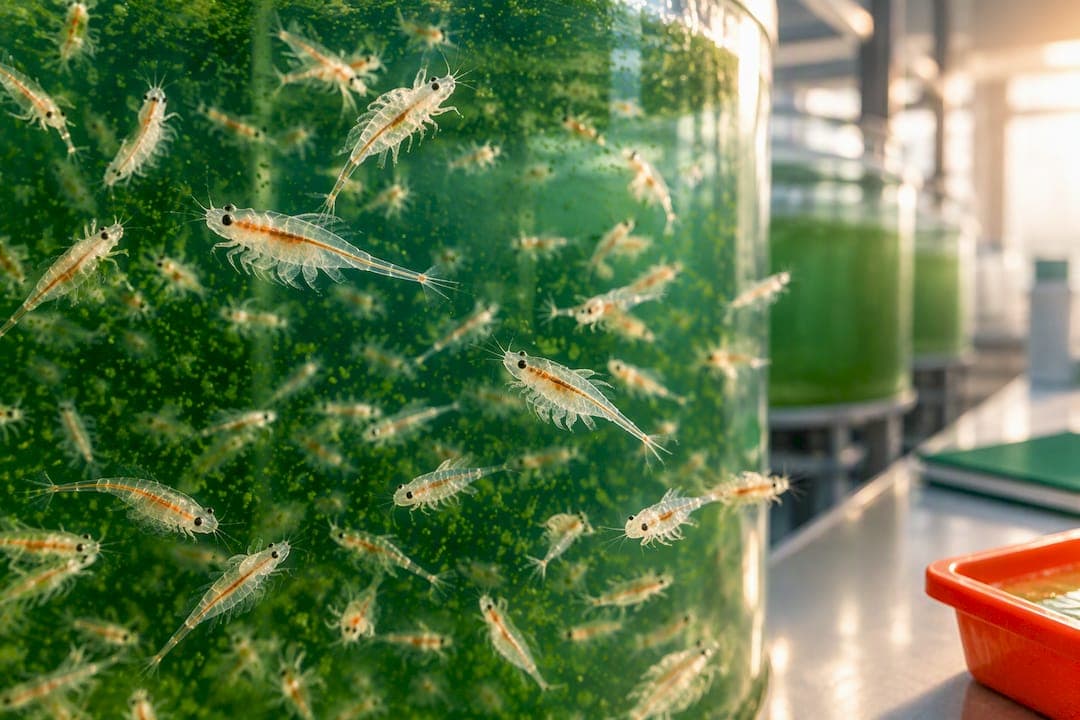
Load a feeding pipette or turkey baster, kill every pump and wavemaker for 15 to 30 minutes, then deliver correctly sized Artemia straight to the target animal's feeding zone. Strain thawed cubes through fine mesh first to keep pack juice out of the display. Check that the shrimp size matches what your target can actually eat, and have a siphon or turkey baster ready to pull out anything left after two or three minutes.
TL;DR:
- Using controlled, farmed Artemia raised on microalgae ensures more consistent nutrition and behavior compared to wild-harvested shrimp.
- Thaw frozen cubes in tank water, strain out the pack juice, and limit feeding to what can be consumed within two to three minutes to maintain water quality.
- Turn off all pumps and wavemakers for 15 to 30 minutes during feeding to prevent prey from scattering and improve target feeding success.
- Match Artemia size to the target animal’s mouth, using Instar I nauplii for fry and small larvae, and reserve enrichment for juveniles and adults needing extra fatty acids.
- Maintaining a regular, consistent feeding schedule and using suppliers with controlled, microalgae-fed Artemia improve routine reliability and fish or coral response.
Table of Contents
- Tools and Quick Prep for Live and Frozen Brine Shrimp
- Step-by-Step Target-Feeding Procedure You Can Follow at the Tank
- Choose the Right Artemia Life Stage and Enrichment for Your Target
- Control Flow and Protect Water Quality During and After Feeding
- Enrichment: What Hobbyists Need to Know and Simple Enrichment Steps
- Common Mistakes, Quick Fixes, and What to Monitor Afterward
- Practical Benefits of Microalgae Fed, Farmed Artemia
- What Actually Moves the Needle on Target Feeding
- Get Consistent Artemia Delivered for Your Feeding Routine
- Sources
- FAQ
Tools and Quick Prep for Live and Frozen Brine Shrimp
A glass feeding pipette gives the most precision for fry and shy eaters, since you can release single drops right where a fish is hovering. A turkey baster moves more volume fast, which works better for a group of juveniles or a cluster of feather dusters. A feeding syringe sits in between, and several generic dedicated aquarium feeders on the market do a similar job with a longer reach for deep or crowded tanks.
Prep depends on whether you're working with frozen or live shrimp:
- Frozen cubes: thaw one cube in a small cup of tank water, then strain it through a fine mesh net. Straining removes the nutrient-rich pack liquid before it ever reaches your display, which cuts down on the dissolved waste that feeds algae and drives up nitrate.
- Portion control: thaw only what you'll use in one session. Refreezing thawed shrimp degrades texture and nutrition.
- Live nauplii: concentrate them by letting the batch settle, then siphon off the top layer of shell debris and weaker nauplii before loading your pipette.
- Optional enrichment: if the target is a breeder or juvenile that needs a nutritional boost, run a short enrichment cycle before feeding rather than after.
Step-by-Step Target-Feeding Procedure You Can Follow at the Tank
Target feeding rewards a routine you can repeat every time without thinking too hard about it. Here's the sequence that works across reef tanks, fry rearing containers, and mixed community setups.
- Prepare your portion. Thaw and strain frozen cubes, or concentrate live nauplii, right before you feed. Keep your siphon or a spare cup nearby.
- Kill the flow. Turn off return pumps, wavemakers, and any internal powerheads. Practitioner consensus favors a 15 to 30 minute still water window, since even a modest wavemaker scatters fine prey across the tank before a slow feeder gets a bite.
- Deliver in slow pulses. Position the pipette or baster tip near the target's usual feeding zone. Fry generally hold in open water near the surface or mid-column; bottom dwellers like gobies or blennies want the food released just above the sand; corals and feather dusters need the shrimp released a few inches from their polyps, not blasted directly onto them.
- Watch the response. A healthy target usually strikes within the first minute. If nothing happens after two minutes, you're either feeding the wrong stage, feeding at the wrong spot, or the animal isn't hungry yet.
- Clean up fast. Give it two to three minutes total, then remove anything left over with a turkey baster or siphon. If you missed the window, plan a small water change or extra mechanical filtration the next morning.
Pro Tip: Feed at the same time and same spot every day. Fish and corals learn the pattern within a week, and that learned response is what makes target feeding faster and more reliable than a random broadcast toss.
Choose the Right Artemia Life Stage and Enrichment for Your Target
Matching size to mouth is the single biggest factor in whether target feeding actually works. A fry that can't fit a metanauplius in its mouth will ignore it no matter how precisely you deliver it.
- Instar I nauplii (freshly hatched, still carrying yolk reserves) are the right call for fry and small larvae. Hatchery protocols recommend using them soon after hatching to take full advantage of that yolk before it's metabolized away.
- Metanauplii suit juveniles that have graduated past the smallest fry stage but still need bite-size prey.
- Adult brine shrimp work for larger fish, mature invertebrates, and anything with a gape wide enough to handle bigger prey without wasting energy chasing it.
- Enrichment windows of roughly 4 to 24 hours make sense when you're conditioning breeders or feeding juveniles that need extra HUFA, DHA, or EPA. Skip enrichment for fry that need Instar I nauplii used immediately.
The practical rule: pick the smallest size your target eats without hesitation. If a size is borderline, cooling the batch slightly slows growth and buys you a little more time before the shrimp outgrow the window you need.
Control Flow and Protect Water Quality During and After Feeding
Every active flow device in a tank disperses fine prey, not just the main return pump. Wavemakers and internal powerheads scatter nauplii across the water column in seconds, which is exactly why forum-tested advice calls for shutting down every source of movement, not just the obvious one.
- Shut off return pumps, wavemakers, and powerheads for the full 15 to 30 minute feeding window.
- Thaw frozen cubes in a cup of tank water and strain before adding to the display; the pack juice carries a disproportionate share of dissolved organics for its volume.
- If shrimp go uneaten, siphon them out immediately rather than waiting for the filter to catch them.
Test ammonia within 6 to 24 hours if you used a larger-than-usual portion. A small tank fed a big batch of uneaten shrimp can spike faster than most hobbyists expect, and catching it early means a partial water change fixes it before anything stresses out.
Enrichment: What Hobbyists Need to Know and Simple Enrichment Steps
Enrichment boosts the fatty acid content of Artemia, mainly HUFA, DHA, and EPA, which matters most for breeders and larvae in active growth phases. A study on soybean lecithin enrichment run at 12 hours showed measurable improvements in larval growth performance, which gives hobbyists a real benchmark for timing.
- Dose enrichment products per the manufacturer's guidance. More is not automatically better and can foul the culture water.
- Aerate gently throughout the enrichment period to keep the emulsion suspended and the shrimp active.
- Schedule your harvest before the Artemia outgrow the size your target needs.
- Cool the batch slightly if you need to slow growth without stopping the enrichment process.
- Skip enrichment entirely for fry. Use freshly hatched Instar I nauplii right away instead, since their natural yolk reserves already cover the nutritional gap enrichment is meant to close.
Common Mistakes, Quick Fixes, and What to Monitor Afterward
Most target-feeding problems trace back to one of three habits, and all three are easy to fix once you see them.
- Pouring pack juice straight into the tank. Fix it by siphoning what you can and testing ammonia. Prevent it going forward by straining every thawed cube first.
- Leaving one flow device running. A single active powerhead undoes the whole still water window. Shut everything down, or feed in a low-flow corner or refugium if total shutdown isn't practical.
- Ignoring a slow ammonia creep. If levels rise after a feeding, run a small partial water change, add extra mechanical filtration, and pause target feeding for a day or two until readings stabilize.
Pro Tip: Keep a simple log of what you fed, how much, and whether ammonia moved afterward. Two or three entries usually reveal your tank's real tolerance, which beats guessing every time.
Practical Benefits of Microalgae Fed, Farmed Artemia
Wild-harvested brine shrimp swing in nutritional value with the seasons, and starvation conditions in natural salt lakes make that swing worse. Farmed Artemia raised on a controlled diet avoid that problem by design. Research on Artemia grazing and nutritional intake points to controlled, microalgae-fed cultivation as the more consistent source of protein and fatty acids compared to wild stock.

That consistency matters directly for target feeding, because you're not guessing whether this week's shrimp carry the same nutrition as last week's.
A basic feeding-schedule checklist to keep near the tank:
- Feed frozen brine shrimp two to three times weekly for adult fish; fry get several small feedings daily.
- Portion to what disappears in two to three minutes, nothing more.
- Note any enrichment window used and when the batch was harvested.
- Log ammonia readings after any larger-than-normal feeding.
What Actually Moves the Needle on Target Feeding
Most target-feeding advice online focuses entirely on the delivery mechanics: which pipette, which angle, how long to wait. That's necessary but incomplete. The variable hobbyists underestimate is the shrimp itself. A perfectly executed feeding technique delivered with inconsistent, wild-variability Artemia still produces inconsistent results, because the animal on the receiving end gets a different nutritional payload every time.
Consistency in the food supply is what lets a feeding routine actually become a routine, rather than a weekly guessing game about whether this batch will trigger the same response as last week's. That's the piece worth paying attention to before you obsess over pipette technique.
— Demeter
Get Consistent Artemia Delivered for Your Feeding Routine
Some providers offer Artemia raised in controlled, land-based systems fed on microalgae to achieve consistent protein content in every batch, providing an alternative to the nutritional variability seen in wild-harvested brine shrimp.
That consistency means the shrimp you drop into your tank this week behave and feed the same way as the batch from last month, which matters a lot once you've built a target-feeding routine your fish or corals recognize. Order live brine shrimp directly for a one-time shipment starting at $17, or set up the Demeter Biosciences membership at $25 a month if you feed regularly and want shipments to show up on schedule without reordering each time. Check current availability and place your order on the Demeterbioscience site today.
Sources
- How to target feed frozen baby brine shrimp
- Artemia Production for Marine Larval Fish Culture (SRAC fact sheet)
- A Comparative Study on Growth Performance, Body Composition, and Liver Tissue Metabolism Rearing on Soybean Lecithin-Enriched Artemia Nauplii and Microdiet in Rock Bream (PMC)
- Feeding Fish Brine Shrimp | Aquarium Guides
FAQ
Are You Supposed to Feed Brine Shrimp?
Yes, if you mean feeding brine shrimp to your fish and invertebrates, adult fish generally do well with frozen brine shrimp two to three times a week, while fry need several small live feedings daily. If you mean feeding your own brine shrimp culture, they graze on microalgae and need nothing extra when raised on a diet like Dunaliella.
What Should I Feed My Brine Shrimp?
Live cultures of Artemia thrive on microalgae, with Dunaliella being one species used in controlled cultivation to produce consistent, high-protein shrimp. Wild-harvested Artemia often face seasonal starvation conditions that farmed, microalgae-fed shrimp avoid.
How Do You Feed Brine Shrimp to Fish?
Use a feeding pipette, turkey baster, or dedicated feeder to deliver thawed and strained frozen shrimp, or concentrated live nauplii, directly to the target animal's feeding zone. Kill all tank flow for 15 to 30 minutes first, then remove anything uneaten within two to three minutes to protect water quality.
How Long Does It Take Brine Shrimp to Reach Full Size?
Artemia hatch as Instar I nauplii and progress to metanauplii within roughly a day, reaching adult size in about two to three weeks under good culture conditions. The exact timeline varies with temperature and feeding, which is one reason controlled, farmed cultivation produces more predictable size classes than wild-harvested stock.