
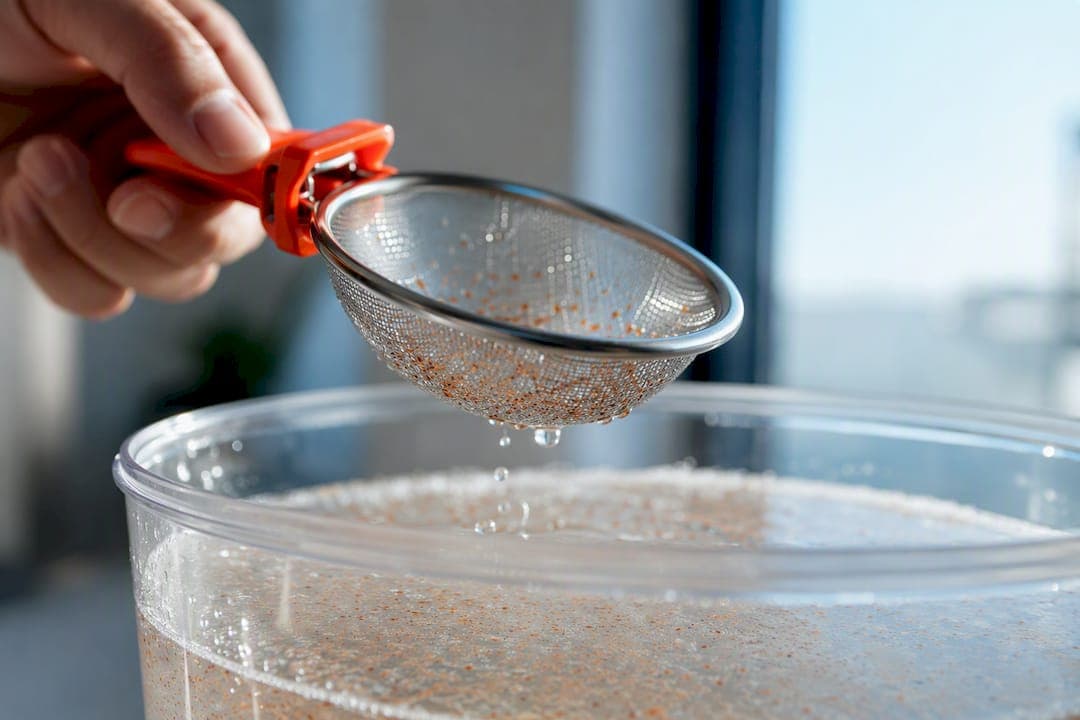
Feed brine shrimp in an amount your tank clears in 2 to 5 minutes, offering fry several small portions a day and adults one to two feedings daily. Watch the clock, not the container. Newly hatched nauplii carry the most nutritional value in the first 12 to 26 hours after hatching, so timing your feed-out matters almost as much as the quantity itself.
TL;DR:
- Feeding brine shrimp every two to five minutes until water clears within a few minutes maximizes nutrition and prevents overfeeding.
- Harvest nauplii within the first 22 to 26 hours post-hatch for optimal protein and fatty acid content, especially for fry and delicate species.
- Run consumption-time tests regularly to adjust feeding portions, aiming for complete clearance within 2 to 5 minutes and avoiding leftovers or cloudy water.
- Enrich nauplii with microalgae or commercial products during the 12 to 24 hour window to enhance lipid and protein levels, especially for older or sensitive fish.
- Consistent, small, frequent hatches with fresh nauplii are more nutritious than large, infrequent batches, supporting healthier growth and development.
Table of Contents
- How much brine shrimp should you feed, and how often?
- How do you know if you're feeding the right amount?
- When is the best time to harvest brine shrimp for peak nutrition?
- How do you enrich or gut-load brine shrimp before feeding?
- What does a practical weekly feeding schedule look like?
- What are the most common brine shrimp feeding mistakes?
- Why farmed, microalgae-fed brine shrimp simplify feeding
- Our take: feed less, feed fresher, and stop guessing
- Sources
How much brine shrimp should you feed, and how often?
Quantity depends entirely on who is eating. A 10-gallon fry-rearing tank with 200 guppy fry needs a completely different dose than a 55-gallon display tank with six adult angelfish, and the biggest mistake hobbyists make is applying one flat number across every setup.
For most home setups, start with these baseline doses and adjust from there:
- Fry tanks (under 2 weeks old): 1 to 2 drops of concentrated nauplii per gallon, delivered via pipette, multiple times daily, adjusted as needed based on observation.
- Juvenile tanks: roughly a small measured amount of live nauplii per 10 gallons, twice daily.
- Adult display tanks: a small measured amount per 20 gallons, once or twice daily, as a supplement rather than a staple.
- Dense breeding or grow-out tanks: treat the consumption-time test (covered next) as the real dosing tool, since stocking density swings so widely from tank to tank.
Fry cannot process large meals, and their digestive tracts empty fast. Multiple small feedings throughout the day for the first two weeks, outperform two big ones every time. Juveniles can handle slightly larger, less frequent portions as their gut matures, and by the time fish reach adult size, brine shrimp typically shifts from primary food to enrichment treat, fed once or twice daily alongside pellets or flake.
Temperature and species metabolism change the math too. A tropical species kept at 78°F burns through food faster than the same species at 72°F, so warmer tanks generally need slightly more frequent, not necessarily larger, feedings. Cold-water species like goldfish digest more slowly and can go longer between feedings without issue. As a rule, match feeding frequency to how quickly your specific fish clear a meal, not to a generic schedule copied from a care sheet.
Marine invertebrate keepers dosing corals or filter feeders should scale down even further, since polyps and mouths are microscopic compared to a juvenile fish's appetite. A pipette delivering droplets directly near the polyp mouths wastes far less than broadcasting nauplii across the whole tank.
How do you know if you're feeding the right amount?
Run the consumption-time test every time you feed, and it will tell you almost everything you need to know within minutes.
- Add your estimated portion and start a timer.
- Watch how long it takes for the tank to visibly clear of nauplii.
- If the water is clean of shrimp within 2 to 5 minutes, your dose is right for that tank.
- If shrimp are still swimming after 10 minutes, cut the next portion by roughly a third.
- If fish are still hunting for food after 60 seconds with nothing left, increase the next dose slightly.
Overfeeding shows up fast if you know what to look for. Cloudy or slightly pink-tinged water within an hour of feeding usually means dead nauplii are decomposing rather than being eaten. A film on the surface, a sudden ammonia smell, or fish that stop chasing food midway through a feeding are all signs you added too much.
The fix is almost always a partial water change, not a bigger filter run. Chronic overfeeding, even by a small margin every day, is one of the fastest ways to crash a small tank's water quality, since decaying shrimp spike ammonia far quicker than uneaten flake food.
Pro Tip: Feed at the same time every day and log the clear time for two weeks. Once you know your tank's exact appetite, you can eyeball portions instead of measuring every time.
When is the best time to harvest brine shrimp for peak nutrition?
Freshness has a shelf clock, and the research backs up what serious breeders have suspected for years.
Protein digestibility and key fatty-acid levels in Artemia nauplii are highest shortly after hatching and decline measurably as the nauplii age, with an experimental study identifying optimal feeding and harvest windows around 22 to 26 hours post-hatch for several target species.
That finding comes from a controlled harvest-timing study on Artemia salina nauplii%20Jun.%202025/10%20JTAS-3271-2024.pdf), which tested harvest times spanning 22 to 36 hours and found digestibility and HUFA content consistently favored the earlier end of that range. The practical takeaway: for smaller fry species like guppies, aim for the 22-hour mark. Hardier or larger species can tolerate nauplii a few hours older without a meaningful nutrition loss.
The biology behind this comes down to a molt. Freshly hatched nauplii are in what's called Instar I, still living off an internal yolk sac and unable to eat anything themselves, which is exactly why their stored protein and lipid reserves are so valuable to whatever eats them. Once they molt into Instar II, they develop a functional gut and start filter-feeding on algae, at which point their own nutritional composition starts to shift and, left too long, decline.
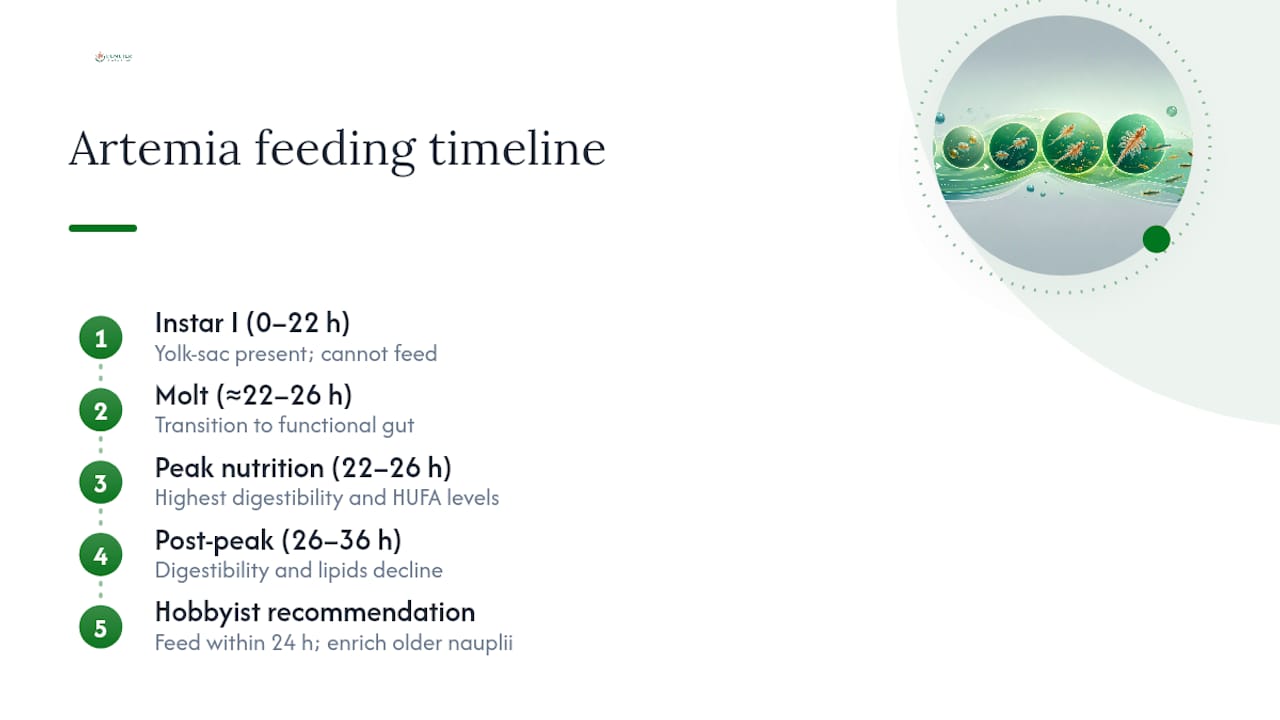
For hobbyists, the compromise is straightforward. If you can feed within the first 24 hours, do it immediately with no extra steps. If circumstances mean you're feeding older nauplii, that's exactly when enrichment earns its place in the routine, a topic worth its own protocol.
How do you enrich or gut-load brine shrimp before feeding?
Enrichment exists because Instar II nauplii have a working gut and no yolk sac left. Once they're filter-feeding instead of living off stored reserves, whatever you put in the water becomes whatever ends up in your fish. That's the entire logic behind the 12 to 24 hour gut-loading window most hatcheries and serious hobbyists follow.
A basic enrichment protocol looks like this:
- Transfer harvested nauplii into clean, aerated saltwater at the same salinity as their hatching water.
- Dose a commercial enrichment product or concentrated microalgae like Dunaliella at the rate listed on the product label.
- Maintain gentle aeration for 12 to 24 hours, avoiding air stones that produce fine micro-bubbles, since those bubbles can trap nauplii and cause die-off that looks like starvation.
- Rinse thoroughly through a fine-mesh net before feeding out, clearing away leftover enrichment product and excess salt.
Trials on enrichment protocols for adult Artemia show measurable increases in lipid and protein content within 12 to 24 hours of feeding, with lipid content in some cases peaking around the 12-hour mark. That's a tight window, and it explains why most published enrichment schedules land somewhere in that same 12 to 24 hour range rather than stretching out over days.
Skip enrichment when you're feeding truly fresh Instar I nauplii within the first few hours after hatching. There's nothing to add value to yet, since the yolk sac is already doing the job. Insist on enrichment when feeding reef corals, delicate marine fry, or broodstock preparing to spawn, where HUFA and carotenoid content directly affect development and color. Our guide to the 12 to 24 hour enrichment rule walks through dosing specifics for hobby setups moving from occasional feeding into a more consistent hatchery routine.
Pro Tip: Split a single hatch batch in half. Feed one half fresh and enrich the other for 18 hours. Comparing growth and color response in your own fish over a month will tell you more than any general guideline.
What does a practical weekly feeding schedule look like?
A copyable schedule removes the guesswork, and most tanks fall into one of three patterns.
- Newly hatched fry (first 2 weeks): feed 4 to 6 times daily, each portion sized to clear in under 2 minutes; hatch a fresh batch every 24 to 36 hours so you're always feeding near-peak nauplii.
- Juveniles (2 to 8 weeks): drop to 2 to 3 feedings daily, offering brine shrimp as roughly half the diet alongside a quality dry food, and start introducing 12-hour enrichment once nauplii production settles into a routine.
- Adults and display tanks: feed brine shrimp once or twice daily as a supplement, ideally 30 to 60 minutes after a staple feeding so it functions as a high-value extra rather than the entire meal.
Mixed-species tanks need a small adjustment. Bottom feeders and slower fish often miss out when faster mid-water species clear the water column first, so target feeding with a turkey baster or pipette near the slower fish helps even things out.
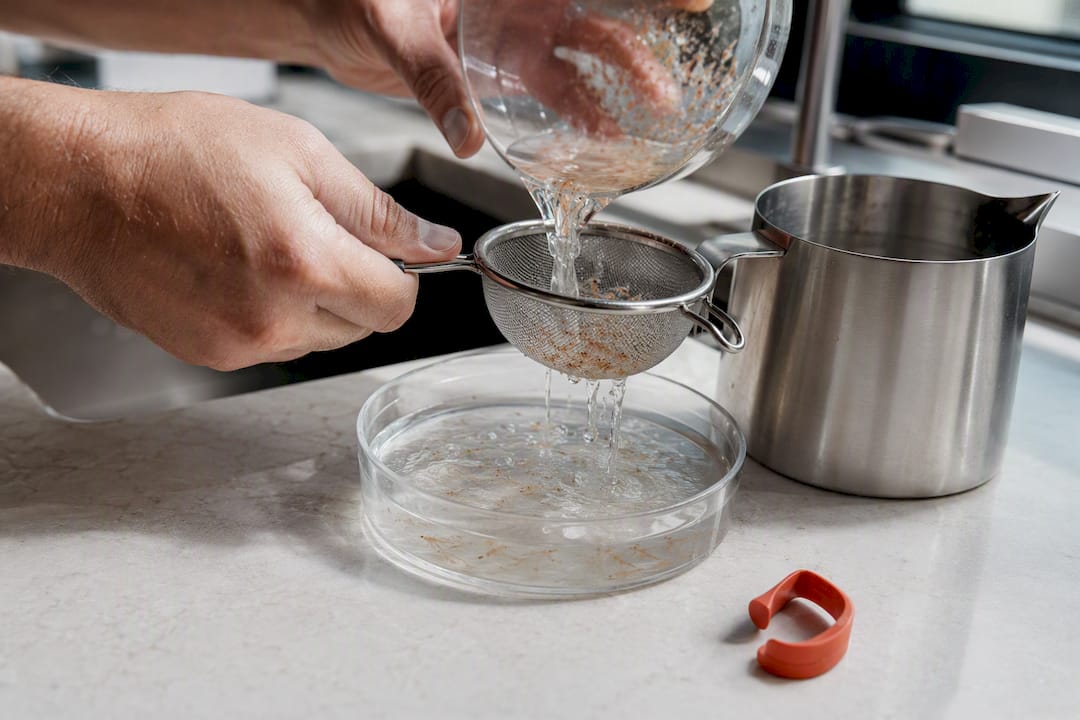
Before adding any batch to a display tank, strain it through a fine-mesh net and give it a quick freshwater or matched-salinity rinse. This step matters more than most hobbyists realize, since unrinsed nauplii carry over hatch-water salt and shell debris that can nudge salinity in smaller tanks over repeated feedings. Our feeding schedule checklist covers the exact rinse-and-transfer sequence step by step, and if you're staging first foods for fry specifically, the stage-by-stage live food guide breaks down what to feed before brine shrimp becomes appropriate at all.
What are the most common brine shrimp feeding mistakes?
Three mistakes account for almost every brine shrimp problem hobbyists report, and all three are fixable within a day.
- Overfeeding: the single most common error, usually from eyeballing a "handful" instead of running the consumption-time test. Fix it by cutting portions by a third and retesting.
- Late harvest: feeding nauplii well past 36 hours old sacrifices the nutritional edge that made hatching them worthwhile in the first place. Fix it by hatching on a tighter, more frequent schedule.
- Poor aeration: either too little, which lets nauplii settle and die, or the wrong type, which creates micro-bubbles that trap and kill them. A gentle air stone setup built for larger bubbles solves both problems at once.
Cloudy water or an ammonia spike after feeding calls for an immediate 10 to 15% partial water change, followed by skipping the next feeding entirely to let the tank recover. For hatchery maintenance, keep a simple checklist: rinse hatching cones weekly, check air stones for bubble size monthly, and discard and restart any culture that shows slow hatch rates or a sour smell rather than trying to nurse it back.
Pro Tip: Keep two hatching containers running on staggered 24-hour cycles. You'll always have a fresh batch ready without ever feeding shrimp older than a day.
Why farmed, microalgae-fed brine shrimp simplify feeding
Wild-harvested brine shrimp vary by season, region, and whatever the shrimp themselves happened to eat before harvest, which makes consistent dosing harder than it needs to be. Demeterbioscience raises live brine shrimp in land-based systems on a diet of Dunaliella microalgae exclusively, targeting a minimum 40% protein content batch after batch.
That consistency changes how you plan feeding schedules:
- Predictable protein levels mean your dosing math doesn't need constant re-adjustment between shipments.
- No seasonal starvation gaps, unlike wild harvests pulled from fluctuating natural salt-lake conditions.
- Scheduling gets easier with live shipments and monthly subscription plans built around your tank's actual consumption rate.
Hobbyists running fry tanks or breeding programs can order live brine shrimp directly, while stores and institutions managing higher volume can look at bulk ordering options sized for retail or research use.
Our take: feed less, feed fresher, and stop guessing
The conventional advice on brine shrimp feeding treats it as a volume problem, when it's really a timing problem. Most hobbyists overthink the quantity and underthink the clock. Our research review points to one clear priority: harvest and feed within the first 24 hours whenever possible, and treat everything past that window as material that needs enrichment to earn its keep.
The consumption-time test deserves more credit than it gets. It's simple, it's free, and it corrects for tank density and appetite better than any teaspoon measurement ever will. Where hobbyist habits genuinely fall short is on hatch frequency: most people hatch once and stretch it across three or four days, quietly feeding older, less digestible nauplii the whole time without realizing the nutritional cost.
If there's one thing to prioritize first, it's smaller, more frequent hatches over bigger, less frequent ones. Everything else, dosing, enrichment, schedule, follows naturally once freshness is handled.
— Demeter