
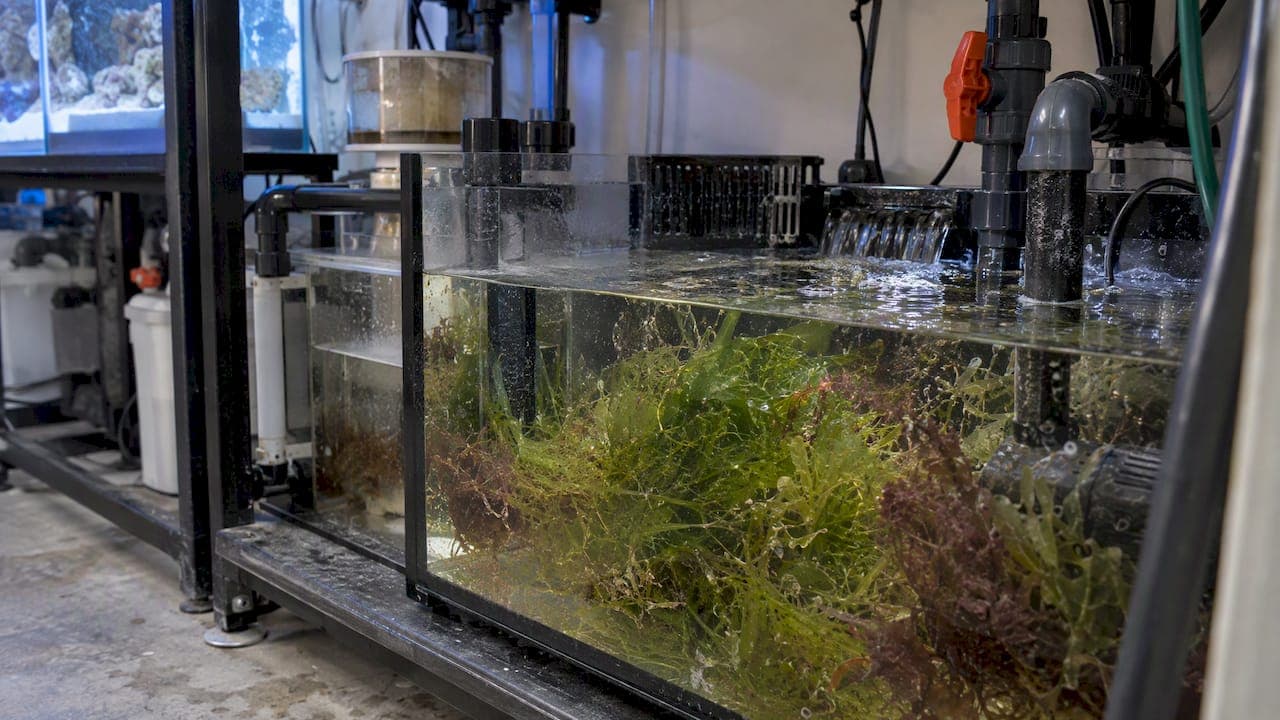
Brine shrimp will not establish a self-sustaining population in a typical refugium or reef tank. Adult Artemia and their nauplii get eaten faster than they can reproduce, and most refugia lack the steady aeration and suspended-particle conditions Artemia need to hatch and grow. You can still use a refugium to hatch a batch for feeding, but treat it as a short-term food source, not a breeding colony.
TL;DR:
- A dedicated hatchery needs 25 to 33 ppt salinity, 28 to 29°C water, continuous vigorous aeration, and constant light during hatching.
- Harvest nauplii within 24 hours, while yolk reserves remain, and rinse them in clean saltwater to remove shells and hatch debris before feeding.
- Artemia need suspended food particles between 5 and 50 microns, such as greenwater or liquid microalgae; coarse flakes and pellets foul the water.
- Buy farmed live shrimp when a reliable, ready to feed supply outweighs daily setup; a home hatch suits learning or covering a short gap.
Table of Contents
- Why refugia and reef tanks usually prevent sustainable Artemia populations
- What Artemia need to hatch and survive, and how that differs from refugium norms
- Practical setups hobbyists can use, and their limits
- Why reproduction rarely builds a lasting population in a reef system
- When buying farmed live brine shrimp makes more sense
- What we tell hobbyists who ask about hatching their own
- How to get live brine shrimp without the daily hatch routine
- FAQ
- Sources
Why refugia and reef tanks usually prevent sustainable Artemia populations
Hobbyists who dump brine shrimp cysts or nauplii into a refugium hoping for a renewable food source almost always see the same result: a brief bloom, then nothing. The problem is not the shrimp. It is the system.
Reef tanks and refugia are full of things that eat nauplii. Copepods, bristle worms, small fish, and even some corals graze on newly hatched Artemia as fast as they appear. A female Artemia can produce broods repeatedly under good conditions, but predation in a mixed-species refugium removes offspring faster than reproduction replaces them. That mismatch, sometimes called predator-prey imbalance in aquaculture circles, is the central reason refugia fail as production systems rather than feeding stations.
Mechanical loss compounds the problem. Protein skimmers pull small organisms out of the water column, return pumps and filter intakes trap nauplii against screens, and general system flow concentrates them in dead zones where predators pick them off easily. None of this requires a design flaw. It is just what filtration and circulation do in a tank built to support corals and fish, not a batch of newly hatched crustaceans.
Refugia also tend to lack the specific water conditions Artemia need to hatch well and keep reproducing:
- Continuous, vigorous aeration that keeps cysts suspended rather than settling into sediment or algae mats.
- Stable salinity and temperature tuned for Artemia rather than for macroalgae, pods, or the display tank it feeds.
- A steady supply of fine suspended particles (5 to 50 microns) that nauplii can actually eat.
- Isolation from grazers, which a shared refugium cannot provide.
Hobby forums report this outcome consistently: a dose of hatched nauplii into the refugium disappears within a day or two, and nothing comes back. That pattern lines up with what aquaculture literature already expects. Artemia production depends on dedicated, predator-free vessels, not multi-species systems where everything else in the tank also wants a meal.
What Artemia need to hatch and survive, and how that differs from refugium norms
Artemia hatching is a narrow window, not a forgiving one. Aquaculture guidance lays out the parameters precisely because small deviations cut hatch rates significantly.
Optimal hatching conditions sit in a tight band: water temperature near 28 to 29°C (82 to 84°F), salinity between 25 and 33 ppt (specific gravity around 1.018 to 1.025), continuous aeration, and a long photoperiod, according to Srac. Hit those numbers and you maximize hatch percentage while minimizing the time it takes cysts to hatch out. Miss them, and hatch rates drop along with nauplii vigor.

A typical refugium rarely matches the conditions Artemia need. Reef systems are usually run at a salinity and temperature optimized for corals and fish, not for Artemia cysts, and most refugia do not have the strong, continuous aeration a hatching cone provides. Lighting in a refugium is set for macroalgae growth cycles, not timed to support rapid, synchronized hatching.
Suspension and oxygen matter beyond just triggering the hatch. Cysts that settle out of suspension and sit in detritus tend to foul rather than hatch, which lowers yield and can sour water quality, a dynamic described in Artemia Culture for Intensive Finfish and Crustacean Larviculture. Keeping cysts moving and oxygenated is not optional. It is the difference between a usable hatch and a wasted one.
Timing also affects what you are actually feeding. Freshly hatched nauplii carry yolk reserves that make them nutritionally dense; as they age past the first day, those reserves deplete and nutritional value drops, per the same Virginia Cooperative Extension guidance. That means a hatch left sitting too long, whether in a hatchery or a refugium, loses value even if a few nauplii manage to survive.
Experimental work on hatching parameters backs this up directly: photoperiod and temperature both have a strong, measurable effect on hatch percentage and hatch time, reinforcing why generic refugium conditions, built for macroalgae and pods, rarely replicate what Artemia cysts actually need.
Practical setups hobbyists can use, and their limits
If the goal is live nauplii for feeding rather than a self-sustaining colony, a dedicated hatch setup works far better than relying on your refugium. Here is a basic process:
- Fill a cone-bottom hatching vessel or a repurposed soda bottle with saltwater mixed to 25 to 33 ppt salinity.
- Warm the water to 28 to 29°C (82 to 84°F) using an aquarium heater placed outside the hatch container or in a water bath.
- Add brine shrimp cysts at the rate recommended on your cyst packaging.
- Run an airstone or airline tubing for continuous, vigorous aeration that keeps cysts suspended.
- Provide constant light during hatching to support a synchronized hatch.
- Turn off aeration briefly once hatched, let shells and unhatched cysts settle or float off, then siphon nauplii from the middle of the water column.
- Rinse nauplii in clean saltwater before feeding to remove hatch debris and residual cyst shells.
Pro Tip: Decapsulate cysts before hatching when you can: removing the chorion with a brief bleach treatment reduces fouling and tends to raise hatch yields, according to Ask.
Decapsulation is worth the extra step for a shared system in particular, since unhatched or decomposing cysts are a common source of foul odor in refugia. A quick decapsulation protocol, rinsing cysts in a dilute bleach solution, then neutralizing and rinsing again, strips the hard outer shell and leaves a cleaner hatch with fewer leftover shells for your filtration to deal with.
Feed size matters once nauplii are in the tank. Artemia feed on particles between 5 and 50 microns, so a greenwater culture or liquid microalgae suits them far better than flake or pellet foods meant for fish, per Artemia Production for Marine Larval Fish Culture. Overfeeding coarse particulate food does not help Artemia grow; it just degrades water quality in whatever vessel they are in.
Harvest on a schedule rather than letting nauplii sit. Pull them within a day of hatching, before yolk reserves deplete and before your target fish or corals outgrow what a 24-hour-old nauplius offers. For a closer look at timing a hatch around a feeding window, our practical hatch and buy guidance discusses how to plan around your feeding schedule.
None of this turns a refugium into a production system. It gives you a repeatable way to produce a batch of nauplii on your own timeline, which is a different goal entirely.
Why reproduction rarely builds a lasting population in a reef system
Artemia biology works against the idea of a self-sustaining refugium population in a second way, independent of predation. Females can switch reproductive strategies depending on conditions: under stress, poor oxygen, or limited food, they shift toward producing dormant cysts rather than live nauplii, a survival adaptation described in The Brine Shrimp Artemia: Adapted to Critical Life Conditions. Cysts are built to wait out bad conditions, not to hatch immediately, so a stressed population produces more dormant eggs and fewer live young right when you need feed.
Artemia evolved in open, hypersaline lakes with extreme but stable selective pressures, not in closed reef systems crowded with predators and filtration equipment. Even a refugium that manages an occasional hatch cannot outpace the constant predation and mechanical losses working against it. The population never accumulates. It just resets to zero after each small bloom.

When buying farmed live brine shrimp makes more sense
Home hatching has a place: it is useful for learning the process or topping off feed between orders. But for consistent nutrition and less daily effort, farmed live brine shrimp raised under controlled conditions solve the variability problem that wild-harvested or home-hatched Artemia carry, since production in a managed system avoids the seasonal swings and starvation stress common in natural salt lakes, as outlined in aquaculture literature on Artemia Production for Marine Larval Fish Culture.
We raise our brine shrimp in land-based systems on a diet of Dunaliella microalgae, aiming for consistent quality from shipment to shipment. For hobbyists who want reliable nutrition without managing hatch timing, salinity, and aeration every few days, a farmed, ready-to-feed product removes that workload entirely.
What we tell hobbyists who ask about hatching their own
We hear this question often: is it worth setting up a home hatchery, or should you just order live shrimp? Our honest answer is that both have a place. A small hatch container is fine for learning the process or filling a short gap, but it takes daily attention to get right, and refugia were never going to replace it.
A simple workflow is to keep a basic hatch kit on hand for occasional use and lean on a subscription for the bulk of your feeding schedule. That combination covers both the hands-on interest and the reliability a growing tank needs.
— Demeter
How to get live brine shrimp without the daily hatch routine
Running your own hatchery every few days is manageable, but it adds up. Ordering live brine shrimp directly gives you fed, ready-to-use nauplii without tying up a vessel, a heater, and an airstone in your fish room.
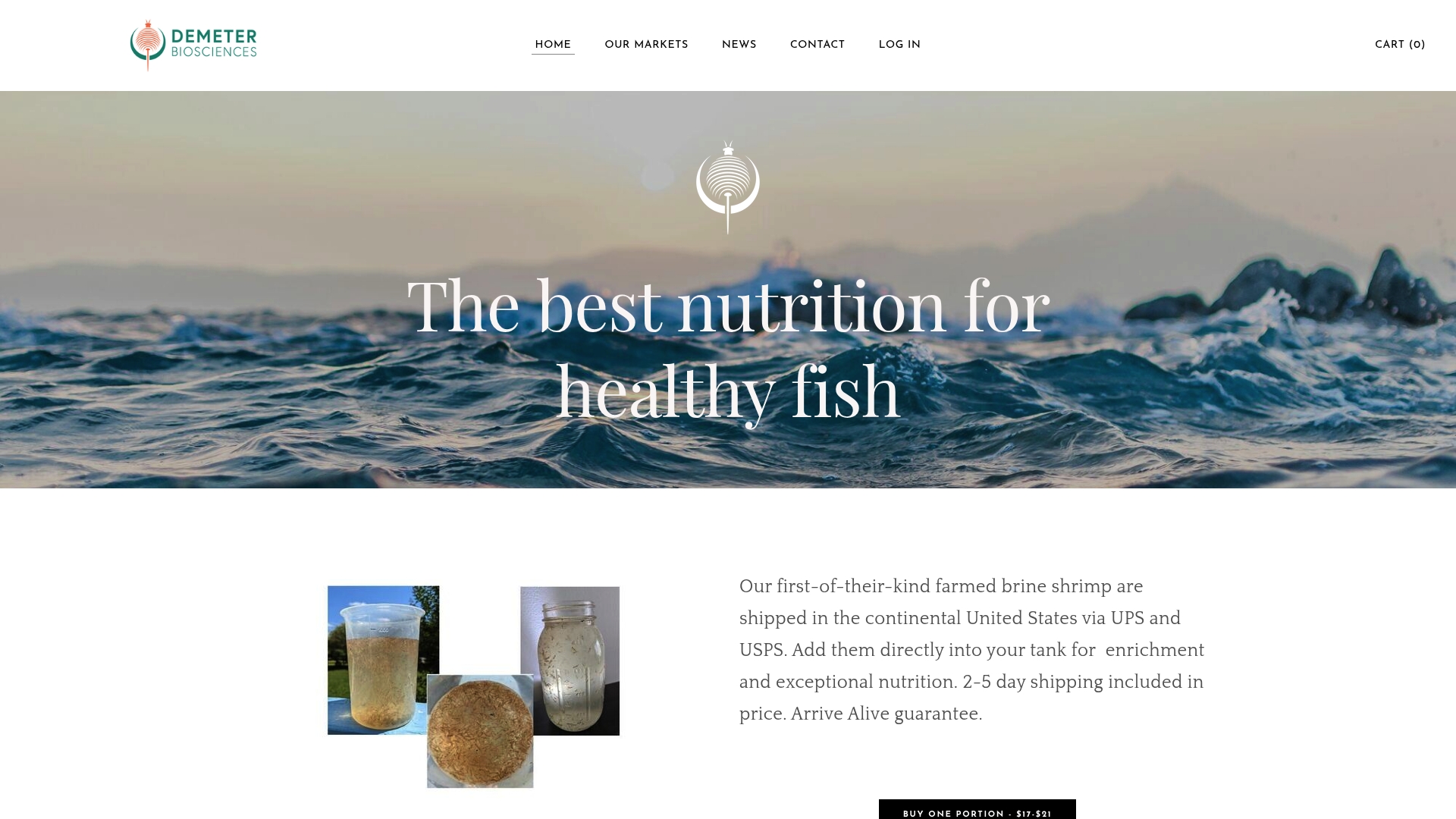
A few ways to buy depending on how much you need:
- A single order works well if you want to try farmed live shrimp before committing to a routine.
- Bulk orders suit fish stores, museums, and anyone feeding multiple tanks on a regular basis.
- The Demeter Biosciences membership at $25 per month delivers shipments on a recurring schedule, so you are not timing a hatch around feeding day.
Each option skips the fouling risk, the aeration setup, and the guesswork of a home hatch, delivering consistent nutrition on your schedule instead of your tank's.
FAQ
Can you hatch brine shrimp with aquarium salt?
Aquarium salt mixed to the right specific gravity, roughly 1.018 to 1.025, can work for hatching, since Artemia respond to salinity rather than a specific brand of salt mix. What matters more is holding temperature near 28°C (82°F) with continuous aeration, per SRAC guidance.
What is the difference between a refugium and a sump?
A sump is a secondary water tank, usually below the display, that houses equipment like heaters, skimmers, and return pumps. A refugium is a specialized section, sometimes built into a sump, dedicated to growing macroalgae or pods in a low-flow, often separately lit space.
Are brine shrimp and Artemia the same?
Yes, "brine shrimp" is the common name for Artemia, a genus of small crustaceans adapted to hypersaline water. The terms are used interchangeably in both hobbyist and aquaculture contexts.
How do I make a brine shrimp hatchery?
A basic hatchery is a cone-bottom or bottle-shaped vessel filled with saltwater at 25 to 33 ppt salinity, kept near 28 to 29°C (82 to 84°F) with continuous aeration and constant light for around 24 hours. Cysts are added directly to the water, and nauplii are harvested from the water column once hatching finishes, as described in Artemia Culture for Intensive Finfish and Crustacean Larviculture.
Is refugium-grown brine shrimp more nutritious than farmed or purchased shrimp?
Not typically. Nutritional quality depends on diet and hatch timing rather than where hatching occurs, and farmed shrimp raised on a consistent microalgae diet avoid the starvation and seasonal variability that affect wild-harvested Artemia, per Artemia Production for Marine Larval Fish Culture.
Sources
- Srac
- Artemia Production for Marine Larval Fish Culture
- Artemia Culture for Intensive Finfish and Crustacean Larviculture
- The Brine Shrimp Artemia: Adapted to Critical Life Conditions