
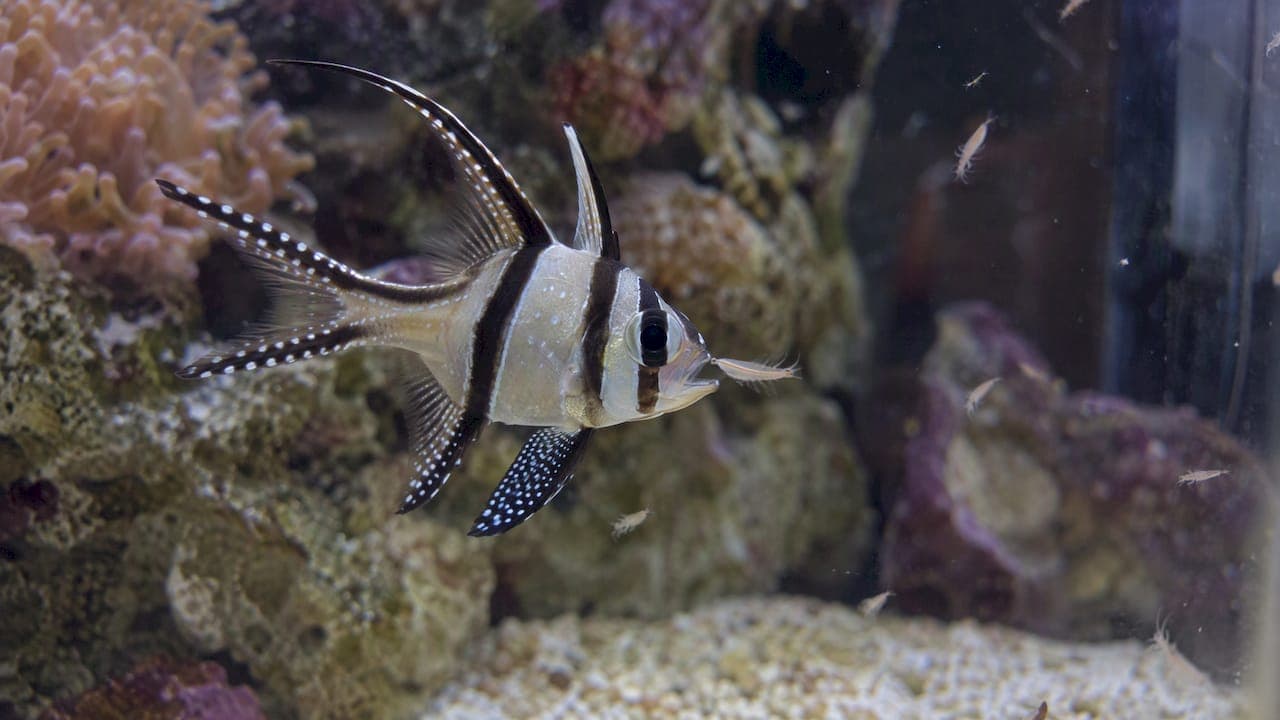
Brine shrimp are a good food for cardinalfish, but only if they are the right kind and prepared well. Live or gut-loaded brine shrimp are the best way to get a new, shy cardinalfish eating. Newly hatched brine shrimp are the standard first food for cardinalfish fry. Plain, unenriched brine shrimp should still never be the whole diet, because on their own they are not nutritionally complete for these fish. This guide covers pajama cardinalfish (Sphaeramia nematoptera) and Banggai cardinalfish (Pterapogon kauderni), the two species most hobbyists keep.
TL;DR
- Cardinalfish are nocturnal carnivores. Offer brine shrimp in the evening, with the lights dimmed, and feed only what they finish in about two minutes.
- Live, gut-loaded brine shrimp are the best tool for starting a new fish that refuses food. Then mix in frozen and prepared foods.
- Brine shrimp alone lack the fatty acids (HUFAs) cardinalfish need long term. Use enriched shrimp and rotate with mysis, copepods, krill and quality pellets.
- Rinse live shrimp in fresh water, then let them sit in tank water for about 10 minutes before feeding, to keep salt and contaminants out of the display.
- Cardinalfish fry can eat newly hatched brine shrimp right away. Juveniles need two to three small feedings a day.
Table of Contents
- Why brine shrimp work for cardinalfish
- Live, frozen or hatched: which brine shrimp to feed
- Getting a new cardinalfish to eat
- How much and how often
- Do not let tankmates steal the meal
- Brine shrimp for cardinalfish fry
- Our perspective: live food that is fed, not starved
- Where to get live brine shrimp for your cardinalfish
- Building a varied diet around brine shrimp
- FAQ
- Sources
Why brine shrimp work for cardinalfish
In the wild, pajama cardinalfish eat small crustaceans, zooplankton and tiny fish larvae. AquariumLab's care guide recommends a varied, meaty diet in the aquarium, and it lists brine shrimp enriched with vitamins among the good options. Brine shrimp fit that profile in size, movement and palatability. A small, drifting crustacean is exactly what a slow, deliberate hunter wants.
The movement matters most. Live prey triggers a feeding response that a pellet sinking through the water often does not. That is why live brine shrimp are so useful for fish that are stressed or newly imported.
Cardinalfish are also relaxed about size. Pajama cardinalfish reach about 3.5 inches and are listed as an easy, peaceful, reef-safe species for tanks of 20 gallons or more, according to Top Shelf Aquatics' species profile. Adult brine shrimp are a comfortable mouthful for them.
Live, frozen or hatched: which brine shrimp to feed
There are three forms of brine shrimp a cardinalfish keeper is likely to use. Each has a job.
| Form | Best for | Main drawback |
|---|---|---|
| Newly hatched nauplii | Cardinalfish fry, very small juveniles | Tiny, and low in HUFAs unless enriched |
| Live adult or juvenile brine shrimp | Starting new fish, triggering the hunting response, conditioning pairs | Must be kept alive and rinsed before feeding |
| Frozen brine shrimp | Everyday maintenance feeding once fish are eating well | Less movement, so it is less likely to tempt a reluctant fish |
Frozen brine shrimp are convenient and cardinalfish readily accept them. Live shrimp are more effective when the problem is appetite. We go deeper on the trade-offs in our piece on live vs frozen brine shrimp. The short version: use frozen as the staple and live as the tool for specific jobs.
Why "enriched" matters
A brine shrimp is only as nutritious as what it has eaten. A freshly hatched nauplius lives off its yolk. Research on feeding fish larvae with omega-3 enriched Artemia shows why practitioners enrich brine shrimp with highly unsaturated fatty acids before feeding them: untreated shrimp are short on the lipids that support growth and disease resistance.

For Banggai cardinalfish specifically, a captive-breeding study reports that enriching Artemia with HUFAs or probiotics improves larval survival, growth and stress tolerance. If you breed cardinalfish, treat enrichment as part of the method, not an extra.
For adults, the same logic applies in a gentler form. A brine shrimp that has recently fed on microalgae is a far better meal than one that has been starving in a bag or a bucket. We cover a practical enrichment method in our 2:1 DHA:EPA live feed enrichment protocol.
Getting a new cardinalfish to eat
A new cardinalfish that ignores food is usually stressed, not sick. Saltwater Aquarium Blog describes the usual cause as the move from the wild or a dealer's system into a home tank. Its suggested fix is to start with live, gut-loaded brine shrimp to trigger natural hunting, then slowly mix in frozen or prepared foods.
Here is a routine that follows that advice:
- Wait for the lights to dim. Cardinalfish are nocturnal hunters. Hobbyists often fail by feeding at peak daylight, when the fish are shy, according to Top Shelf Aquatics.
- Rinse the shrimp. Rinse live brine shrimp in fresh water, then hold them for 10 minutes in a container of tank water, as Fish Tank Advisor recommends. This removes salt and contaminants before they reach the display.
- Offer a small pinch. Use a pipette or a turkey baster near the cave or shaded area where the fish hides.
- Watch. Stay for a few minutes. The goal is to see every fish take at least a few shrimp.
- Remove nothing, add nothing. Live shrimp that are not eaten will survive for a while in saltwater, but do not dump in more to compensate.
- Transition over one to two weeks. Mix a little thawed frozen mysis or enriched frozen brine shrimp into the live portion, then gradually shift the ratio.
Our guide to transitioning fish to live food covers the same principle from the other direction, and it helps if a fish has become fixed on one food.
How much and how often
The general rule from AquariumLab is to feed only what the fish can consume in roughly two minutes. Cardinalfish are not big eaters, and overfeeding is a far more common problem than underfeeding in a reef tank with a few of them.
A workable schedule for adults:
- Daily: one small evening feeding of frozen mysis, enriched frozen brine shrimp or a quality marine pellet.
- Two or three times a week: swap in live, gut-loaded brine shrimp.
- Weekly: a different protein, such as copepods, krill or fish eggs.
For juveniles, Aqua Marine Power notes that growing fish need two to three small feedings daily, moving to high-quality frozen or prepared foods as they mature. The exact schedule depends on your tank, and a fish with a visibly thin belly needs more attention than a calendar.
Do not let tankmates steal the meal
Cardinalfish are slow, deliberate feeders. Bulk Reef Supply points out that faster, more active tankmates easily outcompete them, and it advises watching feeding closely, especially in the evening. Wrasses, damselfish and tangs can clear a pinch of brine shrimp in seconds.
Three fixes that work:
- Feed in two places. Drop some food at one end of the tank to occupy the fast fish, then target-feed the cardinalfish at the other.
- Use the evening window. When the lights dim, many daytime fish settle down, and cardinalfish become bold.
- Choose peaceful companions. If one tank cannot keep a cardinalfish fed, the stocking list is the problem, not the food.
Brine shrimp for cardinalfish fry
Breeding cardinalfish is one of the most rewarding projects in the marine hobby, because the male carries the eggs in his mouth and releases well-developed fry. Aqua Marine Power reports that newly released pajama cardinalfish fry measure roughly 5 to 6 millimeters and can take newly hatched brine shrimp right away. That is a large head start compared with most marine larvae, which need rotifers first.
A simple fry plan:
- Days 1 to 14: newly hatched, enriched brine shrimp nauplii several times a day in small amounts.
- Weeks 2 to 4: add larger, enriched brine shrimp and begin offering fine prepared larval pellets.
- After that: work toward frozen and prepared foods, as the fry grow and their mouths widen.
Banggai fry are similar. According to a hobbyist Q&A, newly emerged Banggai babies can eat newly hatched brine shrimp, and many also accept small larval pellets.
For general principles, our stage-by-stage guide to live foods for fry applies well to cardinalfish, and our article on brine shrimp nutrition for commercial larval fish explains the nutrition side in more depth.
Start with captive-bred fish
Feeding is easier when the fish arrive already accustomed to aquarium life. A University of Hawai'i chapter on Banggai cardinalfish supports choosing captive-bred fish where possible, since wild collection of Banggai cardinalfish has been a sustainability concern. Captive-bred fish are also generally easier to bring onto prepared diets. If you are buying Banggais, ask the seller whether they are captive-bred.
Our perspective: live food that is fed, not starved
We raise brine shrimp on land, in controlled systems, and feed them only on the microalga Dunaliella. Our aim is a consistent protein content of at least 40%. The reason is simple. A brine shrimp is a delivery vehicle: what the shrimp ate is what your fish gets.
Wild-harvested brine shrimp vary with the season and with the conditions of the lake they came from, and they are often starved by the time they reach a tank. A cardinalfish is a slow, selective eater that depends on small, regular meals. It does not have much room to absorb poor food. That is why we think consistent, well-fed live shrimp are particularly suited to this group of fish.
Our practical advice for cardinalfish keepers:
- Use live shrimp as a bridge for new or shy fish, then rotate.
- Do not rely on any single food, ours included. Variety is still the foundation of a healthy diet.
- For breeders, enrich the shrimp for the specific stage you are feeding.
- Check the shrimp before you feed. Active, orange to pinkish shrimp are a better sign than pale, sluggish ones.
We are also a small team that cares about the environmental side of this work, which is why we focus on microalgae and land-based production. You can read more on how we raise our brine shrimp.
— Demeter
Where to get live brine shrimp for your cardinalfish
If you want to try live, microalgae-fed brine shrimp for your cardinalfish, our live brine shrimp ships directly to your home, priced from $17 to $35 depending on the size you choose. If you feed live food regularly, the Demeter Biosciences membership is $25 per month, and you can find it on our featured products page. Our live phytoplankton is $20, which is useful if you want to enrich food or feed corals alongside your fish. Fish stores and clubs can look at our bulk store order.
Buying for a fellow reef keeper? There are gift cards from $10 to $50.
Building a varied diet around brine shrimp
Because brine shrimp cannot carry the whole diet, plan the rest of the menu. Top Shelf Aquatics lists frozen mysis shrimp, enriched brine shrimp and cyclops as suitable foods. AquariumLab adds copepods, krill, fish eggs and good pellets.
A balanced rotation might look like this:
| Day | Evening food |
|---|---|
| Monday | Frozen mysis |
| Tuesday | Live, gut-loaded brine shrimp |
| Wednesday | Quality marine pellet |
| Thursday | Enriched frozen brine shrimp |
| Friday | Live brine shrimp or copepods |
| Saturday | Krill or fish eggs, chopped small |
| Sunday | Light feeding or a fast day |
This is a template, not a prescription. Adjust to your tank's size, the number of fish, and how round and active your cardinalfish look. For more ideas on rotation, see our saltwater fish diet variety list.
Common mistakes
- Feeding at midday. Cardinalfish are shy in bright light and miss meals.
- Skipping the rinse. Salt and debris from the shrimp container end up in your display.
- Using unfed shrimp. Starved brine shrimp offer little nutrition to the fish that eats them.
- Feeding only brine shrimp. The fish may look fine for a while, then fade in color and condition.
- Overfeeding. Two minutes of eating is the limit. Excess food fouls the water.
FAQ
Will cardinalfish eat brine shrimp?
Yes. Cardinalfish are carnivores, and they readily take both live and frozen brine shrimp, as AquariumLab notes. They are best fed in the evening, when they are most active.
Can brine shrimp be the only food for my cardinalfish?
No. Brine shrimp lack some of the highly unsaturated fatty acids a cardinalfish needs long term, unless they have been enriched. Even then, rotate in mysis, copepods, krill and a good pellet for balanced nutrition and color.
What do I feed cardinalfish fry?
Newly hatched, ideally enriched, brine shrimp nauplii. Pajama fry are large enough to eat them from release, and Banggai fry accept them as well. Feed small amounts several times a day, and add larval pellets as they grow.
Why is my new cardinalfish not eating?
The most common reason is stress from the move into your tank. Offer live, gut-loaded brine shrimp in the evening with the lights low, then slowly blend in frozen foods. If the fish still refuses food after a couple of weeks or looks thin, talk to an aquatic veterinarian or an experienced local fish store.
Sources
- Pajama Cardinalfish Care Guide, Aqua Marine Power
- How to Care for Pajama Cardinalfish, AquariumLab
- Pajama Cardinalfish Care Guide, Top Shelf Aquatics
- Pajama cardinalfish, Saltwater Aquarium Blog
- How to Care for Cardinalfish, Bulk Reef Supply
- Brine Shrimp Aquarium Guide, Fish Tank Advisor
- Improvement of Dietary Value of Artemia salina for Fish Larvae, J-STAGE
- Captive Breeding of Banggai Cardinalfish, Academia.edu
- Banggai cardinalfish chapter, University of Hawai'i at Manoa
- What do you feed baby Banggai cardinalfish?, Reptile Knowledge