
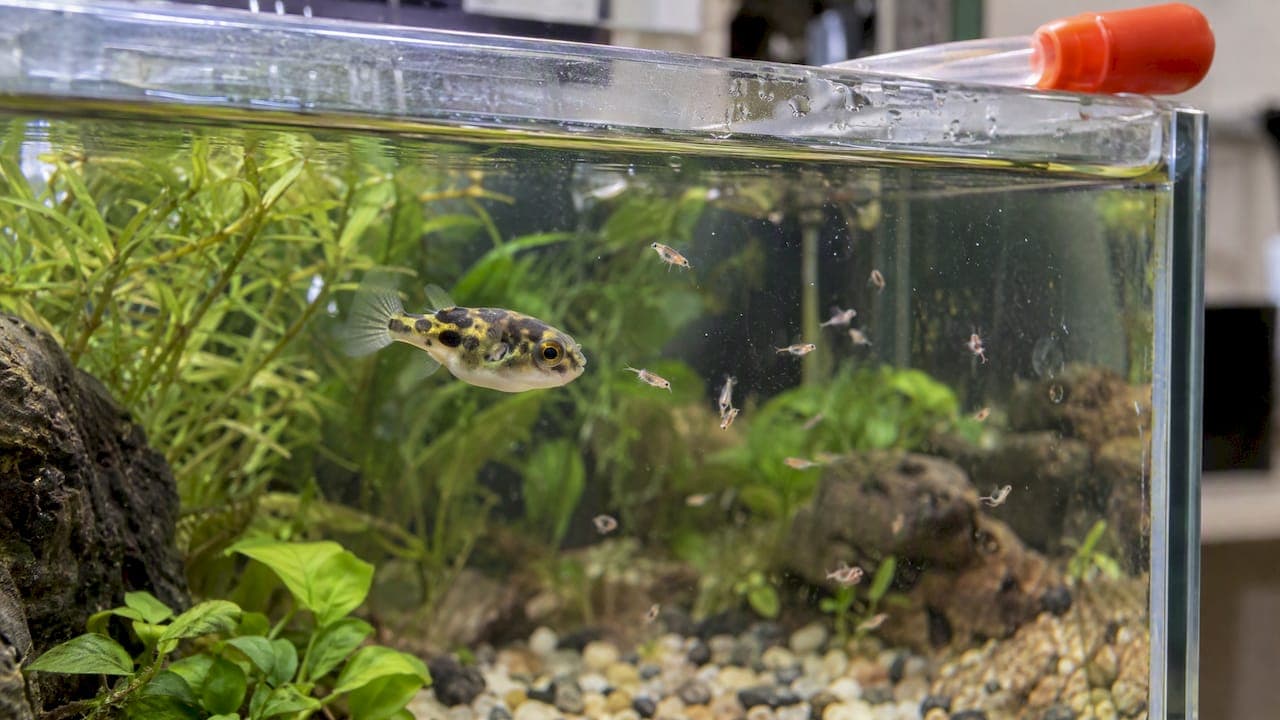
Brine shrimp are a good food for most freshwater puffers, especially pea puffers and other small species, but they should not be the whole diet. Feed them live or frozen as a regular part of a varied menu, enrich them if you hatch them yourself, and pair them with hard-shelled prey such as snails so your puffer's beak-like teeth stay worn down. Below: which puffers eat them, how often, how to get the most nutrition from them, and where they fall short.
TL;DR
- Freshwater puffers are carnivores that generally refuse flake and pellets. Live or frozen meaty foods, including brine shrimp, are the core of the diet for small species.
- Brine shrimp are soft. They don't wear down a puffer's constantly growing teeth, so add snails or other crunchy prey.
- Freshly hatched brine shrimp are low in key fatty acids. Enrich them for a short window before feeding, or buy shrimp raised on algae.
- Feed once a day, only what the fish eats in a few minutes.
- Don't treat ornamental shrimp as tankmates for a puffer. They are usually seen as food.
Table of Contents
- Why puffers take to brine shrimp
- Which puffers eat brine shrimp, and in what form
- How much and how often
- What brine shrimp can't do: the teeth problem
- Nutrition: why enrichment matters
- Hatch at home or buy farmed shrimp
- Our perspective: why feed matters more than the shrimp
- Can puffers live with shrimp?
- Where to get live brine shrimp for your puffer
- A sample weekly menu for a pea puffer
- FAQ
- Sources
Why puffers take to brine shrimp
Puffers are ambush hunters with big appetites and a strong interest in anything that moves. Brine shrimp (Artemia) twitch and swim in open water, which triggers the hunting response in small species like the pea puffer (Carinotetraodon travancoricus). That makes them one of the easiest foods for getting a new, wary puffer to eat.
The Ornamental Aquatic Trade Association notes that freshwater puffers are carnivorous and generally won't accept standard processed flakes or pellets. Smaller species do well on meaty foods such as daphnia, bloodworms and brine shrimp. Hobbyist discussions that rank for this topic say much the same: keepers report that baby brine shrimp can carry tiny puffer fry along and that adult pea puffers take frozen bloodworms and brine shrimp readily.
So the answer to the basic question is yes. The more useful question is what form to feed, how often, and what the shrimp can't do.
Which puffers eat brine shrimp, and in what form
Size decides almost everything. Match the life stage of the shrimp to the mouth and appetite of the puffer.
| Puffer | Best brine shrimp form | Notes |
|---|---|---|
| Pea or dwarf puffer fry | Newly hatched nauplii | Live and moving, small enough for tiny mouths |
| Adult pea puffer | Live adults, frozen adults, nauplii as a treat | Rotate with bloodworms, daphnia and snails |
| Other small freshwater puffers | Live or frozen adults | Part of a varied meaty menu |
| Larger freshwater or brackish puffers | Occasional live or frozen adults | Staple should be hard-shelled prey such as cockles or mussels |
The OATA care sheet makes the size distinction clearly: smaller species thrive on soft meaty foods, while larger ones need harder prey to wear their teeth. For leopard puffers, one university-hosted nutrition guide lists brine shrimp among suitable animal proteins alongside bloodworms and chopped prawns, and points to frozen foods as the most convenient and often safest option because they reduce the risk of introducing pathogens.
Newly hatched nauplii
Baby brine shrimp are the classic first food for pea puffer fry and for newly settled juveniles that ignore everything else. They are also useful for adults that need a feeding response nudged, since a cloud of tiny moving prey draws attention.
Live adult brine shrimp
Adults are fully grown, fast-swimming and a better size for adult pea puffers. Live adults give the hunting activity that keeps puffers engaged, and because they live in saltwater for days, you can keep a small stock and feed from it. Freshwater puffers will eat them quickly, since the shrimp die and sink in fresh water within a short time, so add a measured amount rather than dumping in a dish.
Frozen brine shrimp
Frozen is convenient and a good rotation food. It lacks the movement that triggers hunting, so some picky puffers ignore it at first. Thaw it in a little tank water and offer it with tweezers or a pipette near the puffer's face.

How much and how often
The OATA guidance is to feed freshwater puffers once a day, limiting portions to what the fish can eat in a few minutes, because uneaten food turns into toxic waste. Puffers have round bellies, beg convincingly and are easy to overfeed. A practical approach:
- Offer a small pinch or pipette of shrimp.
- Watch for two to three minutes.
- Remove what is left, or at least net out dead shrimp.
- Vary the menu through the week, so brine shrimp are one of several items rather than the daily default.
For a more detailed schedule you can adapt, see our brine shrimp feeding schedule checklist and our guide to how much brine shrimp to feed.
What brine shrimp can't do: the teeth problem
This is the part most "brine shrimp for puffers" threads skip. A puffer's teeth are fused into a beak that never stops growing. In the wild, snails, crustaceans and other hard-shelled prey grind it down. OATA and other specialist sources point out that soft foods don't do this, and overgrown teeth can cause serious, life-shortening problems if the diet lacks crunchy prey.
Brine shrimp are an excellent treat, good for variety and a way to get a puffer eating. They are not a dental tool. Build the week around that fact:
- Offer small snails several times a week for small species (many keepers breed a snail colony in a separate tub).
- For larger puffers, use cockles or mussels in the shell, as the OATA care sheet recommends.
- Use brine shrimp, bloodworms and daphnia as the soft rotation around them.
- Check the beak now and then. If your puffer struggles to close its mouth or the teeth look long, ask an aquatic veterinarian; trimming is a job for a professional, not a home procedure.
Nutrition: why enrichment matters
Brine shrimp are the most widely used live feed in aquaculture, mainly because cysts hatch predictably in about 24 hours in saltwater at around 28°C. But the same University of Florida IFAS publication notes they are often deficient in essential lipids such as EPA and DHA unless enriched after hatching. A review of live food enrichment explains that copepods are the nutritional benchmark for marine fish larvae, while Artemia needs help to match them.
That research is aimed at fish larvae in hatcheries, but the principle carries over to your tank: what the shrimp ate decides what your puffer gets. Two practical consequences:
Enrich hatchlings briefly. Nauplii are born with a limited yolk reserve and begin to burn through it. Feeding them microalgae or a lipid emulsion for roughly 6 to 12 hours loads them with fatty acids. Left much longer, they metabolize what they took in, and the benefit fades. Plan your hatch so the shrimp go into the tank soon after enrichment. Studies of Artemia fed on microalgae and yeast show that the diet can change fatty acid content of the nauplii.

Mind the shelf life. Shrimp sitting in a bucket for days with nothing to eat are hollow food. Whether you hatch or buy, fresher and better fed is better.
Hatch at home or buy farmed shrimp
Hatching cysts is cheap and gives you a steady supply of nauplii, which suits puffer fry. It also takes daily attention, a warm spot, aeration and rinsing. Many keepers with adult puffers only want a few portions a week, which is where buying live adults makes more sense. We cover both routes for community tanks in brine shrimp for freshwater fish and walk through a tidy setup in how to set up a brine shrimp feeding station. If you are new to the full range of foods, our guide to live fish food types puts brine shrimp beside daphnia, worms and others.
A rough decision rule:
| Situation | Better route |
|---|---|
| Breeding pea puffers, need nauplii daily | Hatch at home |
| One or two adult puffers, occasional live feeding | Buy live adults |
| Several tanks, a store or a classroom | Subscription or bulk |
| Travel or irregular schedule | Frozen backup plus a pre-planned live order |
Our perspective: why feed matters more than the shrimp
We raise brine shrimp on land in controlled, organic systems, fed only on the microalgae Dunaliella, and we aim for at least 40% protein content with consistent quality. We do this because wild-harvested shrimp vary with season and often arrive starved, so the nutrition you pay for is not the nutrition your fish gets.
For puffers, our view is simple. The shrimp are the delivery vehicle, and what the shrimp have eaten is the nutrition. A well-fed adult shrimp full of algae gives a small predator a denser meal than a starved one of the same size. That matters for fish that eat a few bites a day and can't make up the difference elsewhere. It does not change the teeth rule: shrimp are soft, and we would never tell you they replace snails or shelled prey.
— Demeter
Can puffers live with shrimp?
Another common question is whether a puffer can share a tank with shrimp as tankmates. In short, assume not. A pea puffer care sheet explains that some keepers report peaceful coexistence with Red Cherry (Neocaridina davidi) or Amano shrimp, but most adult pea puffers hunt small shrimp, and in small or sparse tanks shrimp are often harassed or killed within hours.
If you want to try anyway, the odds improve only in a large, mature, heavily planted tank with moss, leaf litter and deep hardscape cover. Even then expect losses. If you want shrimp as puffer food, feed brine shrimp and keep your ornamental colony in a separate tank.
Where to get live brine shrimp for your puffer
If you'd rather skip the hatchery routine, we ship farmed live brine shrimp across the United States. Live brine shrimp is priced at $17-35 one-off depending on the size you choose. If you feed regularly, the Demeter Biosciences membership is $25 per month for a monthly live shipment. Our live phytoplankton is $20 one-off, useful if you want to keep adult shrimp fed between feedings. Stores or schools can look at the bulk store order, and a gift card ($10-50) works for a fellow puffer keeper. For the quickest ways to buy, hatch and feed, see our live brine shrimp guide.
A sample weekly menu for a pea puffer
One way to put it together for a single adult pea puffer, with portions sized to a few minutes of eating:
- Monday: live brine shrimp, small portion
- Tuesday: a few small snails
- Wednesday: frozen bloodworms
- Thursday: live or frozen daphnia
- Friday: snails again, plus a few brine shrimp
- Saturday: frozen brine shrimp or mosquito larvae
- Sunday: fast day or a very light feeding
Nobody can promise a given menu fits every fish. Watch the belly: a rounded but not bulging stomach is what you want. If your puffer is thin, dull or refuses everything, test water first, then talk with an aquatic veterinarian.
FAQ
Can puffer fish eat brine shrimp every day?
They can, but they shouldn't rely on it. Brine shrimp are soft and, unless enriched, low in key fatty acids, so a daily-only routine leaves gaps. Rotate with bloodworms, daphnia and snails, and keep to once-a-day feeding of what the fish eats in a few minutes.
Do pea puffers prefer live or frozen brine shrimp?
Most prefer live, because movement triggers their hunting response. Frozen works well as a rotation food and as a safer option against pathogens. Some puffers need a few tries before they take frozen, so offer it near the face with a pipette.
Are brine shrimp enough to keep puffers' teeth healthy?
No. A puffer's beak grows continuously and needs hard-shelled prey like snails, cockles or mussels to wear down. Brine shrimp add variety and hydration but not abrasion. If the teeth look overgrown, see an aquatic veterinarian.
Can I keep shrimp with my puffer?
Usually not. Small ornamental shrimp are often hunted, even by pea puffers, and in small tanks they can be killed within hours. Only a large, mature, densely planted tank gives them a chance, and losses are still likely.
Sources
- How to look after freshwater puffer fish, OATA
- Choosing an Appropriate Live Feed for Larviculture of Marine Fish, UF/IFAS
- Enhancement of Live Food Nutritional Status with Essential Nutrients, PMC
- Variation in fatty acid composition of Artemia salina nauplii, PubMed
- Pea Puffer Care Sheet, Pufferfish Enthusiasts Worldwide
- Leopard Puffer Food: The Complete Nutritional Guide