
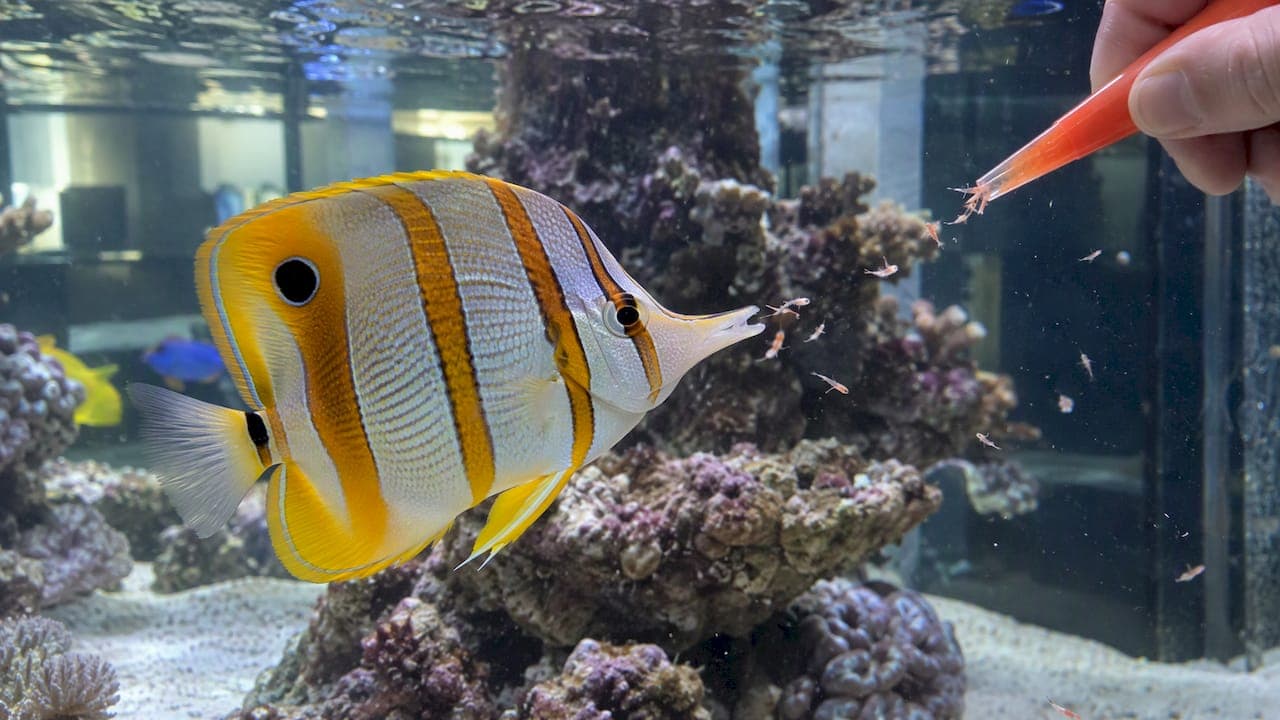
Brine shrimp can be a useful part of a butterflyfish diet, but only the right kind. Plain, unenriched brine shrimp are mostly a filler. Live or fresh shrimp that have been fed a good diet themselves can be a strong appetite trigger for a new fish and a decent nutrient carrier for an established one. Below you will find which butterflyfish take brine shrimp, why what the shrimp ate matters more than the shrimp itself, and how to feed them in a home reef tank.
TL;DR
- Brine shrimp are a delivery vehicle for nutrition, not a complete diet. What they ate decides what your butterflyfish gets.
- Newly hatched Artemia are low in key fatty acids unless enriched, and older unfed ones have used up their yolk reserves.
- Live brine shrimp are most valuable for getting a newly arrived or picky butterflyfish to start eating, then you widen the menu.
- Feed small portions two to three times a day, and keep variety in the diet: mysis, finely chopped seafood, and quality marine prepared foods alongside the shrimp.
- Coral-eating specialists are the hard cases. Brine shrimp alone will not keep them healthy long term.
Table of Contents
- Why butterflyfish are a feeding challenge
- The real issue: brine shrimp are only as good as their diet
- What this means for adult butterflyfish
- How to feed brine shrimp to butterflyfish
- Frozen, live or hatched: which form is best?
- Our perspective: why we raise brine shrimp on microalgae
- Building a balanced butterflyfish menu
- Getting live brine shrimp in the US
- Storing and handling live shrimp
- FAQ
- Sources
Why butterflyfish are a feeding challenge
Butterflyfish belong to the family Chaetodontidae, about 129 species in 12 genera found mostly on Atlantic and Indo-Pacific reefs. They look alike in shape but eat very differently. Some pick at zooplankton in the water column. Some nip at invertebrates. Others live almost entirely on coral polyps, and those are the species that tend to starve in aquariums.
That range is why one answer to "can I feed brine shrimp to my butterflyfish?" does not exist. Your answer depends on the species in your tank:
| Feeding style | Typical examples | How brine shrimp fit |
|---|---|---|
| Planktivores and generalists | Many bannerfish, some Chaetodon species | Good staple component, if enriched |
| Benthic invertebrate pickers | Copperband butterflyfish | Useful live starter, alongside mysis, chopped clam and similar foods |
| Obligate coral feeders | Certain Chaetodon species | Weak substitute. Treat as a bridge, not a diet |
The copperband, with its long snout built for poking into crevices, is the one hobbyists ask about most. Shops that sell it commonly suggest enriched brine shrimp among a varied menu and note that live food can help a newly introduced fish begin feeding. Take that as general husbandry guidance, not a guarantee for any individual fish.
The real issue: brine shrimp are only as good as their diet
The old forum advice that brine shrimp are a useless food has a grain of truth in it. A University of Florida IFAS extension publication explains that newly hatched Artemia can be deficient in the highly unsaturated fatty acids, such as DHA and EPA, that marine fish need, and that enrichment is necessary to improve their value. Artemia do not uniformly take up and keep every nutrient they eat.
The FAO's Artemia manual makes the same point from the aquaculture side: the shrimp carry nutrients into the fish, and their composition reflects what they were fed. A shrimp raised on a rich microalgae diet is a different food from one hatched from cysts in a jar and fed nothing.
Two practical consequences follow:
- Freshly hatched is not the same as nutritious. IFAS notes that nauplii turn transparent after about 24 hours, once the yolk sac is spent. Unfed, they offer little, and a fish may burn more energy hunting them than it gains. That matters most for small or weak fish.
- Enrichment has a window. If you enrich at home, you feed the shrimp a suitable diet for a limited period before offering them, which is the idea behind our 12 to 24 hour enrichment guide.
A peer-reviewed review on enhancing live food adds a useful frame: Artemia and rotifers are often favored as starter feeds because they are convenient, and copepods are the nutritional benchmark for many marine fish larvae. Convenience is the reason brine shrimp are everywhere. Their nutrition has to be earned by how they are raised.
What this means for adult butterflyfish
Much of the published work on Artemia concerns larval fish. Adult butterflyfish are far larger, and no study we can cite tests brine shrimp on adult butterflyfish specifically. So treat the following as sensible reasoning from the research above, plus common aquarist practice, rather than proven protocol.
- An adult can take a whole live shrimp easily, and the fatty acid and protein profile of that shrimp still depends on its own diet.
- Live movement triggers feeding in shy, newly imported fish, which is the main reason hobbyists reach for live brine.
- Because adult butterflyfish graze through the day, several small feedings fit their natural behavior better than one big meal.
A care guide on four-eyed butterflyfish makes the same general case for offering a variety of high-quality foods for balanced nutrition, while admitting that copying the natural corallivore diet in a home tank is hard. Variety is the safety net.
How to feed brine shrimp to butterflyfish
Start with a new or reluctant fish
Newly arrived butterflyfish are often stressed and ignore prepared foods. Live brine shrimp are a common first offer because they move and are small enough for any mouth. Here is a simple approach:
- Keep lights dim for the first feeding so the fish is less exposed.
- Release a small number of live shrimp near the fish's usual hiding place rather than in a cloud at the surface.
- Watch whether the fish picks at them. Do not overfeed: uneaten shrimp in a reef tank simply die and add to the nutrient load.
- Once the fish eats readily, begin mixing in thawed mysis or finely chopped seafood alongside the shrimp.
Keep portions and frequency sensible
Butterflyfish have small stomachs and graze constantly in the wild. Retailers of the species commonly recommend two to three small meals a day, which matches the behavior. Pinch-sized portions, eaten within a couple of minutes, are better than heaps.
Watch the competition
Copperbands and many other butterflyfish eat slowly. Fast, boisterous tankmates such as tangs or wrasses can take the shrimp first. Feed at two spots in the tank, or use a feeding device or rockwork crevice so the butterflyfish can use its snout.
Do not feed cysts or old nauplii
A common mistake from forum threads is tossing brine shrimp eggs straight into the tank. The FAO notes that cysts have a hard protective shell made of chitin-impregnated layers, which is meant to protect the embryo, not to be eaten. Hatching them first is the better route, and a hatching guide such as SpawnOS lists the usual targets: salinity of 25 to 35 ppt, temperature of 25 to 28°C (77 to 82°F), and non-iodized salt.

Even then, freshly hatched nauplii are tiny for an adult butterflyfish. They suit fry and small species far better than a full-sized Chaetodon. For adult fish, grown-out or adult brine shrimp are the more fitting size.
Frozen, live or hatched: which form is best?
| Form | Strengths | Limits |
|---|---|---|
| Hatched nauplii at home | Cheap, available on demand | Tiny, low in fatty acids unless enriched, a daily chore |
| Frozen brine shrimp | Convenient, easy to portion | Nutrition depends on the shrimp's original diet and the processing; no live movement to trigger feeding |
| Live adult brine shrimp | Movement triggers feeding, fit for adult mouths | Quality varies, so source matters |
Live shrimp also raise a fair health question. One forum answer says live feeding is fine, with the risk of parasites. That risk comes from wild-sourced or poorly kept food. A shrimp grown in a controlled, land-based system and not harvested from natural water lowers one source of uncertainty, though you should still use your normal quarantine and observation habits for your fish.
Our perspective: why we raise brine shrimp on microalgae
We grow brine shrimp because we think the usual debate about whether brine shrimp are good or bad for fish asks the wrong question. The shrimp are a vehicle, and the diet is the payload. That is why we raise ours in controlled, land-based, organic systems and feed them only the microalga Dunaliella, aiming for at least 40% protein and steady quality from one shipment to the next.
Wild-harvested brine shrimp swing with the seasons, and animals that sit in a natural water body through lean periods can be starved when they are collected. A fish keeper cannot see that from the outside. A farmed shrimp on a known diet takes that guesswork away.
For butterflyfish, which are finicky and costly, we see live farmed shrimp as a way to get a new arrival eating and a way to carry a good nutritional base into a varied menu. We would not claim that brine shrimp alone solve the hard cases, such as obligate coral feeders. If you want the detail behind our approach, these pages go deeper:
- Brine shrimp nutritional value explained for aquarists
- Dunaliella algae benefits for Artemia enrichment
- Target feeding microalgae-fed Artemia
— Demeter
Building a balanced butterflyfish menu
Think of brine shrimp as one layer in a rotation. A workable weekly plan for an established, healthy generalist butterflyfish might include:
- Daily: a small feeding of live or thawed, nutrient-rich brine shrimp.
- Several times a week: thawed mysis, finely chopped clam, mussel or fish.
- As tolerated: a quality marine pellet or flake, especially those with marine fatty acids. Retailer guidance commonly points to foods rich in omega-3s.
- For finicky fish: a feeding device or crevice for snout feeding.
If you want to compare brine shrimp with another popular staple, our brine shrimp vs bloodworms guide shows how they differ nutritionally. If you rear fry or run a hatchery, the larval nutrition guide and the enrichment protocol are the better starting points.
Signs the diet is working
- The fish approaches food calmly and eats within a minute or two.
- The belly stays gently rounded, never sunken behind the head.
- Colors stay vivid and the fish keeps exploring the rockwork.
A butterflyfish that refuses all food for several days, or whose belly is visibly pinched, needs expert help. Contact an experienced marine fish veterinarian or your livestock supplier early, because starvation in these species progresses fast and a diet change alone may not reverse it.
Getting live brine shrimp in the US
If you keep a butterflyfish, a sump of cultured live shrimp is useful but the supply has to be regular. We ship live farmed brine shrimp direct to customers. Live brine shrimp is priced from 17 to 35 $ one-off, depending on the option you choose. If you feed live shrimp weekly, the Demeter Biosciences membership delivers a monthly live brine shrimp shipment for 25 $ per month. We also offer live phytoplankton at 20 $ for those who want to enrich shrimp or feed corals, and a gift card from 10 to 50 $ for a fellow reefer.
Local fish stores, public aquariums and research groups can look at our bulk store brine shrimp order, and you can read more about the product itself.

Storing and handling live shrimp
You want shrimp to arrive alive and stay nutritious until the fish eat them. These habits help:
- Plan feedings so shrimp are not sitting for days in a cramped container.
- Keep them at a stable salinity and temperature close to the conditions they shipped in.
- Do not pour shipping water into the display tank. Net or strain the shrimp out and rinse them if your routine calls for it.
- Feed what the fish can eat in a few minutes, and keep the rest in a separate container for later meals.
For professional settings the Virginia Tech extension publication on Artemia culture for finfish larviculture stresses that Artemia must be of high quality, as nutritionally complete as possible, and kept in that state until the larvae consume it. The principle scales down to a single butterflyfish: a shrimp is only a good meal if it is still in good condition when eaten.
FAQ
Will my butterflyfish eat brine shrimp?
Many generalist and invertebrate-picking species will, especially live or fresh shrimp that move in the water. Obligate coral feeders often refuse it or accept it only for a short time. If your fish is a specialist, ask the seller what it was eating before you bought it.
Is brine shrimp a good food for butterflyfish?
It is good when the shrimp are nutritionally rich and a poor choice when they are not. Unenriched nauplii are low in important fatty acids, while shrimp raised on a microalgae diet carry more of what the fish needs. Use brine shrimp as part of a varied diet, not as the only food.
How often should I feed a butterflyfish?
Offer two to three small feedings a day, as butterflyfish naturally graze through the day. Give only what is eaten within a couple of minutes, and adjust if tankmates are stealing food.
Can I feed brine shrimp eggs to fish?
It is better to hatch them first. Cysts have a tough chitin-based shell that protects the embryo, and the freshly hatched nauplii are still very small for an adult butterflyfish. They suit fry and small fish better.
How long can brine shrimp go without food?
Newly hatched Artemia live off their yolk sac for roughly the first day, and after that they have little nutrition to give unless fed. That is why feeding or enriching them before they go to your fish matters.
Sources
- FA167: Choosing an Appropriate Live Feed for Larviculture of Marine Fish (UF/IFAS)
- FAO: Manual on the production and use of live food for aquaculture, Artemia
- FAO: Use of cysts
- Enhancement of Live Food Nutritional Status with Essential Nutrients for Improving Aquatic Animal Health: A Review (PMC)
- Butterflyfish family Chaetodontidae (Wikipedia)
- Artemia Culture for Intensive Finfish and Crustacean Larviculture (Virginia Tech)
- Baby Brine Shrimp Hatching Guide (SpawnOS)
- Four-Eyed Butterflyfish Care guide (One Naturalist)
- Copperband Butterflyfish diet and feeding (Top Shelf Aquatics)
- Butterflyfish in saltwater aquariums FAQ (Saltwaterfish.com)