
Dunaliella-enriched Artemia reliably delivers higher beta-carotene, key polyunsaturated fatty acids (PUFAs), and measurable immune support to the fish and shrimp that eat them. A 2026 Scientific Reports controlled trial found goldfish fed Chlorella- and Dunaliella-enriched Artemia reached the highest beta-carotene level (8.90 ± 0.4 mg/100 g) and outperformed unenriched groups on growth rate, feed conversion, and immune markers over 90 days. One enrichment study detected beta-carotene at 1.66 µg/ml in Artemia nauplii fed D. salina, confirming pigment transfer potential.
Quick recommendations:
- Hobbyists: Run a short enrichment window (6–12 hours) with D. salina before feeding nauplii to ornamental fish for visible coloration gains.
- Hatcheries and retailers: Source Dunaliella-fed Artemia for broodstock conditioning and color-sensitive stock; consider mixed-species diets when growth rate is also a priority.
- Museums and research institutions: Controlled-culture Artemia with documented algal inputs give you reproducible nutritional baselines.
Pro Tip: Brine shrimp cannot synthesize carotenoids on their own. Every pigment benefit your fish receives traces back entirely to what the Artemia ate.
Key Takeaways
Dunaliella-enriched Artemia deliver the highest DHA and beta-carotene transfer of any single microalga tested, with a 2026 controlled trial confirming measurable gains in fish growth, coloration, and immune markers.
| Point | Details |
|---|---|
| Beta-carotene transfer | D. salina enrichment produces detectable beta-carotene in Artemia (1.66 µg/ml); fish tissue levels reached 8.90 ± 0.4 mg/100 g in the 2026 trial. |
| DHA advantage | Artemia fed D. salina carry the highest DHA among tested microalgae; expect a measurable PUFA boost over unenriched or lipid-emulsion alternatives. |
| Enrichment window | 6–12 hours at Instar II is the practical enrichment window; coloration gains in fish appear within 2–4 weeks of consistent feeding. |
| Mixed-species diets | Pair D. salina with Tetraselmis or Chaetoceros when growth rate matters alongside pigmentation; single-species D. salina optimizes DHA and color. |
| Demeterbioscience option | Demeterbioscience supplies controlled-culture, Dunaliella-fed live Artemia with guaranteed protein content, available as single shipments, subscriptions, or bulk orders. |
Table of Contents
- What nutrients do Dunaliella algae actually supply to Artemia?
- How does Dunaliella enrichment change Artemia, and what does that mean for your fish?
- How to enrich Artemia with Dunaliella: a practical step-by-step protocol
- When should you use mixed-species enrichment instead of Dunaliella alone?
- How to source Dunaliella-fed Artemia in the U.S.: what to ask and what to check
- How long does enrichment take, and what does it cost?
- What does the research actually say? Key studies summarized
- Why controlled culture makes all the difference
- Ready-made Dunaliella-fed Artemia from Demeterbioscience
- Sources
What nutrients do Dunaliella algae actually supply to Artemia?
Dunaliella salina is the microalgae most studied for carotenoid enrichment of live feeds, and its nutritional profile explains why. The alga is dense in beta-carotene, carries a meaningful PUFA fraction including DHA, and contributes crude protein and lipids that elevate Artemia's baseline nutritional value.
Key nutrients D. salina contributes as Artemia feedstock:
- Beta-carotene: The dominant carotenoid; transfers into Artemia tissue and then into consumer animals as a pigment precursor and antioxidant.
- DHA (docosahexaenoic acid): Among tested microalgae, Artemia fed D. salina showed the highest DHA content, making it the strongest single-species choice for PUFA loading.
- Crude protein and carbohydrates: Enrichment studies show D. salina-fed Artemia carry higher protein and carbohydrate levels than unenriched controls.
- Lipids: Moderate lipid content supports energy density without excessive fat accumulation.
One practical advantage: D. salina lacks a rigid cell wall, which improves digestibility and nutrient conversion efficiency in Artemia compared with some harder-walled species.
| Nutrient | Reported value / condition | Source |
|---|---|---|
| Beta-carotene in enriched Artemia | ~1.66 µg/ml (extraction value, lab trial) | IOSR-JPBS enrichment study |
| Beta-carotene in goldfish tissue (combined diet) | 8.90 ± 0.4 mg/100 g (90-day trial) | Scientific Reports 2026 |
| DHA ranking vs. other algae | Highest among tested species | Unair/UKM fatty-acid trials |
| Crude protein | Higher than unenriched controls | IOSR-JPBS biochemical study |
Microalgal enrichment consistently outperforms commercial lipid emulsions at raising Artemia fatty-acid content, which is why most hatchery protocols default to live or concentrated algae rather than synthetic supplements.
How does Dunaliella enrichment change Artemia, and what does that mean for your fish?
Artemia function as passive bioencapsulation vectors. They ingest whatever the algae contain, and those nutrients transfer to the animals that eat them. Because brine shrimp cannot synthesize carotenoids de novo, the entire pigment load in the Artemia comes directly from D. salina.
Downstream outcomes for fish and shrimp fed Dunaliella-enriched Artemia include:
- Coloration: Beta-carotene from D. salina deposits in skin, fins, and muscle tissue, producing the vivid red-orange pigmentation ornamental fish keepers and hatcheries target.
- Immune support: The 2026 Scientific Reports trial showed improved immune markers in goldfish, consistent with carotenoids' known role as antioxidants that reduce oxidative stress.
- Stress tolerance: Higher antioxidant status correlates with better larval survival under handling and transport stress.
- Growth: Combined Chlorella + Dunaliella enrichment produced superior specific growth rate and feed conversion ratio compared with single-alga or unenriched groups.
"Goldfish fed Artemia enriched with both Chlorella vulgaris and Dunaliella salina showed improved final weight, specific growth rate, feed conversion ratio, and several immune markers compared with unenriched or single-alga groups over a 90-day controlled trial." Scientific Reports, 2026
For hatcheries focused on broodstock maturation, raising Artemia DHA via D. salina can support gonadal development in shrimp and improve larval performance when paired with a high-growth companion alga. More on how microalgae benefits fish health is covered in Demeterbioscience's evidence guide.
How to enrich Artemia with Dunaliella: a practical step-by-step protocol
Stage matters. Newly hatched nauplii (Instar I) have not yet opened their mouths; start enrichment at Instar II (roughly 6–8 hours post-hatch at 28°C), when the digestive tract is functional and feeding begins.
- Prepare your algal culture. Use a dense D. salina suspension at roughly 10⁶–10⁷ cells/ml, or a concentrated paste diluted to that range. Confirm the culture is live and uncontaminated before use.
- Transfer nauplii to the enrichment vessel. Use a clean, aerated container. Density should not exceed 100 nauplii/ml to avoid oxygen depletion and fouling.
- Add D. salina at target concentration. Aim for a visible green-orange tint in the water. Maintain gentle aeration to keep algae and nauplii in suspension.
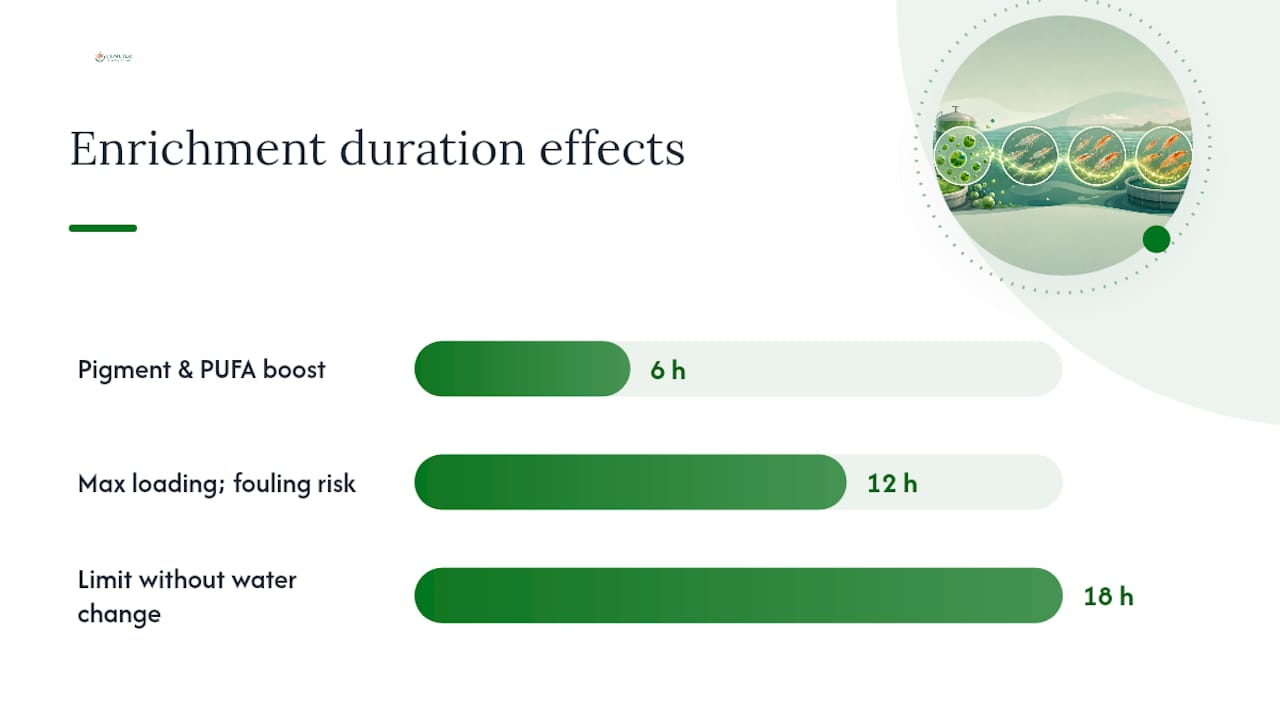
- Enrich for 6–12 hours. Six hours is sufficient for a pigment and PUFA boost; 12 hours maximizes loading but increases fouling risk. Do not exceed 18 hours without water changes.
- Rinse before feeding. Pass enriched nauplii through a fine sieve (100–150 µm) and rinse with clean saltwater to remove excess algae and metabolites.
- Feed immediately. Nutritional quality degrades within 1–2 hours post-rinse. Feed directly to target animals.
Troubleshooting checklist:
- Oxygen dropping below 5 mg/L: reduce nauplii density or increase aeration.
- Water fouling (milky, foul-smelling): shorten enrichment window or reduce algal dose.
- Poor coloration after feeding: check algal viability; dead or degraded D. salina transfers little beta-carotene.
Pro Tip: For color-focused goals, use pure D. salina for the enrichment window. For growth-focused goals, blend D. salina with Tetraselmis (roughly 50:50) to capture both DHA loading and faster Artemia development.
See Demeterbioscience's algae in brine shrimp diet guide for additional hobbyist-level protocol details.
When should you use mixed-species enrichment instead of Dunaliella alone?
D. salina leads on carotenoids and DHA, but it does not dominate every metric. Comparative trials show Chaetoceros and Tetraselmis tend to produce better Artemia growth and survival, while D. salina consistently wins on DHA and pigment content. That tradeoff is real and worth planning around.
| Goal | Best primary alga | Tradeoff | Recommended mix |
|---|---|---|---|
| Maximum pigmentation | D. salina | Slower Artemia growth | D. salina + Tetraselmis (50:50) |
| Highest DHA/PUFA loading | D. salina | Lower growth/survival vs. diatoms | D. salina + Chaetoceros |
| Fastest Artemia growth | Tetraselmis or Chaetoceros | Lower carotenoid transfer | Add D. salina at 25–30% of diet |
| Balanced broodstock diet | Mixed species | More complex culture management | D. salina + Tetraselmis + Chaetoceros |
Replacing D. salina with agricultural by-products to cut costs reduces DHA and EPA in Artemia, even when probiotics are added. salina* treatment consistently yielded the highest DHA/EPA profile in that substitution trial. Cost-cutting on algae quality has a direct, measurable nutritional cost.
Pro Tip: Mixed-species regimes are standard in serious hatchery operations. If you're buying pre-enriched Artemia rather than enriching in-house, ask your supplier which algae species were used and in what ratio — a single-species answer isn't always the whole story.
For more on balancing algal species for growth outcomes, Demeterbioscience's blog covers practical hatchery scenarios.
How to source Dunaliella-fed Artemia in the U.S.: what to ask and what to check
Whether you're a hobbyist ordering a single shipment or a research institution setting up a recurring supply, the questions you ask a supplier before buying matter more than the price per unit.
Supplier questions to ask before ordering:
- What Dunaliella strain do you culture, and is it grown in controlled conditions or wild-harvested?
- What are the protein and lipid specs per batch, and do you test them?
- Can you provide beta-carotene or DHA test results for recent lots?
- What are the harvest-to-ship intervals, and how are Artemia packaged for transit?
- Do you offer live, frozen, or dried formats, and which do you recommend for my application?
Format comparison for U.S. buyers:
- Live Artemia (farmed, Dunaliella-fed): Best nutritional transfer; requires fast shipping and immediate use. Ideal for hobbyists, retailers, and research labs with regular feeding schedules.
- Concentrated live D. salina paste: Useful for in-house enrichment programs; requires cold chain and short shelf life management.
- Frozen or dried Artemia: Convenient for storage but carotenoid and PUFA content degrades with processing. Acceptable for maintenance feeding, not optimal for broodstock or larval programs.
For retail aquarium stores stocking live feeds alongside prepared products like goldfish flakes, live Dunaliella-fed Artemia adds a premium live-feed tier that prepared foods cannot replicate.
Shipping and storage basics: Live Artemia ship best in insulated packaging with oxygen supplementation; transit beyond 48 hours without temperature control degrades survival rates. Ask for a live-arrival guarantee and confirm the supplier's cold-chain protocol.
How long does enrichment take, and what does it cost?
Enrichment timelines are short. The nutritional loading window is 6–12 hours for most applications; observable coloration changes in fish appear within 2–4 weeks of consistent feeding with enriched Artemia.
| Scenario | Timeline | Expected outcome |
|---|---|---|
| Single enrichment session (hobbyist) | 6–12 hours | Pigment and PUFA boost in one feeding batch |
| Consistent feeding over 2–4 weeks | Daily enrichment sessions | Visible coloration improvement in ornamentals |
| Broodstock conditioning (hatchery) | 4–8 weeks of enriched feeding | Improved gonadal maturity indicators |
Cost variables to budget for:
- DIY enrichment: Algal culture equipment, D. salina starter culture, aeration, and labor. Viable at scale for hatcheries; time-intensive for hobbyists.
- Buying Dunaliella-fed Artemia: Higher per-unit cost than wild-harvested, but no culture overhead. Price varies by volume, shipping distance, and format (live vs. frozen).
- Substituting cheaper algae or by-products: Reduces input cost but measurably lowers DHA/EPA output, as the substitution trial data shows.
DIY vs. buy decision checklist:
- Do you have space and equipment for a live algal culture? If no, buy pre-enriched.
- Do you need consistent, documented nutritional specs? If yes, buy from a controlled-culture supplier.
- Are you feeding fewer than 50 fish? DIY enrichment is probably not worth the overhead.
- Are you running a hatchery or research program with volume needs? DIY or a bulk supplier contract both make sense.
What does the research actually say? Key studies summarized
The evidence base for D. salina enrichment of Artemia is solid for pigmentation and DHA transfer; growth outcomes are more nuanced.
- 2026 Scientific Reports trial (goldfish, 90 days): Combined Chlorella + Dunaliella enrichment produced the highest beta-carotene in fish tissue (8.90 ± 0.4 mg/100 g), along with superior growth rate, feed conversion, and immune markers. This is the strongest recent controlled trial linking Dunaliella-enriched Artemia to downstream fish outcomes.
- Substitution trial: Replacing D. salina with agricultural by-products lowered DHA/EPA, confirming algal quality is not interchangeable with cheaper inputs.
"Microalgae often outperform commercial lipid emulsions at enhancing live feed fatty-acid content and are recommended for improving Artemia nutritional profiles." IJERR comparative review
Limitations to note: Most trials use specific Artemia strains (A. franciscana) and particular fish species under lab conditions. Real-world hatchery results vary with water quality, temperature, and feeding frequency. Treat the evidence as directional, not as guaranteed performance specs.
Why controlled culture makes all the difference
Wild-harvested brine shrimp are nutritionally unpredictable. Seasonal starvation, variable water conditions, and unknown diet inputs mean the Artemia you receive one month may carry a completely different nutritional profile than the batch from the month before. That variability is the core problem controlled culture solves.
Every batch reflects a consistent, documented diet rather than whatever the shrimp happened to encounter in a salt lake. For research institutions that need reproducible feeding trials, that consistency is not a convenience; it is a methodological requirement. For retailers and hobbyists, it means the coloration and vitality benefits are repeatable, not occasional. Institutional buyers should expect a supplier to provide batch-level nutritional data, not just general species claims. Demeterbioscience's research missions page outlines the production controls and sustainability rationale behind this approach.
Ready-made Dunaliella-fed Artemia from Demeterbioscience
If running your own enrichment program is not practical, Demeterbioscience ships live Dunaliella-fed brine shrimp directly to hobbyists, retailers, and institutions across the U.S. salina*.
Retailers and research institutions with volume needs can place a bulk brine shrimp order for recurring supply. Monthly subscription plans are available for aquarium hobbyists who want reliable live feed without managing a culture setup. If you want to skip the enrichment overhead entirely and receive Artemia that already carry the Dunaliella nutritional profile, visit the product overview page and place your first order.
Sources
- Chlorella vulgaris and Dunaliella salina-enriched Artemia salina enhances growth, pigmentation, gut morphology and immune-related pathways in goldfish (Carassius auratus) | Scientific Reports
- Fatty Acids Profiles and Growth Performances of Artemia franciscana Fed with Different Types of Microalgae
- Evaluation of the Biochemical Composition of Four Marine Algae and Its Nutritional Value for Brine Shrimp.
- Fatty Acids Profiles and Growth Performances of Artemia franciscana Fed with Different Types of Microalgae (UKM repository PDF)
- The effects of substituting Dunaliella salina algae with agricultural by-products and probiotic Lactobacillus rhamnosus on growth indices proximate body composition and fatty acids profiles of Artemia franciscana
- Comparative microalgae efficiency for Artemia growth and nutrition (IJERR / review references)