

Brine shrimp are one of the most widely used live feeds in aquaculture and ornamental fishkeeping, yet their nutritional value is routinely misunderstood. Most hobbyists assume brine shrimp are consistently nutritious. They are not. The brine shrimp nutritional value explained here goes well beyond basic protein counts. It covers how developmental stage, diet, water conditions, and processing method each alter what your fish actually receive. Whether you manage a commercial hatchery or maintain a planted freshwater tank, understanding these variables lets you feed with precision rather than guesswork.
Table of Contents
- Key takeaways
- Brine shrimp nutritional value explained: the biological foundation
- How diet and environment shape fatty acid profiles
- Processing effects on nutritional retention
- Practical feeding recommendations for aquarists and professionals
- What years of working with brine shrimp nutrition actually taught me
- Get consistently nutritious brine shrimp for your animals
- FAQ
Key takeaways
| Point | Details |
|---|---|
| Nutritional profile varies widely | Dried nauplii range from 37% to 71% protein depending on source and processing. |
| Life stage determines composition | Freshly hatched nauplii deliver a different nutrient ratio than adults or cysts, with practical implications for larval fish. |
| Fatty acids are environmentally set | EPA and DHA content is not fixed. It reflects what the brine shrimp ate, making enrichment a necessity for marine larvae. |
| Live forms outperform processed | Fresh, live brine shrimp retain the highest nutritive value compared to frozen or freeze-dried alternatives. |
| Farmed shrimp offer consistency | Controlled cultivation avoids the seasonal variability and starvation that make wild brine shrimp nutritionally unreliable. |
Brine shrimp nutritional value explained: the biological foundation
Understanding what brine shrimp actually contain starts with recognizing that they are not one thing nutritionally. They are a biological system whose composition shifts across life stages.
Cysts. Brine shrimp cysts (dormant eggs) are dense with energy reserves but present a shell barrier that limits direct nutrient availability for fish. Decapsulated cysts show biochemical composition comparable to freshly hatched nauplii, but their dry weight and energy content run 30 to 40% higher. This makes them calorie-dense but not necessarily richer in bioavailable protein.
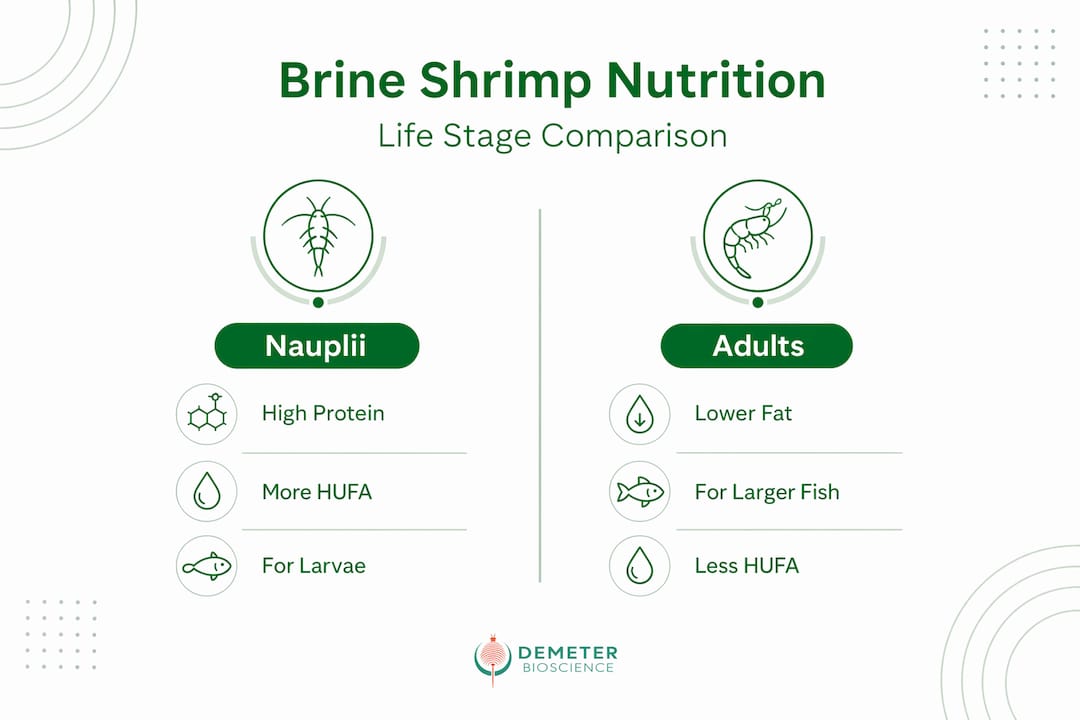
Nauplii. Freshly hatched nauplii are the most commonly recommended form for larval fish. They are small enough for most fish fry to consume, actively swimming which triggers prey detection in young fish, and retain yolk reserves from the cyst. The nutritional content of dried nauplii spans 37% to 71% protein, 12% to 30% lipid, 11% to 23% carbohydrate, and 4% to 21% ash, with this wide spread reflecting both source strain and processing choices.
Adults. Adult brine shrimp are larger and therefore suited to bigger fish, but their nutritional density per unit of dry weight trends lower than nauplii. They also contain less of the residual yolk lipid that makes newly hatched nauplii particularly valuable for marine larvae.
Here is a practical comparison of nutrient ranges across life stages on a dry weight basis:
| Life stage | Protein (%) | Lipid (%) | Carbohydrate (%) | Ash (%) |
|---|---|---|---|---|
| Cysts (decapsulated) | 50–60 | 18–25 | 15–20 | 5–10 |
| Nauplii (freshly hatched) | 37–71 | 12–30 | 11–23 | 4–21 |
| Adults | 45–60 | 10–20 | 10–15 | 8–15 |
The data makes one thing clear: if you are feeding marine fish larvae and expecting consistent nutrition from any batch of brine shrimp nauplii without knowing their origin, you are working with a wide range, not a fixed number.
How diet and environment shape fatty acid profiles
The most consequential and most overlooked dimension of brine shrimp nutrition is fatty acid composition. Specifically, EPA (eicosapentaenoic acid) and DHA (docosahexaenoic acid), the highly unsaturated fatty acids (HUFAs) that larval marine fish require for neurological development and survival. Brine shrimp do not synthesize these compounds from scratch. Fatty acid composition in nauplii is highly environmentally determined, meaning what your brine shrimp ate is what your fish get.

This has a direct consequence for wild-harvested brine shrimp. In natural salt lakes, brine shrimp feed on whatever algae and bacteria are present, and those microbial communities shift with season, salinity, and water temperature. Why wild brine shrimp are nutritionally poor in certain periods comes down to exactly this. When their food source is low in HUFAs, the shrimp are low in HUFAs. There is no compensating mechanism.
Farmed vs wild brine shrimp nutritional value differences therefore come down to diet control. In a controlled culture environment, operators can choose what the shrimp eat. Enrichment with polyunsaturated fatty acids through marine oils is now standard aquaculture practice specifically for this reason. Enrichment protocols typically involve suspending nauplii in a solution rich in marine oils or concentrated microalgae for 8 to 24 hours before feeding, which loads the shrimp's gut with the target fatty acids.
Key practical points on fatty acid management:
- Wild-caught brine shrimp from commercial sources have no guaranteed HUFA content, which is the core reason why wild brine shrimp are nutritionally poor for marine larval rearing.
- Microalgae like Dunaliella naturally contain carotenoids and essential nutrients that enrich brine shrimp without artificial additives.
- Enrichment is most effective on live nauplii because the gut is still active and retains enrichment emulsions during feeding.
- Brine shrimp protein content and fatty acid levels differ significantly between wild and farmed sources, and that gap widens whenever wild sources experience food scarcity.
Pro Tip: If you are rearing marine fish larvae and using commercially sourced frozen brine shrimp, always check whether the product was enriched before freezing. A non-enriched frozen nauplii product can be close to nutritionally empty for marine larval needs.
Processing effects on nutritional retention
Form matters as much as source. The dietary value of brine shrimp drops measurably as you move away from live, fresh forms. Understanding those tradeoffs helps you make better purchasing decisions.
- Live brine shrimp retain the highest nutritive value of any form. The gut is intact, enrichment compounds are held in the digestive tract, and enzymes remain active. For hatcheries and serious hobbyists, live shrimp represent the gold standard.
- Frozen brine shrimp are convenient but lose some nutritional integrity. The freeze-thaw cycle ruptures cell membranes, which allows lipid oxidation and nutrient leaching. If the shrimp were enriched before freezing, some of that value is preserved, but not all.
- Freeze-dried brine shrimp extend shelf life at the cost of fat-soluble vitamins and delicate fatty acids. Processing methods like freeze-drying and acid preservation reduce key nutritional components, often requiring targeted supplementation to compensate.
- Decapsulated cysts offer a shelf-stable compromise. They are free of the outer shell, safe from bacterial contamination on the shell surface, and match the biochemical composition of nauplii reasonably well while avoiding the hatching step.
- Gut-loaded or pre-enriched forms represent a middle ground between convenience and quality. Some commercially prepared frozen brine shrimp are enriched before processing, partially restoring HUFA content.
Pro Tip: When frozen brine shrimp are your only option, soak the thawed product in a quality HUFA supplement or spirulina suspension for 15 to 30 minutes before feeding. This simple step partially compensates for enrichment losses during freezing.
Practical feeding recommendations for aquarists and professionals
Applying brine shrimp nutrition knowledge requires matching feed form and preparation to your specific fish species and their life stage. There is no single best answer. The right choice depends on what you are trying to achieve.
For larval marine fish: Live, enriched nauplii are the non-negotiable standard. The nutritional value of specific HUFAs delivered via brine shrimp requires managing culture inputs and enrichment steps directly. This means either running your own enrichment program or sourcing from a producer who controls the brine shrimp diet before harvest.
For freshwater tropical fish: Adult or nauplii forms, live or frozen, work well here. Freshwater species generally tolerate lower HUFA levels, so enrichment becomes less critical. Protein content and prey size matching matter more for these species.
For reef and saltwater ornamentals: Adult-sized live or frozen brine shrimp are a useful supplemental food, but the brine shrimp health advantages are primarily physical stimulation and feeding motivation. Nutritional density for adult marine fish should come from a broader diet that includes pellets or other high-protein feeds.
Here is a comparison of form and expected nutritional outcome for different feeding goals:
| Form | Protein retention | HUFA content | Best use case |
|---|---|---|---|
| Live enriched nauplii | High | High (with enrichment) | Marine larvae, first feeds |
| Live non-enriched nauplii | High | Variable | Freshwater fry, conditioning |
| Frozen enriched | Medium | Medium | General marine fish, convenience |
| Frozen non-enriched | Medium | Low | Freshwater supplemental feeding |
| Freeze-dried | Low to medium | Low | Backup food, freshwater adults |
| Decapsulated cysts | High | Variable | Larval fish when nauplii unavailable |
Additional considerations:
- Feed nauplii within 24 hours of hatching for maximum yolk content. As nauplii consume their own reserves, the caloric density drops.
- Portion brine shrimp feedings so fish consume the batch within a few minutes. Uneaten live brine shrimp in saltwater tanks die quickly, foul water, and contribute nothing nutritionally once dead.
- For aquatic nutrition programs in commercial settings, tracking which brine shrimp strain and feed protocol produced the best larval survival rates gives you data to refine over multiple production cycles.
What years of working with brine shrimp nutrition actually taught me
I have spent a long time watching hobbyists and professionals make the same mistake with brine shrimp: treating them as a single, predictable feed item. They are not. What I have found is that the brine shrimp nutritional content breakdown that matters most to your fish has almost nothing to do with the species of brine shrimp and almost everything to do with what those shrimp ate before you fed them.
The enrichment step is where most people leave performance on the table. Many aquarists buy frozen brine shrimp, thaw them, and feed immediately. That process delivers very little for marine species. I have seen larval survival rates in controlled trials improve dramatically when the only change was switching from non-enriched frozen to live, Dunaliella-fed shrimp. The fish were not getting more shrimp. They were getting better shrimp.
My other strong conviction is that consistency matters more than peak nutritional value on any given day. A brine shrimp source that reliably delivers 40% protein and a stable fatty acid profile will outperform a theoretically richer source that varies based on season or stock condition. That is exactly why the controlled farming approach produces better long-term feeding outcomes than relying on wild harvests. Wild brine shrimp nutritional quality is a gamble. Farmed, diet-controlled shrimp are not.
The nutritional profile of brine shrimp is not fixed biology. It is a management outcome. Once you internalize that, you start making better decisions at every step.
— Demeter
Get consistently nutritious brine shrimp for your animals
At Demeterbioscience, every batch of brine shrimp is raised in land-based, controlled systems on a diet of Dunaliella algae, guaranteeing at least 40% protein content and a stable nutritional profile with every order. That is the consistency that wild-harvested sources cannot match. Whether you are running a commercial hatchery, stocking a display tank, or feeding sensitive marine larvae, you can explore our live brine shrimp products and monthly subscription options. For larger operations, our bulk product options support museums, local fish stores, and aquaculture facilities at scale.
FAQ
What is the protein content of brine shrimp nauplii?
Dried brine shrimp nauplii contain between 37% and 71% protein depending on their source, diet, and how they were processed. Farm-raised nauplii fed consistent microalgae diets tend to hit the higher end of that range reliably.
Why are wild brine shrimp nutritionally poor for marine larvae?
Wild brine shrimp are nutritionally poor for marine larvae because their fatty acid composition reflects whatever they ate in their natural habitat, which changes with season and location. Without deliberate enrichment with EPA and DHA, wild brine shrimp often lack the HUFAs that marine larval fish require for development.
Do frozen brine shrimp retain their nutritional value?
Frozen brine shrimp retain moderate protein levels but lose meaningful amounts of delicate fatty acids and fat-soluble vitamins during the freeze-thaw process. Enriching thawed brine shrimp in a HUFA supplement before feeding partially compensates for these losses.
How does enrichment improve brine shrimp nutrition?
Enrichment works by suspending live nauplii in a solution containing marine oils, concentrated algae, or HUFA emulsions for 8 to 24 hours. The shrimp's gut loads with the enrichment material, which is then transferred directly to the fish that consume them.
What is the difference between farmed and wild brine shrimp nutritional value?
Farmed brine shrimp raised on controlled algae diets offer predictable protein content and targeted fatty acid profiles. Wild brine shrimp vary significantly between seasons and harvest locations, making them unreliable for nutritionally sensitive applications like marine larval rearing.