
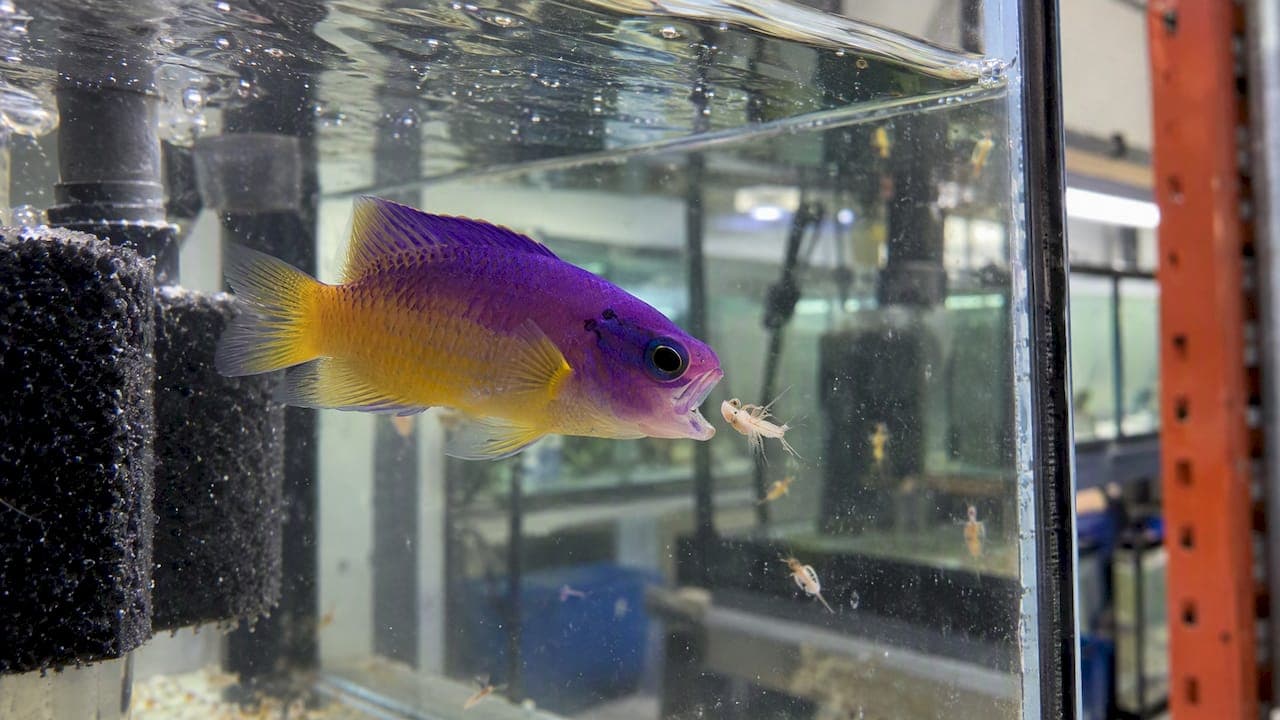
Yes, dottybacks eat brine shrimp, and most take them eagerly. What matters is the form you offer (live, frozen or newly hatched), whether the shrimp are nutritionally enriched, and how much you drop in at a time. Used as one part of a varied, meaty diet, enriched brine shrimp suit adult dottybacks. Newly hatched nauplii also work as a first Artemia food for larvae in a breeding setup.
TL;DR
- Dottybacks are small predators of invertebrates, so live or frozen brine shrimp fit their natural feeding style well.
- Enrichment matters more than the species of shrimp: unenriched brine shrimp are a thin meal, and fatty acids (EPA and DHA) are important for dottyback development.
- Feed twice a day, only what your fish can finish in a few minutes, and rotate in mysis, krill and quality prepared foods.
- For breeders, a gradual three-day transition onto newly hatched Artemia improved larval survival in one study.
- Live brine shrimp fed on microalgae are a convenient way to get a gut-loaded food without hatching your own.
Table of Contents
- Do dottybacks eat brine shrimp?
- Which form of brine shrimp suits a dottyback?
- How nutritious are brine shrimp for dottybacks?
- How to feed brine shrimp to an adult dottyback
- Feeding dottyback larvae and juveniles
- Can brine shrimp live in your tank as a food source?
- We think the shrimp matters as much as the species
- Getting live, microalgae-fed brine shrimp
- Common mistakes to avoid
- A simple weekly feeding plan
- FAQ
- Sources
Do dottybacks eat brine shrimp?
They do. Dottybacks (the genera Pseudochromis, Labracinus and relatives) are small, active carnivores. The University of Florida's marine culture overview notes that dottybacks typically consume small invertebrates, which is exactly what a brine shrimp is: a small, soft-bodied crustacean that drifts and twitches in the water column. That movement triggers a strike response in a way that flake rarely does.
In the aquarium, that means three practical things:
- A newly introduced dottyback often accepts live or thawed brine shrimp before it accepts anything else, which helps when you are weaning it onto prepared foods.
- Dottybacks are bold and quick, so they usually get their share even in a community of faster feeders.
- Their appetite is easy to overestimate. A fish that attacks every shrimp is not necessarily hungry, and leftover food is the main way brine shrimp feeding goes wrong.
If you keep other small predators, the same logic applies. We cover a related case in our guide to brine shrimp for damsels and another in feeding cardinalfish brine shrimp.
Which form of brine shrimp suits a dottyback?
There are four forms worth knowing, and each has a different job.
| Form | Best for | Main strength | Main watch-out |
|---|---|---|---|
| Live adult brine shrimp | Adults, picky eaters, conditioning before breeding | Movement triggers feeding; can be gut-loaded | Only as nutritious as what the shrimp ate |
| Newly hatched nauplii | Larvae and very small dottybacks | Right size for tiny mouths | Fresh nauplii carry little fat unless enriched |
| Enriched frozen brine shrimp | Daily feeding for adults | Convenient, easy to portion | Thaw and rinse; nutrition depends on the product |
| Dried or freeze-dried | Occasional variety | Long shelf life | Least appealing to many fish; should not be the staple |
For an adult fish in a reef or fish-only system, live or enriched frozen brine shrimp are the sensible core. The British trade body OATA recommends small meaty frozen feeds such as enriched brine shrimp, mysis shrimp or krill for basslets and dottybacks. Notice that brine shrimp are one entry on that list, not the whole list.
Live adults versus nauplii
Adult brine shrimp are far bigger than nauplii and carry more body mass per bite, so adult dottybacks get more from them. Nauplii are the right choice only for larvae or for very small fish. The nauplii stage is short-lived as a feed: the window when they are at their most useful is limited, which we explain in our piece on brine shrimp life stages and the 6 to 12 hour feed window. For a deeper look at the biology, see our Artemia nauplii guide.

How nutritious are brine shrimp for dottybacks?
This is the question most forum threads argue about, and the honest answer is that it depends on what the shrimp themselves have eaten. Brine shrimp are not a complete food by default. A shrimp that has been starved, or one pulled straight from a hatching container, is mostly a package of water and a small amount of yolk reserves. A shrimp that has been feeding on microalgae is a much better meal.
That is why aquarists who keep fussy or colorful dottybacks talk about "enriched" brine shrimp. Practical Fishkeeping notes that dottybacks generally take live, frozen and dry foods, and it names spirulina-enriched brine shrimp and quality flake as useful options for helping prevent color fading in some species.
We make our own claims on this point as a producer. Our live brine shrimp are raised on land in a controlled system and fed only the microalga Dunaliella, and we design the process to deliver at least 40% protein content with consistent quality from batch to batch. You can read how the algae support the shrimp in our article on Dunaliella benefits for Artemia enrichment.

Why fatty acids matter
The strongest research on dottyback nutrition comes from breeding work. A study on rearing the Sunrise dottyback explains that adequate dietary EPA and DHA are important during larval development, and that shortages can cause poor growth, low feed efficiency, anemia and high mortality. That finding concerns larvae, so do not read it as a claim about every adult fish. But it explains why enrichment is treated as a necessity by people who raise dottybacks from eggs, and it is a good reason for adult keepers to prefer enriched food too.
If you hatch or hold your own Artemia, our 2:1 DHA to EPA enrichment protocol walks through the process step by step.
Can brine shrimp be a staple?
Think of enriched brine shrimp as a reliable base that you build around, not a single-ingredient diet. OATA's husbandry view is that brine shrimp belong in a mix with other meaty feeds and that portion control protects water quality. Rotating in mysis, krill, and a good prepared pellet or flake covers gaps that any one food leaves.
How to feed brine shrimp to an adult dottyback
A simple routine works for most species.
- Feed twice a day. OATA advises feeding basslets and dottybacks twice daily, giving only what they can eat within a few minutes.
- Target the food. Use a pipette or a turkey baster to release shrimp near the fish's territory. This stops faster tankmates from stealing it and keeps food off the substrate.
- Thaw frozen cubes in tank water, not tap water, and strain off the liquid. The liquid carries a lot of dissolved organics that you do not want in the system.
- Watch the last shrimp. When the fish slows down and stops chasing, stop feeding. A dottyback that is still guarding a crevice with a full belly is not hungry.
- Rotate. Offer brine shrimp on some feeds and mysis or krill on others. Add a quality prepared food a few times a week.
One point is worth stressing for water quality. OATA warns that uneaten food breaks down and releases toxic waste into the aquarium. In a reef tank with a skimmer and good flow this is easier to manage, but it still shows up as nuisance algae and nitrate if you overfeed.
How much is enough?
There is no honest number that fits every fish. A pea-sized fish and a six-inch fish have very different needs. Start with a small pinch or a few live shrimp per fish, watch how many get eaten in two to three minutes, and scale to match. If shrimp are reaching the sand, you are overfeeding.
Feeding dottyback larvae and juveniles
If you breed dottybacks, brine shrimp stop being a treat and become a milestone. Early larvae need very small prey such as rotifers, and the move to Artemia is a critical step.
The University of Florida overview notes that newly hatched larvae can consume newly hatched Artemia less than two weeks after hatching. A 2021 study of orchid dottyback larvae gives finer detail: larvae could ingest nauplii from 5 days post-hatching, but survival was higher when the transition began at 11 or 14 days.
The same study points to how you make the switch:
- Go gradual. A three-day transition, co-feeding the original prey with Artemia before finishing the switch, improved survival compared with an abrupt change.
- Enrich the Artemia. Enriched metanauplii introduced at 11 or 13 days post-hatching maintained steady survival after the transition, and the 11-day enriched group reached mean survival of 58 ± 10% by day 20.
These results come from one species under hatchery conditions, so treat the exact days as a starting reference and not a guarantee for your own tank. The principle holds broadly: delay the switch until larvae are developed enough, mix the foods for a few days, and use enriched prey.
For the practical side of feeding tiny fish at home, the logic in our first 30 days guide for danio fry transfers well, and so does matching prey to mouth size, which we discuss in Daphnia versus brine shrimp for hobbyists.
Can brine shrimp live in your tank as a food source?
Some reef keepers add live brine shrimp to a sump or refugium so that fish can graze on them. It can work as a supplement, but brine shrimp are a salt-water species that will not thrive indefinitely in a reef system, and they need algae to stay fed. The practical approach is to treat them as a delivery of live food, not a self-sustaining colony. Our article on brine shrimp in a refugium explains how to hatch or add them for food and not for a colony.
A few cautions for dottybacks in particular:
- Dottybacks are predators of small crustaceans. Practical Fishkeeping-style advice and long-running hobbyist discussions both warn that some dottybacks will go after ornamental shrimp. Brine shrimp in a feeding session are fine, but do not assume a dottyback leaves cleaner or ornamental shrimp alone.
- Dottybacks are territorial toward other dottybacks. Feeding time is when that aggression shows, so spread food across the tank if you keep more than one species.
We think the shrimp matters as much as the species
Our view at Demeter is simple: a brine shrimp is only as good as its last meal. Wild-harvested shrimp can be caught in conditions where food is scarce and the seasons swing, so what ends up in the bag can vary a lot. That variability is what hobbyists feel when one batch gets devoured and the next gets ignored.
We grow our shrimp on land, in a controlled and sustainable system, and feed them only Dunaliella, an organic microalga. Our aim is a shrimp that arrives alive, full of what it ate, and consistent in nutrition, with at least 40% protein content. For a predator like a dottyback, which reads movement and chases live prey, a live, algae-fed shrimp is a natural fit.
We also believe in feeding with intent. Target-feeding, small portions, and a varied menu keep fish healthy and water clean. If you want the how-to, our guide on target feeding brine shrimp is where we would start.
Demeter
Getting live, microalgae-fed brine shrimp
If you would rather not run hatching jars every few days, we ship live brine shrimp directly to hobbyists. One-off orders of live brine shrimp are priced from $17 to $35 on our live brine shrimp page, and a monthly membership at $25 per month keeps a shipment arriving on a schedule. If you also keep corals or filter feeders, our live phytoplankton is $20 per order, and gift cards run from $10 to $50. Fish stores and institutions can look at our bulk store order.
You can read more about how we raise them on our brine shrimp product page.
Common mistakes to avoid
- Feeding only plain brine shrimp. A single-food diet leaves gaps. Mix in mysis, krill and a quality prepared food.
- Skipping enrichment. Unenriched shrimp are a weak meal, especially for growing fish and breeders.
- Pouring thaw liquid into the tank. Strain it first.
- Feeding by the clock, not by the fish. Stop when the chasing stops.
- Rushing larval transitions. Co-feed over a few days instead of switching in one step.
- Ignoring tankmates. Dottybacks are quick and territorial, so make sure slower fish also get fed.
A simple weekly feeding plan
Here is a template for a single adult dottyback in a mixed reef. Adjust it to your species and to what your fish actually finish.
| Day | Morning | Evening |
|---|---|---|
| Monday | Live or enriched brine shrimp | Mysis |
| Tuesday | Quality prepared pellet or flake | Enriched brine shrimp |
| Wednesday | Krill (small pieces) | Live brine shrimp |
| Thursday | Mysis | Prepared food |
| Friday | Enriched brine shrimp | Krill |
| Saturday | Live brine shrimp | Mysis |
| Sunday | Light feed or skip | Enriched brine shrimp |
The plan keeps brine shrimp in the rotation several times a week without letting them crowd out everything else. A lighter day gives the fish and the filtration a break.
FAQ
Can dottybacks live on brine shrimp alone?
It is not a good idea. Brine shrimp are useful, particularly when enriched or fed on microalgae, but a varied diet of meaty foods and quality prepared foods covers more nutritional ground. Use brine shrimp as one regular component, not the only one.
Are live or frozen brine shrimp better for dottybacks?
Both work. Live shrimp trigger the strongest feeding response and are helpful for picky or newly arrived fish. Frozen enriched shrimp are convenient for daily feeding, as long as you thaw and strain them first. Many keepers use both.
How often should I feed brine shrimp to a dottyback?
Twice a day is a sound baseline for adults, offering only what the fish can finish within a few minutes. You do not need to give brine shrimp at every feed. Alternate with mysis, krill and prepared food.
When can dottyback larvae eat brine shrimp nauplii?
In one orchid dottyback study, larvae could take newly hatched nauplii from 5 days after hatching, but survival was better when the switch started at 11 or 14 days, with a gradual three-day co-feeding period. Your own results may differ by species, so watch the larvae closely.
Sources
- Chen and Zeng (2021), Transition to Artemia feeding phase for orchid dottyback larvae
- Fernández-Díaz et al. (2006), Breeding and rearing the Sunrise Dottyback
- OATA, How to care for basslets and dottybacks (2022)
- Practical Fishkeeping, Dottybacks for the reef aquarium