
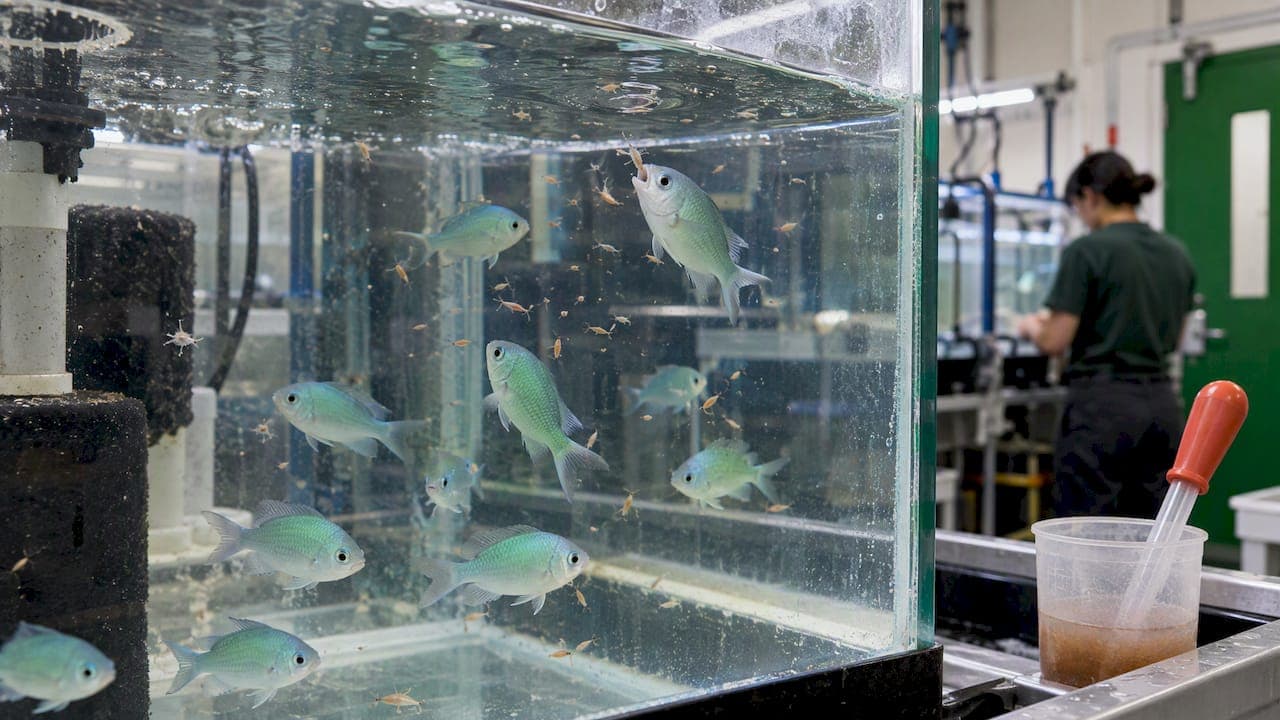
Yes, chromis eat brine shrimp, and most take them eagerly. But brine shrimp work best as one part of a varied diet, not the whole menu. Nutritional value depends heavily on the age of the shrimp, where they came from, and whether they were enriched or fed well before they reached your tank. This guide covers what brine shrimp can and cannot do for a school of chromis, how much to offer, how to keep the water clean, and when to hatch your own versus buy farmed live shrimp.
TL;DR
- Chromis are omnivores. OATA recommends a varied diet with enriched brine shrimp as a supplement to quality flake or pellet food.
- Brine shrimp quality varies widely. Newly hatched nauplii are a convenient first bite, but they are not a complete meal for marine fish.
- Feed small portions two to three times a day and offer only what the school clears in a few minutes.
- Rinse live shrimp before they go in the tank, and never let uneaten shrimp or shells pile up.
- If you want a consistent, algae-fed product without running a hatchery, farmed live shrimp are an option. If you hatch, enrich the shrimp before you feed.
Table of Contents
- Can chromis eat brine shrimp?
- What brine shrimp offer, and where they fall short
- Enrichment: why it matters and how it works
- How much and how often to feed chromis
- Feeding brine shrimp without fouling the tank
- Hatch your own or buy farmed live shrimp?
- Our perspective: why feed matters more than the label
- Where to get algae-fed live shrimp
- Common mistakes with chromis and brine shrimp
- FAQ
- Sources
Can chromis eat brine shrimp?
They can, and they should be offered some variety. Chromis and damselfish are described by the Ornamental Fish International-affiliated trade body OATA as omnivorous. In the wild, chromis such as the green chromis hang in the water column above the reef and pick at plankton all day. A moving, drifting live shrimp triggers that same feeding response better than a flake that sinks or clumps.
That is the main reason hobbyists reach for live brine shrimp. Live prey gets shy or picky fish eating, brings out natural schooling behavior at feeding time, and gives you a way to condition new arrivals. It is also why newly hatched brine shrimp have been a staple of the hobby for decades.
The catch is that "brine shrimp" is not one food. A shrimp that hatched this morning, a shrimp that starved in a bag for three days, and an adult that fed on good algae are three different foods. The rest of this article is mostly about closing that gap.
What brine shrimp offer, and where they fall short
Brine shrimp are convenient. They are easy to hatch, easy to ship, and fish love them. But convenient is not the same as complete.
Rob Toonen's Reefkeeping article on the nutritional value of live foods states that the nutritional content of brine shrimp varies substantially with their age, their source, and the quality of the cysts they hatched from. He also notes that brine shrimp are often not among the most nutritious foods for marine fish. That article dates from 2004, but the biology it describes has not changed.
Aquaculture research points the same way. Texas A&M AgriLife Extension's guide to choosing live feeds for marine fish larvae says brine shrimp are deficient in the fatty acids DHA, EPA, and ARA for most developing marine fish larvae. The guide is about larval fish in hatcheries, not adult chromis in a reef tank, so treat it as an indicator of what Artemia lack by default, not as a feeding rule for your school. Still, the message is clear: Artemia are useful, convenient prey, but they are nutritionally limited unless properly enriched.
What this means for a chromis keeper:
- Do not rely on brine shrimp alone. Pair them with a quality marine flake or pellet and, if you like, frozen foods.
- Pay attention to what the shrimp ate. A shrimp that fed on microalgae carries different nutrition than one that has been starved.
- Know the life stage. Newly hatched nauplii and fed juveniles or adults are not interchangeable.
Enrichment: why it matters and how it works
This is the part many hobbyists skip, and it is the biggest lever you have on quality.
According to the Texas A&M guide, the first larval stage (Instar I) cannot be enriched because those nauplii are non-feeding. They live off their yolk reserves. Later stages can and should be enriched before they are fed to marine fish. Toonen explains that Artemia begin feeding at Instar II, typically 6 to 30 hours after hatching, and at 28°C feeding begins at about 8 hours. He recommends enriching them by letting them ingest a HUFA (highly unsaturated fatty acid) supplement, rather than just coating them on the outside.
Peer-reviewed work supports the idea. A study on HUFA-enriched Artemia fed to white-shrimp postlarvae found higher DHA, DPA, and ARA in the animals that ate enriched Artemia compared with unenriched ones. Another study on EPA-rich enrichment for greater amberjack larvae found it improved the long-chain HUFA quality of the Artemia and supported larval growth and survival. Both studies involve other species, so they show the mechanism, not a measured result for chromis.
In practice, there are three routes:
- Hatch and feed immediately. Easiest, and fine as an occasional treat. The nutrition is whatever the cyst provided.
- Hatch, then enrich for a set window. Let the nauplii pass the first non-feeding stage, then give them a HUFA product or microalgae to ingest before feeding them out. We walk through the timing in our brine shrimp enrichment guide.
- Buy shrimp that were already raised on a quality algal diet. This skips the enrichment step, though it does not turn brine shrimp into a complete diet on its own.
How much and how often to feed chromis
Chromis graze nearly all day on the reef, so small, frequent meals suit them better than one big feeding. OATA advises feeding chromis twice daily and offering only what they can eat within a few minutes. Many keepers go to two or three small feedings, as long as each is cleared quickly and the total stays modest.
A practical routine for a school of five to eight chromis:
- Morning: a pinch of quality flake or pellet.
- Afternoon or evening: a small spoonful or a few pipette squirts of live or thawed brine shrimp, a few times a week rather than every day.
- Watch the clock. If the school is still picking at food after three minutes, you fed too much.
- Watch the bellies. Chromis should look rounded but not bloated. Thin, hollow bellies mean too little or too much competition at the feeding spot.
Because live shrimp swim, they spread through the water column and reach the shy fish at the edge of the school. That can be a real advantage in a busy tank with larger or faster fish. For a tank with a mixed community, a feeding schedule you can repeat is worth more than a perfect one you skip. Our feeding schedule checklist lays out a routine you can adapt, and a simple feeding station makes the daily routine faster and cleaner.
Feeding brine shrimp without fouling the tank
OATA warns that uneaten food breaks down and releases toxic waste into the water. That is the real risk with live shrimp in a saltwater tank: not the shrimp themselves, but the surplus.
Here is how to avoid it:
- Rinse first. Live shrimp usually arrive or hatch in water that is saltier or dirtier than your tank. Strain them and rinse with a little clean water before feeding so you are not dumping hatch debris or excess salt into the display. A medaka-culture guideline from the EPA notes that rinsing is desirable in static or low-flow systems to avoid salt buildup. It is not a chromis-specific rule, but the logic carries over to any closed tank. Our rinsing walkthrough covers the steps.
- Keep eggshells out. Hatched cysts leave empty shells that float. Texas A&M warns that shells and exoskeletons from decapsulation, hatching, and molting can deteriorate water quality if they stay in the culture system. Never pour the whole hatching container into your tank.
- Do not pour freshwater-soaked shrimp in and hope. Brine shrimp are saltwater animals, so in a reef tank the leftovers are a food source for the fish, but anything the fish miss is still waste.
- Feed at a spot with flow. A target area near a powerhead or the return keeps shrimp suspended long enough for the school to catch them.
- Run your skimmer and test. If ammonia, nitrite, or nitrate climb after you add live food, cut the portion.
Hatch your own or buy farmed live shrimp?
Both routes work. The right choice depends on how many fish you feed, how much time you have, and how consistent you need the food to be.
Hatching at home
Brine shrimp eggs, called cysts, cannot be fed directly. A NOAA fisheries leaflet states that fish cannot digest the tough shells. They have to hatch first.
The University of Massachusetts protocol for hatching Artemia uses 30 to 35 PSU artificial seawater, light, and about 24 to 28 hours. The nauplii swim toward the light and can be collected from a mesh sieve, and the protocol describes harvesting them several times across 48 hours. Texas A&M says cysts hatch in about 24 hours at 28°C, with an optimal hatching salinity of 15 to 35 g/L. The American Killifish Association's beginner guide says hatching generally takes 24 to 36 hours at 72 to 80°F, usually with aeration.

The upside is low cost and fresh nauplii on demand. The downsides are daily work, timing, the shells to separate, and the fact that you are feeding a starting-stage animal with limited nutrition unless you add an enrichment step. For a reef setup, our guide to hatching versus buying for reef tanks compares the two in more detail.
Buying farmed live shrimp
If you do not want to run a hatchery on your counter, farmed live shrimp are the simpler path. You open the bag, rinse, and feed. The question is what the shrimp were raised on.
That matters because brine shrimp are filter feeders. Berkeley's Museum of Paleontology notes they feed on particles of roughly 5 to 50 microns, including microscopic algae, and that they live in salt ponds and saline lakes, not the open ocean. The University of Utah's Genetic Science Learning Center says Dunaliella green algae is the food that keeps brine shrimp healthiest. A shrimp's nutrition reflects what it ate.
Our perspective: why feed matters more than the label
We raise brine shrimp for a living, so we have a strong view on this: the word "brine shrimp" tells you almost nothing about food value. What counts is what the shrimp ate and how recently.
Wild-harvested shrimp depend on conditions we cannot control. Natural habitats swing with the season, and shrimp can go through stretches of poor feeding or even starvation before they are collected and sold. Our production is land-based and organic, and our shrimp are fed exclusively on the algae Dunaliella. We guarantee at least 40% protein content, so the shrimp that reach you do not swing from batch to batch the way wild shrimp can.

We will be straightforward about the limits too. Live brine shrimp, ours included, are a feed, not a full diet. Chromis do best with a quality prepared food as the base and live shrimp as a regular, nutritious addition that triggers natural feeding. The research above is clear that marine fish gain from a varied diet. If you are raising larvae or fry that need specific fatty acids, enrichment still matters, and you should plan for it. If you are feeding a school of adult chromis in a reef tank, a clean, algae-fed live shrimp a few times a week is an easy way to add quality and activity to feeding time.
For larger operations, our notes on brine shrimp nutrition for commercial larval fish and microalgae-fed brine shrimp meal go deeper.
— Demeter
Where to get algae-fed live shrimp
If you want a steady supply, we ship farmed live brine shrimp fed on Dunaliella, at $17 to $35 depending on the option you choose. If you feed a school every week, the monthly membership is $25 per month for a monthly live shipment. We also sell live phytoplankton at $20, and gift cards from $10 to $50 if you are buying for another hobbyist. Local fish stores and museums can look at our bulk store order page.
Common mistakes with chromis and brine shrimp
- Feeding only brine shrimp. It keeps fish happy at feeding time but leaves nutritional gaps. Use it as a supplement.
- Overfeeding because the fish keep eating. Chromis will take whatever is in the water. Stop at a few minutes.
- Pouring in the hatchery. Empty shells and hatch water go in the trash or down the drain, not the tank.
- Ignoring shrimp age. Starved or old shrimp lose value. Feed hatchlings quickly, and enrich or feed fresh shrimp promptly.
- Skipping the rinse. Salt buildup and debris add up in a closed system.
FAQ
How long will baby brine shrimp live in freshwater?
Not long. Brine shrimp are saltwater animals, and in freshwater they die within a short time and can foul the water as they decay. For a freshwater tank, feed them soon after they go in, and do not expect them to live as a continuous food source. For more on that, see our guide to brine shrimp for freshwater fish.
Do brine shrimp live in saltwater, and what do they eat?
Yes, but in hypersaline water such as salt ponds and saline lakes, not the open ocean. They filter small particles from the water, mostly microscopic algae. The University of Utah's learning center identifies Dunaliella green algae as the food that keeps them healthiest.
How often should I feed chromis brine shrimp?
Use brine shrimp as a supplement a few times a week, within two to three small daily feedings overall. OATA's guidance is to offer only what the fish can eat within a few minutes. If food is left after that, reduce the next portion.
Should I enrich brine shrimp before feeding chromis?
It helps. Newly hatched first-stage nauplii cannot be enriched because they do not feed yet, but later stages can be enriched with a HUFA supplement they ingest. If you buy shrimp raised on algae, you start from a better baseline, but a varied diet is still the goal.
Sources
- How to look after chromis and damselfish, OATA
- Choosing an Appropriate Live Feed for Larviculture of Marine Fish, Texas A&M AgriLife Extension
- Nutritional Value of Live Foods for the Coral Reef Aquarium, Reefkeeping
- Effect of HUFA in Enriched Artemia on white-shrimp postlarvae
- Optimizing Artemia Enrichment: A Low DHA/High EPA Protocol
- Guidelines for the Culture of the Medaka, US EPA
- Brine, NOAA Fishery Leaflet
- Brine Shrimp for Anemones, University of Massachusetts
- The AKA Beginners Guide, American Killifish Association
- Observing Brine Shrimp, UC Museum of Paleontology
- Brine Shrimp, University of Utah Genetic Science Learning Center