
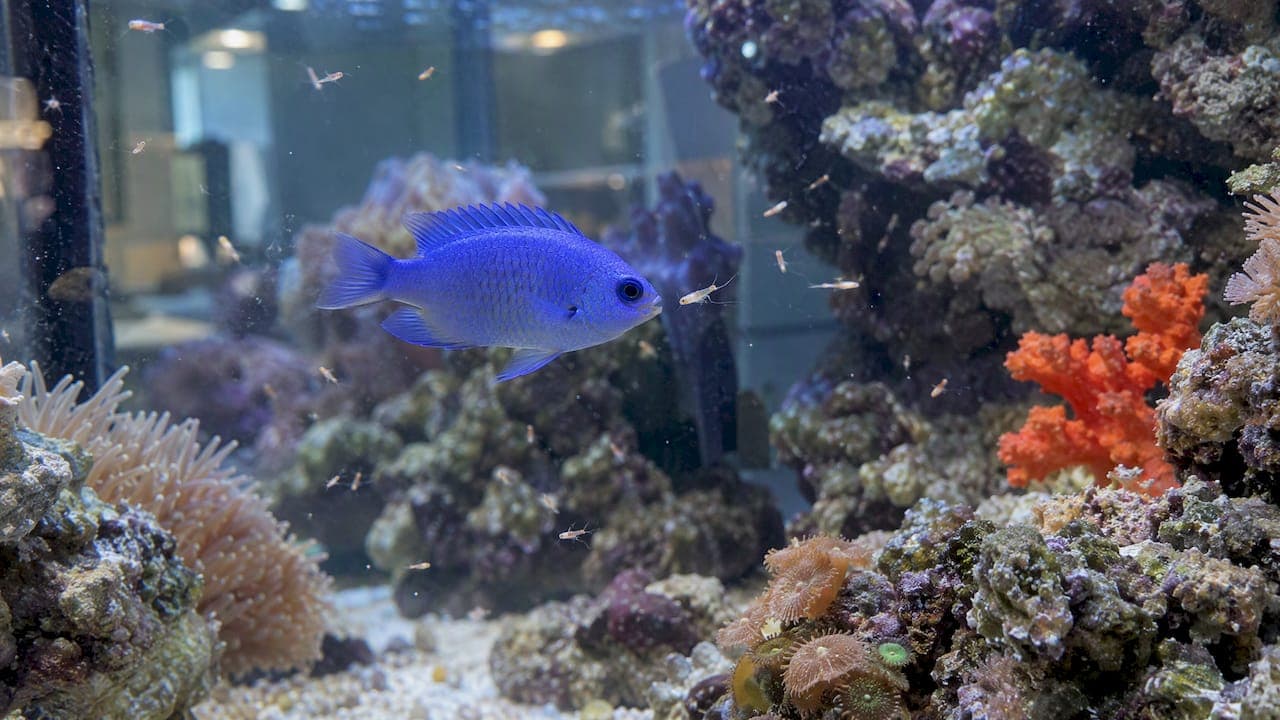
Damselfish eat brine shrimp eagerly, and live brine shrimp is one of the best ways to bring out natural hunting behavior in them. The catch is quality. A brine shrimp is only as nutritious as what it ate last, so a well-fed, recently hatched or farmed shrimp is a good food, while a starved one is mostly water and shell. This guide covers which stage to feed, how much, how often, how to keep your tank clean, and when brine shrimp should not be the only thing in the bowl.
TL;DR
- Damsels accept brine shrimp readily, whether live, thawed frozen, or newly hatched nauplii. Reefs.com's damselfish profile lists brine shrimp among their accepted foods.
- Nutrition depends on the shrimp. Starved or aged brine shrimp offer little, so feed them freshly hatched and enriched, or buy shrimp that were fed well.
- Feed small portions that the fish finish within a couple of minutes, and remove leftovers. Brine shrimp should be one part of a varied diet, not the whole diet.
- Brine shrimp do not last long in an established reef tank, so plan on feeding them in measured doses rather than keeping a colony in the display.
Table of Contents
- Do damselfish eat brine shrimp?
- Why live brine shrimp are worth feeding
- The nutrition catch: brine shrimp are only as good as their last meal
- Which brine shrimp stage to feed damsels
- How much and how often
- Do not make brine shrimp the whole diet
- Will brine shrimp survive in a reef tank?
- Keeping the tank clean when you feed brine shrimp
- Hatching your own for damsels
- Our perspective: why we farm brine shrimp on algae
- Skip the hatchery: live farmed brine shrimp
- A simple damsel feeding plan
- FAQ
- Sources
Do damselfish eat brine shrimp?
Yes. Damselfish are omnivores with a broad appetite. The Reefs.com article on damselfishes and chromises notes that they take a wide range of aquarium foods, including brine shrimp, flakes, bloodworms, chopped fish, clam and squid meat, algae sheets and frozen preparations. A care guide for the blue devil damselfish describes the species as an omnivore, recommends a mix of flakes and meaty foods, and lists brine shrimp among the foods suitable for conditioning fish before spawning.
That makes brine shrimp an easy win. Damsels are bold feeders, so you rarely need to coax them. What deserves more thought is which form you feed and what that shrimp has eaten.
Why live brine shrimp are worth feeding
Live prey moves, and movement triggers feeding. Damsels that ignore a flake will often chase a swimming shrimp. That hunting behavior is useful for picky new arrivals, for fish recovering from shipping stress, and for pairs you want in spawning condition.
Nutritionally, brine shrimp can be a strong food. One hobbyist-focused source reports that they can contain up to 60% protein by dry weight and work well as part of a varied diet. Tropical Fish Hobbyist makes a related point: adult live brine shrimp can be excellent fish food when they are properly cared for and nourished before feeding, and cultured or nutritionally manipulated Artemia can have higher food value.
The key phrase is nourished before feeding. That is where most of the quality differences come from.
The nutrition catch: brine shrimp are only as good as their last meal
Reef-keeping writer Rob Toonen compares brine shrimp to swimming grocery bags: what they deliver depends on what is inside them. Newly hatched nauplii carry a yolk reserve and become less nutritious as they use it up. Once they reach the second larval stage (Instar II), they can be enriched with highly unsaturated fatty acid (HUFA) supplements before you feed them.
The research on marine fish larvae backs this up. A Texas A&M extension publication on live feeds for marine fish larviculture states that brine shrimp are deficient in DHA, EPA and ARA for most developing marine fish larvae, and that Instar II and later stages should be enriched before feeding. Your adult damsels are not larvae, but the principle carries over: unenriched, starved shrimp are a filler, not a complete meal.
Studies on enrichment methods show there is more than one route:
- A 2023 study found that EPA-rich oils can replace high-DHA enrichment for Artemia fed to greater amberjack larvae.
- Another 2023 study reported that soybean lecithin at 10 g per cubic meter of seawater for 12 hours effectively enriched Artemia nauplii.
These are aquaculture protocols, not hobby recipes, so treat them as proof that enrichment works rather than as exact instructions for your tank. For a practical hobbyist version, see our 12 to 24 hour enrichment guide.
Which brine shrimp stage to feed damsels
Brine shrimp go through cyst, nauplius, juvenile and adult stages, and nauplii and adults are the two used as fish food. Here is how that plays out with damsels.
| Form | Best for | Strengths | Watch out for |
|---|---|---|---|
| Newly hatched nauplii | Damsel fry, juveniles, small species | Tiny, easy to eat, trigger feeding | Nutrition drops as the yolk is used up, so feed soon after hatching or enrich |
| Enriched nauplii or juveniles | Juveniles and conditioning | Better fatty acid profile | Needs extra setup and timing |
| Live adults | Adult damsels | Larger prey, strong hunting response | Quality depends on how they were fed and held |
| Frozen, thawed | Routine feeding | Convenient, easy to portion | Generally less nutritious than live, especially fresh nauplii |
The comparison of frozen and live comes from a hobbyist guide: live shrimp stimulate hunting, while frozen are convenient but usually less nutritious. Frozen food should be thawed before it goes into the tank.
For a deeper look at the stages, our Artemia nauplii guide covers the biology, hatching and feeding in one place.
How much and how often
Damsels are active and greedy, which makes overfeeding the most common mistake. Care sheets for damselfish generally recommend small portions given once to a few times a day, limited to what the fish can finish in roughly one to three minutes. Anything left over should come out with a net or siphon.
A workable routine for a typical damsel tank:
- Feed a small pinch or a measured scoop of live or thawed brine shrimp once or twice a day.
- Watch the first minute. If the fish stop chasing food, you have fed enough.
- Remove what is left after two to three minutes.
- Rotate other foods through the week: quality pellets or flakes, algae sheets, and meaty frozen foods.
If you keep several damsels, scatter the food across the tank. Dominant fish will guard one corner and starve the rest otherwise.
Do not make brine shrimp the whole diet
Brine shrimp are eagerly accepted, but on their own they are nutritionally incomplete. A brine shrimp lesson from a fish-care manufacturer, API's educational guidance, makes the same point: fish health depends on a balanced prepared diet rather than brine shrimp alone.
Because damsels also graze algae, they benefit from plant matter in the mix. A weekly rotation that covers protein, plant matter and fatty acids is more useful than any single "best" food. If you want to compare brine shrimp against another popular frozen food, our brine shrimp versus bloodworms breakdown walks through the trade-offs, and the brine shrimp nutritional value explainer covers what is actually in them.
Will brine shrimp survive in a reef tank?
Not for long. In an established reef tank, predation, unsuitable conditions and the lack of conditions for reproduction all limit survival. Damsels, wrasses and anything else with a mouth will clear them quickly, and brine shrimp are freshwater-tolerant, high-salinity animals that do not breed in standard reef conditions.
That is useful rather than a problem. It means you can feed a dose and trust the fish to finish it. Whatever escapes goes to the filter feeders or dies, so portion control still matters. If you keep a refugium, our piece on brine shrimp in a refugium explains why you should hatch for food instead of trying to keep a colony, and the reef tank brine shrimp guide compares hatching with buying.
Keeping the tank clean when you feed brine shrimp
Brine shrimp can cause water problems if you handle them carelessly. Three issues come up.
Leftovers and die-off
Uneaten shrimp die and foul the water, especially in smaller tanks. The API lesson cited above warns about exactly this and recommends feeding only what the fish will consume.
Shells and unhatched cysts
Hatching cysts leaves empty shells, and molting nauplii shed exoskeletons. The Texas A&M publication notes that these remnants can deteriorate water quality if they are not removed from the culture system. Separate hatched larvae from shells and unhatched eggs before feeding. A fine mesh does the job: a medaka husbandry manual specifies a 150 µm mesh for separating larvae from unhatched eggs and shells.
Hatch water
Do not pour hatch water into the display. Strain the shrimp, rinse them in clean saltwater, and add only the shrimp. Forum veterans also point out that cysts can carry bacteria, which is one more reason to keep hatch water out.

Hatching your own for damsels
Hatching is cheap and works for small groups of fish. A hobbyist guide gives the typical conditions: saltwater at about 26.5 to 27.5°C (roughly 80°F), pH 8 or higher, vigorous aeration and continuous light, with most cysts hatching in 24 to 36 hours. A laboratory manual describes hatching daily in 2 to 3% salt water at 28 to 30°C with strong aeration.
The basic routine:
- Mix saltwater in a container, add cysts, and keep it warm with an air stone running hard.
- After about a day, turn off the air and shine a light at the bottom. Nauplii swim toward the light while shells float or sink.
- Siphon the nauplii out through fine mesh and rinse them.
- Feed promptly, or enrich for several hours first if you want better nutrition.
The trade-off is time. Staggering hatches so you always have fresh nauplii takes planning, and the yolk-reserve problem means timing matters. For lab-style protocols with exact timings, see our 18 to 36 hour hatch protocol.
Our perspective: why we farm brine shrimp on algae
We built Demeter Biosciences around one frustration: most brine shrimp reaching fish are either hatched from cysts and fed nothing, or harvested wild, where seasonal swings and starvation make their nutrition unpredictable. That matches the "swimming grocery bag" problem above.

So we raise ours in controlled, land-based systems and feed them only on the microalga Dunaliella. Our target is at least 40% protein with consistent quality from shipment to shipment. For a damsel keeper, that means you are not guessing whether the shrimp in the bowl has anything left to give. You can read more about the approach on our brine shrimp product page and in our piece on why microalgae-fed brine shrimp pay off.
Our advice is still the same as the research: use brine shrimp as a staple within a varied diet, feed small amounts, and pull what is not eaten.
— Demeter
Skip the hatchery: live farmed brine shrimp
If hatching, straining and timing enrichment sounds like more work than your damsels deserve, our live brine shrimp ship directly to you at $17 to $35 depending on the size you choose. For steady feeding, the monthly membership is $25 per month and sends a live shipment on a recurring basis. We also sell live phytoplankton at $20 for the rest of your tank, and gift cards from $10 to $50 if you are buying for another aquarist, all on our featured products page. Stores, museums and institutions can ask about a bulk store order.
A simple damsel feeding plan
| Day | Main feeding | Second feeding |
|---|---|---|
| Mon | Live brine shrimp | Quality pellet or flake |
| Tue | Pellet or flake | Algae sheet |
| Wed | Live brine shrimp | Thawed frozen meaty food |
| Thu | Pellet or flake | Algae sheet |
| Fri | Live brine shrimp | Pellet or flake |
| Sat | Thawed frozen meaty food | Algae sheet |
| Sun | Light feeding or rest day | None |
Adjust for tank size and fish count. A single damsel in a large tank needs a much smaller portion than a group in a small tank, and the rule is always the same: if food is still falling to the bottom after a few minutes, you fed too much.
FAQ
Can I feed brine shrimp to damsels every day?
You can, in small portions, but it is better to rotate. Brine shrimp are nutritionally incomplete on their own, so mix in prepared pellets or flakes, algae and other meaty foods through the week.
Are baby or adult brine shrimp better for damsels?
It depends on the fish. Newly hatched nauplii suit fry and small juveniles, while adult brine shrimp suit larger damsels. Nauplii lose nutritional value as their yolk runs out, so feed them soon after hatching or enrich them first.
Is frozen brine shrimp good enough?
Yes for routine feeding, as long as you thaw it first and do not rely on it alone. It is convenient, but generally less nutritious than live shrimp, so use live brine shrimp as a regular boost.
Will leftover brine shrimp harm my reef tank?
Leftovers can. Uneaten shrimp die and foul the water, and hatch shells add to the load. Feed only what the fish finish in a few minutes, strain out hatch water and shells, and net out what remains.
Sources
- Aquarium Fish: Damselfishes and Chromises, Reefs.com
- Blue devil damselfish care guide
- Brine shrimp benefits and how to hatch them
- Tropical Fish Hobbyist, August 2015
- Nutritional Value of Live Foods for the Coral Reef Aquarium, Reefs.com
- Choosing an Appropriate Live Feed for Larviculture of Marine Fish, Texas A&M
- Optimizing Artemia Enrichment: Low DHA/High EPA Protocol
- Comparative study on Artemia nauplii enrichment, 2023
- Brine Shrimp Aquarium Guide
- Can Brine Shrimp Survive in a Reef Tank?
- API Lesson 7: Brine Shrimp
- A Manual for Breeding of Medaka in Large Scale