
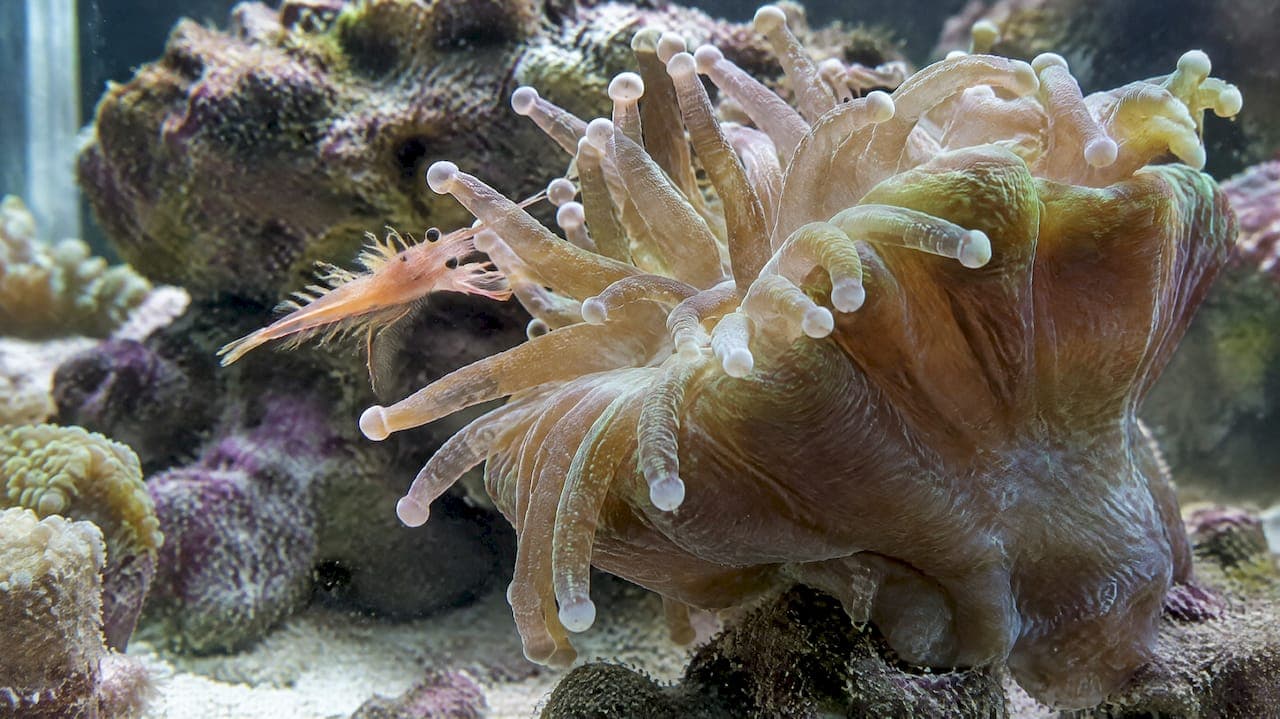
Yes, corals eat brine shrimp, as long as the shrimp are the right size and nutritionally worth eating. Use freshly hatched Instar I nauplii, or Artemia that were enriched or raised on algae, because plain adults offer little. The sections below cover which life stages to use, how to enrich them, and how to deliver them to your corals without fouling the tank.
TL;DR:
- Small polyped corals need freshly hatched Instar I nauplii, while large mouthed LPS and anemones can take larger enriched stages; responses vary by species.
- Instar I nauplii retain yolk reserves for roughly 12 to 24 hours, so harvest promptly; older shrimp need enrichment to restore nutritional value.
- Natural Artemia often lacks EPA and DHA; enrich the shrimp with microalgae or a labeled supplement for at least 12 hours before feeding.
- Direct release often feeds fish first, so use a pipette for competing colonies, pause pumps briefly, and remove uneaten shrimp to limit nutrient buildup.
- A few feedings per week suit most tanks; daily feeding is appropriate only when filtration can handle waste, with nitrate and phosphate monitored.
Table of Contents
- Do corals actually eat brine shrimp, and which ones benefit?
- Which Artemia stage and size should you feed?
- Why enrichment matters and how to do it at home
- How do you feed corals brine shrimp in a reef tank?
- What can you feed alongside Artemia?
- Troubleshooting common feeding mistakes
- Why farmed, microalgae-fed Artemia make sense for hobbyists
- Our practical recommendation for reef keepers
- Where to get microalgae-fed live brine shrimp from us
- FAQ
- Sources
Do corals actually eat brine shrimp, and which ones benefit?
Corals are not just light-powered ornaments. Many scleractinian species capture zooplankton with their tentacles and digest it, and Artemia is the zooplankton most reef keepers can get their hands on. Most SPS, LPS and some soft corals will consume brine shrimp when the shrimp are the appropriate size for the polyp.
The strongest evidence comes from a controlled study on Pocillopora damicornis. Researchers fed reattached polyps brine shrimp daily and tracked them for 60 days. The fed polyps showed significant increases in polyp diameter, new polyps, skeleton weight, symbiont density and chlorophyll content, along with better immune capacity. That is a broad set of benefits, not just faster growth. Feeding changed how healthy the colony was across several measures at once.
Juvenile corals may also benefit from feeding. A study of Artemia nauplii feeding found that fed recruits grew and had higher post-transplantation survival than unfed controls, according to this juvenile coral study. Those findings are from a study, not a reef tank recipe, but they illustrate how heterotrophic feeding may matter for small, fast-growing tissue.
Why polyp morphology decides who eats
Whether a coral captures Artemia depends largely on its anatomy. Large-polypod LPS such as Euphyllia, Trachyphyllia and Lobophyllia have long, sticky tentacles and big mouths. They snag live nauplii and even larger stages, then pull them to the mouth. Small-polyped SPS have tiny tentacles and mouths, so they need the smallest food you can offer. Many soft corals fall in between, and several of them filter fine particles more than they hunt prey.

Behavior also matters. Some corals extend feeding tentacles only at night or when they smell food in the water. Others respond within a minute of food arriving. If you watch your tank at feeding time, you will learn quickly which colonies are hunters and which ones ignore everything you add.
Species differences are real
Do not assume every coral responds the same way. In 90-day comparative trials, Artemia nauplii supported significantly greater growth for Pocillopora acuta than several alternative diets, yet the results varied by species. Pocillopora tends to respond strongly to Artemia in trials, while Acropora shows species-specific responses, so one genus can look excellent on a diet that does little for another.
The practical lesson is to treat Artemia as one tool in a feeding plan, then watch each colony. Extended polyps, better color, new branches and faster tissue growth are your signs that a coral is using the food. A coral that never opens up for it is telling you to try a different size or a different feed.
Which Artemia stage and size should you feed?
Brine shrimp are not one food. They are a series of life stages that differ in size, movement and nutrition, and picking the wrong one is the most common reason hobbyists see corals ignore their Artemia.
- Instar I (freshly hatched nauplii): Small, orange-brown, and carrying a yolk sac. They do not eat yet, so everything they offer comes from their own reserves. This is the stage most corals handle best.
- Instar II and later (metanauplii): After the first molt, the shrimp open their mouths and start filter feeding. They grow larger and lose much of the nutritional density their yolk provided.
- Juveniles and adults: Larger than nauplii. Large LPS and anemones can take them, but small-polyped corals may not be able to, and unenriched adults are a poor nutritional deal.
The 12 to 24 hour window
Newly hatched Instar I nauplii depend on internal yolk for roughly 12 to 24 hours. After they molt to Instar II, their nutritional density drops as they begin filter feeding and burn through those reserves. That is why timing matters more than almost anything else you do with live Artemia. If you hatch a batch and leave it in the hatching jar without feeding it, you may be offering your corals a hollow, larger shrimp.
The simple rule: harvest nauplii soon after hatching, and feed them within that first window. If you want to hold them longer, you must feed the shrimp something worth carrying, which is the subject of the next section. For a full hatching walkthrough, our guide on hatching reef tank brine shrimp covers the equipment and routine.
Matching stage to coral
- SPS and small-polyped corals: Freshly hatched Instar I nauplii only. Anything larger will be ignored or tangled in the colony.
- LPS with big tentacles: Nauplii work well, and slightly larger enriched stages are often grabbed eagerly.
- Soft corals: Nauplii and fine particulate foods. Many of these corals feed more on particles than on prey.
- Anemones and big-mouthed LPS: Enriched juveniles or adults can work, and they are often the one group that will take a mouthful.
Harvest timing in practice
Hatch time depends on temperature and salinity, so use your own setup's timing rather than a fixed number. Set a timer when you start a batch, check for movement at the expected hatch time, and harvest when you see a dense cloud of orange swimmers. Rinse them with clean saltwater before feeding, because the hatching water carries unhatched cysts, shells and waste that you do not want in the display.
Pro Tip: Shine a flashlight at the bottom of a clear hatching container. Nauplii swim toward the light and the empty shells stay behind, so you can siphon off a clean, concentrated cloud from the lit spot.

Why enrichment matters and how to do it at home
Even perfectly timed nauplii have a weakness. Natural Artemia are often deficient in essential highly unsaturated fatty acids like EPA and DHA, so enrichment or gut-loading with microalgae or supplements is needed for complete nutrition. Aquaculture literature makes the same point: Artemia are widely used but typically lack adequate EPA and DHA unless enriched, and enrichment with microalgae and other substances improves their lipid and fatty acid profile. Hatchery manuals add that Artemia nutritional quality is highly variable, so consistent enrichment protocols and harvest timing determine how useful the shrimp really are.
For hobbyists, the takeaway is blunt. A shrimp that has not been fed anything is mostly empty calories. A shrimp that has been loaded with fatty acids and algae becomes a package of nutrients your corals can digest.
Practitioners recommend gut-loading or enriching Artemia for at least 12 hours so they carry essential fatty acids before feeding, which shifts them from nutritionally weak to nutrient-dense live feed.
What to enrich with
- Live microalgae: Dunaliella and Nannochloropsis are the usual choices. Shrimp filter them and carry them in the gut. They are also a natural fit for corals, since the shrimp arrive pre-packaged with algae.
- Commercial enrichment products: Emulsions and powders formulated to add EPA and DHA. Follow the label for dosing, because overdosing clouds the water and can crash a small culture.
- HUFA-focused ratios: If you want to go deeper, our 2:1 DHA to EPA enrichment protocol explains how hatcheries target specific fatty acid ratios.
A hobbyist enrichment protocol
- Hatch and harvest. Collect Instar I nauplii as soon as the hatch peaks, then rinse them in clean saltwater.
- Move to an enrichment container. Use a clean vessel with gentle aeration, saltwater at your normal tank salinity, and a moderate shrimp density so the water does not foul. Start lighter than you think you need.
- Add the enrichment. Dose live microalgae or a commercial enrichment product according to its label. Keep the water slightly tinted rather than opaque.
- Hold for at least 12 hours. This matches the practitioner guidance above. Keep aeration steady and temperature stable.
- Slow growth if needed. If you want to keep the shrimp small, chill the container in the refrigerator or a cool spot. Cooler water slows molting and growth, which keeps them at a size small-polyped corals can handle.
- Rinse and feed. Strain the shrimp, rinse them in clean saltwater to remove leftover enrichment, and feed immediately.
The full 12 to 24 hour enrichment rule is spelled out in our enrichment post if you want the hatchery version.
Pro Tip: Test a small enrichment batch before committing a full hatch. If the culture water turns foul or the shrimp look sluggish after a few hours, back off the enrichment dose rather than pushing through.
How do you feed corals brine shrimp in a reef tank?
Good shrimp mean nothing if they never reach the polyps. Delivery is where most feeding plans succeed or fail, and the choice comes down to three methods.
- Direct release: Pour the rinsed shrimp into the tank near a pump outlet. Fast and simple, but fish will eat much of it and uneaten shrimp can die and add to the nutrient load.
- Targeted feeding: Use a pipette or syringe to squirt nauplii at individual colonies. Best for picky or slow-feeding corals and for anyone with a lot of fish competing for food.
- Isolated feeding: Place the coral in a small container, or turn off flow around a section of the tank, and let the shrimp sit near the colony. This works well for frags and for corals that need extended contact time.
Starting dosage
Start small. A rough starting point is a small amount of nauplii for a modest tank, then watch how the corals respond. If polyps are extending and catching shrimp, you can increase the volume gradually. If the shrimp drift past untouched or pile up in corners, you are overfeeding and should cut back.
Our feeding schedule checklist gives a day-by-day rhythm if you want a ready-made routine.
Frequency and timing
A few feedings per week suit most tanks, with smaller daily feedings possible if your filtration can handle it. In the Pocillopora trial the researchers fed daily, but that was a controlled setting with tight water management. In a mixed reef with fish, invertebrates and limited export, a more cautious schedule is wiser. Many corals feed best after lights go down, so an evening feeding often gets better results than a midday one.
Tank management during feeding
- Turn down or briefly pause pumps so the shrimp do not get blown across the tank before corals can grab them. Restart flow when feeding ends.
- Switch off the skimmer for the feeding window, or reduce its draw, so it does not strip the shrimp from the water.
- Watch for shrimp that settle on the sand or rock. Siphon out uneaten shrimp, because dead Artemia can add to the tank’s nutrient load.
- Feed only what the corals can eat in a short time. If food is still floating around uneaten, reduce the amount.
- Test nitrate and phosphate regularly while you ramp up, since heavier feeding changes the nutrient budget.
What can you feed alongside Artemia?
Artemia are a good base, but no single food covers everything. Pairing them with other feeds fills gaps and gives corals more to work with.
- Mysis: Larger and meatier than nauplii, and a good fit for big-mouthed LPS and anemones. A source of protein and fat in a bite-sized package.
- Microbound commercial diets: Pellets, powders and slurries made to be small enough for polyps, often fortified with amino acids, vitamins and fatty acids. Handy when you cannot hatch fresh shrimp.
- Live phytoplankton: Feeds filter feeders and soft corals, and it is also a natural enrichment source for Artemia. Our live phytoplankton is made for exactly that role.
A simple rotation
One workable pattern: nauplii on most feeding days, a microbound diet or phytoplankton on others, and mysis once or twice a week for the corals that can use bigger prey. Keep notes, and adjust when you see a colony grow, fade or stall.
Choosing a commercial diet
Look for foods with a clear ingredient list, particle sizes that match your corals, and fatty acids listed rather than hidden behind vague claims. Whatever you choose, introduce it gradually and keep an eye on water quality, because a rich food in a lightly filtered tank causes trouble fast.
Troubleshooting common feeding mistakes
Most problems come from too much food, the wrong size, or poor-quality shrimp. Here is how to fix them.
- Uneaten Artemia everywhere: Cut the dose, switch to targeted feeding, and siphon out leftovers. If corals are not responding at all, check that polyps are actually open and that the shrimp are small enough.
- Nitrate or phosphate creeping up: Reduce feeding frequency, increase water changes, and review your export. Do not push through a rising trend.
- Corals ignoring the food: The shrimp may be too large, too old or not enriched. Try fresh Instar I nauplii and feed after lights out.
- Shrimp dying quickly in the tank: Saltwater shock, temperature differences or poor hatching water. Rinse and acclimate them gently.
- Enrichment seems to have failed: Shrimp look pale or the culture water is foul. Restart with a smaller enrichment dose and a clean container.
Signs the shrimp are too old or large include corals pulling tentacles back, shrimp swimming strongly out of reach, and visible guts packed with nothing. If tank parameters decline at any point, stop feeding, test your water and go back to a baseline until things settle.
Pro Tip: Keep a small cold container in the fridge for slowing growth on a batch you cannot use right away, but treat it as a short-term fix, not storage. Fresh, enriched nauplii always beat old, chilled ones.
Why farmed, microalgae-fed Artemia make sense for hobbyists
Everything above comes down to one idea: controlled enrichment turns Artemia from a filler into a real food. The research supports it, and so does hatchery practice, where consistent protocols and tight harvest timing separate good batches from poor ones. The 12 to 24 hour window means a home hatch has to be timed exactly, and batch quality can swing from week to week.
That variability is why we raise our own. Our brine shrimp are grown in land-based, sustainable systems and fed exclusively on the microalgae Dunaliella, and we disclose its protein content. Our controlled diet and conditions are intended to provide a consistent feed. For a hobbyist, that means a shrimp raised on microalgae, without the daily juggling of hatching, timing and enrichment.
Enrichment is essential because natural Artemia is often deficient in EPA and DHA, so the algae a shrimp eats before it is fed matters as much as its size. (Aquaculture of brine shrimp)
The practical takeaway is simple. You can follow the enrichment protocol above and get excellent results, or you can start with farmed, algae-fed shrimp and skip most of the preparation. Both routes lead to the same destination: a nutrient-dense feed delivered while it is still fresh.
Our practical recommendation for reef keepers
Our recommendation is plain. Feed fresh Instar I nauplii or properly enriched Artemia, never old, unfed adults. Use targeted feeding for corals that are slow to respond, and keep your doses cautious, because a clean tank with modest feeding beats a rich tank with water-quality problems. We favor farmed, microalgae-fed shrimp for their consistency, since a dependable feed lets you spend your attention on the corals instead of the culture.
— Demeter
Where to get microalgae-fed live brine shrimp from us
If you would rather skip the hatching and enrichment routine, we ship live, farmed brine shrimp raised on microalgae. A one-off order of live brine shrimp runs from $17 to $35, and our monthly membership at $25 per month keeps a steady supply arriving on a schedule. If you run a shop or several systems, we also offer a bulk store order, and our live phytoplankton at $20 pairs naturally with the enrichment steps above.
A few buying tips: order close to the day you plan to feed, since freshness drives nutrition, and choose a subscription if you feed corals several times a week and want predictable deliveries. One-off orders suit anyone testing the approach on a single tank. When you are ready, order our live brine shrimp and start feeding your corals the right way.
FAQ
Will brine shrimp survive in a reef tank?
Not for long, in most cases. Saltwater Artemia can live for a while in marine water, but fish, corals and pumps remove them quickly, and they are not a self-sustaining population in a display. Treat them as a feed you add and expect to be eaten or removed, not as a resident.
Will clownfish eat brine shrimp?
Yes, clownfish readily eat brine shrimp, which is why direct release into the tank often feeds the fish before the corals. If you want corals to get their share, use a pipette to target the colonies, or feed the fish first so they are less competitive.
How long does it take brine shrimp to reach full size?
Hatched nauplii grow over a matter of weeks to adult size, but the nutritious window for feeding corals is far shorter. Instar I nauplii depend on their yolk for roughly 12 to 24 hours, so most hobbyists feed them long before they get big.
When should you start feeding brine shrimp?
Feed freshly hatched nauplii as soon as you harvest them, or enrich them for at least 12 hours first. Enrichment for at least 12 hours is the guidance that turns plain shrimp into a nutrient-dense feed. Begin with small doses and increase as your corals show they are using the food.
Sources
- Feeding juvenile corals brine shrimp drastically increase their growth
- Brine Shrimp Feeding Contributes to Fast Growth and Enhanced Immune Capacity of Reattached Polyps of Scleractinian Coral Pocillopora damicornis - PMC
- En