
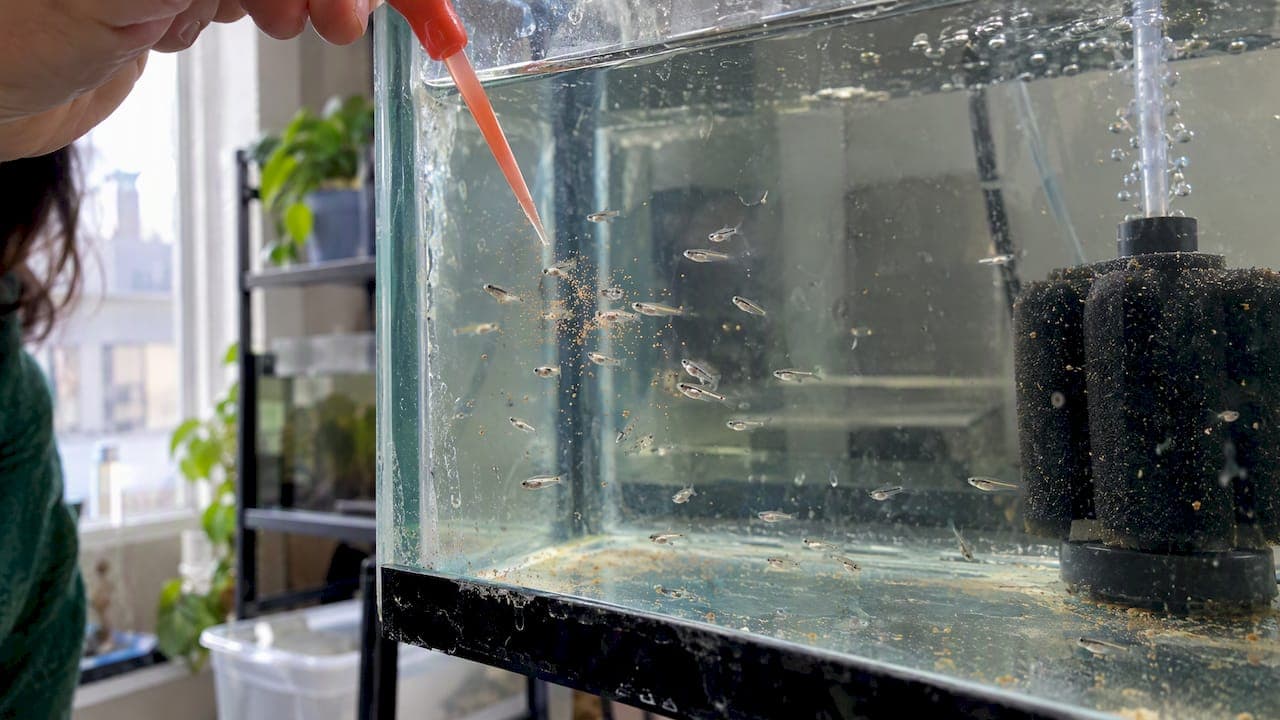
Feed danio fry in this order: yolk sac first, then infusoria or liquid fry food once they're free-swimming, then rotifers or newly hatched brine shrimp alongside a powdered larval diet, then increasing Artemia and crushed flakes as they grow into juveniles. Three rules decide whether this works: wait until fry swim horizontally before offering food, feed tiny particles several times a day, and protect water quality above almost everything else. A steady source of farmed, microalgae-fed Artemia makes the middle stages far easier to repeat.
TL;DR:
- Wait until fry swim horizontally, usually four to five days after fertilization, before offering microscopic foods such as infusoria or liquid fry food.
- From 7 to 14 days after fertilization, introduce Artemia nauplii and powdered larval diets while continuing infusoria, so smaller fry still receive edible particles.
- After heavier feedings, change 10% to 30% of the water; clouding within minutes signals overfeeding and calls for smaller portions.
- By the third or fourth week, replace one of five daily Artemia feedings with powdered food, then increase gradually while retaining one or two live feedings.
- By the second or third week, fry often differ in size; offer overlapping particle sizes and separate larger individuals if cannibalism appears.
Table of Contents
- Stage-by-stage feeding schedule from day 0 to 30 and beyond
- How to culture infusoria, rotifers, and hatch baby brine shrimp
- Feeding cadence and water-quality rules that prevent fatal spikes
- Weaning fry onto powdered and flake diets
- Common feeding mistakes and quick fixes
- What Demeter's farmed, microalgae-fed Artemia delivers for fry rearing
- Nutritional requirements specific to danio fry
- Comparing brine shrimp quality for danio fry nutrition
- How feeding needs shift as danio fry develop
- Signs of feeding stress and nutritional deficiency in danio fry
- Why overlapping feeds beats chasing a perfect food
- Shop: live brine shrimp and starter options for a steady supply
- FAQ
- Sources
- Primary lab SOPs and protocols used to build this guide
Stage-by-stage feeding schedule from day 0 to 30 and beyond
For the first two to three days after hatching, danio fry live off their yolk sac and need no food at all. Offering anything during this window just fouls the water. The signal to start feeding is behavioral: fry shift from lying on the tank bottom to swimming horizontally in open water, usually around four to five days post-fertilization.
Once they're free-swimming, fry need microscopic first foods such as infusoria or a liquid fry food, since their mouths are still too small for most prepared diets. Research from the University of Florida IFAS extension confirms this timing and notes that fry at this stage do best on food in constant supply rather than occasional large doses.
Between 7 and 14 days post-fertilization, most fry can handle Artemia nauplii (baby brine shrimp) and powdered larval diets. Overlap the two: keep offering infusoria for a few more days while introducing Artemia, so smaller or slower fry aren't left without food they can actually eat.

From 14 to 30+ days, increase Artemia volume and introduce juvenile powders, moving to finely crushed flakes once most of the group takes Artemia reliably rather than waiting for every last fry to catch up.
Watch for these physical cues rather than relying on the calendar alone:
- Rounded, visibly full bellies shortly after feeding, often tinted orange from Artemia.
- Active, directional swimming toward food rather than drifting.
- A visible size spread developing by week two, which tells you to size-grade rather than assume uniform readiness.
Maintaining live-feed availability during the first 12 to 21 days improves both growth and survival rates, which is the single biggest reason hobbyists lose fry during this window isn't disease, it's gaps in feeding.
How to culture infusoria, rotifers, and hatch baby brine shrimp
You don't need a lab to produce the live foods this schedule calls for. A few simple setups cover most of it.
- Start an infusoria culture four to five days before your fry hatch: add a lettuce leaf or hay to a jar of aquarium water and let it sit in indirect light; it clouds, then clears as populations peak, which is your harvest window.
- Source or culture rotifers only if you're raising larger batches; most home breeders skip straight from infusoria to Artemia, since rotifers require more consistent upkeep than a casual setup rewards.
- Hatch Artemia cysts in a small hatchery cone with aerated saltwater at room temperature; cysts hatch in roughly 18 to 36 hours, and harvesting right at that point gives you the most nutritious, mobile nauplii.
- Decapsulate cysts if you want to reduce shell ingestion, using a brief bleach or sodium hydroxide treatment followed by thorough rinsing and neutralization; follow an established protocol exactly, and wear gloves and eye protection.
Keep separate nets, siphons, and containers for each culture to avoid cross-contamination, and rinse Artemia nauplii in fresh water before feeding to strip away residual salt.
Pro Tip: Harvest Artemia under a bright light pointed at one side of the container; nauplii swim toward it, letting you scoop concentrated, debris-free nauplii.
Feeding cadence and water-quality rules that prevent fatal spikes
Feed danio fry multiple times a day during the first few weeks, adjusting frequency based on food type: live foods can be offered more often since they don't foul water as fast as powders.
- Feed only until most fry show rounded bellies, then stop, rather than feeding on a fixed schedule regardless of appetite.
- Watch for cloudiness forming within minutes of feeding; that's your sign you've overfed.
- Do a 10 to 30% water change after heavier feedings, especially once powdered diets enter the rotation.
Overfeeding is the leading cause of ammonia and nitrate problems in fry tanks, not the food choice itself. Research on larval rearing protocols found that maintaining stable water quality alongside continuous food availability matters more than finding one 'perfect' first food, a finding that holds across species raised this way, danios included.
Weaning fry onto powdered and flake diets
Move fry toward prepared diets once most of the group eats Artemia confidently and shows steady growth, typically by the third or fourth week. Rushing this wean before fry can process drier particles stalls growth.
A simple DIY larval mix works well: combine a powdered larval diet with crushed freeze-dried rotifers, then suspend a small pinch in a cup of tank water and pour it in as a slurry rather than dry powder, which tends to clump and sink unevenly.
- Start by replacing one of five daily Artemia feedings with the powdered mix.
- Increase to two, then three feedings over the following week as fry adjust.
- Keep the final one or two feedings as live Artemia until fry are reliably eating crushed flakes.
Store larval diets chilled or frozen in small portions, as institutional nursery protocols recommend, since exposure to air and moisture degrades them quickly.
Common feeding mistakes and quick fixes
Most fry losses trace back to a handful of repeatable errors, and most are fixable within a day.
- Cloudy water after feeding: cut the next feeding's volume in half and do an immediate 20% water change.
- Fry appear to refuse food: check particle size first, since fry gapes are tiny, then offer a live alternative like freshly hatched Artemia if powder is being ignored.
- Signs of cannibalism among larger fry: feed smaller amounts more often and separate visibly larger fry into their own container to stop size-driven predation.
- Slow or stalled growth across the group: confirm you're overlapping food types during transitions rather than switching cold, since gaps in appropriate-sized food stall the slowest fry first.
Pro Tip: Keep a simple log of feeding times and water changes for your first few spawns; patterns in what worked become obvious faster than memory alone will tell you.
Once you're managing multiple spawns or struggling with labor, a flow-through or auto-top-off nursery setup reduces manual water changes and tends to improve survival consistency compared with static tanks.
What Demeter's farmed, microalgae-fed Artemia delivers for fry rearing
That consistency matters practically: a predictable hatch rate and stable nutritional value make dosing easier and cut down on the culture failures that derail a feeding schedule mid-stream.
- Predictable hatch rates mean less guesswork when timing nauplii for a specific day's feeding.
- Consistent protein content simplifies dosing since you're not compensating for a weaker or variable batch.
- A controlled, farmed source avoids the seasonal starvation conditions wild Artemia populations experience naturally.
Working a recurring shipment or membership into your routine keeps a continuous Artemia supply on hand, so the 7 to 30-day window, when demand for live Artemia peaks, never runs short. Store live shipments cool and aerated, and plan order cadence around your hatch calendar rather than reordering only once supply runs out.
Nutritional requirements specific to danio fry
Danio fry need a diet unusually high in protein relative to their body size, since rapid early growth and tissue development draw heavily on amino acid reserves. Artemia nauplii, a standard live feed at this stage, provide roughly 48% crude protein, which lines up well with what fast-growing fry require during their first month.
Fats matter nearly as much, particularly essential fatty acids that support neurological and visual development; this is where enriched or microalgae-fed Artemia has an edge over plain hatched nauplii, since the fatty acid profile of the nauplii reflects what they were fed before harvest. A shrimp raised on Dunaliella carries a different, more consistent lipid profile into the fry's gut than one harvested from a variable wild population.
Vitamins, particularly fat-soluble ones absorbed alongside dietary lipids, round out the picture, though hobbyists rarely need to supplement separately if they're rotating through infusoria, enriched Artemia, and a quality powdered larval diet. The practical takeaway is less about chasing a precise macronutrient ratio and more about rotating food sources so no single nutritional gap persists for more than a few days at this fast-growing stage.
Comparing brine shrimp quality for danio fry nutrition
Not all Artemia deliver the same nutrition, and the difference shows up directly in fry growth rates. Wild-harvested brine shrimp come from saline lakes where food availability swings with season, meaning the shrimp themselves can be nutritionally depleted or inconsistent depending on when they were collected.
Farmed Artemia raised on a controlled microalgae diet avoids that variability by design.
For danio fry specifically, that consistency translates into more predictable growth curves between feedings, since you're not compensating for an unexpectedly weak batch mid-schedule. Microalgae-fed Artemia also tend to carry a steadier fatty acid profile, which matters during the 7 to 21 day window when fry are building the sensory and neurological systems that depend on those lipids. The practical difference for a hobbyist is fewer surprises: a batch of farmed, algae-fed nauplii behaves the same way today as it did last month.
How feeding needs shift as danio fry develop
Feeding needs change fast during the first month, more from developmental stage than from season, since most hobbyists breed danios indoors under stable tank conditions. The yolk-sac period demands nothing; the first-feed window demands microscopic particles in near-constant supply; and by three to four weeks, fry can process particle sizes and feeding gaps that would have stalled growth two weeks earlier.
That said, ambient conditions do shift feeding behavior somewhat. Cooler room temperatures slow fry metabolism and reduce how often they need feeding, while warmer conditions speed digestion and can justify an extra feeding per day. Hobbyists breeding across different seasons without climate control sometimes notice fry raised in summer months reach the Artemia stage a day or two faster than winter spawns, simply from faster overall development at warmer temperatures.
The bigger shift to track is within-group variation as fry age: by two to three weeks, a single spawn often splits into faster and slower developers needing different particle sizes simultaneously. That's a developmental reality more than a seasonal one, and it's why overlapping food types during transitions matters more than adjusting for time of year.

Signs of feeding stress and nutritional deficiency in danio fry
A few visible signs tell you something's wrong with feeding before losses start mounting. Sunken, concave bellies instead of the rounded profile you'd expect after feeding usually mean fry aren't getting enough food, often because particle size doesn't match their current gape.
Lethargic or erratic swimming, especially fry hanging near the surface or bottom rather than moving through the water column, can point to either nutritional deficiency or a water-quality problem triggered by overfeeding, so check both before assuming one cause. A widening size gap within a single spawn, some fry visibly thriving while others stall, often signals that slower developers are being outcompeted for food rather than suffering a true deficiency, which is fixed by feeding more frequently in smaller amounts rather than increasing total volume.
Pale coloration or a lack of the orange gut tint that normally follows an Artemia meal suggests fry aren't eating enough of it, worth checking particle size and feeding frequency before assuming a disease issue. In most cases, the fix is procedural: shorten the interval between feedings, confirm you're offering a size range that spans the whole group, and hold off adjusting water chemistry until feeding itself is ruled out as the cause.
Why overlapping feeds beats chasing a perfect food
The hobbyists who struggle most aren't the ones using the "wrong" food, they're the ones switching cold between stages instead of overlapping. Overlap, patience, and a logbook beat any single ideal diet.
— Demeter
Shop: live brine shrimp and starter options for a steady supply
Keeping Artemia on hand without constant hatching runs is the easiest way to stick to this schedule. Our live brine shrimp ships direct and costs $17 to $35 per order, raised on Dunaliella microalgae for consistent protein batch after batch.
For breeders managing multiple spawns, our Demeter Biosciences membership at $25 per month delivers a recurring shipment timed to your hatch calendar, so you're never caught short during the 7 to 30 day window when Artemia demand peaks. Clubs and stores running higher volumes can also look at bulk ordering for repeatable supply across several tanks at once.
FAQ
How many days can danios go without food?
Adult danios can comfortably go without food for several days to a week, relying on stored energy reserves, but fry have no such buffer. Fry need food within a day or two of becoming free-swimming, since their energy reserves from the yolk sac deplete quickly once they start active swimming.
What is the best food to feed fish fry?
The best food depends entirely on the fry's developmental stage: infusoria or liquid fry food for the first days after free-swimming, then newly hatched Artemia and powdered larval diets as the fry's mouth size increases. Research on larval rearing supports matching particle size to gape size and keeping multiple food sizes available during transitions.
Will danios eat guppy fry?
Danios are not natural fry predators in the way some livebearers can be, but they will eat anything small enough to fit in their mouths, including tiny guppy fry, if kept in the same tank. Separating fry from adult fish of any species during the first few weeks avoids this risk entirely.
What is the best fish food for danios?
For adult danios, a quality flake or small pellet food covers their nutritional needs well, while fry require the staged progression of infusoria, Artemia, and powdered larval diets described above. A consistent, high-protein Artemia source like microalgae-fed nauplii supports strong growth during the critical first month.
Will danio fry eat regular flake food?
Not at first. Regular flake food is far too large for newly free-swimming fry, which need microscopic particles until roughly two to three weeks old, at which point finely crushed flakes can gradually be introduced alongside Artemia.
Sources
- Feeding larval fish: stages and live feed guidance (IFAS)
- Improved protocol for rapid zebrafish growth without reducing reproductive performance (PMC)
Primary lab SOPs and protocols used to build this guide
- Feeding larval fish: stages and live feed guidance (IFAS)
- Improved protocol for rapid zebrafish growth without reducing reproductive performance (PMC)