
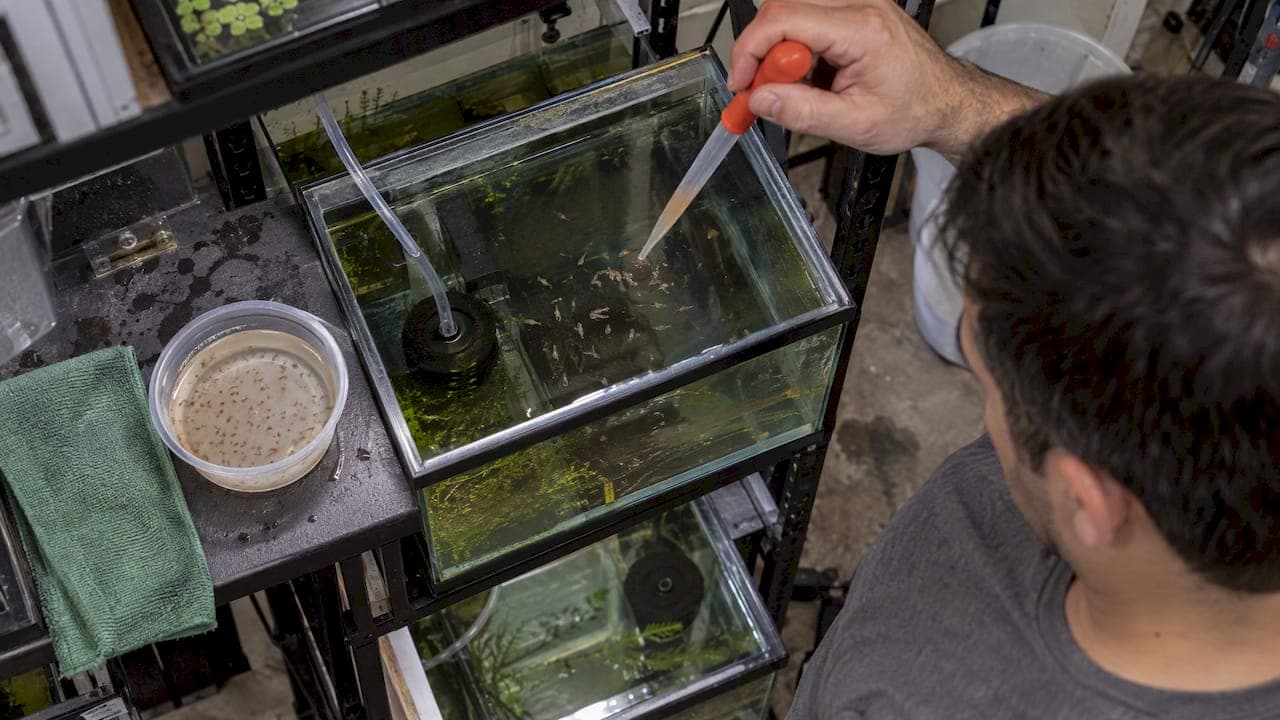
For predictable, hatch-on-demand bridging between rotifers and larger feeds, newly hatched brine shrimp (Artemia) work best, especially when mouth gape sits around 400 to 500 µm or you're raising many marine larvae. For ongoing feeding of freshwater fry and small juveniles, daphnia and Moina fit better because they survive and reproduce in freshwater. The real trade-off is salinity and enrichment needs versus freshwater survivability and culture continuity.
TL;DR:
- Artemia cysts usually hatch within 18 to 48 hours, but marine larvae that need DHA and EPA require enrichment before feeding.
- Use a container holding 10 gallons, with dechlorinated water and gentle aeration, for Moina; harvest every 5 to 10 days, leaving breeding stock.
- Move to Artemia nauplii when mouth gape reaches 400 to 500 µm; young Moina under 400 µm better fit smaller freshwater fry.
- Keep daphnia cultures separate from display tanks, where predation, filtration, and tank conditions rarely support reliable populations; siphon uneaten feed to limit ammonia.
Table of Contents
- 1. Size, lifecycle, and water type compared
- 2. What each feed offers nutritionally, and what it lacks
- 3. How to hatch Artemia and start a daphnia culture
- 4. Matching feed to fry mouth gape and life stage
- 5. Can daphnia or brine shrimp live in a display tank?
- 6. Harvesting, storage, and fixing common culture problems
- 7. When buying farmed, microalgae-fed Artemia makes sense
- Live brine shrimp without the hatch setup
- FAQ
- Sources
1. Size, lifecycle, and water type compared
Picking between these two live feeds comes down to three measurable factors: size, water chemistry, and how each one fits into a feeding schedule.
- Newly hatched Artemia run about 500 µm, a close match for larvae with small mouth gapes, including many marine species just past the rotifer stage.
- Young Moina stay under 400 µm, while adults reach 700 to 1,000 µm, giving a wider size range as the culture matures.
- Artemia require saltwater to hatch and do not survive long in freshwater, so they cannot establish a lasting population in a freshwater tank.
- Daphnia and Moina reproduce in freshwater, allowing hobbyists to maintain a continuous culture instead of hatching new batches.
| Factor | Artemia (brine shrimp) | Daphnia / Moina |
|---|---|---|
| Typical size | ~500 µm newly hatched | <400 µm young Moina, 700 to 1,000 µm adult |
| Water type | Saltwater only for Artemia | Freshwater for Daphnia and Moina |
| Source | Dormant cysts, hatched on demand | Continuous live culture |
| Scheduling | Batch hatch, 18 to 48 hours | Ongoing harvest every few days |
Artemia hatcheries run on cysts, so supply is batch-based and scheduled around hatch time. Daphnia and Moina cultures are ongoing, which means less daily prep once established but more attention to tank hygiene, since a crashed culture can introduce disease risk just as easily as a poorly rinsed Artemia batch.
2. What each feed offers nutritionally, and what it lacks
Artemia cysts run roughly 51 to 55% protein by dry weight, and high-quality cysts can yield 200,000 to 300,000 nauplii per gram once hatched. The catch is that freshly hatched nauplii are often poor in essential fatty acids, particularly DHA and EPA, which many marine larvae need for proper development.
That gap is why enrichment, or bioencapsulation, exists: feeding nauplii a HUFA-rich supplement before offering them to larvae can raise DHA and EPA content substantially, improving survival and stress resistance in early stages. Skipping this step for species that depend on it undercuts the whole point of using Artemia in the first place.
Daphnia and Moina don't come with a fixed nutrition profile. Their value shifts with what they're fed, so a culture raised on quality algae tends to produce more useful prey than one fed scraps or yeast alone. For freshwater fish that don't need the same HUFA loading as marine larvae, algae-fed daphnia can be a solid, low-maintenance nutritional source without any enrichment step. Our enrichment guide breaks down a simple 12 to 24 hour approach for hobbyists working with Artemia specifically.

3. How to hatch Artemia and start a daphnia culture
Both feeds are manageable at hobby scale, but they run on different clocks.
Artemia hatch workflow:
- Store cysts cool and dry until ready to hatch.
- Hydrate and aerate cysts in saltwater; most hatch within 18 to 48 hours.
- Decapsulate cysts beforehand if you want to skip empty shells in the harvest.
- Rinse hatched nauplii thoroughly before feeding or enriching.
- Enrich with a HUFA supplement for several hours if feeding marine larvae.
Daphnia or Moina culture:
- Set up a 10-gallon container with dechlorinated water and gentle aeration.
- Feed with green water algae or a yeast suspension in small, frequent doses.
- Harvest every 5 to 10 days once density builds, leaving enough breeding stock behind.
- Thin the culture regularly, since overcrowding slows reproduction.
Hygiene matters in both systems. Rinse every harvest, quarantine new daphnia cultures before adding them near existing stock, and if a culture smells off or crashes repeatedly, discard it and start fresh rather than nursing it along. Our hatch protocol for quick turnarounds walks through timing in more detail for anyone hatching on a tight schedule.
Pro Tip: Enrich Artemia right before feeding, not right after hatching, so the HUFA boost is still intact when larvae eat them.
4. Matching feed to fry mouth gape and life stage
Fry feeding generally follows a size progression: rotifers first for the smallest mouths, then Artemia nauplii once gape opens to around 400 to 500 µm, then larger live prey or crushed dry feed as fish grow. Getting this sequence wrong, either feeding too large too early or holding back too long, slows growth and can starve weaker fry out of a batch.
For freshwater species, Moina and daphnia often replace Artemia in this sequence since they survive in the same water the fry are raised in. Young Moina under 400 µm suit small fry, while adults past 700 µm work for juveniles with bigger mouths; past that point, switching to a different prey size keeps feed from outgrowing what fish can capture.
Marine larvae typically stay on Artemia nauplii for a window of roughly five to twenty days post-hatch, depending on species, before weaning onto larger live feed or a dry diet. Watching capture rate during feeding is the simplest check: if fish are striking and missing repeatedly, the prey may already be too large, and it's time to move on. Our stage-by-stage feeding guide covers this progression across several common species.

5. Can daphnia or brine shrimp live in a display tank?
Daphnia can survive briefly in a display tank if the fish aren't hunting them aggressively, but counting on a display population to sustain feeding long term rarely works. A separate culture tank gives far more reliable output, since display conditions, filtration, lighting, and predation pressure all work against a stable daphnia population.
Artemia are a different story entirely: they die in freshwater, so there's no scenario where they persist in a standard freshwater display. In a marine or reef tank, saltwater conditions change the picture, but Artemia still aren't a self-sustaining population the way daphnia can occasionally be. Either way, uneaten live feed decomposes and drives ammonia spikes, so timed feeding and a quick siphon of leftovers protect water quality regardless of which feed you're using.
6. Harvesting, storage, and fixing common culture problems
Netting works for quick daphnia harvests, while siphoning or concentrating Artemia at the water's surface under a light source makes collection faster and cleaner. Short-term refrigeration can hold either feed for a few days, though nutritional quality drops the longer they sit, so re-feeding or enriching before use helps offset that loss.
- Low yield usually traces back to underfeeding the culture or overcrowding past what the container can support.
- Sudden crashes often follow a water-quality shift, so check ammonia and pH before assuming disease.
- Algae overgrowth or a bacterial film on the water surface signals it's time to partial-water-change or restart the culture outright.
Pro Tip: Feed your culture a few hours before harvesting rather than right after, so the prey you collect carries better nutrition into the tank.
Our feeding schedule checklist has more detail on timing harvests around feeding windows.
7. When buying farmed, microalgae-fed Artemia makes sense
Land-based, microalgae-fed Artemia offer a more consistent nutritional profile than wild-caught cysts, which vary with season and harvest conditions. For hobbyists feeding regularly, buying removes the hatch-and-enrich cycle entirely and cuts the biosecurity risk that comes with running your own hatchery. A subscription or bulk order simply fits better than DIY culture for anyone feeding on a steady, predictable rhythm.
— Demeter
Live brine shrimp without the hatch setup
If hatching cysts and managing enrichment timing isn't something you want to add to your routine, we raise live brine shrimp on land-based systems where our Artemia feed exclusively on Dunaliella microalgae, which keeps protein content at a consistent 40% or higher without the starvation variability that affects wild-harvested shrimp.
This fits hobbyists who want reliable, algae-fed nauplii for bridging larval stages or conditioning adult fish without running a hatchery. We offer a few ways to get it:
- Single orders of live brine shrimp priced $17 to $35 for hobbyists who feed occasionally.
- Demeter Biosciences membership at $25 per month for a recurring shipment if you feed on a regular schedule.
- Bulk orders through our institutional and high-volume page for fish stores, museums, or research operations.
For a lot of hobbyists, buying consistent, pre-enriched Artemia is simply less hassle than keeping cyst stock and a hatching setup running year-round.
FAQ
Can I put daphnia in a fish tank?
Yes, daphnia can go directly into a fish tank, and many fish eat them readily. A separate culture tank is still the more reliable way to keep a steady supply, since a display tank rarely sustains a breeding daphnia population on its own.
Can daphnia and shrimp live together?
Daphnia and freshwater aquarium shrimp can share a tank without major conflict, since daphnia aren't a threat to shrimp and mostly feed on algae and organic particles. Daphnia can show up as an occasional snack for shrimp, which is generally harmless to the tank.
What's better, mysis or brine shrimp?
Neither is universally better since the right choice depends on mouth gape and life stage: Artemia nauplii are sized for small larvae, while mysis are larger and suit bigger juveniles or adult fish. Match the prey size to what your fish can capture rather than picking one as a default.
Which is better, daphnia or Moina?
Moina tends to work better for intensive hobbyist culture because it reaches higher sustained densities and turns over faster than many Daphnia species. Daphnia can still be a good freshwater fry food, but Moina's smaller young size (under 400 µm) makes it a closer match for very small fry mouths.
Sources
- Culture Techniques of Moina : The Ideal Daphnia for Feeding Freshwater Fish Fry
- Artemia Production for Marine Larval Fish Culture (SRAC/Texas A&M)
- Use of nauplii and meta-nauplii (FAO guidance)
- Artemia culture guidance (Virginia Cooperative Extension/CNRE-60)