
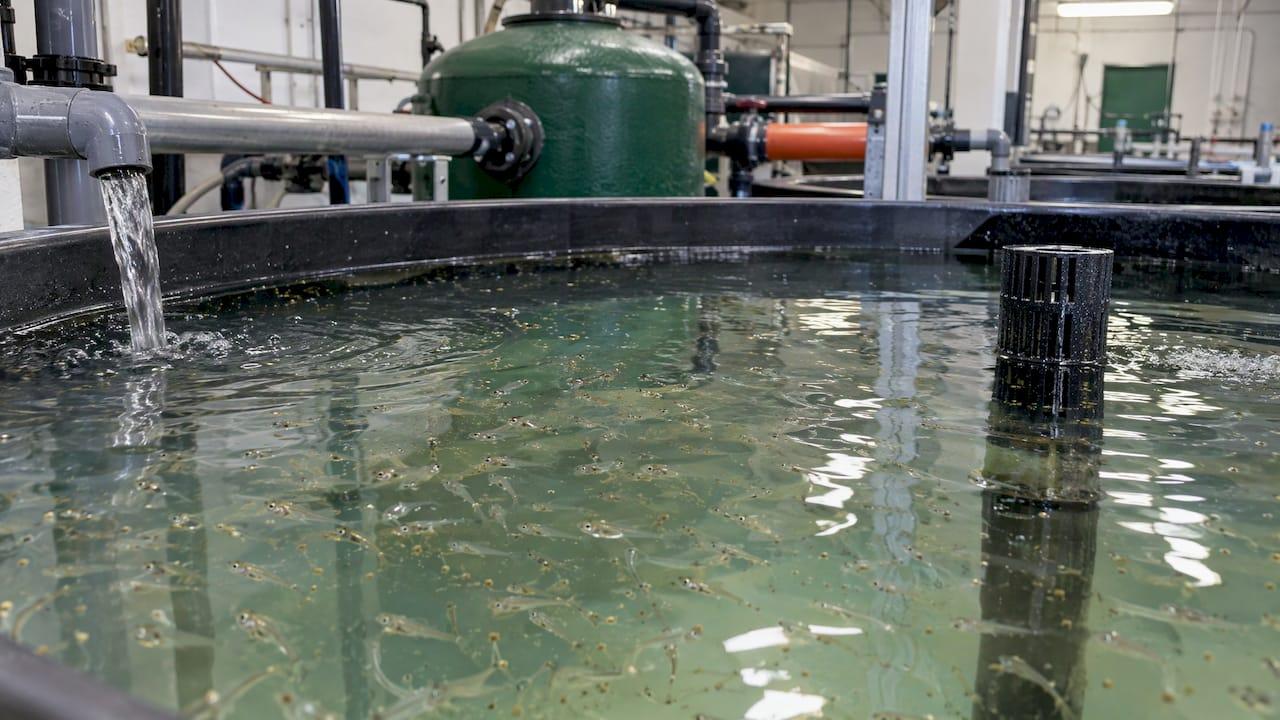
Live feeds belong in a recirculating aquaculture system (RAS) at the larval stage, when fish cannot yet digest formulated pellets. The main options are microalgae, rotifers, brine shrimp (Artemia) and, in research settings, copepods. They work best when you match the organism to the larva's mouth size, feed it fresh or enriched, and dose it so uneaten animals never overload your biofilter. This guide covers what to feed, when, how much risk each choice carries, and how to keep a closed system clean while you do it.
TL;DR
- Live feeds cover the first-feeding window, when larvae lack a fully developed digestive system and formulated feeds often give poor growth and survival.
- Rotifers suit the smallest mouths but need enrichment. Artemia nauplii are convenient and are best fed right after hatching or after enrichment.
- The real RAS risks are labor, batch-to-batch nutritional variability and bacterial introduction, and all three can be managed with routine.
- Feed small, frequent amounts that larvae finish in minutes, so ammonia and organic load stay low.
- Farmed, microalgae-fed brine shrimp from a controlled source can take hatchery work and variability out of the routine.
Table of Contents
- What live feeds do in a recirculating system
- The main live feeds compared
- Choosing a live feed for your species
- Feeding live prey without wrecking water quality
- The real risks, and how to manage them
- Perspective
- Where farmed live brine shrimp fits in a RAS routine
- Order live feed for your system
- Costs and scale: what to expect
- FAQ
- Sources
What live feeds do in a recirculating system
A RAS reuses water through mechanical filtration, a biofilter and often disinfection. Everything you add ends up in that loop. That is why feed choice matters more here than in a flow-through pond: a wasted feed means ammonia, and ammonia means stress.
Live feeds are organisms such as microalgae, rotifers and Artemia given to developing fish and shellfish larvae. The FAO manual on live feeds notes that live organisms seem to meet the needs of small larvae, while formulated feeds generally do not and can lead to poor growth and survival.
Two reasons stand out:
- Digestion. Many species hatch with an incomplete gut. Academic work on marine larviculture describes live feeds as essential for the early development of fish that cannot process inert feed once the yolk sac is used up.
- Behavior. Moving prey get noticed. The same source explains that the movement of live food improves larval perception and can trigger the feeding response. A pellet sinking in a tank does neither.
Formulated feeds still matter in RAS, especially for juveniles and grow-out, and the transition between the two is where good hatchery practice shows. Live feed is the bridge, not the destination.
The main live feeds compared
The 2025 review of live feeds in fish larviculture lists rotifers, brine shrimp, copepods and microalgae as the commonly cultured organisms, each with a role set by size, nutrition and species. Here is how they compare in practice.
| Live feed | Typical role | Strength | Watch out for |
|---|---|---|---|
| Microalgae | Feed for rotifers, green water for larvae, food for filter feeders | Foundation of the food chain | Culture space, consistency |
| Rotifers | First feed for small marine and freshwater larvae | Small size, high density culture | Low in essential fatty acids without enrichment |
| Artemia nauplii | Second feed after rotifers, or first feed for larger mouths | Cysts store for years and hatch on demand | Nutrition peaks right after hatch |
| Copepods | Premium first feed in research and some hatcheries | Make their own highly unsaturated fatty acids | Commercial-scale production limited |
| Juvenile and adult brine shrimp | Larger fry, juveniles, broodstock | Bigger prey, good protein | Source quality |
Microalgae
Algae are the base layer. They feed rotifers and some larvae directly, and many hatcheries add them to the tank as "green water." If you culture them yourself you need light, nutrients and a clean inoculum. If you buy them, a live culture saves the space and the crashes. Our live phytoplankton is one way to skip that step.
Rotifers
Rotifers such as Brachionus plicatilis are widely used for marine fish larvae because they are small and can be produced at high densities. A Texas A&M extension publication points out that they usually need enrichment, since they lack enough DHA, EPA and ARA on their own.
Virginia Tech's rotifer production guide describes two culture styles. Batch systems restart cultures at regular intervals. Continuous systems often use recirculating technology to hold higher densities with less labor. Rotifers can be fed algae or formulated diets and are enriched before they go to the larvae.
Artemia (brine shrimp)
Artemia nauplii are a staple because the cysts keep for years and hatch when you need them. The catch, per the FAO manual, is that nutritional value is highest right after hatching and falls quickly as the nauplii use up their yolk sac. That is the logic behind feeding promptly or enriching before feeding. Our guide to Artemia nauplii biology, hatching and feeding walks through it, and the 6 to 12 hour feed window explains the timing for fish keepers.
Copepods
Copepods can synthesize essential fatty acids themselves and keep favorable DHA:EPA and EPA:ARA ratios, so they may need little or no enrichment. The same Texas A&M publication noted that commercial-scale production had not been achieved at the time, though indoor intensive results looked promising. For most RAS operators today, rotifers and Artemia remain the working tools.
Choosing a live feed for your species
Start with the larva, not the catalog. The Texas A&M source says the choice should rest on the species' mouth gape, digestive capacity and behavioral response to moving prey.
A practical sequence:
- Find the gape at first feeding. Measure or look up the mouth opening for your species. Very small mouths point to rotifers or small copepods. Larger mouths can take Artemia nauplii straight away.
- Match prey size. Prey should fit comfortably, not barely. For hobby-scale fry, our comparison of Daphnia and brine shrimp for 400 to 500 micron gape shows how to think about it.
- Check the nutrition. Marine larvae in particular depend on fatty acids. If the prey is low in DHA or EPA, enrich it. Our 2:1 DHA:EPA enrichment protocol covers the method for hatcheries and aquarists.
- Plan the handoff. Decide when you will co-feed formulated diet and when you will wean off live prey, so the live feed never becomes the bottleneck.
For species-specific examples, see our notes on Apistogramma fry food and the lab protocol for zebrafish brine shrimp. For the wider picture, our larval rearing guide to live food and the role of brine shrimp in larval rearing cover the stages in order.
Feeding live prey without wrecking water quality
A closed loop punishes overfeeding. A few habits keep it stable.
Dose by consumption, not by schedule
Feed an amount larvae clear in a short period, then feed again. Small, frequent doses keep prey available without leaving dead or dying organisms to decay. Watch the tank: if prey are still swimming in numbers at the next feeding, cut the dose.

Keep prey alive and visible
Freshwater species like Artemia die in freshwater systems and decay. Marine larvae can tolerate them longer. Either way, a dead prey item is waste. Rinse hatched or shipped prey before they go in, which also removes hatching debris, and feed them while they are active.
Let the system help
Some setups use living prey as part of the system itself. In the zebrafish rotifer polyculture method, larvae are raised with rotifers in the same system, giving an on-demand, nutrient-rich food source without chemical waste that limits performance. Refugium keepers use a related idea at small scale: our piece on brine shrimp in a refugium explains why you hatch for food, not to build a colony.
Watch the biofilter
When you start live feeding, test ammonia and nitrite more often for the first week or two. A rise tells you the dose is too high or the filter is not yet carrying the new load. Adjust the feed, not the testing schedule.
The real risks, and how to manage them
Live feeds are not free of trade-offs, and a good operator plans for them. The 2025 larviculture review names three: labor intensity and cost, nutritional variability between batches, and the chance of introducing pathogenic bacteria such as Vibrio into the rearing system through contaminated feed.
Labor. Culturing rotifers or hatching Artemia daily is real work. Continuous rotifer systems cut it, as the Virginia Tech guide notes. Buying prey ready to feed cuts it further.
Variability. Wild-harvested or poorly fed prey differ from batch to batch. Enrichment, consistent rearing and a single reliable supplier narrow the spread. Track growth and survival by batch so you notice a drift early.

Biosecurity. Treat anything entering a RAS as a possible carrier. Rinse prey with clean water, keep hatching and culture vessels separate from larval tanks, use dedicated nets and buckets, and disinfect equipment between uses. If your species is sensitive, ask your fish health professional or state aquatic animal health authority about screening and disinfection for your setup.
Perspective
We built Demeter Biosciences around one observation: in a recirculating system, the quality of the prey matters as much as the quantity. Wild-harvested brine shrimp can swing with the season and with starvation in their natural environment. That is a problem when you are trying to run a tight, repeatable program.
Our approach is to farm brine shrimp on land in controlled, organic, sustainable systems, feeding them only the microalga Dunaliella. Our production is designed to deliver at least 40% protein content and consistent nutritional quality, shipment after shipment.
For hobbyists, that means a predictable live food for fry and adult fish. For hatcheries, stores and institutions, it means a supply you can plan around without running your own culture room. We see live feed as the foundation of healthy fish, and we think it should be produced in a way that is also good for the planet.
Demeter
Where farmed live brine shrimp fits in a RAS routine
Brine shrimp are useful at more than one stage. Newly hatched nauplii serve larvae with mouths large enough for them. Larger live brine shrimp serve fry, juveniles, and conditioning of broodstock, with a bigger bite of protein per feeding. Because ours are raised on a single microalga diet and not harvested from the wild, you are working from a steady source and not from a shifting one.
A simple weekly pattern in a hobby or small hatchery RAS:
- Feed live brine shrimp to fry in several small portions a day, rinsed and fed while active.
- Offer enriched prey where the species needs more fatty acids.
- Begin co-feeding a fine formulated diet as the fry grow, and reduce live prey as acceptance improves.
- Test ammonia and nitrite daily during the transition.
If you also culture rotifers or filter-feeding animals, a live algae supply gives them something to eat. For bigger programs, our market overview shows who we supply, and our write-up on the sustainable live food trend explains why hatcheries and aquarists are moving this way.
Order live feed for your system
We ship farmed live brine shrimp directly to hobbyists. Live brine shrimp is priced from $17 to $35 as a one-off order. If you feed on a rhythm, the Demeter Biosciences membership delivers a monthly live brine shrimp shipment for $25 per month.
Live phytoplankton is $20 as a one-off, and gift cards run from $10 to $50. Local fish stores, pet retailers, museums and research institutions can use the bulk store brine shrimp order. You can see everything on the Featured Products page.
Costs and scale: what to expect
Readers often ask what a RAS costs before they ask about feed. System cost depends heavily on species, size and whether it is a hobby build or a commercial farm, so any single figure is misleading without your design. What you can control early is the feed side. Compare your options on labor hours per week, loss to variability, and time to a stable feeding routine. A supplier that delivers consistent live prey can shift hours away from culture and toward monitoring, which is where larval programs are usually won.
FAQ
Can formulated feed replace live feed in a RAS?
Not for the first-feeding stage of most altricial species. Larvae with undeveloped digestive systems often grow and survive poorly on formulated feeds alone, according to the FAO live feeds manual. Formulated diets take over as fish grow, usually through a co-feeding period.
Which live feed should I start with?
Let the larva's mouth size decide. The smallest mouths usually need rotifers, while larger ones can take Artemia nauplii directly. Check the gape for your species, then choose prey that fits comfortably.
Do live feeds carry disease into a recirculating system?
They can. Live feeds, including Artemia, can carry bacteria such as Vibrio, so rinsing, separate equipment and disinfection routines matter. For species-specific screening advice, talk to your fish health professional.
How often should I feed live prey?
Small, frequent feedings work best, sized so larvae eat most of the prey within a short time. Watch the tank before each feeding and cut the dose if prey are still swimming in numbers. Test ammonia and nitrite more often while you adjust.
Do brine shrimp need enrichment?
Nauplii are most nutritious right after hatching and decline as the yolk sac is used. Enrichment helps for species with higher fatty acid needs. Our enrichment protocol explains the method and timing.
Sources
- FAO Fisheries Technical Paper 361: Manual on the production and use of live food
- Live Feeds in Marine Aquaculture
- Choosing an Appropriate Live Feed for Larviculture of Marine Fish
- Rotifer Production as a First Feed Item for Intensive Aquaculture
- The Complete and Updated Rotifer Polyculture Method
- Utilization of live feeds in fish larviculture: A review