
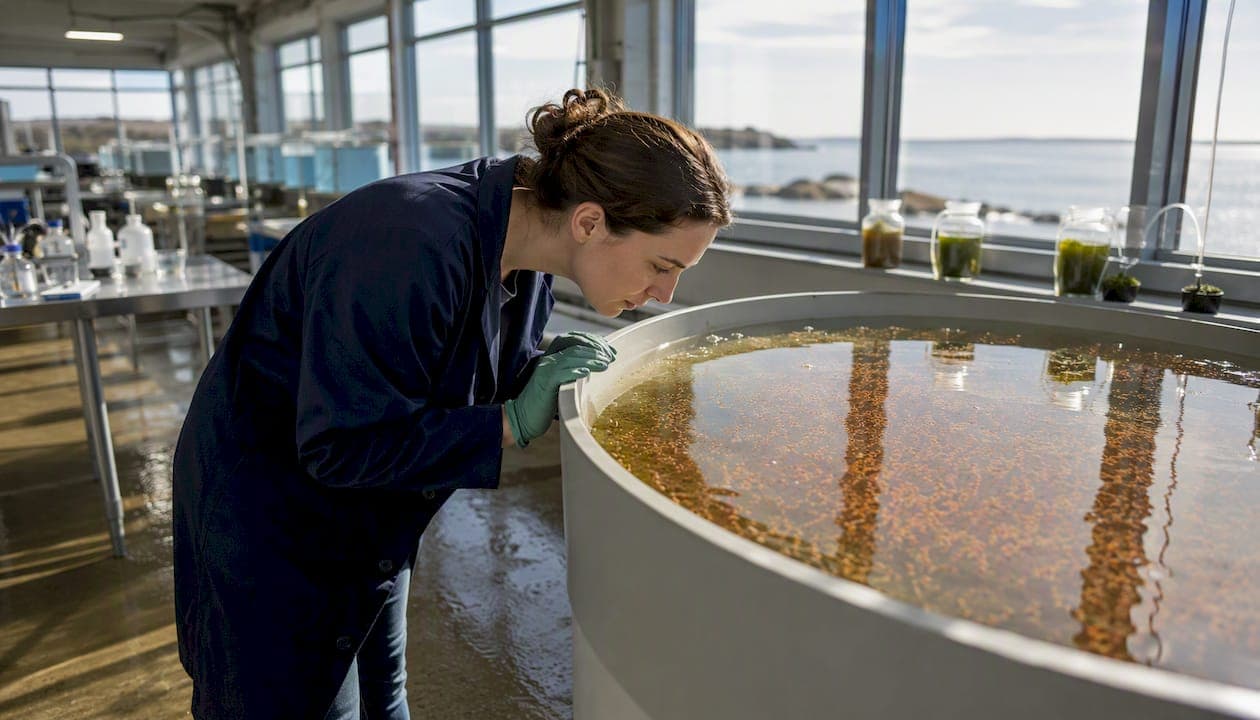
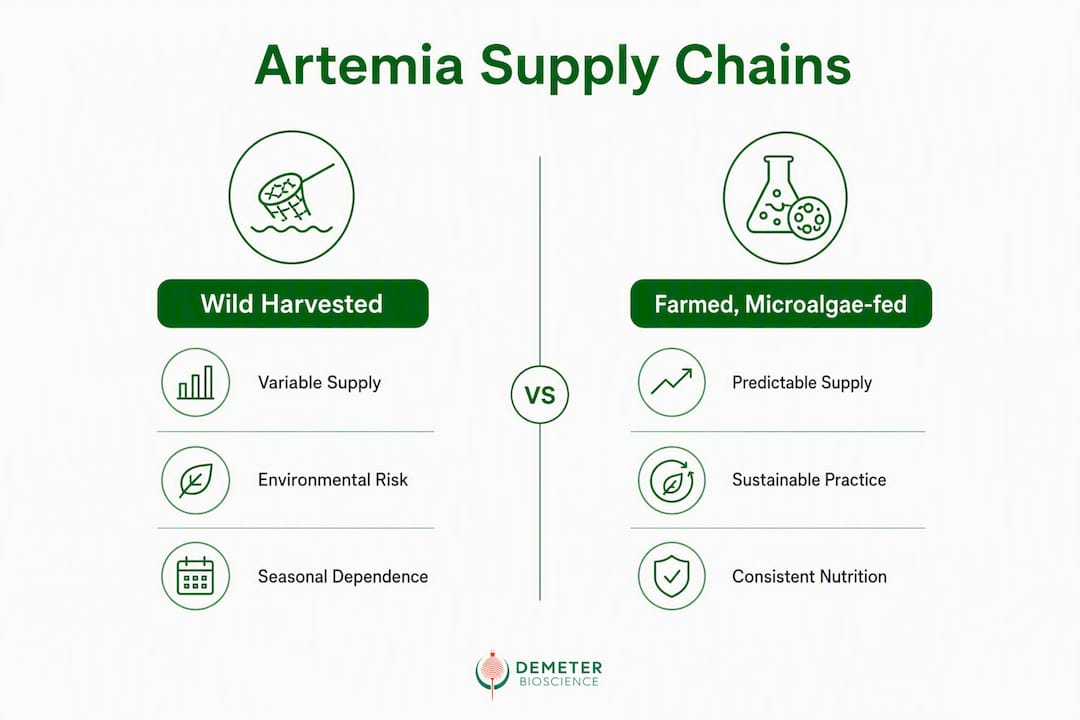
The sustainable live-food market trend in aquaculture is the commercial shift from wild-harvested brine shrimp (Artemia) to farmed, microalgae-fed Artemia that deliver consistent, HUFA-enriched nutrition year-round. Roughly 90% of global Artemia production still comes from wild inland salt lakes, a supply chain one drought or regulatory change away from collapse. Farmed Artemia fed on microalgae like Dunaliella salina and Isochrysis galbana are the industry's answer to that fragility. Demeterbioscience is among the suppliers already operating this model in the United States.
Before you source your next batch, check three things: the microalgae species used in enrichment, a lab-verified protein percentage (look for ≥40%), and whether the supplier ships live with a viability guarantee.
- The trend is farmed, microalgae-fed Artemia replacing wild-harvested cysts as the default live feed.
- Nutritional quality is the primary driver for hatcheries; supply reliability is the primary driver for retailers and institutions.
- Demeterbioscience feeds exclusively on Dunaliella and guarantees ≥40% protein per batch.
Table of Contents
- Why is the Artemia supply chain shifting right now?
- How does microalgae feeding change Artemia nutrition?
- How is farmed, microalgae-fed Artemia actually produced?
- What should buyers check before sourcing sustainable Artemia?
- What does the market outlook look like through 2030?
- How Demeterbioscience puts this model into practice
- Key Takeaways
- The industry is moving, but not fast enough
- Get started with Demeterbioscience's farmed live Artemia
- Useful sources and further reading
Why is the Artemia supply chain shifting right now?
The short answer: wild supply is degrading while demand keeps climbing.
Annual global consumption of Artemia cysts sits at 3,500–4,000 tonnes, underpinning the production of over 900 billion crustacean post-larvae and fish fry. That volume flows through a hatchery industry valued at more than USD 2 billion. Yet approximately 90% of that supply is harvested from inland salt lakes, primarily the Great Salt Lake in Utah. Multi-decade studies on Great Salt Lake harvests have documented declining cyst buoyancy and rising nauplii mortality, direct signals that sustained harvesting pressure is degrading the resource.
"Growing hatchery demand and reliance on wild cysts could constrain aquaculture growth if supplies remain volatile." — Responsible Seafood Advocate analysis on the global brine shrimp supply bottleneck
On the demand side, aquaculture is expanding faster than wild Artemia can reliably serve it. Museums, public aquariums, and research institutions add another layer of pressure: they need traceable, pathogen-screened feed on a fixed schedule, not whatever the seasonal harvest delivers. Disease risk compounds the problem. Wild cysts can carry pathogens into hatchery systems; processed cysts can be disinfected, but contamination risk re-enters during hatching if conditions are uncontrolled. The FAO's 2021 SDG-aligned Artemia workshop explicitly recommended developing bio-secure farmed Artemia production guidelines as a strategic priority. That recommendation is now becoming commercial reality.
How does microalgae feeding change Artemia nutrition?
Artemia's nutritional profile is highly plastic. Feed it well and it becomes a precision delivery vehicle for the fatty acids larval fish and crustaceans need most. Feed it poorly and you get a live organism with almost no nutritional value.
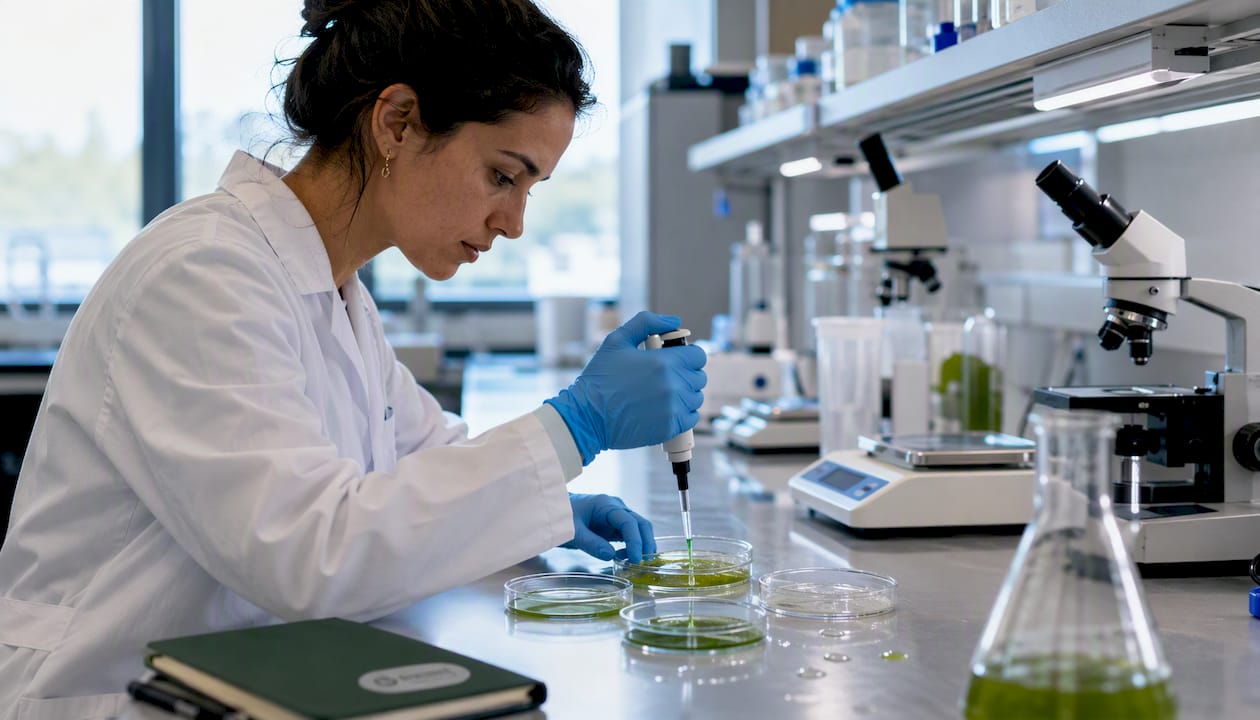
The key metrics are DHA (docosahexaenoic acid), EPA (eicosapentaenoic acid), and total HUFA (highly unsaturated fatty acids). Experimental feeding trials show that Artemia fed Dunaliella salina achieve the highest DHA content compared with several other microalgae species. Isochrysis galbana drives higher total PUFA enrichment and can outperform many commercial enrichment emulsions in HUFA delivery. For larval fish and shrimp, adequate DHA/EPA is not optional: deficiencies cause skeletal deformities, reduced swim-bladder inflation, and elevated mortality during the first critical weeks.
| Nutritional dimension | Wild-harvested Artemia | Microalgae-fed Artemia |
|---|---|---|
| Protein content | Variable; often below 40% | ≥40% with controlled feeding |
| DHA level | Low to negligible | Elevated with D. salina or I. galbana |
| EPA level | Low | Increased with I. galbana enrichment |
| HUFA profile | Inconsistent | Consistent batch-to-batch |
| Larval survival indicator | Unpredictable | Improved with HUFA-adequate feed |
Pro Tip: When reviewing a supplier's lab certificate, look for a fatty-acid profile (GC-FID method), not just a proximate analysis. A proximate panel shows protein and fat totals; only the fatty-acid breakdown tells you whether DHA and EPA are actually present at levels that support larval development. For brine shrimp nutritional value, request both.
How is farmed, microalgae-fed Artemia actually produced?
The production sequence in a land-based system runs: cyst hatching in controlled saline tanks → nauplii rearing under monitored temperature and salinity → continuous microalgae feeding (Dunaliella or Isochrysis cultures) → enrichment protocol completion → quality testing → live packing and cold-chain dispatch.
Each step removes a variable that wild harvest cannot control. Temperature and photoperiod stay consistent. Microalgae density in the water column is managed to ensure Artemia feed continuously rather than starving between tidal cycles as they would in a natural lake. Biosecurity is applied at hatching (cyst disinfection) and maintained through the rearing phase by controlling water inputs and preventing cross-contamination.
"Processed cysts can be disinfected, but pathogens can enter during the hatchery stage if conditions are not controlled." — FAO workshop report on biosecurity in Artemia production
The sustainability case is concrete. Land-based farming removes extraction pressure from ecologically sensitive salt lakes. Microalgae cultivation systems can consume CO₂ and mitigate nutrient waste from animal production, adding an environmental co-benefit beyond just replacing wild harvest. Buyers should expect suppliers to provide batch traceability records, a certificate of analysis for each lot, and documented pathogen screening. Those three items are the minimum credible sustainability claim.
| Production feature | Wild harvest | Land-based farmed |
|---|---|---|
| Supply predictability | Seasonal, weather-dependent | Year-round, controlled |
| Disease/pathogen risk | Higher (unmanaged environment) | Lower with biosecurity protocols |
| Nutritional consistency | Variable | Consistent with microalgae feeding |
| Ecological impact | Extraction pressure on salt lakes | Reduced; algal systems add co-benefits |
| Traceability | Limited | Batch-level tracking feasible |
What should buyers check before sourcing sustainable Artemia?
A supplier claiming "sustainable" live Artemia should be able to answer every item on this list without hesitation.
- Fatty-acid profile: — Request a GC-FID fatty-acid panel showing DHA and EPA values per gram of Artemia biomass.
| Evaluation dimension | Buyer question to ask |
|---|---|
| Nutritional profile | "Can you provide a fatty-acid panel showing DHA and EPA?" |
| Consistency/availability | "Do you ship year-round with no seasonal gaps?" |
| Sustainability credentials | "What microalgae species do you use, and do you have batch traceability?" |
| Product form & packaging | "How is the live shipment packed, and what is the viability guarantee?" |
| Shipping lead time | "What is your typical order-to-delivery window?" |
| Price shape | "Do you offer subscription or bulk pricing for recurring orders?" |
Pro Tip: For commercial larval fish hatcheries, request a minimum of three consecutive batch certificates before committing to a supplier. Consistency across batches matters more than a single impressive result.
What does the market outlook look like through 2030?
The global Artemia market is forecast to grow substantially through 2026–2034, driven by rising seafood demand and aquaculture technology improvements. The structural shift toward farmed, microalgae-fed product is real, but the timeline for broad adoption is measured in years, not months.
"Farmed Artemia in controlled environments represent a necessary strategic response to wild-supply volatility, offering predictable output and reduced disease risk." — Responsible Seafood Advocate
Near-term (now through 2027), farmed microalgae-fed Artemia will remain a premium, niche-to-institutional product. Capital costs for land-based systems are high, and microalgae biomass production at scale requires energy and infrastructure investment. Mid-term (2028–2030), as more farms reach operational scale and microalgae cultivation costs fall, broader hatchery uptake becomes realistic. Buyers planning procurement strategy now should lock in supplier relationships early, because capacity at quality-certified farms is limited.
Supply-chain risks to monitor: microalgae biomass supply disruptions (energy costs, water access), regulatory changes affecting Great Salt Lake harvesting quotas, and shipping cost volatility for live cold-chain logistics.
How Demeterbioscience puts this model into practice
Demeterbioscience operates a land-based Artemia rearing system in the United States, feeding exclusively on Dunaliella microalgae and targeting ≥40% protein per batch. Every lot is backed by laboratory analysis. The production model is designed specifically to avoid the seasonal gaps and nutritional inconsistency that define wild-harvested supply.
Ordering options available through Demeterbioscience's product pages:
- Single live shipments: Direct-to-consumer orders for aquarium hobbyists and small retailers, shipped live with cold-chain packaging.
- Monthly subscription plans: Recurring shipments at reduced per-unit cost, suited to aquarists and small hatcheries with steady demand.
- Bulk institutional orders: High-volume packages for museums, public aquariums, research institutions, and commercial hatcheries, with custom lead times.
- Gift cards: Available for hobbyist gifting.
Typical lead time for live shipments is short, and packaging includes insulated containers with gel packs to maintain viability in transit. Institutional buyers can request batch certificates and fatty-acid panels before placing a first order.
"Consistent, traceable, microalgae-fed Artemia is what modern hatcheries and research institutions need. Wild harvest cannot deliver that reliability." — Demeterbioscience production team
Pro Tip: New institutional customers should request a trial order before committing to a bulk contract. A single batch lets you verify live-arrival rate, protein content against the certificate, and cold-chain performance under your specific shipping conditions.
Key Takeaways
Farmed, microalgae-fed Artemia fed on Dunaliella salina or Isochrysis galbana deliver consistent ≥40% protein and elevated DHA/EPA levels that wild-harvested cysts cannot reliably match.
| Point | Details |
|---|---|
| Wild supply is fragile | Roughly 90% of global Artemia comes from wild salt lakes, creating real supply and quality risk. |
| Microalgae species matter | Dunaliella salina maximizes DHA; Isochrysis galbana raises total PUFA — ask your supplier which they use. |
| Demand a lab certificate | Request a GC-FID fatty-acid panel and protein percentage before committing to any supplier. |
| Market growth is confirmed | The global Artemia market is forecast to grow through 2034; locking in a reliable farmed supplier now reduces procurement risk. |
| Demeterbioscience | Offers land-based, Dunaliella-fed Artemia with ≥40% protein, available as single orders, subscriptions, or bulk institutional packages. |
The industry is moving, but not fast enough
The science on microalgae-fed Artemia is settled. Dunaliella salina raises DHA. Isochrysis galbana outperforms most commercial emulsions on PUFA delivery. Land-based farming eliminates the seasonal gaps and degrading cyst quality that wild harvest increasingly produces. None of that is contested.
What the industry underestimates is how long the transition will take at scale. Most hatcheries still default to wild cysts because they are cheaper today and the supply chain is familiar. That calculus is changing as Great Salt Lake harvesting faces increasing regulatory and ecological pressure, but the shift will not happen automatically. Buyers who wait for the market to normalize before switching will find themselves competing for limited capacity at the few farms already operating at quality standards.
The smarter move is to qualify a farmed, microalgae-fed supplier now, run a trial batch, and build the relationship before demand outpaces supply. The nutritional upside is immediate. The supply security benefit compounds over time.
Get started with Demeterbioscience's farmed live Artemia
Demeterbioscience gives aquarium hobbyists, hatcheries, retailers, and research institutions a direct path to farmed, Dunaliella-fed live brine shrimp with verified ≥40% protein and full batch traceability. No seasonal gaps, no mystery sourcing.
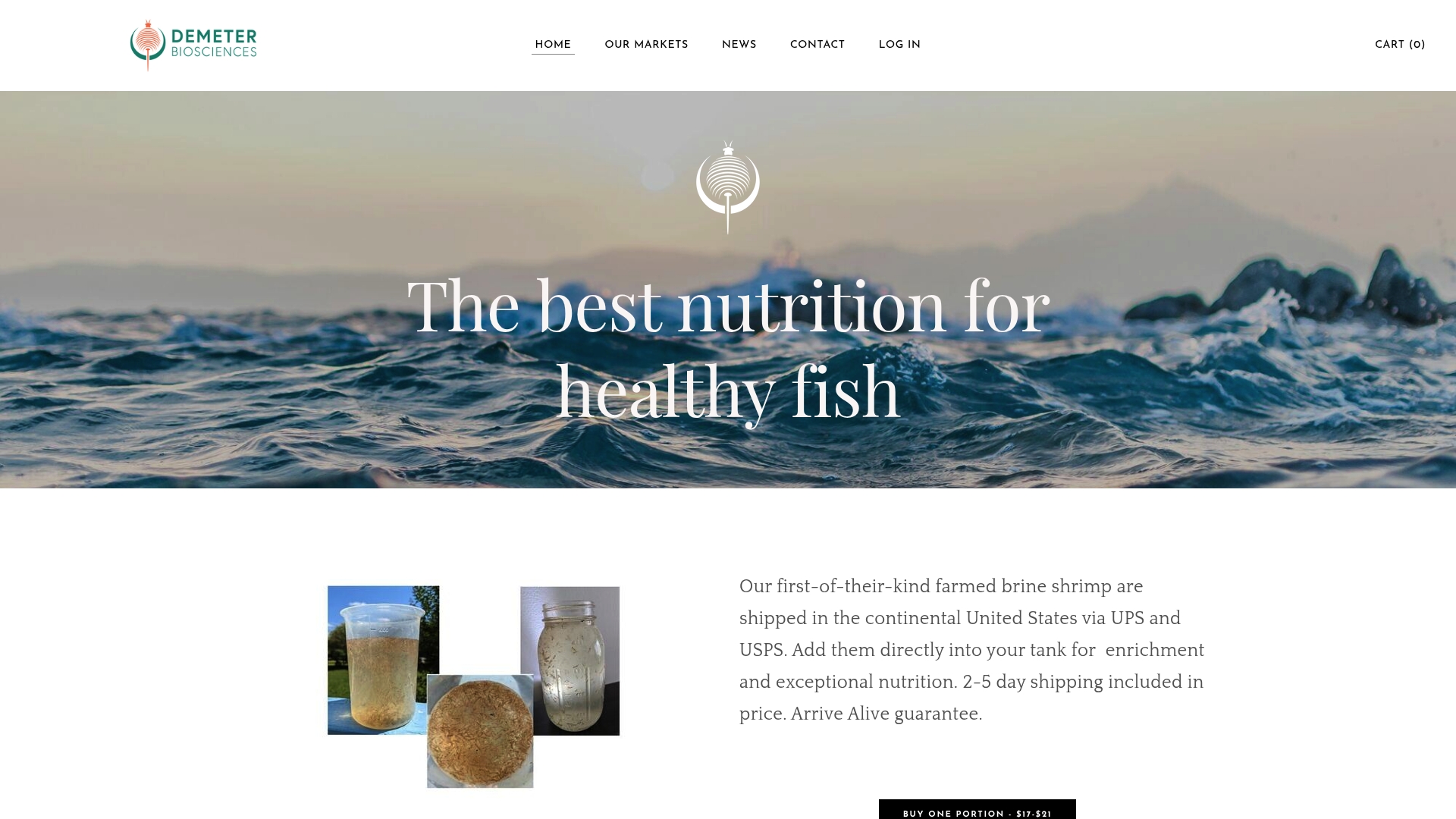
Single orders ship live with cold-chain packaging. Monthly subscriptions lock in consistent supply at lower per-unit cost. Institutional and museum buyers can place bulk orders with custom lead times and receive batch certificates on request. For research institutions and commercial hatcheries evaluating a new supplier, a trial order is the right first step: verify live-arrival rate, confirm the fatty-acid panel against your spec, and assess cold-chain performance before scaling up.
Ready to source sustainable, microalgae-fed Artemia? Order live brine shrimp directly, or contact the team for institutional pricing and bulk procurement inquiries.
Useful sources and further reading
| Source | Best for |
|---|---|
| FAO SDG-aligned Artemia aquaculture workshop report (2021) | Policy context, biosecurity guidelines, and production recommendations |
| Responsible Seafood Advocate: global brine shrimp supply bottleneck | Supply-chain risk analysis and wild-harvest degradation data |
| Responsible Seafood Advocate: baby food bottleneck analysis | Market demand pressure and strategic farmed-Artemia rationale |
| Reviews in Aquaculture (2025): live feeds and enrichment techniques | Technical enrichment protocols and microalgae vs. emulsion comparisons |
| Sains Malaysiana (2022): microalgal diets and fatty-acid content in Artemia franciscana | Species-level DHA data for D. salina vs. other microalgae |
| ENACA: Artemia production and inland salt lake reliance | Wild-harvest dependency statistics |
| Global Artemia Market Size, Share, Trends & Growth Analysis 2026–2034 | Market forecasts and CAGR projections |
| Review on integrated Artemia production in solar salt ponds | Alternative production models and saltworks integration |