
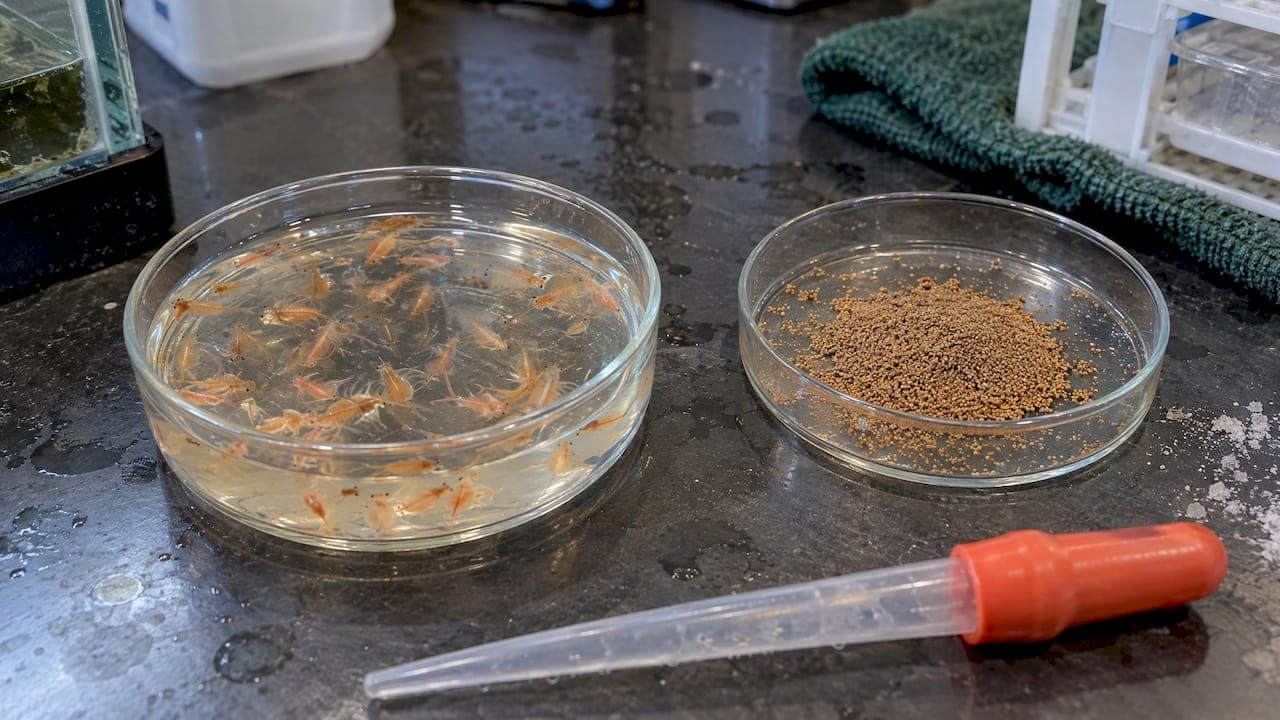
Hatching brine shrimp eggs is the cheaper route per feeding, and buying live brine shrimp is the easier, more consistent one. Which wins depends on how many mouths you feed, how often, and how much daily labor you will tolerate. Eggs are dormant embryos you hatch yourself in about a day. Live shrimp arrive already swimming, with no hatchery, no failed batches and no timing to manage.
Below we walk through what you are actually buying with each option, what the extension research says about hatching and nutrition, and a simple way to decide.
TL;DR
- "Eggs" are dormant embryos called cysts. They store dry for a long time and hatch in roughly 24 hours under the right conditions: 25 to 28°C, 15 to 35 g/L salinity, strong light and heavy aeration.
- Hatching wins on shelf life and cost per feeding, but it costs you daily labor, equipment and the occasional crashed batch.
- Freshly hatched nauplii are not a complete food. Their fatty acid profile can be inconsistent, so both options benefit from smart feeding or enrichment.
- Live farmed shrimp suit people who want no hatchery, steady quality, or an occasional treat feeding. Hatching suits high-volume fry rearing.
- Many keepers do both: eggs for fry, live shrimp for adult fish and for the days a batch fails.
Table of Contents
- What you are really comparing
- How hatching eggs works, step by step
- Where eggs win
- Where eggs lose
- Where live brine shrimp win
- Side-by-side comparison
- Which one fits you
- Enrichment: the part both camps skip
- Our perspective
- Getting live shrimp from us
- FAQ
- Sources
What you are really comparing
The phrase "brine shrimp eggs" hides a detail that explains most hatching trouble. What you buy in the jar is a cyst: an embryo in diapause, wrapped in a hard shell called the chorion. Practitioners point out that most failures are not bad eggs but storage or conditions that never trigger the embryo to wake up, such as too little light or the wrong salinity or temperature.
Live brine shrimp are the other end of the process. Someone else has grown them, so you are buying finished animals rather than a project. The distinction matters because it moves the work. With eggs, you do the hatching. With live shrimp, the grower does the culture and you handle only feeding and holding.
One more point: most commercial cysts are collected from the wild in natural hypersaline lakes, then dried and marketed. That makes egg quality dependent on the lake, the season and the harvest. Farmed live shrimp are raised in a controlled setting instead.

How hatching eggs works, step by step
Hatching is not hard, but it is unforgiving about details. Extension guidance gives the target conditions: about 24 hours at 25 to 28°C, salinity of 15 to 35 g/L and more than 2,000 lux of light. In practice:
- Mix salt water in a cone-bottom container or clear bottle, at the salinity you are targeting.
- Add cysts at a modest ratio. Overloading is a classic way to crash a hatch, because oxygen runs out.
- Aerate vigorously from the bottom so the cysts stay suspended.
- Keep the water warm and lit. Our own temperature guide for hobbyists suggests hatching at 80 to 82°F and holding hatched shrimp at 68 to 74°F.
- After roughly a day, stop the air, let shells and unhatched cysts separate, and siphon the nauplii from the bottom.
- Rinse them in fresh or salt water, depending on what your fish need, and feed.
Then you repeat it, usually every day if you keep fry. A hatch also runs on a clock. Our 18 to 36 hour lab protocol covers how timing changes for zebrafish larvae.
Decapsulated eggs
Some keepers buy decapsulated cysts, where the shell has been chemically removed. According to the University of Florida, decapsulated cysts lack the chorion, leaving only the embryo inside a thin membrane. That removes the problem of fry swallowing shell fragments. University of Florida also describes storing decapsulated cysts in saturated brine in the refrigerator so a bulk batch can serve several days of feeding. They are still a hatching project, just a cleaner one.
Where eggs win
Shelf life. Dry cysts are the reason brine shrimp became the most widely used live feed on earth. They can sit on a shelf, and aquaculture and research facilities prefer them as an off-the-shelf live feed. If you want food on hand for a trip to the fish room at 6 a.m., nothing beats a sealed can.
Cost per feeding. A jar of eggs makes a lot of nauplii. If you run a breeding rack or raise fry daily, the arithmetic favors eggs by a wide margin.
Volume on demand. Need ten times the usual amount for a spawn? A hatchery scales up easily.
Where eggs lose
Labor and equipment. You need a container, an air pump, a heater or warm spot, light, salt and a siphon or harvesting setup. Then you rinse, count and clean. It adds up to a daily routine.
Batch-to-batch variability. Storage matters more than people expect. Research on cysts shows repeated hydration and dehydration cycles reduce energy content, vitamin C and fatty acids and cut hatch percentage. A jar stored in a warm fish room or opened over and over can quietly decline.
The nutrition clock. Newly hatched Instar I nauplii live off a yolk sac, so they are at their most energy-rich right after hatching. Extension guidance warns that once they molt, that advantage disappears quickly unless they are enriched, and enrichment is limited because the shrimp can break down the fatty acids they take up. If you cannot feed immediately, a cold bank at 2 to 10°C slows their metabolism and preserves their stores.
Failure days. A crashed batch means hungry fry. Experienced keepers run two hatchers staggered by a day for exactly this reason.
Where live brine shrimp win
Buying live shrimp makes sense when a hatchery is more trouble than the food is worth.
- No setup. You skip the aeration, heating, lighting and harvesting.
- Consistent quality. Our shrimp are farmed on land in controlled systems and fed only the microalgae Dunaliella, which is how we hold protein content at no less than 40%. Cysts, by contrast, range from about 28 to 55% protein depending on source.
- A varied diet. Adult-stage shrimp are a different food from freshly hatched nauplii, and many fish take them eagerly. Our guides on microalgae-fed Artemia and target feeding cover how to deliver them to picky eaters.
- No wasted batches. You order what you need, and you do not discard 20 gallons of unused culture.
- Predictable for small tanks. One nano reef or a handful of freshwater fish does not justify a daily hatchery.
The tradeoffs are plain too. Live shrimp ship on a schedule, need to be held at a sensible temperature when they arrive, and cost more per feeding than eggs at scale. They are not a substitute for a fry-raising operation that needs thousands of fresh nauplii every morning.
Side-by-side comparison
| Factor | Hatching eggs (cysts) | Farmed live brine shrimp |
|---|---|---|
| Setup | Hatchery, air, heat, light, salt | None beyond a holding container |
| Daily effort | High: set up, harvest, rinse | Low: feed and keep |
| Shelf life | Long when dry and stored well | Short: live animals |
| Cost per feeding | Lowest at volume | Higher per feeding |
| Quality consistency | Varies with source and storage | Controlled by the grower |
| Best for | Fry rearing, breeders, large volume | Adult fish, small tanks, backup feed |
| Risk | Failed hatch, shells in food | Shipping timing, holding temperature |
Which one fits you
Freshwater and saltwater hobbyists
If you keep a community tank or a reef with a few picky eaters, live shrimp are probably the better fit. If you breed fish or raise fry, learn to hatch, and keep live shrimp as insurance. Our guides split this by tank type: freshwater fish and reef tanks. If you are thinking of using them in a sump, see why we say hatch for food, not a colony.
Fish stores, schools and museums
The daily hatching routine is the hidden cost for a shop or an exhibit. Staff turnover, weekends and holidays make a hatchery fragile. A scheduled shipment of live shrimp is often more practical than assigning someone to run one.
Hatcheries and labs
High-volume larviculture usually runs on cysts, and for good reason. Where your protocol demands repeatable results, source and storage control matter; see our notes on research-grade brine shrimp. Live farmed shrimp can still serve alongside hatching for juveniles and broodstock.
Enrichment: the part both camps skip
Brine shrimp work best when you think of them as a carrier for nutrition rather than a finished meal. Recent reviews describe Artemia enrichment strategies built around fatty acid profiles, and the idea holds for any keeper. A fish only gets what the shrimp contain at the moment it eats them.
Research found that enriching nauplii with microalgae changes their fatty acid composition. A hatchery can do that after hatching, within a limited window. A farm can build it in from the start by choosing what the shrimp eat. That is the logic behind our microalgae-fed approach. If you want a hands-on protocol, we cover a 2:1 DHA to EPA enrichment in a separate guide.

Our perspective
We farm brine shrimp, so you might expect us to tell you never to hatch eggs. We will not. Cysts are a remarkable tool, and for fry they remain the standard for good reasons.
What we see is that the wild supply behind most cysts changes with the lake and the season, and that wild brine shrimp can be nutritionally uneven because they live with natural swings in food. We raise ours on land in controlled systems, fed only Dunaliella, so the protein level stays at 40% or above and the nutrition does not depend on what a lake produced that year.
So our advice is practical. If you raise fry every day, hatch. If you want to feed adult fish well without running a hatchery, or you want a dependable backup, buy farmed live shrimp. Our comparison of live and frozen brine shrimp covers the third option for the days neither fits.
— Demeter
Getting live shrimp from us
We sell live brine shrimp for $17 to $35 per order, depending on the size you pick. If you would rather not reorder, the Demeter Biosciences membership delivers a monthly live shipment for $25 per month. Stores, museums and institutions can use the bulk store order. We also sell live phytoplankton for $20, and a gift card from $10 to $50 is handy for a fellow hobbyist.
FAQ
Are brine shrimp eggs really eggs?
Not quite. They are cysts: dormant embryos in diapause inside a hard shell. They wake up when they are hydrated in suitable salt water with warmth, light and oxygen. That is why storage and conditions decide the result, not just the quality of the jar.
How long does it take to hatch brine shrimp eggs?
About 24 hours under good conditions, at 25 to 28°C with salinity of 15 to 35 g/L and strong light, according to the University of Florida. Cooler water or weak light slows hatching and can lower the hatch rate.
Are decapsulated eggs better than regular eggs?
They remove the shell, so there are no fragments for fish to swallow, and they do not require separating shells from nauplii. You can also store a prepared batch in saturated brine in the refrigerator for about a week. They suit fry and small fish where shells are a concern.
Can I feed newly hatched shrimp right away, or do I need to enrich them?
Feed right away if you can: newly hatched nauplii carry their yolk reserves. If you must wait, move them to a cold bank at 2 to 10°C. For demanding marine larvae, enrichment matters because the fatty acid profile of plain nauplii can fall short.
Is it worth buying live brine shrimp if I can hatch eggs for less?
It depends on your time. If you value skipping the equipment and daily routine, or you feed only a few fish, the higher cost per feeding can be worth it. If you feed fry in volume every day, eggs are the cheaper tool.
Sources
- Teach Aquaculture Curriculum: Dancing with Brine Shrimp (UF/IFAS FA176)
- Storage of Decapsulated Artemia (UF/IFAS FA203)
- Choosing an Appropriate Live Feed for Larviculture of Marine Fish (UF/IFAS FA167)
- Artemia Production for Marine Larval Fish Culture (SRAC 702)
- Artemia Culture for Intensive Finfish and Crustacean Larviculture (Virginia Cooperative Extension)
- Fatty acid composition of Artemia nauplii enriched with microalgae and baker's yeast (PubMed)
- Hydration/dehydration cycles and cyst quality (Aquaculture International)
- Artemia Enrichment Strategies: A Comprehensive Review (Reviews in Aquaculture)