
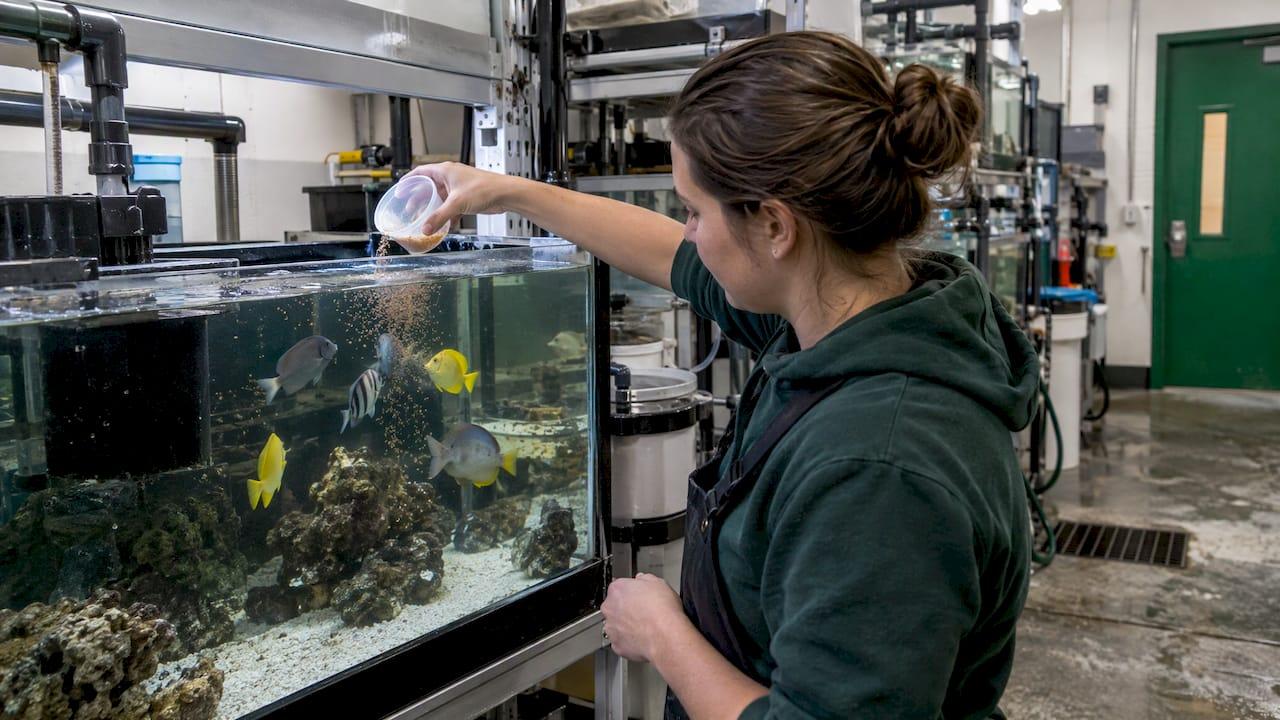
Feeding live food ethically comes down to three tests: the animal eating it should benefit, the food should be raised with care, and its source should not strain wild ecosystems. Farmed live brine shrimp fed on microalgae meets all three. They are cultured on land, so nothing is taken from the wild. They are raised on a controlled diet, so their nutrition is consistent. And they give aquarium fish, corals and exhibit animals the movement and feeding response that many species look for. Our own live brine shrimp, available from $17 to $35 per order, are grown this way.
This guide is for aquarium hobbyists, fish store and pet retail buyers, fish farmers, and museum or research aquarium staff. It explains when live feeding is justified, what to ask a supplier, and how to handle live feed so that nothing suffers needlessly.
TL;DR
- Live feeding is easiest to justify when it supports natural behavior, growth and survival, and when the predator is not injured or stressed by the way it is done.
- Source matters as much as method: ask whether the feed is wild-caught or farm-raised, where, and how, and avoid anything of unknown origin.
- Farmed, land-based brine shrimp avoids wild harvest pressure and seasonal swings. Ours are fed only the microalgae Dunaliella and are guaranteed at least 40% protein.
- Good handling, meaning feeding promptly, storing correctly and removing leftovers, protects both the animals and your water quality.
- Build live food into a balanced plan. Match it to the species, and watch body condition and appetite.
Table of Contents
- What "ethical" means when you feed live food
- When live feeding is justified
- Why no single food fits every species
- Sourcing: farmed versus wild-harvested
- Handling live feed humanely
- An ethical live-feeding routine
- Our live brine shrimp, for hobbyists and facilities
- Our perspective
- FAQ
- Sources
What "ethical" means when you feed live food
Search this topic and you will find heated arguments about feeding live vertebrates, such as mice or feeder fish, to predators. That debate is real, but it is only one corner of the subject. For most aquarium keepers and aquatic facilities the practical questions are broader:
- Is it good for the animal being fed? Does the food support health, growth, natural behavior and normal feeding?
- Was the food itself raised responsibly? Was it cultured under controlled, well-managed conditions, or taken from somewhere unknown?
- What does sourcing do beyond your tank? Does it add pressure to wild populations or habitats?
An ethical routine answers all three. It does not require you to give up live food. It requires you to choose and handle it deliberately.
When live feeding is justified
The most useful research here is a 2019 PLOS ONE study by Marshall, McCormick and Cooke on how professionals view live prey feeding. It reports that some people consider live feeding necessary to promote behaviors that occur naturally in the wild, with possible benefits for behavior, general health and lifespan. The same study also names the risks that apply when prey fight back: injury to the predator while hunting and killing, and wasted energy in an enclosure that is unnatural or limited in size.
The study gives concrete examples of the benefit. Cuttlefish show greater growth and survival when fed live shrimp rather than frozen. In seahorses, prohibiting a live diet can have fatal consequences for developing fry. The study also notes that the health benefit disappears when hunting causes significant damage, which can happen in small tanks.
From this, a practical rule follows. Live feeding is easiest to justify when:
- the species has a documented need or strong preference for live prey;
- the prey cannot injure the predator;
- the enclosure is big enough for natural feeding behavior without harm;
- the amount offered matches what will be eaten, so no prey is left to suffer or foul the water.
Small, cultured crustaceans such as brine shrimp suit this rule well. They are a food organism that fish, corals and many invertebrates feed on naturally, and they pose no danger to the animal eating them. Our guide to why fish prefer live food goes deeper into the feeding response, and why live food triggers feeding covers it from the behavior side.
Rules in regulated settings
The same 2019 study notes that in the UK, live prey feeding in captive settings needs written justification and ethical review, and only after a veterinary surgeon advises it. Trained staff must observe the feeding away from public view, and uneaten prey must not remain in the enclosure. It also found that UK and US professionals differ in how acceptable they find live feeding in some scenarios. US readers should treat the UK rules as a model of careful practice, not as a US legal requirement. If you run a facility with a veterinarian, ask them about your own protocol.
Why no single food fits every species
An ethical diet starts with knowing what the animal needs, and that knowledge is thinner than most people assume. A 2023 review of fish welfare in public aquariums points out that specific nutritional requirements are unknown for most captive fish species. Commercial formulated feeds exist for carp, salmonids and catfish, but they are often a poor fit for the many species kept in public aquaria. The general recommendation is a palatable diet that meets the species' daily nutritional and behavioral needs.
The same review lists the natural foods some aquariums use, including brine shrimp, krill, bloodworms and algae. Its caution is about quality and acceptance. Food must be free of contaminants and pathogens. If a fish does not recognize or accept what you offer, the food decomposes on the bottom and harms water quality, or other fish eat it and become obese. Either outcome is a welfare problem.
This is why acceptance matters ethically, not just practically. Food that is eaten readily, fully and quickly is food that does not pollute the tank. Our captive fish nutritional protocol lays out how to build a plan around the species, and the article on protein in captive marine animal health explains why protein quality is worth paying attention to.
Sourcing: farmed versus wild-harvested
The second ethical test is where the food comes from. A 2023 PLOS ONE study by Fischer and colleagues assessed aquarium exhibit tanks and found high welfare scores overall: an average of 78.8 for wild-collected fishes and 74.5 for aquaculture fishes, out of a maximum of 84. It concluded that sustainable harvest can work in low to moderate numbers. It also describes what controlled sourcing offers: animals accustomed to being fed by people, with preventive care such as parasite management before they arrive and could spread disease to established tanks. The authors suggest considering aquaculture as a way to relieve pressure on stressed aquatic environments or where large numbers of fish are being taken.
That reasoning extends to feed. Wild-harvested live food depends on what nature provides in a given season and place. Farmed feed is produced on a schedule, in a known environment, with a known diet. That is the logic behind our approach: land-based, organic and sustainable systems, with brine shrimp fed exclusively on the microalgae Dunaliella. Our aim is a guaranteed minimum of 40% protein and consistent nutritional quality, avoiding the seasonal variability and starvation conditions that wild populations can face. You can read how our brine shrimp are produced on our product page.
Sustainability is also a footprint question for larger operations. The ACP Sustainable Purchasing Guide from March 2024 reports that animal feed accounts for 23% of the greenhouse gas emissions associated with procurement among the ACP members who reported. For a zoo or aquarium, feed is therefore one of the largest levers for reducing impact. Our guides to sustainable fish food and environmentally responsible fish food cover this ground for buyers.

Questions to ask any feed supplier
Professional guidance on seafood purchasing is consistent: ask, and expect clear answers. The Nutrition Advisory Group's sustainability article recommends asking for the common and species name, whether the product is wild-caught or farm-raised, and how and where it was caught or farmed. If a product comes from several sources during the year, ask for the countries, methods and time of year of the catch.
The Association of Zoos and Aquariums' March 2026 procurement guidance adds three habits for buyers:
- request documentation and transparency on certifications such as MSC, ASC or BAP;
- prioritize vendors that supply Seafood Watch Best Choices and Good Alternatives;
- avoid products of unknown origin so that everything stays traceable.
The same piece notes that nutrition data for many seafood species remains incomplete, which makes simple like-for-like feed swaps hard. Its author stresses the value of clear communication with vendors about your sustainability goals, and of buyers comparing notes. That applies to every retailer and facility buying live feed: state what you need, and choose suppliers who can tell you exactly how their product is raised. Our guide to sourcing sustainable aquatic feed in 2026 turns this into a buying checklist.
Handling live feed humanely
Ethical sourcing is wasted if the feed is mishandled afterward. Several professional documents set out the basics that apply to anyone keeping aquatic animals.
Feed on time and transition thoughtfully
The Pet Industry Joint Advisory Council's best management practices for aquatic wholesalers say fish should be fed within three hours of arrival. They add that initially wild fish should be offered live feeds and moved to artificial feeds within 24 hours. An aggressive feeding response should appear by the third feeding. If fish are not eating by the third presentation, change the diet or look for parasites or disease. For retailers, this timing is a welfare standard, not just a sales detail.
Timing also matters in collection and shipping. A marine aquarium trade best practices document from For the Fishes states that small to medium fish under 4 inches should be fed 5 days after collection, and larger fish after 8 to 9 days. If shipment is delayed, the animals must still be fed or they suffer irreversible digestive damage. Fish that go unshipped and unfed for three weeks or more should be returned to the sea.
If you are moving fish onto live food, our guide on how to transition fish to live food walks through it step by step.
Store feed correctly
The PIJAC practices give clear storage windows: use feed within 2 months if stored at ambient temperature, within 6 months if refrigerated or frozen, and within 1 to 2 days if open bags or containers sit at room temperature. Keep food in closed containers to prevent insect and rodent infestations, and keep unopened containers off the ground. The same document recommends acclimating incoming animals in a dedicated area to limit disease transmission.

Live shipments follow their own timing. Plan so that a live shipment is used while it is fresh, and have your tank or holding system ready before it arrives.
Supervise feeding, especially in public settings
The Nutrition Advisory Group's guidance on fish fed to fish-eating animals, published through USDA APHIS in 2023, says food must be wholesome, palatable, free from contamination, and of sufficient quality and nutritive value. An employee who manages the species should oversee feeding, and staff should be trained to notice changes. It allows public feeding of fish when the institution provides the food, holds it under proper conditions, and a qualified employee supervises. Museums and exhibit aquariums that offer feeding experiences can use this as the standard for their programs. Our live aquatic exhibit nutrition guide covers that setting in more detail.
An ethical live-feeding routine
Putting the evidence together gives a routine any keeper or facility can follow.
- Know the species. Find out whether it needs, prefers or simply tolerates live food. Use live food where it supports natural behavior and growth.
- Choose cultured over unknown. Pick feed raised in a controlled system with a stated diet and origin. Avoid organisms scooped from unknown water.
- Ask the source questions. Species, wild or farmed, where, how, and for facilities, certifications and traceability.
- Prepare before delivery. Have the tank, holding system and feeding area ready. Keep new animals and new feed separate from established systems until they are checked.
- Feed in measured amounts. Offer only what will be eaten within a few minutes. Remove leftovers so they do not decompose.
- Watch the result. Steady body condition, normal feces, consistent appetite and little uneaten food indicate the plan is working. If a fish refuses food by the third presentation, change the diet or investigate disease.
- Keep a balanced diet. Use live food as part of a complete plan matched to the species, not as a substitute for nutrition the animal needs.
- Store and rotate. Follow the storage windows above and use feed while it is fresh.
Our live brine shrimp, for hobbyists and facilities
If you want a live food that fits the routine above, we raise brine shrimp on land in organic, sustainable systems, feeding them only the microalgae Dunaliella. They are guaranteed to contain at least 40% protein, whatever the season.
You can order live brine shrimp from $17 to $35 as a one-off purchase. Our monthly membership is $25 per month and delivers live brine shrimp on a recurring basis. For corals and filter feeders we also offer live phytoplankton at $20. Fish stores, museums and research institutions can use the bulk store order. Gift cards run from $10 to $50.
Browse the full range on our featured products page.
Our perspective
Ethical live feeding is not a question of live versus not live. It is a question of what the animal needs, how the food was raised, and how carefully it is delivered.
We built Demeter Biosciences around that idea. Our brine shrimp are grown in land-based systems, fed only on the microalgae Dunaliella, and raised to a guaranteed minimum of 40% protein. That means no dependence on wild harvests, no seasonal swings in quality, and a feed whose origin we can describe from start to finish.
We think buyers should expect exactly that kind of transparency from any supplier of live food. Ask where it comes from and what it ate. When the answer is a controlled, sustainable system with a defined diet, you can feed with confidence, whether you keep a single reef tank or supply a hundred stores.
We also believe the same thinking belongs in research and education. Museums, schools and institutions that show visitors living aquatic ecosystems are in a position to model careful, responsible feeding. We are glad to supply them.
Demeter
FAQ
Is it ethical to feed live food to fish?
It can be, when the live food supports natural behavior, growth or survival and does not injure or stress the animal eating it. Research on cuttlefish and seahorse fry shows live diets can improve survival in some species. Choose food raised in a controlled system, and feed amounts that will be eaten.
Is farmed live food better than wild-caught?
Farmed feed comes from a known environment with a known diet, so quality and origin are traceable. Research on aquarium sourcing notes that aquaculture can ease pressure on stressed wild environments. Our brine shrimp are farmed on land and fed only on Dunaliella microalgae, with at least 40% protein guaranteed.
What should I ask a live food supplier?
Ask for the species name, whether it is wild-caught or farm-raised, and where and how it was raised or caught. Facilities should also ask about certifications and traceability, and avoid products of unknown origin. Professional zoo and aquarium guidance recommends these same questions.
How much live food should I give?
Offer only what your animals will eat within a few minutes, and remove leftovers so they do not decay and foul the water. Watch for steady body condition, normal feces and a consistent appetite. If a fish is not eating by the third presentation, change the diet or have the fish checked for parasites or disease.
Can I use live brine shrimp as a regular part of the diet?
Yes. Many keepers and facilities use brine shrimp alongside other foods, matched to the species. Our monthly membership delivers live brine shrimp on a schedule, so you can keep a steady routine. Ask your veterinarian or aquatic specialist if you manage a sensitive or unusual species.
Sources
- Perception of the ethical acceptability of live prey feeding (PLOS ONE, 2019)
- Fish Welfare in Public Aquariums and Zoological Collections (PMC, 2023)
- Using ecosystem health and welfare assessments to determine sustainable harvest (PLOS ONE, 2023)
- ACP Sustainable Purchasing Guide (March 2024)
- Sustainability Issues Come Home: Choosing Seafood for Zoo Animals (Nutrition Advisory Group)
- Sustainable Procurement of Feed Sources (AZA, March 2026)
- Best Management Practices for Freshwater and Marine Aquatic Wholesalers (PIJAC, 2016)
- Best Practices for the Marine Aquarium Trade (For the Fishes, 2010)
- Handling Fish Fed to Fish-Eating Animals (Nutrition Advisory Group, 2023)