
Sustainable aquatic product sourcing is defined as the practice of selecting feed ingredients and suppliers that meet environmental, economic, and social standards throughout the entire supply chain. Aquaculture farmers who source sustainable aquatic feed products reduce ecosystem pressure, meet tightening regulatory requirements, and protect long-term profitability. The Aquaculture Stewardship Council (ASC) Feed Standard and Chain of Custody certification are the two most recognized frameworks governing this process in 2026. Sustainable seafood supports environmental health and the communities that depend on it, and purchasing decisions without verified provenance actively reshape markets for the worse.
What does sourcing sustainable aquatic feed products require?
Before you contact a single supplier, you need three things: a clear understanding of relevant certifications, a method for verifying supplier claims, and a framework for ranking suppliers by environmental risk.
The ASC Feed Standard defines what qualifies as a sustainable aquaculture product at the feed level. It covers ingredient sourcing, traceability, and social responsibility. Chain of Custody certification goes one step further. It verifies traceability at every stage of the supply chain, preventing the mixing of certified and non-certified feed products. Farm-level certification alone does not guarantee feed sustainability. You need both.

Self-reported supplier questionnaires are the weakest form of sustainability data. Third-party sustainability rating platforms now cover more than 150,000 companies across 205 industries in 180 countries. That scale means you can benchmark any major feed supplier against verified peers rather than trusting their own claims.
Key certifications and evaluation tools for sustainable feed sourcing:
- ASC Feed Standard: Covers ingredient origin, social compliance, and environmental impact
- MSC Chain of Custody: Verifies traceability from ingredient source to finished feed product
- Third-party sustainability rating platforms: Provide audit-ready scores across environmental, social, and governance dimensions
- Life cycle assessments (LCAs): Quantify environmental impact per kilogram of feed produced
- Science Based Targets initiative (SBTi): Sets the threshold for credible supplier emissions reduction commitments
| Evaluation Tool | What It Verifies | Best Used For |
|---|---|---|
| ASC Feed Standard | Ingredient sourcing and social compliance | Farm and feed supplier selection |
| Chain of Custody | Traceability at every supply chain stage | Preventing certified/non-certified mixing |
| Third-party rating platforms | Cross-industry sustainability benchmarking | Supplier shortlisting and ongoing monitoring |
| Life cycle assessments | Carbon and resource footprint per feed unit | Comparing ingredient alternatives |
Pro Tip: Request a supplier's Chain of Custody certificate number and verify it directly on the ASC or MSC public database before signing any purchasing agreement.
How to source sustainable aquatic feed products step by step
Start with your highest-volume suppliers. Environmental impact scales with purchase volume, so targeting your top five feed suppliers first delivers the greatest reduction in your overall footprint.
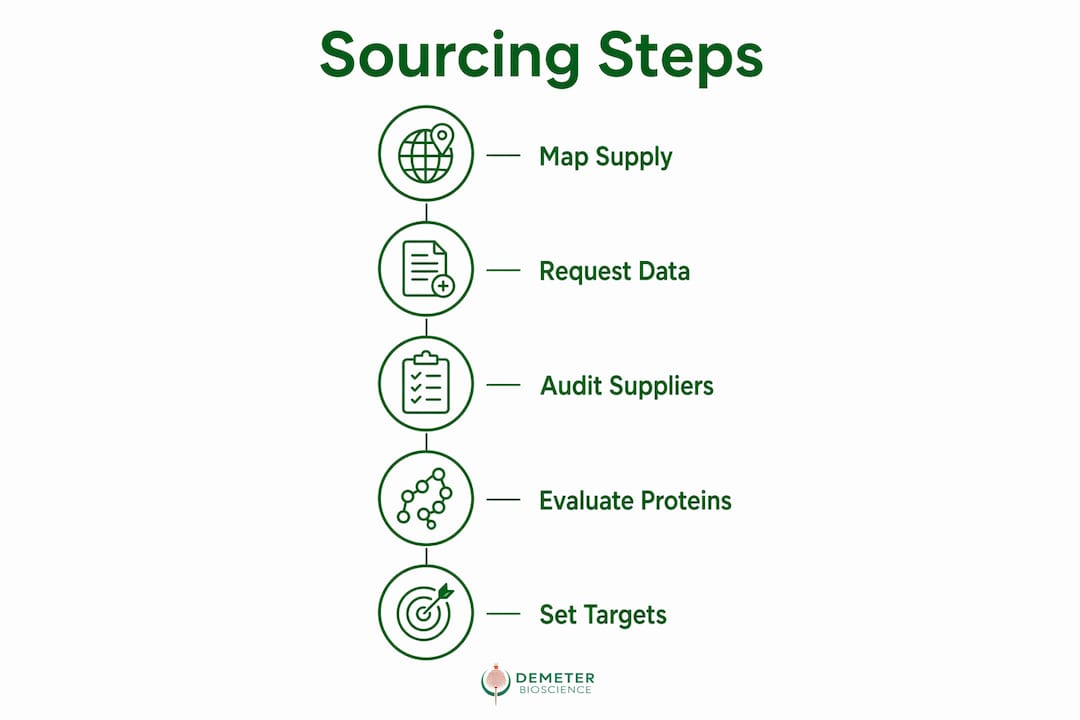
Step 1: Map your current feed supply chain
List every ingredient in your current feed formulation and identify which supplier provides each one. Note the country of origin, the ingredient category (fishmeal, soy, algae, etc.), and whether any existing certification covers it. This map becomes your baseline for measuring improvement.
Step 2: Request primary sustainability data
Ask each supplier for primary data: product carbon footprints, life cycle assessments, or verified emissions reports. Primary supplier data is more accurate than spend-based estimates, though it requires more effort to collect. Spend-based estimates use average industry figures and miss supplier-specific practices entirely.
Step 3: Audit live feed supplier sustainability practices
On-site audits work best when they are targeted by risk, not applied uniformly. Risk-informed auditing focuses resources on suppliers with the highest environmental exposure, such as those sourcing fishmeal from unmanaged fisheries or operating in regions with weak labor protections. A practical guide to evaluating fish food suppliers can help you build a scoring rubric before the audit begins.
Step 4: Evaluate alternative protein ingredients
Fishmeal is the single largest driver of environmental impact in most aquaculture feed formulations. Replacing a portion of it with microalgae, insect meal, or fermentation-derived proteins reduces both your carbon footprint and your exposure to wild fishery volatility. Demeterbioscience cultivates brine shrimp fed exclusively on the microalgae Dunaliella, delivering at least 40% protein content with full traceability from algae to animal. Microalgae as fish feed represents one of the most nutritionally consistent alternatives available today.
Step 5: Set measurable targets and engage suppliers
The 2026 Science Based Targets initiative criteria require companies to cover at least 67% of their Scope 3 emissions with reduction targets or direct supplier engagement. That threshold is not aspirational. It is the minimum for credible sustainability claims. Set specific reduction targets for each major feed ingredient category and communicate them directly to your suppliers.
Pro Tip: Schedule a supplier workshop rather than sending a survey. Category managers who hold direct conversations with suppliers collect better data and get faster responses than those who rely on automated email campaigns.
What are the most common mistakes when sourcing sustainable feed?
The most dangerous mistake is accepting zero-emissions supplier reports without questioning the methodology. Zero-impact submissions that lack a calculation basis almost always indicate poor data quality rather than genuine zero environmental impact. Experienced procurement managers flag these immediately and request the underlying methodology before proceeding.
Conflicting certifications are a real problem. A supplier may hold an ASC farm certification but lack Chain of Custody documentation for the specific feed ingredients they sell you. Without Chain of Custody, you cannot verify that certified and non-certified materials have not been mixed during processing or transport. Always ask for both certificates, not just one.
Low supplier engagement is the second most common barrier. Automated surveys sent to dozens of suppliers at once generate low response rates and shallow data. Direct requests and supplier workshops consistently yield higher response rates and better data quality. Category managers with existing supplier relationships achieve the best results.
Red flags to watch for during supplier evaluation:
- Sustainability claims with no third-party verification or audit trail
- Zero-emissions reports with no calculation methodology attached
- Chain of Custody gaps between farm certification and feed ingredient traceability
- Suppliers who cannot name the fishery or agricultural source of their raw ingredients
- Pricing that is inconsistent with the cost of certified sustainable sourcing
Balancing economic viability with sustainability is a genuine tension, not a false choice. Feed certified to ASC or MSC standards typically costs more than uncertified alternatives. The business case rests on reduced regulatory risk, access to premium markets, and the long-term stability of certified supply chains.
What emerging feed ingredients are changing sustainable aquaculture?
Mycofeed is the most significant new ingredient to enter the sustainable aquaculture feed options list in recent years. Developed through fermentation of rice bran and hull with fungi, Mycofeed delivers 40% protein and 84% digestibility. Incorporating up to 50% Mycofeed in tilapia diets reduces fishmeal content to approximately 2.5% without harming growth performance. That is a meaningful reduction in pressure on wild fisheries.
Microalgae and macroalgae are the other major category reshaping feed formulation. Microalgae species like Dunaliella, Spirulina, and Chlorella deliver high protein concentrations alongside omega-3 fatty acids, carotenoids, and vitamins that synthetic supplements cannot fully replicate. Macroalgae contribute prebiotic fiber and trace minerals. Both can be cultivated on land using non-arable space and minimal freshwater, which removes two of the biggest environmental objections to conventional feed ingredients.
| Ingredient | Protein Content | Key Advantage | Environmental Benefit |
|---|---|---|---|
| Mycofeed | ~40% | 84% digestibility, low fishmeal dependency | Uses agricultural by-products (rice bran/hull) |
| Microalgae (Dunaliella) | 40%+ | Full nutritional traceability | Land-based, no wild fishery impact |
| Insect meal | 40–60% | Converts organic waste streams | Reduces feed-to-protein land footprint |
| Macroalgae | Variable | Prebiotic fiber and trace minerals | Sequesters carbon during cultivation |
Agricultural by-products represent a third category worth tracking. Fermentation technology now converts materials like rice bran, wheat middlings, and brewery waste into feed ingredients with competitive protein profiles. These ingredients repurpose waste streams that would otherwise generate methane in landfills, turning an environmental liability into a feed resource.
Pro Tip: When adding a new ingredient to your feed formulation, request a digestibility coefficient from the supplier alongside the proximate analysis. Protein percentage alone does not tell you how much of that protein your fish will actually absorb.
Key Takeaways
Sourcing sustainable aquatic feed products requires verified certifications, primary supplier data, and targeted auditing to deliver genuine environmental and nutritional results.
| Point | Details |
|---|---|
| Certifications are the baseline | ASC Feed Standard and Chain of Custody certification are the minimum verification requirements for credible sustainable feed sourcing. |
| Primary data beats estimates | Request life cycle assessments and product carbon footprints from suppliers rather than relying on spend-based industry averages. |
| Audit by risk, not by habit | Focus on-site audits on suppliers with the highest environmental exposure to maximize impact and efficiency. |
| Emerging ingredients reduce fishmeal | Mycofeed and microalgae can replace significant portions of fishmeal without compromising fish growth or nutritional quality. |
| Engagement drives data quality | Supplier workshops and direct conversations consistently outperform automated surveys for collecting accurate sustainability data. |
Why transparency is the real competitive advantage in feed sourcing
After working closely with aquaculture operations across different scales, the pattern is clear: the farms that succeed at sustainable sourcing are not the ones with the most certifications. They are the ones with the most honest supplier relationships.
Certifications matter. They set a floor. But a supplier who holds an ASC certificate and refuses to share a life cycle assessment is giving you a credential, not transparency. The farms I have seen build genuinely sustainable feed programs treat their suppliers as partners in a shared goal, not as vendors to be audited and forgotten.
The three-pillar model of sustainability, environmental, economic, and social, only works when all three are tracked simultaneously. I have seen operations that achieved impressive carbon reductions by switching to a cheaper alternative protein, only to discover later that the ingredient was produced under poor labor conditions in an unregulated facility. That is not sustainable sourcing. That is cost-cutting with a green label.
The most underrated step in the entire process is the supplier workshop. Sending a 40-question survey to a small feed producer and expecting a complete, accurate response is unrealistic. Sitting down with that supplier, explaining what data you need and why, and helping them understand how to calculate it, that conversation produces results that no automated platform can replicate.
Sustainability in aquatic feed sourcing is not a destination. It is a continuous process of verification, engagement, and improvement. The farms that treat it that way are the ones that will still be operating profitably in 20 years.
— Demeter
Demeterbioscience: sustainable live feed for aquaculture farms
Aquaculture farmers who want a live feed option with full supply chain transparency have a direct path forward with Demeterbioscience.
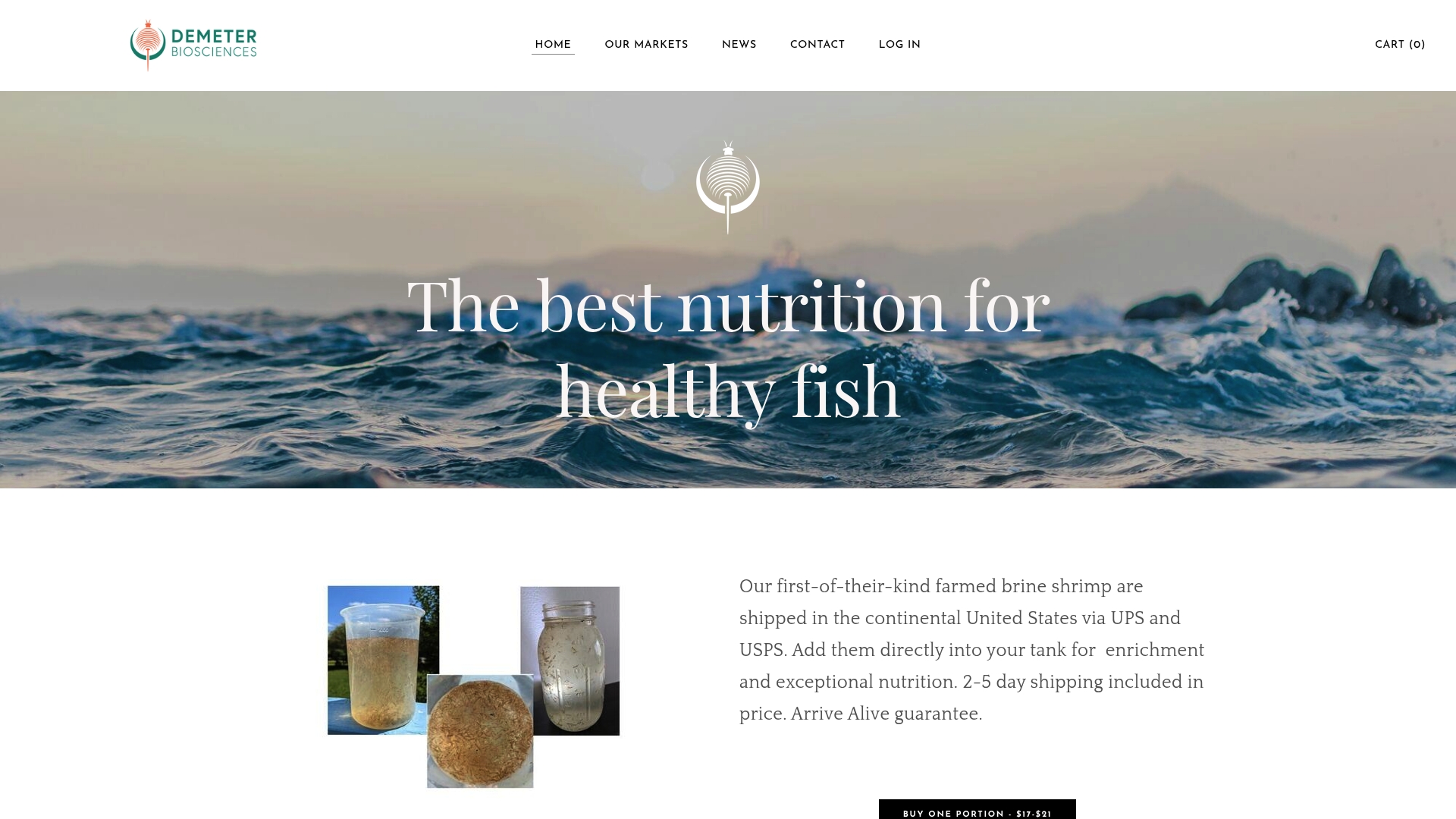
Demeterbioscience cultivates brine shrimp in land-based, organic systems fed exclusively on Dunaliella microalgae, guaranteeing at least 40% protein content and consistent nutrition in every shipment. There is no seasonal variability, no wild harvest pressure, and no uncertainty about what your fish are eating. Farmers can order live brine shrimp for direct delivery or explore bulk ordering options for larger operations and retail accounts. The farmed approach also delivers measurable environmental advantages over wild-harvested alternatives, as detailed in Demeterbioscience's analysis of farmed vs. wild feed.
FAQ
What is sustainable aquatic product sourcing?
Sustainable aquatic product sourcing is the practice of selecting feed ingredients and suppliers that meet verified environmental, economic, and social standards across the entire supply chain. It requires certifications like the ASC Feed Standard and Chain of Custody, not just self-reported supplier claims.
What certifications should I look for when comparing sustainable aquatic feed suppliers?
The ASC Feed Standard and MSC Chain of Custody certification are the two most recognized standards for verifying sustainable aquatic feed. Third-party sustainability rating platforms provide additional benchmarking across environmental, social, and governance dimensions.
How do I audit live feed supplier sustainability practices effectively?
Target audits by environmental risk rather than applying them uniformly across all suppliers. On-site audits focused on high-risk suppliers, combined with requests for primary data like life cycle assessments, deliver the most reliable picture of actual sustainability performance.
Can emerging ingredients like microalgae replace fishmeal in aquaculture diets?
Microalgae and fermentation-derived proteins like Mycofeed can replace significant portions of fishmeal without harming fish growth. Mycofeed incorporated at up to 50% of diet reduces fishmeal to approximately 2.5% in tilapia diets while maintaining growth performance.
Why do zero-emissions supplier reports raise red flags?
Zero-emissions reports without a calculation methodology almost always indicate poor data quality rather than genuine zero environmental impact. Procurement managers should always request the underlying calculation basis before accepting any zero-impact submission as valid.