
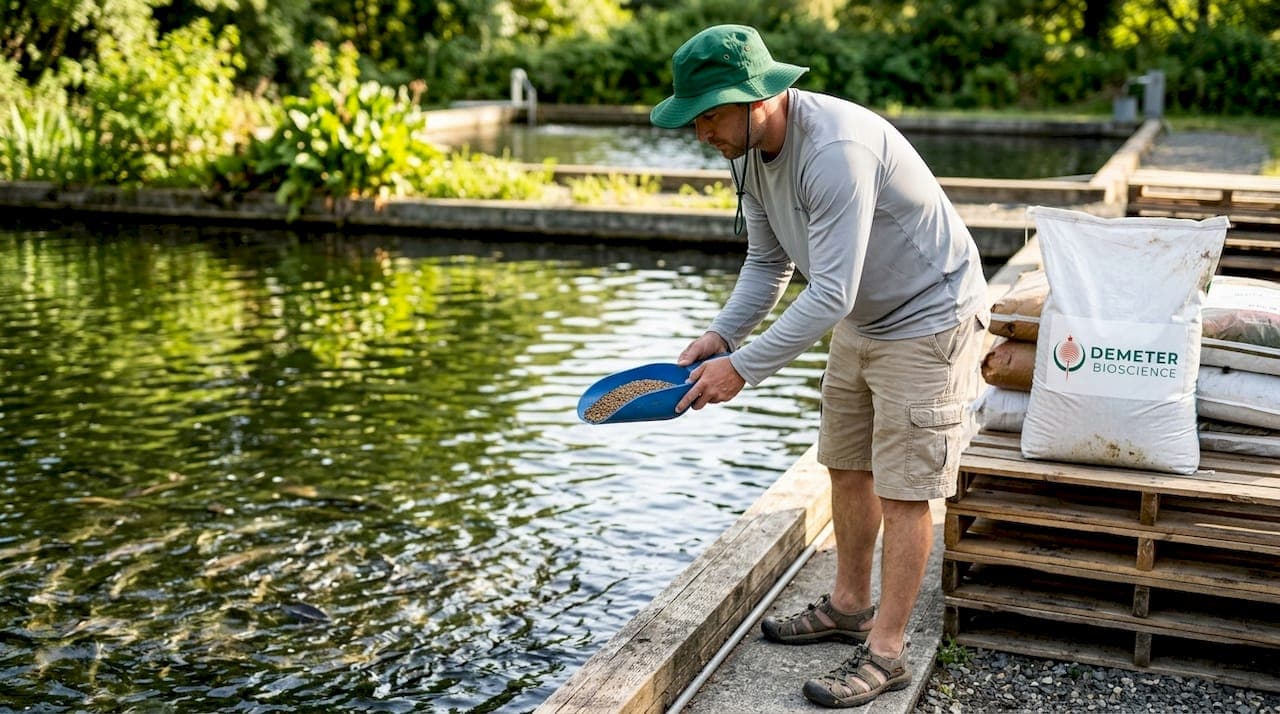
The assumption that wild-caught fish feed is automatically the greener choice runs deep among even well-informed consumers. But the data tells a more complicated story. Understanding why farmed fish food is more sustainable than wild requires looking past simple labels and into the actual environmental mechanics of each system. Fuel combustion, ecosystem disruption, feed conversion efficiency, and ingredient sourcing all factor into the real carbon math. This article breaks down where each system wins, where it still falls short, and why modern aquaculture feed formulations are pulling ahead on nearly every measurable metric.
Table of Contents
- Key takeaways
- Why farmed fish food is more sustainable than wild
- Advances making farmed feed cleaner
- Ecological and nutritional advantages of farmed feed
- Challenges and where the industry is headed
- My take on farmed fish feed sustainability
- How Demeterbioscience supports sustainable aquaculture feed
- FAQ
Key takeaways
| Point | Details |
|---|---|
| Fuel drives wild fish emissions | Boat fuel accounts for 60-90% of the carbon footprint of wild-caught fish, far exceeding feed production costs. |
| Feed is aquaculture's biggest lever | Farmed fish feed represents roughly 55% of aquaculture's emissions, making ingredient innovation the most impactful sustainability target. |
| Plant-based feeds are rising fast | Crop-based feed ingredients increased 124% between 2008 and 2020, reducing dependence on wild fishmeal. |
| Controlled environments reduce risk | Land-based farming and recirculating systems eliminate ocean contamination, genetic pollution, and bycatch with no equivalent in wild fisheries. |
| Management determines outcomes | Sustainability depends on practices and oversight, not simply whether fish are farmed or wild-caught. |
Why farmed fish food is more sustainable than wild
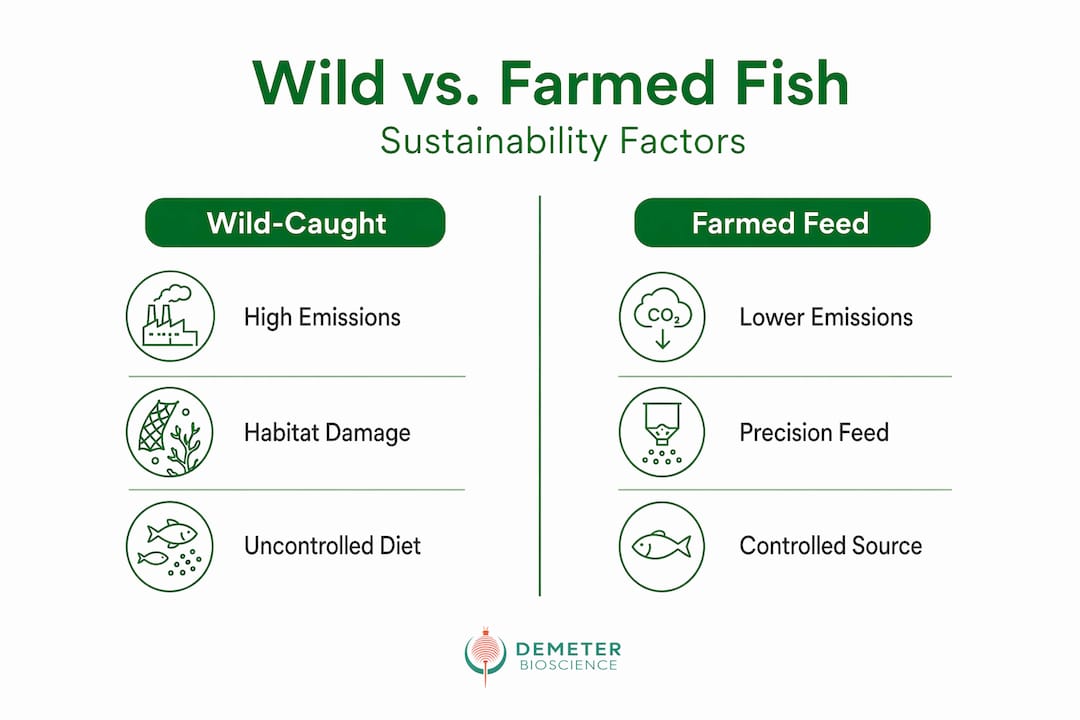
The core carbon argument for wild fish often goes like this: nature does the growing, so there's no feed to manufacture. That sounds clean until you account for the diesel burned to find, catch, refrigerate, and transport those fish across open ocean.
Boat fuel accounts for 60 to 90% of the total carbon emissions in the wild-caught fishing industry. Trawlers dragging nets through deepwater fisheries can burn thousands of liters of fuel per trip. Processing, refrigeration at sea, and long-haul shipping add substantially more. When you stack the full lifecycle, wild-caught fish frequently carries a higher carbon cost per kilogram of edible protein than most people realize.
Farmed fish feed, by contrast, does represent a real emissions source. Feed production accounts for roughly 55% of aquaculture's carbon footprint. That figure sounds alarming at first. But here's the distinction that matters: it's a controllable, improvable variable. You can reformulate feed. You cannot decarbonize a diesel engine mid-ocean at any practical scale.
The fishmeal paradox
For years, the loudest criticism of farmed fish centered on traditional fishmeal feeds. The concern was legitimate: fishmeal-based feeds paradoxically required more wild fish by weight than the farmed fish they produced. A salmon farm pulling in anchovies or herring to feed its stock wasn't solving the wild fish pressure problem. It was shifting it.
That era of feed formulation is giving way to something significantly cleaner. Between 2008 and 2020, the industry increased crop-based feed ingredients by 124%, reducing the direct draw on wild ocean stocks. The trajectory is clear, and the pace is accelerating.
Pro Tip: When evaluating the sustainability of any aquaculture operation, ask specifically about its Fish In to Fish Out (FIFO) ratio. A well-managed modern salmon farm should be trending toward or below 1:1, meaning it uses less than one kilogram of wild fish to produce one kilogram of farmed fish.
Advances making farmed feed cleaner
The feed reformulation story in aquaculture isn't just about swapping one ingredient for another. It represents a genuine scientific and industrial shift toward feeds that are nutritionally complete without drawing heavily on finite ocean resources.
Microalgae and plant proteins have emerged as the most promising alternatives to traditional fishmeal. Microalgae in particular can be cultivated on non-arable land using brackish or recycled water, producing high concentrations of omega-3 fatty acids, proteins, and pigments without any ocean extraction. Algae like Dunaliella can be grown in tightly controlled systems that eliminate the seasonal variability and nutritional inconsistency common in wild-harvested feed inputs.
Beyond microalgae, the ingredient diversification happening across the industry includes:
- Insect meal, particularly from black soldier fly larvae, which convert organic waste into high-protein biomass at low land and water cost
- Single-cell proteins derived from fermentation, offering consistent amino acid profiles with minimal land use
- Seaweed and macroalgae, increasingly used as feed supplements that add minerals and bioactive compounds
- Processed crop byproducts, such as soy protein concentrate and canola meal, which redirect agricultural co-products into feed rather than waste
Each of these reduces the demand for wild fishmeal while maintaining the nutritional density farmed fish require.
Controlled farm environments do something else wild fisheries cannot: they allow precision optimization of the Feed Conversion Ratio (FCR). FCR measures how many kilograms of feed it takes to produce one kilogram of fish. Farmed salmon typically achieve a lower FCR than wild-capture systems, meaning less total resource input per unit of edible protein. That efficiency gap compounds over millions of tons of production.
Pro Tip: Look for aquaculture operations certified by the Aquaculture Stewardship Council (ASC) or Best Aquaculture Practices (BAP). These certifications require verifiable data on feed sourcing, FCR, and environmental impact, giving you a credible baseline to evaluate sustainability claims.
Ecological and nutritional advantages of farmed feed
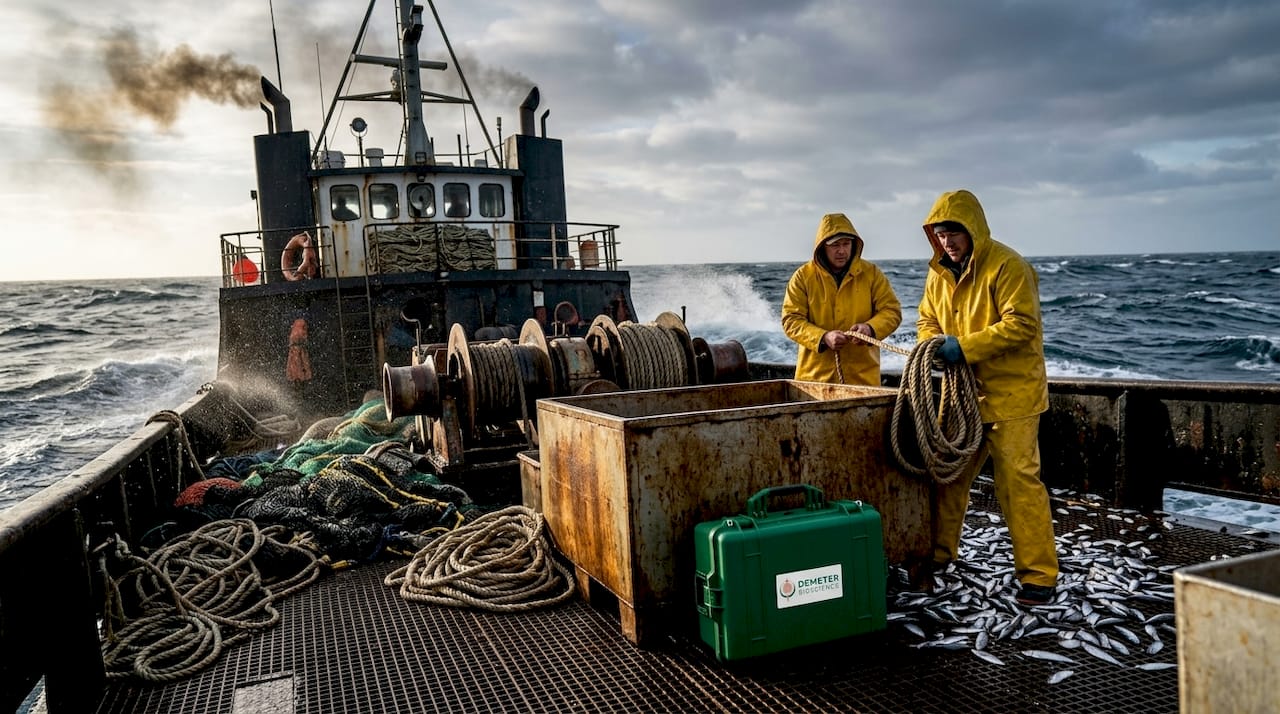
The environmental damage done by industrial wild fishing extends well beyond fuel emissions. Bottom trawling, one of the most common wild-catch methods, physically destroys seafloor habitats that took decades or centuries to develop. Bycatch, the unintended capture of non-target species, runs into millions of tons globally every year, affecting marine food webs in ways that are difficult to fully measure.
Farmed fish raised on controlled diets sidestep most of these risks by design. Here's a direct comparison of the two systems across key ecological factors:
| Ecological factor | Wild-caught fishing | Farmed fish with modern feed |
|---|---|---|
| Habitat destruction | High (trawling, dredging) | Minimal to none (land-based) |
| Bycatch risk | Significant across most methods | Near zero |
| Contaminant exposure | Variable, often elevated | Lower due to controlled feed |
| Genetic pollution risk | None | Manageable with containment |
| Fuel emissions per kg | Very high (60-90% of footprint) | Controlled at farm level |
| Feed resource efficiency | No optimization possible | FCR-optimized continuously |
Beyond the ecological comparison, farmed fish show lower exposure to contaminants than wild fish because their feed is formulated, tested, and controlled. Wild fish accumulate whatever pollutants exist in their ecosystem. The ocean is not a clean input.
U.S. fish farms rank among the most environmentally efficient food production systems in the world when managed under enforced responsible practices. That efficiency isn't accidental. It comes from precision. Controlled feed, controlled environment, controlled outcomes.
"The sustainability question isn't really 'wild or farmed.' It's 'how is this system managed and what are the measurable outcomes?' Feed formulation is where the leverage is." — Aquaculture sustainability researcher
Challenges and where the industry is headed
Acknowledging remaining challenges isn't a concession. It's the honest picture of where aquaculture stands and why continued investment in feed innovation matters.
Antibiotic use in some farmed fish operations remains a legitimate concern, particularly in regions with weaker regulatory frameworks. The risk of disease spread in net-pen ocean farms is real, and fish escape events can introduce genetic contamination into wild populations. These are not hypothetical problems.
The industry's most credible answer is structural, not just formulaic:
- Recirculating Aquaculture Systems (RAS) eliminate ocean contact entirely. RAS technology reduces water usage by over 99% compared to open net pens, prevents fish escapes, and removes the risk of ocean pollution from farm effluent.
- Circular feed economy principles are gaining traction. Nutrient-rich waste water from fish tanks can be diverted to grow algae or irrigate crops, which then re-enter the feed supply chain. Waste becomes input.
- Scalability is where farmed fish holds a structural advantage wild fisheries simply cannot replicate. Global salmon production surpassed 2.4 million tons in 2024, with over 80% farmed. Wild salmon stocks cannot be expanded. Farmed production capacity can be.
Measurable transparency through required emissions calculations and standardized reporting is increasingly being built into regulatory frameworks globally. That accountability infrastructure is what separates credible sustainability claims from marketing language.
Pro Tip: Support aquaculture operations that publish annual sustainability reports with actual emissions data, feed sourcing breakdowns, and FCR figures. Vague "eco-friendly" claims without numbers mean very little.
My take on farmed fish feed sustainability
I'll be direct about something the broader conversation usually glosses over. The sustainability debate between wild and farmed fish has been framed poorly for years, and the framing has real consequences. Wild-caught fish became a shorthand for "pure" and "natural," while farmed fish got associated with crowded pens and chemical inputs. That picture is outdated, and it's holding back consumer and policy support for the very innovations that could genuinely reduce pressure on ocean ecosystems.
What I've observed working in this space is that feed formulation is where the real environmental story lives. The emissions, the resource consumption, the ecological risk — nearly all of it flows through what you feed the fish and how you source it. Getting that right matters more than any other single variable. Microalgae-based feeds, in particular, represent something I find genuinely exciting. They close the nutritional loop without touching the ocean, and they can be produced at scale on marginal land.
I've also seen how microalgal protein functions as more than a feed ingredient. It's a food security lever. When you can grow high-protein, omega-3-rich biomass in a controlled tank rather than extracting it from a depleting ocean, you're fundamentally changing the resource equation for global fish production.
The uncomfortable truth is that well-managed farmed fish raised on modern feed formulations are, in most measurable ways, the more sustainable choice. Not because aquaculture is perfect, but because it's improvable in ways wild fisheries are not.
— Demeter
How Demeterbioscience supports sustainable aquaculture feed
The insights in this article aren't abstract for Demeterbioscience. They're the foundation of what we build. Demeterbioscience produces live brine shrimp cultivated exclusively on Dunaliella algae in land-based, organic systems. No wild harvesting. No seasonal nutritional variability. No starvation conditions that gut-load wild brine shrimp with empty calories.
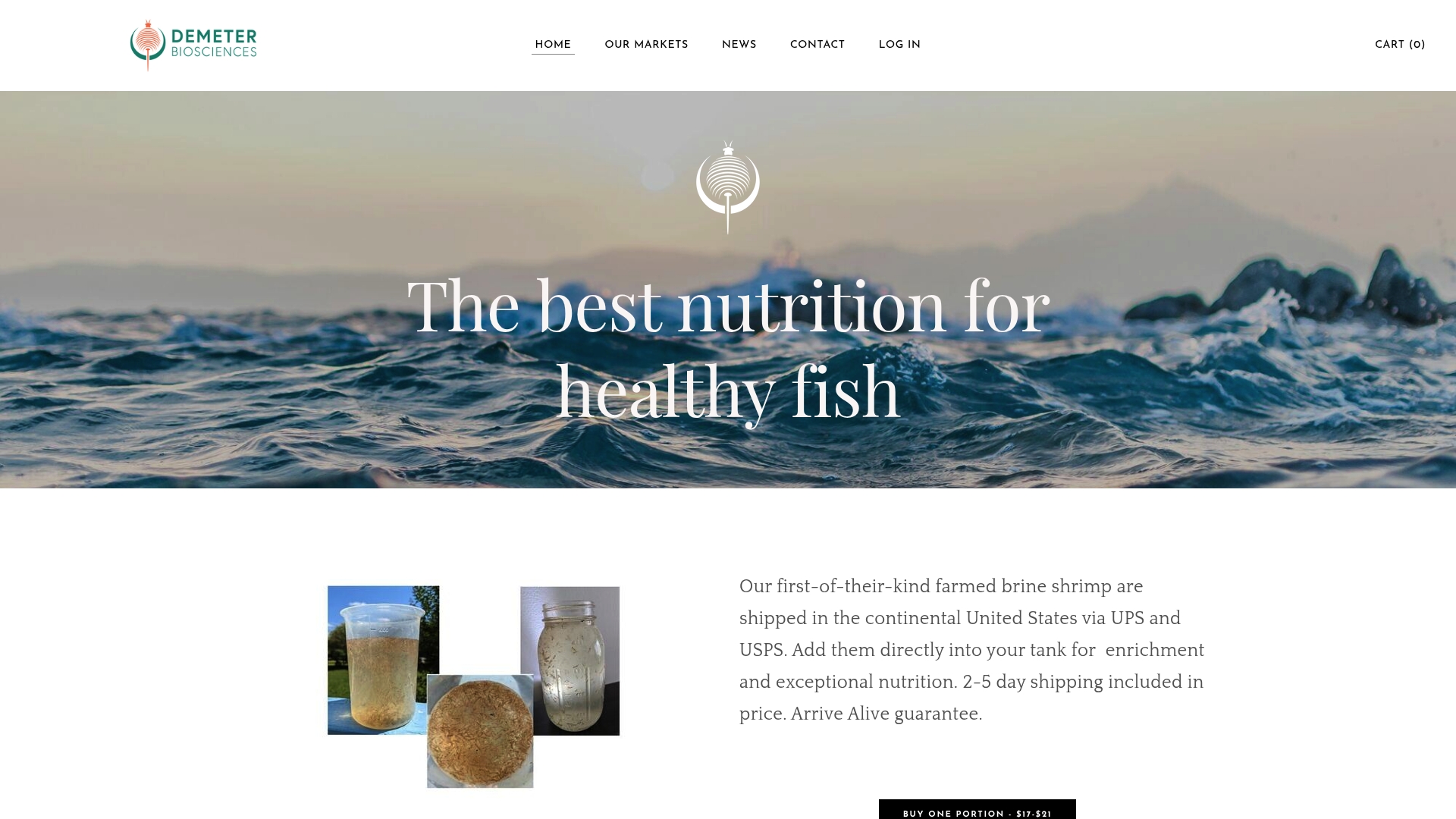
The result is a feed input with guaranteed protein content above 40%, consistent nutritional quality, and a production system that doesn't extract anything from the ocean. Whether you're supporting ornamental fish, aquaculture research, or a commercial operation looking to reduce wild fishmeal dependency, the sustainable brine shrimp feed from Demeterbioscience is built to deliver. Explore the full microalgae feed research behind our products, or review our fish meal product lines to find the right sustainable feed solution for your system.
FAQ
Why is farmed fish feed considered more sustainable than wild feed?
Farmed fish feed can be reformulated, optimized, and sourced from non-ocean ingredients like microalgae and plant proteins, while wild fishing relies on diesel-intensive vessel operations that account for 60 to 90% of its carbon footprint. Feed production is a controllable variable; ocean fuel combustion is not.
Does farmed fish feed still rely heavily on wild fishmeal?
Modern feed formulations have significantly reduced wild fishmeal dependence, with crop-based ingredients rising 124% between 2008 and 2020. Microalgae, insect meal, and plant proteins now supplement or replace fishmeal in many commercial operations.
What is Feed Conversion Ratio and why does it matter for sustainability?
FCR measures kilograms of feed required to produce one kilogram of fish. Farmed salmon typically achieve a lower FCR than wild-capture equivalents, meaning less total resource input per kilogram of edible protein produced.
Are farmed fish safer to eat than wild-caught fish?
Farmed fish raised on controlled diets show lower contaminant exposure than wild fish, which accumulate pollutants present in their natural environment. That said, the specific practices of each farm matter considerably.
What role do recirculating aquaculture systems play in sustainability?
RAS facilities eliminate ocean contact, prevent fish escapes, and reduce water usage by over 99% compared to net-pen operations. They represent the most environmentally controlled form of fish farming currently available at commercial scale.