
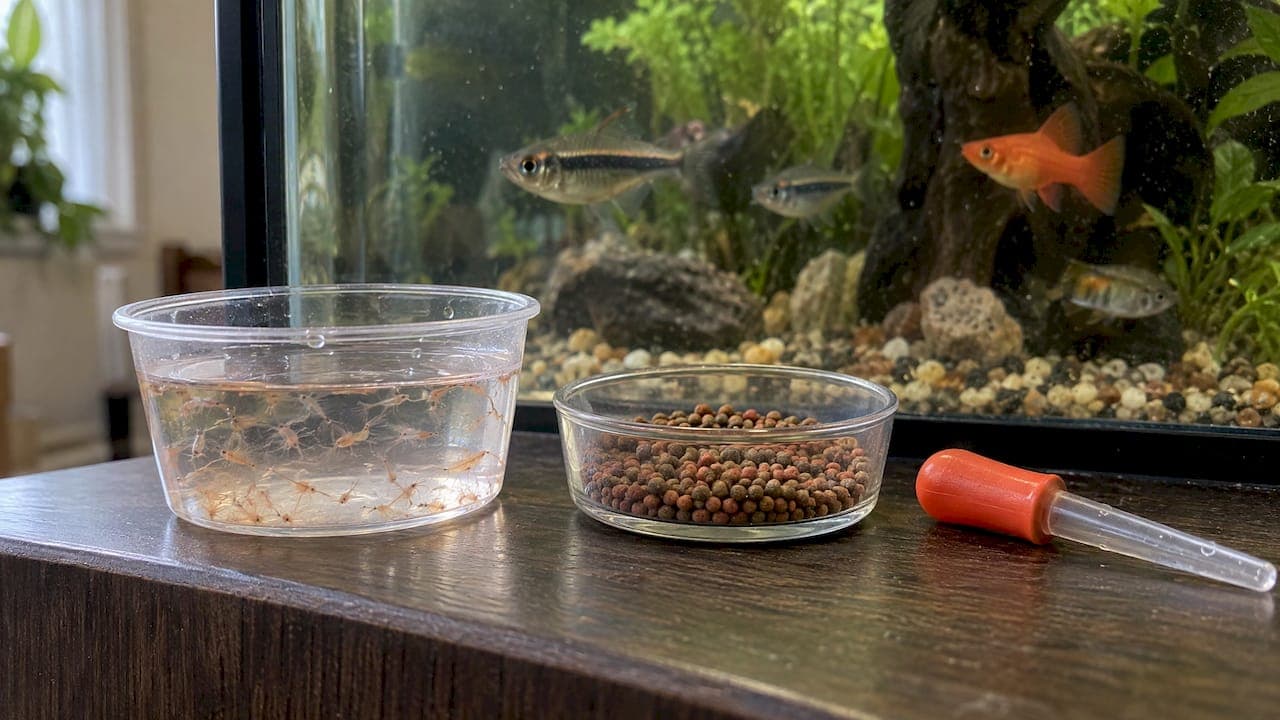
Pellets make the best daily staple for most aquarium fish, because they are formulated to be nutritionally balanced. Live brine shrimp are the best way to add variety, trigger natural hunting behavior, and bring picky or young fish into condition. You do not have to pick one. The strongest feeding plans use a good pellet as the base and live brine shrimp as the regular upgrade. This guide shows how to split the two, what each one can and cannot do, and how to feed without fouling your water.
TL;DR
- Pellets and flakes are usually formulated to supply the right nutrient mix, so they work well as a primary food, according to MSD Veterinary Manual.
- Live brine shrimp are a strong source of protein and fat, but live food alone may not be a complete diet. Pair them with a quality dry food.
- Feed a base food most days and add live brine shrimp a few times a week for conditioning, variety and fussy eaters.
- Feed small amounts, remove what is not eaten, and discard opened dry food after 2 months.
- Larvae and fry are the exception: many need live prey first, then a gradual move to microdiets.
Table of Contents
- The short comparison
- What pellets do well
- What live brine shrimp do well
- Fish by fish: who needs what
- What about freeze-dried brine shrimp?
- Do not feed live food only
- Enrichment: getting more out of live shrimp
- How to feed both without fouling the water
- Get live brine shrimp delivered
- Our perspective
- FAQ
- Sources
The short comparison
| Factor | Pellets and flakes | Live brine shrimp |
|---|---|---|
| Nutritional balance | Formulated as a mix of nutrients | Good protein and fat, but not a complete diet alone |
| Convenience | Store dry, feed in seconds, easy to automate | Need to be kept and fed from a live supply |
| Feeding response | Reliable once fish are trained to them | Strong hunting response, tempts picky fish |
| Best role | Daily staple | Conditioning, treats, fry and larvae |
| Water impact | Clouds water if overfed | Uneaten shrimp can die and foul water if overfed |
The row that matters most is the first one. Nobody should treat brine shrimp as a replacement for a balanced dry food, and nobody should treat a dry food as a replacement for the behavior and appetite live prey can bring out.
What pellets do well
A pellet is a manufactured diet. That is its strength. The MSD Veterinary Manual notes that live foods can be a good source of protein and fat but may lack other elements, while commercial dried foods are usually formulated to contain the proper nutrient mix when fed properly.
That makes pellets the reliable backbone of a feeding plan, and it explains why a betta is a good example. The University of Illinois veterinary college advises that bettas are carnivores that should be fed a balanced pelleted or flaked food daily, with brine shrimp offered as a treat in moderation. That is exactly the split we recommend: balanced base, live treat.
Pellets also win on practicality:
- They keep on a shelf, so you are never caught without food.
- Portions are easy to measure and repeat.
- They suit automatic feeders, which matters if you travel.
- Sinking and floating versions let you match feeding level, such as surface feeders versus bottom dwellers.
Flakes vs pellets
Flakes and pellets share the same logic: both are dry, formulated foods, and the MSD guidance covers them together. The difference is mostly behavioral. Flakes spread across the surface and suit small mouths and surface feeders. Pellets are denser, sink or float at a controlled rate, and tend to be easier to portion for larger fish. Pick the size your fish can swallow in one bite.
What live brine shrimp do well
Live brine shrimp do something no dry food can: they move. Many fish, from cichlids to dwarf species, respond to moving prey with a feeding enthusiasm that a dropped pellet rarely provokes. For a fish that is stressed, recovering, newly arrived or coming into breeding condition, that appetite is useful.
They also deliver real nutrition. Protein and fat are the macronutrients that live foods supply well, per the MSD guidance above. Our own farmed brine shrimp are raised on the microalgae Dunaliella, and we design our production around a protein content of at least 40%. That is our claim about our own product, and it is the reason we feed the shrimp on algae rather than letting them go hungry or depend on seasonal wild conditions.

If you want to see how the live form compares with other formats, our guide to live vs frozen brine shrimp goes through it in detail, and our comparison of brine shrimp vs bloodworms covers another common choice.
Where the brine shrimp you buy comes from matters
Most brine shrimp in the trade begin as cysts. The University of Florida's IFAS Extension explains that brine shrimp are wild-harvested from natural hypersaline lakes as dormant cysts that are easily collected, stored dry and marketed. Hatchlings from those cysts, called nauplii, are what most hobbyists feed.
The same IFAS publication points out that newly hatched brine shrimp nauplii are nutritionally deficient for most developing marine fish larvae, short on the fatty acids DHA, EPA and ARA. The practical lesson is that what a brine shrimp ate matters to the fish that eats it. A shrimp fed a consistent diet of algae carries a different nutritional profile than one that has gone without food. That is the thinking behind our land-based system, where the shrimp are fed exclusively on Dunaliella so quality does not swing with the season.
Fish by fish: who needs what
The right ratio depends on what you keep.
Bettas and other small carnivores
A daily balanced pellet or flake, with brine shrimp as a treat, matches the veterinary advice above. Two or three live or frozen servings a week is a comfortable pattern for most healthy adult bettas, and it keeps the base food from becoming boring.
Goldfish and community fish
Omnivores do best on a quality pellet as the staple. Live brine shrimp add protein and a foraging challenge. Our article on whether goldfish can eat brine shrimp safely covers portion sizes and how often. For a broader view of freshwater tanks, see brine shrimp for freshwater fish.
Gobies, blennies and other fussy marine fish
Some marine species are reluctant to take dry food at first. Research on cleaner gobies from the University of Florida found that a mixture of brine shrimp, mysis shrimp and pellet-based foods has been successful in conditioning cleaner goby species. The same publication notes that goby larvae require live food and can be gradually weaned to commercial microparticulate feeds around settlement.
That sequence is worth copying at home: begin with what the fish will eat, then mix in pellets until the dry food is accepted.
Fry and larvae
Young fish are where live food is hardest to replace. A study on rock bream larvae found that live prey supported higher growth at 25 to 40 days post hatch, while microdiet feeding increased length and growth rate at 41 to 55 days. The authors describe replacing live prey with microdiet as a major obstacle in larval nutrition. For fry, plan on live brine shrimp first and a gradual transition after. Our larval rearing guide and commercial larval nutrition guide walk through the stages.
What about freeze-dried brine shrimp?
Freeze-dried brine shrimp sit between the two formats. They store like a dry food and are convenient, and they are a handy treat or backup when live food is not on hand. They do not move, so they do not trigger the same hunting response as live shrimp. Many keepers soak them briefly in tank water before feeding so they do not float and are easier to swallow. Treat freeze-dried shrimp as a supplement to the base diet, in the same role as frozen, and read the label of the specific product for its protein and fat figures.
Do not feed live food only
Two cautions apply to any live-food plan, and both are about using it well.
First, variety. The MSD guidance says that fish fed only live food from day one may refuse other foods. If you want a fish that accepts pellets later, whether because you travel or because you use an automatic feeder, start offering both early.
Second, source. The same manual notes that live foods can sometimes introduce parasites or diseases into the fish's environment. That is a reason to buy from a clean, controlled culture rather than collecting from the wild. Our farmed shrimp are raised in controlled, land-based systems, and we explain the topic in more depth in our piece on brine shrimp disease risk.
Enrichment: getting more out of live shrimp
Brine shrimp can carry added nutrition. The IFAS publication explains that instar I nauplii cannot be enriched, but all other life stages should be enriched before being fed to marine fish larvae. It also warns that fatty acid levels can be inconsistent because the shrimp do not uniformly consume enrichments and may use some of the nutrients before being eaten.
In the rock bream study, 24-hour enrichment was associated with lower protein and n-3 LC-PUFA content than shorter enrichment times. Longer is not automatically better.
For hobbyists, the takeaway is simple. Enriching is a tool for breeders and for fish with special needs. For everyone else, the easiest route to a consistently nutritious shrimp is to start with one that was well fed from the beginning, which is how we approach it. Our post on why microalgae-fed shrimp pay off covers the 40% protein target, and the microalgae-fed brine shrimp meal guide covers the meal form.

How to feed both without fouling the water
The goal is a base food, plus supplements, in small amounts.
- Choose a primary food. The MSD guidance recommends a primary food source supplemented by other foods. A quality pellet or flake is the usual choice.
- Add live brine shrimp on a schedule. A few times a week works for most community tanks. Fry and conditioning fish may get more.
- Measure the amount. The MSD Manual's nutrition chapter says adult fish should ideally be fed 3% of their body weight daily for maintenance, and fry and fingerlings up to 5%. In practice, that is a small pinch per fish.
- Watch for leftovers. If food is still on the substrate after a few minutes, you fed too much. Remove it and cut back next time.
- Do not rotate between too many bags. Keep dry food in a pest-proof container in a cool, low-humidity spot. The same chapter advises that feeds kept at room temperature should be discarded 2 months after opening. Buy smaller bags rather than one large one.
- Fast and adjust. If a fish looks bloated or the water is cloudy, reduce portions before changing anything else.
A sample week for a community tank
| Day | Feeding |
|---|---|
| Monday | Quality pellet or flake |
| Tuesday | Live brine shrimp |
| Wednesday | Quality pellet or flake |
| Thursday | Pellet, plus a plant-based food for herbivores |
| Friday | Live brine shrimp |
| Saturday | Quality pellet or flake |
| Sunday | Light feeding or a rest day |
Adjust for species. Herbivores need more plant matter, and fry need smaller, more frequent meals.
Get live brine shrimp delivered
If you want to add live food to a pellet-based routine, we ship farmed live brine shrimp directly to hobbyists. Our one-off live brine shrimp orders are priced from $17 to $35. If you would rather have a steady supply, the monthly membership with a live brine shrimp shipment is $25 per month.
Stores, museums and institutions can order through our bulk brine shrimp program. Reef keepers who also want live algae can see our phytoplankton, which is $20 per order.
Our perspective
We do not think of brine shrimp and pellets as rivals. A pellet is a convenient, balanced base, and most tanks should have one. What a pellet cannot do is hunt, swim or wriggle, and that is where live food earns its place.
What worries us is the quality of the live food itself. Wild-harvested brine shrimp depend on natural lakes, with seasonal swings in what the shrimp can eat, and starvation conditions can leave them thin. We built our system to remove that variable. Our shrimp are raised on land in controlled, organic and sustainable systems and fed exclusively on the microalgae Dunaliella, with a design target of at least 40% protein and consistent nutritional quality from one shipment to the next.
Our advice is practical: keep your pellet, and add fresh, well-fed live shrimp on a regular schedule. That gives your fish balance from the dry food and appetite, variety and conditioning from the live food.
Demeter
FAQ
Can brine shrimp replace pellets completely?
For most adult fish, no. Live foods can be a good source of protein and fat but may not provide a complete diet, while formulated dry foods are designed to supply the right mix of nutrients. Use pellets as the base and brine shrimp as a regular supplement. Larvae are the exception, since many need live prey at first.
How often should I feed live brine shrimp?
For a typical community tank, a few feedings a week alongside a daily or near-daily base food works well. Keep the total amount small, since adult fish are ideally fed around 3% of body weight per day, and remove anything left uneaten. Fish being conditioned for breeding, and fry, may be fed more often in smaller portions.
Are flakes or pellets better to feed with brine shrimp?
Both are formulated dry foods and both pair well with brine shrimp. Choose by fish size and feeding level: flakes for small, surface-feeding fish, pellets for larger fish or those that feed lower in the water. The best one is the one your fish eat completely within a couple of minutes.
Is freeze-dried brine shrimp as good as live?
Freeze-dried shrimp are convenient and store well, so they make a good backup or treat. They do not move, so they do not bring out the same hunting response as live shrimp. Many keepers soak them in tank water first. Use them as a supplement rather than the main food.
Will my fish stop eating pellets if I feed live shrimp?
It can happen if live food is all a fish ever gets. Veterinary guidance notes that fish fed only live food from the start may refuse other foods. Offer pellets regularly, and keep live shrimp in a mix so the dry food stays familiar.
Sources
- Providing a Home for Fish, MSD Veterinary Manual
- Nutritional Diseases of Fish, MSD Veterinary Manual
- Your Betta Needs More Than a Bowl, University of Illinois Veterinary Medicine
- A Comparative Study on Growth Performance, Body Composition and Liver Metabolism of Rock Bream Larvae, PubMed Central