
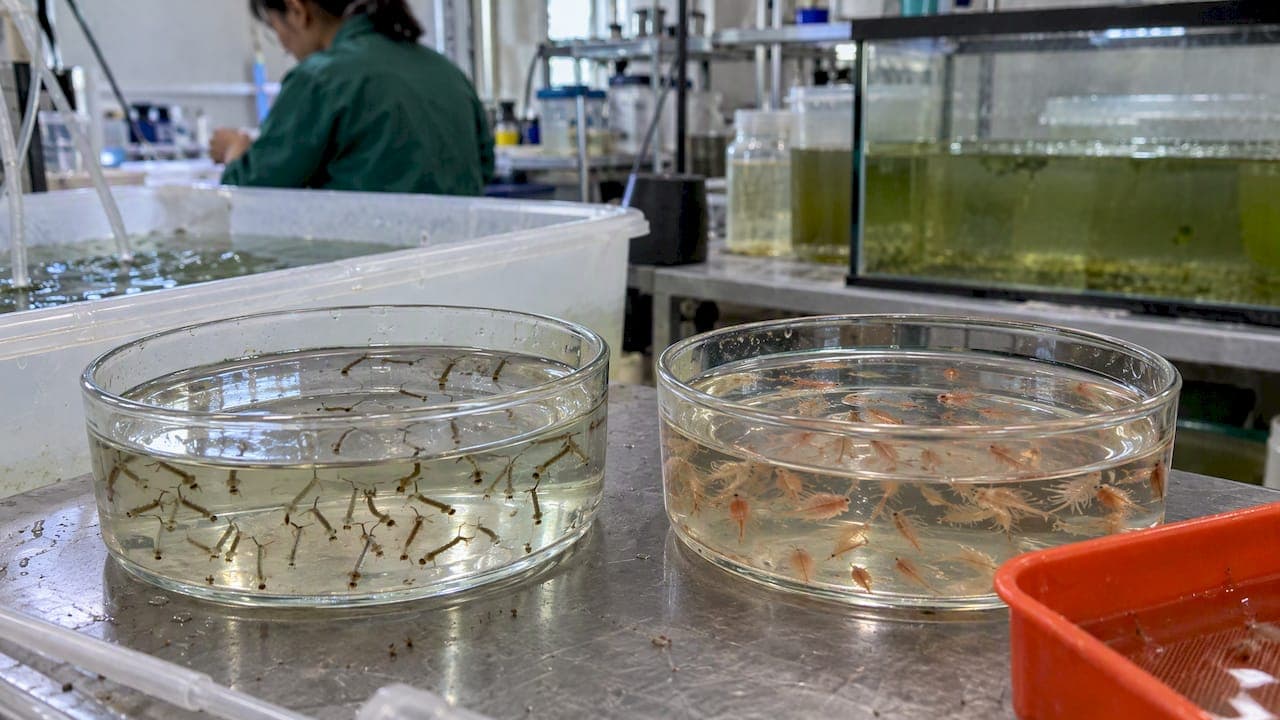
For most fish keepers, brine shrimp is the better live food. Mosquito larvae are nutritious and fish go after them, but they bring a wild-collection risk, a legal and neighborly headache, and a supply that disappears in winter. Brine shrimp, especially farmed and well fed, give you predictable size, predictable nutrition and no pathogen gamble. Below we compare the two on what matters: nutrition, safety, effort, cost and which fish each suits.
TL;DR
- Both are good protein sources. Brine shrimp (Artemia) run roughly 37% to 71% protein on a dry basis depending on strain and stage, so the feed you choose matters more than the species label.
- Mosquito larvae collected from ponds, buckets or ditches can carry parasites, bacteria and pollutants into a closed tank. Brine shrimp from a controlled farm do not.
- Raising your own mosquito larvae means breeding a pest. Brine shrimp hatch from cysts or arrive live by mail with no such issue.
- Freshly hatched brine shrimp lose energy fast, so feed them soon after hatching or buy them fed and live.
- Our pick for most home aquariums, fry tanks and small commercial setups: farmed live brine shrimp.
Table of Contents
- The short comparison
- Where mosquito larvae win
- Where mosquito larvae fall short
- Where brine shrimp win
- Which fish eat which
- Our perspective: why we do not recommend wild-collected food
- How to switch from larvae to brine shrimp
- What if you already have mosquito larvae in your tank or pool?
- Where to get farmed live brine shrimp
- Common mistakes to avoid
- FAQ
- Sources
The short comparison
| Factor | Mosquito larvae | Brine shrimp |
|---|---|---|
| Protein | High, comparable to brine shrimp | High, varies by strain and feeding |
| Source | Wild-caught or home-bred | Hatched from cysts or farmed |
| Disease and parasite risk | Real when collected from the wild | Low when farmed or hatched from cysts |
| Seasonal supply | Warm months only | Year-round |
| Size consistency | Larvae and pupae of mixed size | Uniform nauplii or adults |
| Behavior in tank | Wrigglers hang at the surface, fast swimmers | Drift in the water column, easy to catch |
| Legal and neighbor issues | Breeding mosquitoes is a nuisance and a public health concern | None |
| Effort | Constant culture of a pest | Hatch in a day, or order live |
Where mosquito larvae win
They deserve fair credit. Larvae of the common house mosquito are an old hobbyist favorite because they are soft-bodied, active and eaten by almost any surface or mid-water feeder. Killifish, bettas, guppies, hatchetfish and many small tetras take them eagerly. A study on mass culture of Culex pipiens larvae as feed for freshwater prawn examined their proximate composition and confirmed they are a workable live food in a research setting.
They are also free if you already have standing water. That is the whole appeal, and it is also where the trouble starts.
Where mosquito larvae fall short
The biosecurity problem
Wild larvae live in whatever the water holds: bacteria, parasites, pesticide residue, runoff. A forum tip that says to scoop them from a rain barrel skips all of that. One educational resource on the topic advises you not to collect larvae from stagnant ponds or ditches because they are more likely to be contaminated.
There is also a disease angle. Researchers in Sweden studying tularemia, caused by Francisella tularensis, note that human cases are assumed to be transmitted by mosquitoes. That is a human-health finding, not proof that larvae fed to fish will sicken your tank. But it is a reminder that wild mosquito larvae are not a clean, inert food, and a sealed aquarium is a poor place to experiment with them.
Breeding a pest on purpose
Culturing mosquito larvae means keeping buckets of water that produce biting adults if a single pupa escapes. The CDC's advice for homes is the opposite: empty, scrub, turn over, cover or throw out items that hold water, including buckets and pools, once a week. A larva culture that runs longer than a week is exactly what that guidance tells you to avoid. If you keep one anyway, you need to harvest everything before pupae hatch, every time.

Behavior in the tank
Active larvae are hard for slow or small fish to catch. In the prawn study above, the group fed only mosquito larvae showed significantly lower growth and survival, attributed to cannibalism. That was a prawn, not an aquarium fish, so do not over-read it. The practical lesson holds: a food that behaves unpredictably gives unpredictable results, and a single-item diet is a weak plan whatever the item.
Larvae you do not catch also keep growing. Uneaten wrigglers become pupae and then adult mosquitoes in your house.
Supply
You cannot buy a reliable stream of mosquito larvae in January in most of the US. Whatever you rely on in summer, you need a second plan for the other months.
Where brine shrimp win
Consistent, manageable nutrition
Brine shrimp are the standard live starter feed in hatcheries for a reason. Freshwater fry and marine larvae alike are commonly started on rotifers and Artemia nauplii, and no artificial feed has yet fully replaced them, according to a general overview of brine shrimp aquaculture. The same overview gives dried nauplii a range of 37% to 71% protein and 12% to 30% lipid, which shows how much the strain and handling matter.
That range is the honest part of the story. A brine shrimp is not automatically a rich food. Newly hatched nauplii live off a yolk reserve, and the USDA-funded extension publication on Artemia production for marine larval fish notes the nauplii lose a large share of their dry weight and energy within a day at room temperature. Feed them soon after they hatch, or feed ones that have been raised on a good diet.
Quality can be controlled
What the shrimp eat decides what your fish get. FAO guidance on ongrown Artemia says the nutritional quality of biomass produced in tanks resembles natural biomass except for lipid content, which is where the diet plays a role. That is why we raise ours on a single microalga, Dunaliella, rather than leaving them to whatever a lake or salt pond provides. Our full breakdown of the numbers is in our guide to brine shrimp protein content.
No pest, no permit, no culture to babysit
Brine shrimp live in salt water, so an escaped batch in a freshwater tank simply dies and never becomes anything else. There is no public-health angle and no neighbor to annoy. You can hatch cysts in a day, or skip the hatching altogether and receive live shrimp.
Easy for fish to eat
Brine shrimp drift, pulse and hover, which triggers a feeding response in fish without outpacing them. For mouth-size matching, newly hatched nauplii suit small fry, while adults suit larger fish. If you are choosing between brine shrimp and another live crustacean, our comparison of Daphnia vs brine shrimp explains how to match feed to mouth size.
Which fish eat which
- Fry and small mouths (bettas fry, killifish fry, livebearer fry, small marine larvae): newly hatched brine shrimp nauplii. Mosquito larvae are too large and fast for most of these.
- Small adult fish (guppies, tetras, rasboras, dwarf cichlids): adult or sub-adult brine shrimp, or mosquito larvae only if they come from a clean source you control.
- Surface feeders (bettas, hatchetfish, killifish): both work, but brine shrimp avoid the escape problem.
- Larger carnivores and marine fish: brine shrimp are easier to dose and, for marine species, behave better in a saltwater tank. See our overview of live fish foods for aquariums.
- Freshwater tanks specifically: brine shrimp are a regular treat in many setups, and our piece on brine shrimp for freshwater fish covers hatching versus buying farmed.
Our perspective: why we do not recommend wild-collected food
We raise brine shrimp on land, in controlled systems, fed only on Dunaliella microalgae. We aim for at least 40% protein and steady quality from batch to batch. That is the point of farming them: wild populations swing with the seasons and can go through starvation periods, and a hobbyist cannot see that in the net.

Mosquito larvae are the same story in a different animal. A free food from an uncontrolled pond has uncontrolled contents. For the hobbyist who loses a tank of fry, the savings are never worth it. If you love the idea of live, moving food, choose one whose origin you know.
We also think about what "live" means in practice. Live shrimp are not a replacement for a balanced diet, and no single live food should be the only thing your fish eat. We see them as the high-value feeding that conditions breeders, starts fry and gets fussy eaters going, alongside a quality prepared diet.
— Demeter
How to switch from larvae to brine shrimp
- Stop collecting. Do not net larvae from ponds, ditches or rain barrels for the aquarium.
- Choose your route. Hatch cysts at home for fry, or order farmed live brine shrimp for adult feeding and conditioning. Our hatching and feeding guide walks through the hatch.
- Feed small amounts. Give what the fish finish in a few minutes, then watch. Brine shrimp in a freshwater tank live only a short time, so uneaten ones are not a long-term problem, but they still add to the load.
- Rotate foods. Mix brine shrimp with other live and prepared foods. For a nutrition comparison with another popular option, see brine shrimp vs bloodworms.
- Consider live versus frozen for your routine. We cover the trade-offs in live vs frozen brine shrimp.
What if you already have mosquito larvae in your tank or pool?
Larvae in an aquarium usually mean an open container or an outdoor tank. Fish will eat them, and a covered tank prevents the problem. For outdoor water you cannot drain, the CDC says larvicides can kill larvae and pupae before they grow into biting adults, and that homeowners can use them. Read the label and follow it. If the water holds fish or you have pets, confirm on the product label that it is suitable for your situation, or ask your local mosquito control district.
For pools, larvae are a sign of neglected water rather than a swimming hazard in themselves. Fix circulation and sanitizer levels, and cover the pool when it is not in use.
Where to get farmed live brine shrimp
We ship live brine shrimp raised in our land-based system, at $17 to $35 per order depending on the size you pick. If you feed regularly, the monthly membership is $25 per month for a recurring live shipment. Fish stores, museums and research groups can look at our bulk store order. Want to give a hobbyist friend a try? Gift cards run from $10 to $50 on the gift card page. If you also keep corals or filter feeders, we sell live phytoplankton at $20.
To learn more about how we raise them, see our brine shrimp product page.
Common mistakes to avoid
- Treating "live" as automatically "nutritious." A starved wild shrimp or a contaminated larva is live, but it is not good food.
- Overfeeding larvae to leave a surplus. Leftovers become pupae and then adults.
- Feeding hatched nauplii a day late. Energy drops quickly after hatching, so time your feeds.
- Using home remedies in water that holds fish or pets. Use a labeled product instead.
- Relying on one food. Variety is what keeps a tank healthy, whichever live food you pick.
FAQ
Are mosquito larvae better than brine shrimp for fish?
Not for most keepers. Mosquito larvae are a good protein source, but wild-collected larvae can carry contaminants and pathogens, and the supply is seasonal. Farmed or cyst-hatched brine shrimp give you predictable quality all year.
Can I feed mosquito larvae to my fish safely?
Only if you know exactly where they came from and the water was clean. Even then, you are raising a pest that must be harvested before it becomes biting adults. Most hobbyists are safer choosing brine shrimp or another farmed live food.
What kills mosquito larvae instantly?
The CDC points to removing standing water or treating water you cannot dump with a registered larvicide, used exactly as the label directs. Skip homemade mixtures, which can contaminate water that fish, pets or wildlife use.
Is it okay to swim in a pool with mosquito larvae?
Larvae are not the main risk to a swimmer. Their presence signals poor circulation or sanitizing, which is the real problem. Restore the water to proper treatment, and cover it when it is idle.
Sources
- Mass culture of mosquito larvae (Culex pipiens) and their nutritive value as food for the freshwater prawn
- Are mosquito larvae safe to feed fish? (IERE)
- Tularemia and mosquito transmission in Sweden (CDC Stacks)
- Mosquito Control at Home (CDC)
- Larvicides (CDC)
- EIFAC Workshop on Mass Rearing of Fry and Fingerlings of Freshwater Fishes (FAO)
- Aquaculture of brine shrimp (Wikipedia)
- Artemia Production for Marine Larval Fish Culture (SRAC Publication No. 702)
- Tank production and use of ongrown Artemia (FAO)