
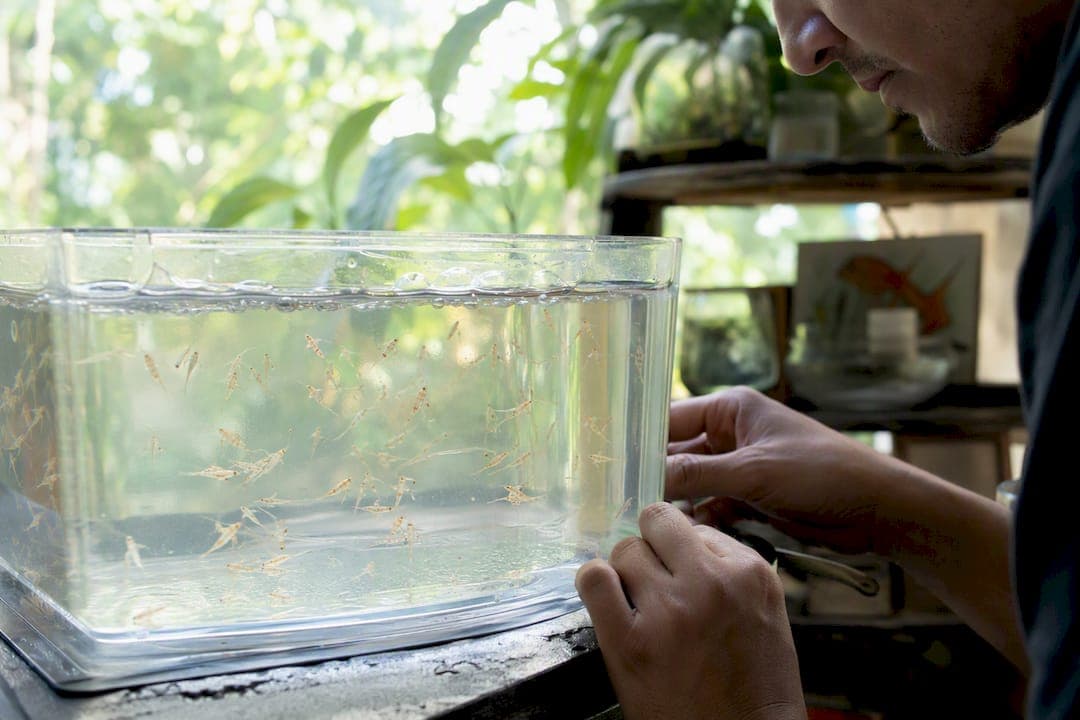
Wild-harvested brine shrimp carry a real, well-documented parasite and bacterial burden, farmed live Artemia carries much less of it, and frozen or freeze-dried products fall lowest for parasites but still deserve caution around bacterial residue. If you feed live nauplii to larval fish or shrimp, that risk profile should shape which product you buy, not just price or convenience.
A USGS-published study found that cestode prevalence in wild Artemia populations varies widely across months and species. Separately, a cross-sectional occupational study found that a significant minority of hatchery workers showed sensitization or symptoms tied to Artemia exposure. Demeterbioscience's land-based, algae-fed cultivation exists specifically to sidestep the wild-harvest variables driving those numbers.
What to do in the next 24 hours:
- Switch to a biosecure, farmed source or start decapsulating and rinsing any wild-harvested cysts before hatching.
- Discard hatch water instead of dumping it straight into production tanks or display aquariums.
- If you're feeding frozen product, thaw it fully and rinse before serving to reduce residual bacterial load.
Pro Tip: Decapsulation is the single highest-return move you can make in one evening—check out this Aquarium Care Made Easy guide for step-by-step tips on improving your hatchroom hygiene. Stripping the chorion off cysts before hatching removes external microbial contamination and most exposed parasite stages in one pass.
Key Takeaways
Disease risk from brine shrimp drops sharply as you move from wild-harvested live product toward biosecure farmed sources and proper hatchroom hygiene.
| Point | Details |
|---|---|
| Wild-harvest carries the highest parasite load | Cestode prevalence in wild Artemia populations ranged from 4% to 72% depending on month and species. |
| Format changes your risk profile | Frozen and freeze-dried products cut parasite risk sharply but can still carry bacterial residue on thaw. |
| Hatchwater is a Vibrio incubator | Discard hatch water rather than dosing it into production tanks or display aquariums. |
| Handling cysts carries occupational risk | A significant minority of exposed hatchery workers showed sensitization or symptoms in cross-sectional research. |
| Farmed sources reduce exposure | Demeterbioscience's closed, land-based, Dunaliella-fed system removes bird-driven cestode exposure and seasonal variability. |
Table of Contents
- What Pathogens Put Brine Shrimp Disease Risk on Your Radar?
- Does Product Format Change Your Disease Risk?
- How Do Pathogens Actually Spread From Artemia to Your Fish?
- How Can You Tell If Your Brine Shrimp Are Contaminated?
- What Steps Actually Reduce Brine Shrimp Pathogen Risk?
- When Should You Avoid Wild-Caught Brine Shrimp Entirely?
- What Does a Lower-Risk, Farmed Brine Shrimp Source Look Like?
- Where Demeterbioscience Fits Into Your Feed Decision
- Frequently Asked Questions
- Sources
What Pathogens Put Brine Shrimp Disease Risk on Your Radar?
Brine shrimp are not sterile packets of protein. They're small crustaceans that live in open water, filter feed constantly, and pick up whatever their environment offers. That means several distinct pathogen categories deserve separate attention rather than one blanket "clean or dirty" label.
- Avian cestodes (cysticercoids): the biggest parasite concern in wild populations. Artemia serve as intermediate hosts, and infection rates track closely with nearby waterbird activity, since these worms need a bird host to complete their life cycle.
- Vibrio species, including V. parahaemolyticus: bacteria that proliferate rapidly during hatching, especially in warm, poorly aerated hatch water, and cause disease in the larvae that eat contaminated nauplii.
- Yeasts and filamentous bacteria: documented culture-system invaders, with Leucothrix mucor infestations reported as far back as early Artemia salt-pond studies.
- Microsporidia such as EHP: occasionally identified in Artemia biomass, a concern mostly for shrimp farming operations.
- Chemical and nanoparticle residues: contaminants like flame retardants or silver nanoparticles that bioaccumulate in Artemia tissue and transfer to fish that eat them.
Most of these threats reach your tank through feed, though cestodes are partly an ecological curiosity, since the worm itself only matures in a bird, not in your fish.
Does Product Format Change Your Disease Risk?
Yes, significantly, and the differences are large enough to change which product you buy for sensitive systems. Cysts (eggs) arrive with whatever sat on their shell during harvest and storage. Decapsulating them, stripping the outer chorion with a bleach solution, cuts external contamination and hatch-associated microbial load, though it does add a processing step and slightly changes hatch timing.
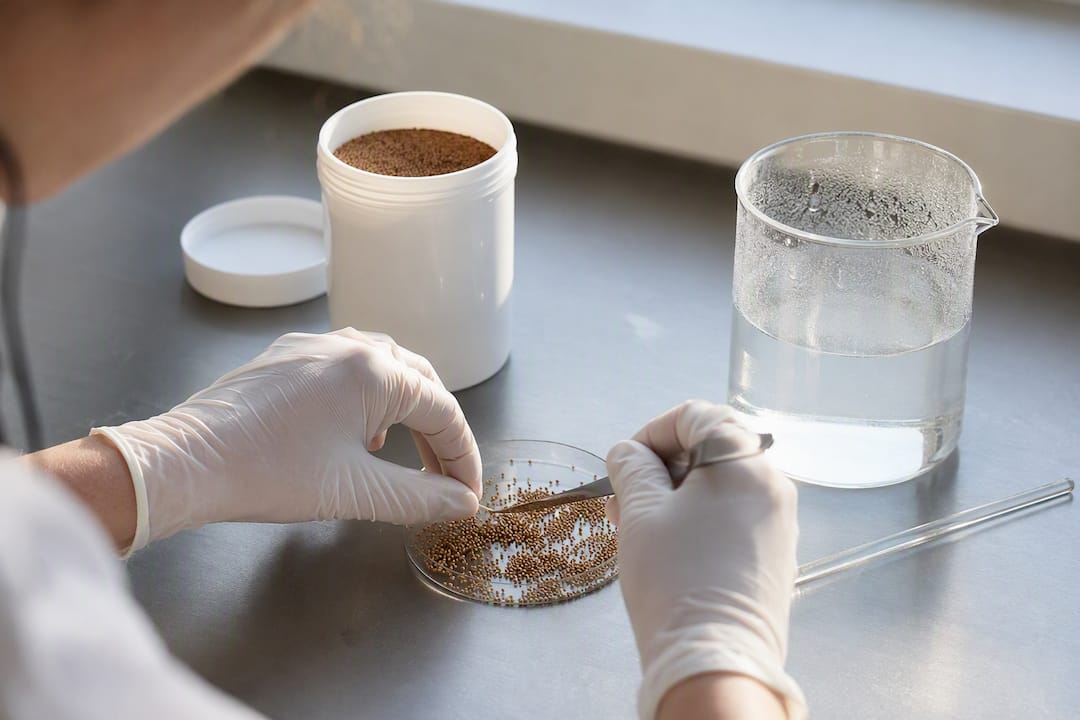
Freshly hatched nauplii carry whatever grew in the hatch water during the 24 to 36 hours it took them to emerge. Warm, stagnant hatch water is a Vibrio incubator, and newly hatched larvae have almost no gut flora to compete with it.
Live-cultured adults split sharply by production method. Open wild-harvested salt ponds, especially those near flamingo or shorebird colonies, run high cestode prevalence. Closed, land-based farms remove that exposure entirely because there's no bird contact and no wild parasite reservoir.
Frozen and freeze-dried products kill most live parasites and much of the bacterial load through processing, but Vibrio toxins and some bacterial residues can survive freezing and reappear on thaw, so the risk shifts from "live parasite transmission" toward "bacterial residue," not to zero.
How Do Pathogens Actually Spread From Artemia to Your Fish?
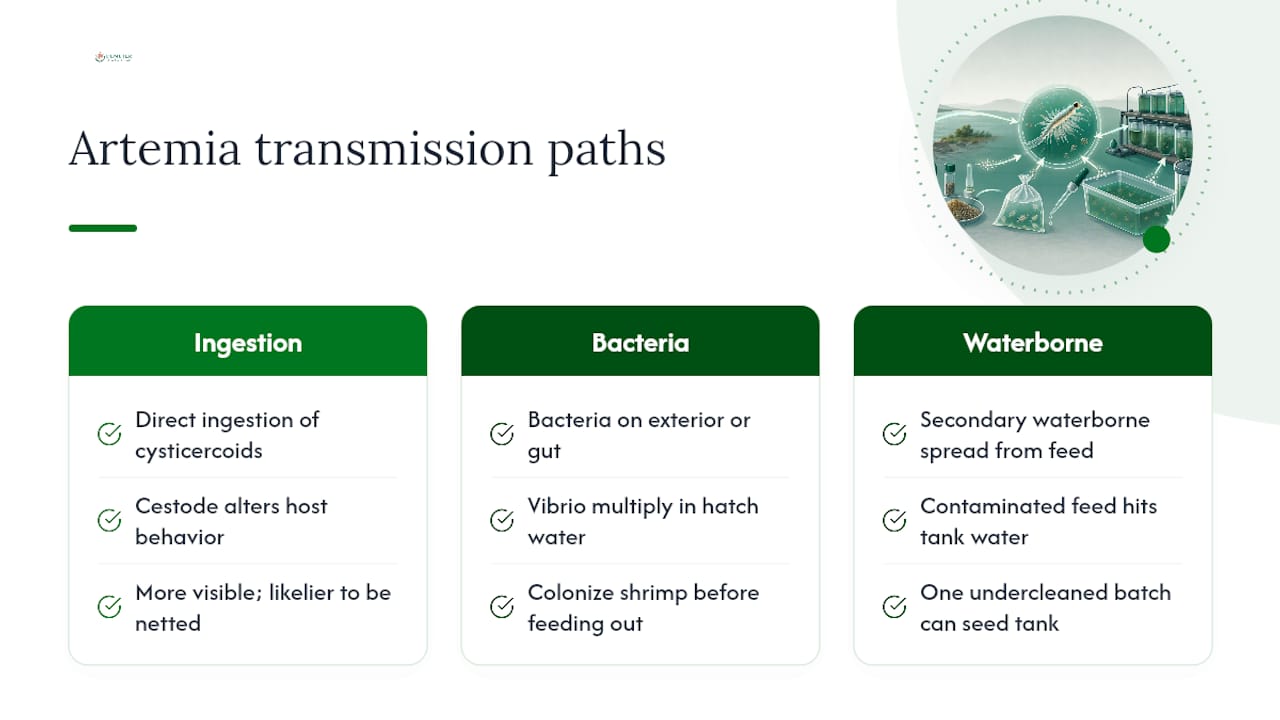
Transmission happens through three main paths: direct ingestion of infected cysticercoids, bacteria riding on the shrimp's exterior or gut content, and secondary waterborne spread once contaminated feed hits your tank water. None of these require dramatic exposure. A single batch of undercleaned nauplii can seed an entire hatch tank.
Laboratory infection work on nodavirus susceptibility has demonstrated that Artemia can act as a viral vector under experimental conditions, which matters most for marine finfish hatcheries running high-density larval systems. On the bacterial side, research on Vibrio proliferation during hatching shows the bacteria multiply fast in hatch water and colonize the shrimp before they're ever fed out, and cestode infections themselves change host behavior in ways that widen the transmission window.
Cestode-infected Artemia show altered feeding rates, reduced fecundity, and shifts in behavior that increase surface time. That combination makes infected individuals both more visible to predators and, practically speaking, more likely to be netted during harvest.
That PLOS ONE finding on cestode parasitism helps explain why wild-harvest prevalence numbers cluster so unevenly across a season.
Cestode prevalence fluctuated widely across a single annual sampling cycle, with Flamingolepis liguloides reaching notable peaks in some months for A. parthenogenetica and A.
How Can You Tell If Your Brine Shrimp Are Contaminated?
Watch the shrimp before you watch the fish. Discolored nauplii, erratic or sluggish swimming, or a sudden hatch failure often signal a bacterial bloom in the hatch water, and these signs typically show up within 12 to 24 hours of hatching. In fish, lethargy, white stringy feces, or a mortality spike within 24 to 72 hours of a feeding points back to the batch you just used.
- Run a small-scale hatch test in a separate container before committing an entire batch to production tanks.
- Check hatch water for cloudiness or an off smell, both common bacterial bloom indicators.
- Use basic microscopy to scan for visible cysticercoids or abnormal cell structures in a nauplii sample.
- For higher confidence, send pooled nauplii or hatch water to a lab for Vibrio culture or PCR virus screening, and include a moribund fish sample if mortality is already underway.
What Steps Actually Reduce Brine Shrimp Pathogen Risk?
Reducing risk isn't about doing everything at once. It's about ranking the moves by how much risk each one removes per minute of effort.
- Source biosecure or farmed Artemia first. This single decision eliminates most cestode exposure before you even open the package.
- Decapsulate and rinse cysts if you're working with a wild-harvested or unknown-origin product.
- Hatch in isolated, filtered vessels, never in a container that shares water with your display or production system.
- Discard hatch water rather than dosing it into your tank. This is where Vibrio concentrations peak.
- Avoid feeding unhatched cysts directly to larvae. Unhatched shells carry more surface contamination than swimming nauplii.
Hatchroom hygiene matters as much as the shrimp themselves. Keep water temperature and salinity consistent, restrict casual access to hatch vessels, and maintain steady aeration throughout the hatching window since stagnant zones are where bacteria concentrate fastest.
Probiotic pre-exposure has real experimental backing here. Trials testing specific lactic acid bacteria strains found that Lactiplantibacillus plantarum KCFe63 and Limosilactobacillus fermentum NCCu21 protected Artemia against Vibrio parahaemolyticus when applied before or alongside exposure. That's a meaningful tool for hatcheries running high volumes, less critical for a hobbyist feeding a single tank twice a week.
Quarantine newly fed larvae or juveniles for 48 to 72 hours and watch for the mortality or lethargy signs described above. If losses exceed your normal baseline mortality rate during that window, stop the batch and switch sources rather than waiting it out.
Pro Tip: Pair a short pre-feeding rinse with a low-dose probiotic soak. It's a five-minute habit that addresses both the bacterial residue on the shrimp's surface and the gut-level Vibrio load before it ever reaches your fish.
When Should You Avoid Wild-Caught Brine Shrimp Entirely?
Skip wild-harvest Artemia for immunocompromised larvae, high-value broodstock operations, or any harvest site with known heavy waterbird activity, since that's precisely where cestode prevalence peaks. The cost of a disease event in a high-value rearing system dwarfs whatever you save buying wild-harvested product.
Handling dry cysts carries its own risk, separate from what your fish face. Cross-sectional research on hatchery workers found that a meaningful proportion of exposed staff developed IgE sensitization or reported respiratory and skin symptoms tied to Artemia handling. Cyst dust and hatchroom aerosols are the main triggers.
- Wear a mask when handling dry cysts or during active hatching, especially in enclosed hatchrooms.
- Use gloves if you have any known shellfish sensitivity.
- Improve ventilation around hatch tanks rather than relying on open-air diffusion.
- Reject any shipment that arrived warm, with compromised packaging, or with visible moisture damage, since heat and poor packaging accelerate microbial growth in transit.
What Does a Lower-Risk, Farmed Brine Shrimp Source Look Like?
A closed, land-based farming system removes the two biggest wild-harvest variables: bird-driven cestode exposure and seasonal nutritional swings tied to starvation conditions in natural salt ponds. Demeterbioscience raises its Artemia exclusively on Dunaliella microalgae in a controlled environment, which means no wild parasite reservoir and a consistent, traceable feed history behind every shipment.
When you're vetting any supplier, farmed or otherwise, run through this checklist:
- Confirm the culture system is closed and land-based, not an open coastal pond.
- Ask what the shrimp are fed and whether that feed source is consistent year-round.
- Look for stated hygiene or testing practices, not just marketing language.
- Check shipping guarantees and what happens if a shipment arrives compromised.
- Confirm there's a real contact point for support if something goes wrong.
Product format should match your use case: hobbyists generally want live shipments sized for a single tank, hatcheries need bulk ordering with predictable volume, and researchers or museums often fall somewhere in between. For a deeper look at how controlled-diet cultivation changes the nutritional and safety picture, Demeterbioscience's research guide on source-controlled Artemia walks through the comparison in more detail.
Balancing live feed value against biosecurity
Live Artemia remain one of the best nutritional tools available for larval fish, and nothing in the parasitology research changes that fact. What it changes is where you source them and how you handle them once they arrive. The evidence on cestode prevalence, Vibrio proliferation, and occupational sensitization doesn't argue against live feed. It argues for treating sourcing and hatchroom hygiene as seriously as you already treat water chemistry. Readers who internalize that distinction, prioritizing biosecure sources and sensible protocols over convenience, will see far fewer unexplained mortality events tied back to their feed.
Where Demeterbioscience Fits Into Your Feed Decision
If you've been choosing between wild-harvested cysts from a big-box supplier and whatever live culture your local fish store has on hand, there's a third option that sidesteps the variability driving most of the risks covered here. Demeterbioscience raises its brine shrimp exclusively on Dunaliella microalgae in a closed, land-based system, which means no bird-driven cestode exposure and no seasonal starvation swings that leave wild shrimp nutritionally inconsistent.
That translates into a few concrete advantages for your tank or hatchery:
- Consistent 40%+ protein content batch after batch, not subject to wild seasonal variation.
- No exposure to avian cestode life cycles, since the cultivation system has no bird contact.
- Subscription shipments available for hobbyists who want a repeatable, lower-risk supply without reordering every time.
- Bulk packages sized for hatcheries, museums, and research institutions that need volume and traceability.
If you're feeding a single display tank, start with a live brine shrimp order sized for your setup. Running a hatchery or research program, the bulk ordering page is built for that volume. Either way, checkout walks you through product format and subscription options so you can lock in recurring shipments instead of gambling on a new wild-harvest batch every month.
Frequently Asked Questions
Is brine shrimp disease risk higher for live feed than frozen feed? Yes, generally. Live wild-harvested Artemia carry the highest parasite exposure, while freezing kills most parasites and much of the bacterial load, though some bacterial residue can survive processing.
Can brine shrimp parasites infect my fish directly? Avian cestodes need a bird host to mature, so they don't establish in fish, but Vibrio and other bacteria carried by contaminated Artemia can cause disease directly in fed animals.
How do I reduce brine shrimp pathogen risk at home? Decapsulate and rinse cysts, hatch in isolated containers, discard hatch water instead of reusing it, and source from a biosecure or farmed supplier whenever possible.
Are farmed brine shrimp actually lower risk than wild-caught? Closed, land-based farming removes bird contact entirely, which eliminates the main cestode transmission pathway and produces more consistent nutritional quality year-round.
Should I wear protective gear when handling brine shrimp cysts? Yes, especially with dry cyst dust or during active hatching. A meaningful share of exposed hatchery workers develop sensitization, so a mask and good ventilation are reasonable precautions.
Sources
- High prevalence of cestodes in Artemia spp. throughout the annual cycle: relationship with abundance of avian final hosts
- Parasitism by cestodes affects feeding rates and host fitness in Artemia spp.
- Proliferation, colonization, and detrimental effects of Vibrio species during brine shrimp hatching
- Occupational allergy to Artemia fish fry feed in aquaculture
- Global brine shrimp supply a potential bottleneck to aquaculture expansion, part 1 - Responsible Seafood Advocate