
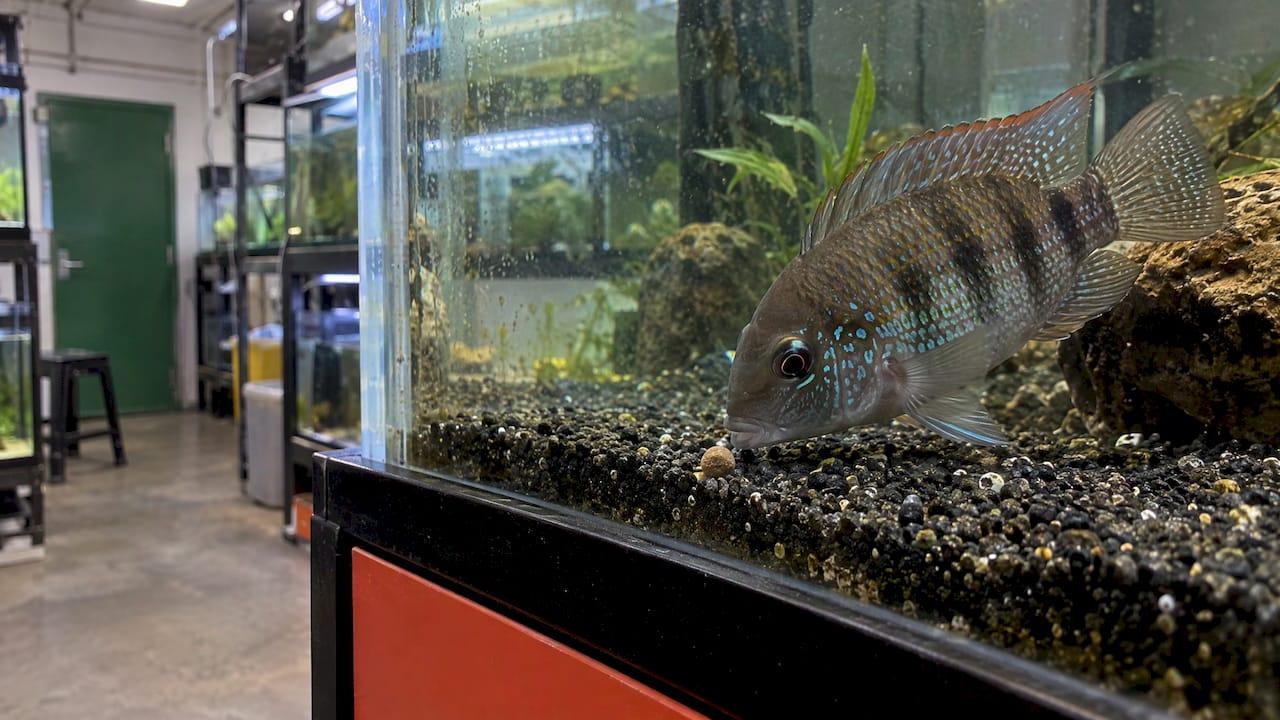
Most fish learn to take pellets when you switch them gradually. Start by making feeding time predictable. Offer a pellet sized to the fish's mouth alongside the food it already accepts. Then shrink the old food's share over about one to two weeks. Feed small amounts several times a day, and remove what goes uneaten. Fish that refuse at first usually need a longer overlap, a different pellet size or a different time of day, not force.
TL;DR
- Switch gradually. Published weaning work reports about 7–14 days of overlap, and an abrupt change can drastically cut survival.
- Match pellet size to mouth size. A pellet that is too small or too large gets ignored.
- Feed small, frequent portions. Offer only what the fish finish in a few minutes, and siphon out leftovers.
- Use a familiar food as a bridge, such as live brine shrimp, then mix pellets in and raise their share each day or two.
- If a fish refuses, change one thing at a time: pellet size, feeding time, or the length of the overlap.
Table of Contents
- Why fish refuse pellets at first
- Step 1: Get the fish settled and feeding reliably
- Step 2: Choose the right pellet
- Step 3: Use a bridge food and a gradual overlap
- Step 4: Let other fish teach
- Step 5: Feed small amounts, often
- Step 6: Keep the water clean while you train
- What to do when a fish refuses pellets
- Species notes: one method, different details
- Our perspective
- Live brine shrimp for the transition
- FAQ
- Sources
Why fish refuse pellets at first
A fish does not know a pellet is food. Many species hunt by movement, scent and shape. A hard, still, dry pellet sinking through the water looks nothing like a living shrimp or worm. Fish that were wild-caught, or raised on live food, often ignore pellets for days even when they are hungry.
That is normal. Training is not about forcing a fish to eat. It is about making the pellet familiar, then making it worth eating. Three levers do most of the work: consistency (the same time, the same spot, the same cue), the bridge (a food the fish already loves), and sizing (a pellet the fish can actually take into its mouth).
Step 1: Get the fish settled and feeding reliably
Do not start pellet training on a fish that is not yet eating well in your tank. A bowfin guide from the North American Native Fishes Association describes the order: let the fish acclimate on chopped earthworms or shrimp first, and only then introduce prepared foods, starting with freeze-dried tubifex broken into small pieces before switching to sinking shrimp pellets. The lesson holds for most picky or predatory species. Stable feeding first, new food second.

Then build a signal. A veterinary advice article on training fish suggests conditioning fish to a consistent cue that equals food: give the cue, feed a little within a few seconds, and repeat. A light tap on the lid, a particular spot at the surface, or simply you walking up to the tank at the same time works. Within a week or so, most fish come to the front of the tank when you appear.
Step 2: Choose the right pellet
Pellet choice decides more failures than technique does. A University of Florida extension guide notes that pellet size matters: a very small pellet may be unacceptable to larger fish, and a too-large pellet may be hard for smaller fish to eat. In other words, acceptance often comes down to matching particle size to mouth size.
Use this as a working checklist:
- Size: pick a pellet the fish can take in one bite without struggling. For fry and small fish, crush larger pellets to a fine grain.
- Behavior: surface feeders need floating pellets. Midwater fish often prefer slow-sinking ones. Bottom dwellers need sinking pellets that reach them before others eat them.
- Species and life stage: welfare guidance for aquaculture recommends adapting feeding regimes and pellet size and formulation to species, age, weight and behavioral needs, so follow the label guidance for your species rather than a one-size rule.
- Freshness: the same extension guide says feeds can turn rancid and some vitamins break down, so buy often and do not store feed longer than three months. Refrigerating dry feed is not recommended, but freezing is acceptable to extend shelf life. Stale pellets smell wrong to a fish, and a fish that is already wary will not touch them.
Goldfish keepers have a good example of how much the choice matters. Different goldfish food types suit different feeding styles, and matching goldfish food types to how your fish actually eats can make pellets far easier to introduce.
Step 3: Use a bridge food and a gradual overlap
The most reliable way to move a fish onto pellets is to keep the food it loves in the picture and slowly reduce its share.
Commercial weaning work supports the gradual approach. Dr. Daniel Benetti's account of weaning marine fish, published by the Global Seafood Alliance, says live feeds should be extended before dry diets are introduced, then overlapped during weaning. It reports that weaning can take 7–14 days, and that an abrupt change can drastically reduce survival. Aquarium fish are not hatchery larvae, but the principle carries over: overlap, do not replace overnight.
A home version looks like this:
- Days 1–3: feed the usual food (live brine shrimp, for example), and drop a few pellets in at the same time and place. Do not expect them to be eaten yet.
- Days 4–6: feed the bridge food first to bring the fish up to the feeding spot, then add pellets while the fish are still in feeding mode.
- Days 7–10: halve the bridge food. Fish that are hungry and used to the feeding spot will start to sample pellets.
- Days 10–14: offer pellets first, with a small bridge-food top-up only if the fish hold back.
- After the switch: keep an occasional live or frozen meal in the rotation for variety, if the species benefits.
Timelines move with the species. A trial with juvenile longfin smelt co-fed dry feed and Artemia found that the fish consumed dry feed and did as well in survival, growth and condition as fish fed Artemia alone. So a mixed diet is a legitimate end state, not a failure.
If your fish are used to live food, our guide on how to transition fish to live food covers the reverse direction, and the same overlap logic applies. For a side-by-side look at the two food types, see brine shrimp vs pellets.
Step 4: Let other fish teach
Fish learn from each other. In a pikeperch study, researchers used trainer fish (Vimba vimba) that already ate pellets. Direct application of pelleted feed with the trainers improved growth, and pellets were accepted more readily than with other adaptation methods. All groups in the 14-day trial ended up accepting pellets, which shows that persistence matters as much as the method.
At home, this means a pellet-eating tankmate of a compatible species can speed things up. Keep the pairing safe: never add a fish just to be a teacher if it could be bullied or could outcompete the newcomer. For bottom-dwelling fish such as plecos, a dedicated pleco feeder can help sinking pellets reach them in a community tank where faster fish would otherwise claim everything first.
Step 5: Feed small amounts, often
Pellet training works best when meals are short and frequent. The UF/IFAS guide says a common mistake is overfeeding pet fish, which degrades water quality. It adds that for most pets one feeding a day is enough, while young stock generally needs small meals more frequently. In an aquaculture example for fingerlings, the Global Seafood Alliance article describes feeding 6 to 10 times a day to satiation, with frequency reduced as the fish grow. That is a farm schedule. At home, a fry or juvenile may get several tiny meals, and an adult usually does well on one or two.
One research example shows how small the portions can be. In the longfin smelt study, the dry-feed weaning group got 1 g a day divided into four 0.25 g feedings, plus Artemia only once a day at the end of the day. The fish were hungry at each dry-feed meal, which is why they ate.
How much is enough
A simple rule: offer only what the fish will finish in about three to five minutes. A bait-feeding guide from a feed manufacturer uses this window, and it is a handy benchmark for aquariums as well. If pellets are still drifting or sitting on the bottom after that, you gave too much. Next time, cut the portion by a third.
Signs your fish are eating enough during training:
- They come to the feeding spot on cue.
- They strike or sample pellets within a minute or two.
- Their bellies are gently rounded, not sunken or bloated.
- Waste is regular and normal for the species.
Signs of trouble: pellets spat out repeatedly, a sunken belly, hiding, or clamped fins. Those fish need a vet who treats fish, or an experienced aquarium professional, rather than more pellets.
Step 6: Keep the water clean while you train
Training means some pellets go uneaten. Left alone, they foul the water. The Global Seafood Alliance weaning guidance warns that uneaten feed builds up with overfeeding and clouds the water. Its answer is strong aeration, high water exchange (at least 100% per day, ideally 300–500% in a hatchery setting), and daily siphoning of tank bottoms to remove uneaten feed and feces.
You do not need a hatchery's exchange rate in a home tank. Do take the principle:
- Siphon leftovers after each training session, or at least once a day.
- Skim the surface before feeding so floating dust does not trap pellets. A southern flounder hatchery manual describes this step: skimming the tank surface before feeding so feed does not get trapped there.
- Test water more often during the first two weeks and do small, regular water changes.
- Do not fix a refusing fish by adding more pellets. More food only means more waste.
What to do when a fish refuses pellets
Work through this list, changing one thing at a time:
- Slow down. Go back one step in the overlap and stay there three or four days.
- Resize. Crush the pellet smaller or step up to a larger one. Mouth size is the most common hidden problem.
- Try a different time. Some fish feed best at dawn or after lights out. A care guide for pajama cardinalfish, a nocturnal species, suggests that a reluctant fish may need coaxing with brine shrimp or other frozen foods first, then weaning to pellets later, and that trying a night feeding can help.
- Soak the pellet. A few seconds in tank water softens it and releases scent. Do not soak in anything but tank or dechlorinated water.
- Add movement. Drop pellets near the current from a filter outlet so they tumble, or feed live food in the same spot to wake up the feeding response.
- Reduce competition or stress. A shy fish will not feed in a busy tank. Feed at one end for the timid fish and the other for bold ones.
What not to do: starve the fish to "make it hungry enough." It stresses the animal and can push it into a decline. Keep the bridge food available until the fish is reliably eating pellets.
Species notes: one method, different details
Small community fish and fry. Fine crushed pellets or micro-pellets work. Fry need very small, frequent meals, and live food is a natural bridge. Our guides on gourami fry, danio fry and rainbowfish fry walk through the first weeks, and our piece on matching feed to gape size explains why size comes first.
Predatory and "monster" fish. Bass, bowfin, snakeheads and similar fish often start on live or whole foods. Use the live-to-prepared steps above and keep the pellets as large as the fish can handle.
Picky marine fish. Start with frozen or live shrimp, then blend. Patience is the rule, and a species that only feeds at night may need an evening feed.

Pond fish. Some hobbyists keep a floating feeding ring in the water for days so the fish get used to it and learn that pellets appear there. The principle is the same as the tank cue: a consistent spot and a consistent time.
Our perspective
We raise live brine shrimp on land, fed only on the microalgae Dunaliella, and we are designed to deliver at least 40% protein in every batch. We talk to hobbyists and stores every week, and the same pattern comes up: fish that cannot be moved onto prepared food are almost never stubborn. They are unfamiliar with the new food, and they still associate a living, moving meal with eating.
That is why we think of live brine shrimp as the bridge, not the opposite of a pellet. A fish that charges at live shrimp is a fish in feeding mode, and a fish in feeding mode will sample whatever lands beside it. Because our shrimp are farmed in a controlled setting rather than harvested from wild populations that swing with the seasons, the nutrition you offer on the bridge days is consistent, which keeps the fish in good condition through the switch.
Our advice is simple: do not rush, keep portions small, and keep the bridge food on hand until the pellets are eaten without hesitation. A feeding schedule makes this easier, so we wrote a brine shrimp feeding schedule checklist you can adapt, and a guide to the life stages of brine shrimp to time each feed.
Demeter
Live brine shrimp for the transition
If your fish will not look at a pellet yet, a lively, well-fed bridge food gives you something to build on. We ship live brine shrimp farmed on land and fed on organic Dunaliella microalgae, at $17–$35 per order. If you want a steady supply during a two-week transition and beyond, the monthly membership is $25 per month for a recurring live brine shrimp shipment.
Running a store, museum exhibit or lab? See our bulk store brine shrimp order page. If you are buying for another hobbyist, a gift card runs $10–$50.
FAQ
How long does it take to train a fish to eat pellets?
Many fish take pellets within one to two weeks of a gradual switch. Published weaning work reports about 7–14 days with overlap, though some species and wild-caught fish take longer. Go at the fish's pace and keep the old food available until pellets are reliably eaten.
Can I train an adult fish, or only young ones?
Adults can learn, but they are usually slower to accept new foods than juveniles. Use the same method: a familiar bridge food, a pellet sized to the mouth, a steady cue, and small portions. A pellet-eating tankmate of a compatible species can help.
How many pellets should I feed during training?
Offer only what the fish finish in roughly three to five minutes, and split the day's food into small meals. For most pet fish, one feeding a day is enough, while juveniles need smaller meals more often. Siphon out anything left over.
Why does my fish spit pellets out?
The usual causes are the wrong size, a stale pellet, or unfamiliarity with the taste. Try a smaller or crushed pellet, buy fresh feed, and mix pellets in with the bridge food so the flavor becomes familiar. If the fish also looks thin or lethargic, see a veterinarian experienced with fish.
Sources
- Southern flounder hatchery manual, NOAA Institutional Repository
- Adaptation to pelleted feed in pikeperch fingerlings, Aquatic Living Resources
- Tank Raising Bowfins, North American Native Fishes Association
- How to Train a Fish, Fish Vet
- Fish Nutrition, UF/IFAS Extension
- On-farm Welfare Standards in Aquaculture, NALB annex
- Weaning marine fish from live to dry diets, Global Seafood Alliance
- Captive Rearing of Longfin Smelt, PubMed Central
- Pajama Cardinal Fish Care Guide
- Goldfish food types
- The Pleco Feeder