
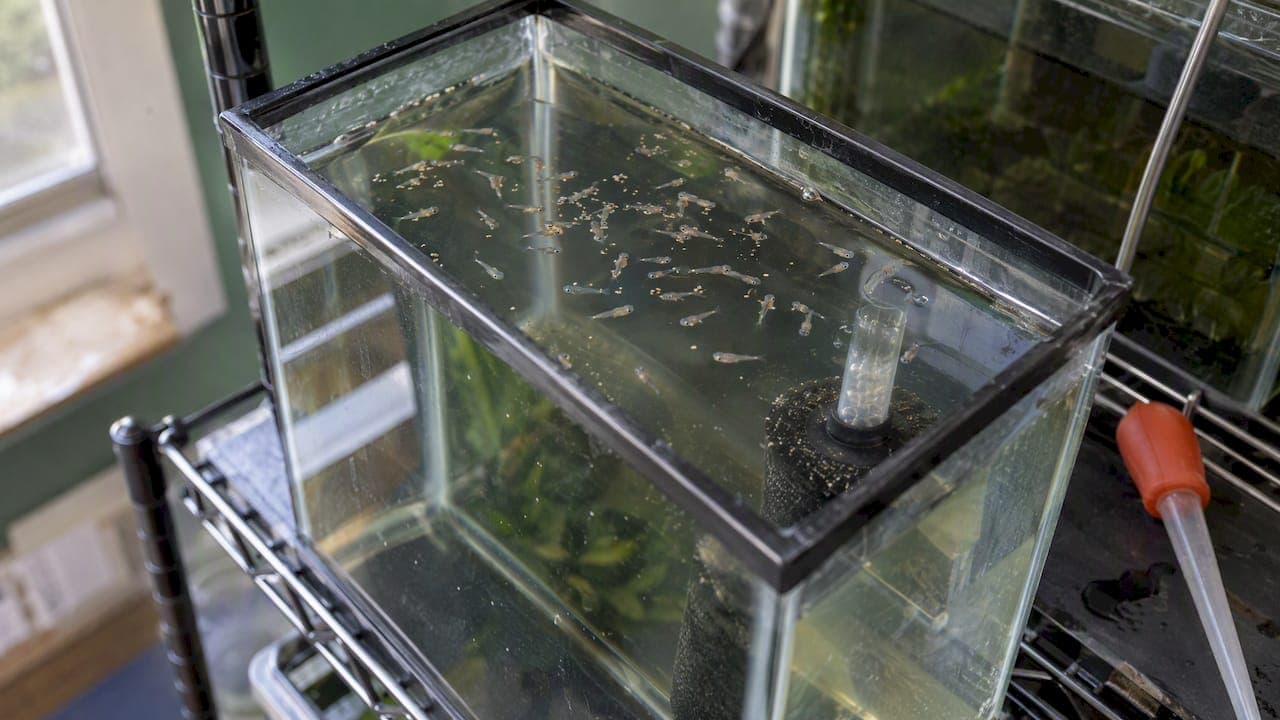
Rainbowfish fry need food the moment they hatch, and it has to be tiny. Start with powdered fry food or other microscopic foods sprinkled on the surface, feed several small meals a day, and move to live baby brine shrimp as soon as the fry can swallow them. That can be as early as three to seven days for some fry, or two weeks or more for others. The rest of this guide covers the details: what to offer first, how often, how to tell the fry are ready for the next step, and how to keep the tank clean while you do it.
TL;DR
- Rainbowfish fry have little yolk reserve, so feed small amounts of a very fine first food right after hatching. Don't wait for them to "settle in."
- First foods are microscopic: infusoria, green water, vinegar eels or a powdered fry food in the 5–50 micron range, sprinkled on the surface where the fry live.
- Feed small meals often, at least twice a day and ideally more, and offer only what the fry clear quickly.
- Move to live baby brine shrimp when the fry can eat them. An orange belly after a feeding is the sign that it's working.
- Overfeeding kills more fry than underfeeding. Remove uneaten food and keep the water clean.
Table of Contents
- Why the first week decides most of the outcome
- Stage one: the first foods (days 1 to about 7)
- Stage two: microworms and baby brine shrimp (about week 1 to 3)
- How often and how much to feed
- Keeping the fry tank clean
- Our perspective: why the brine shrimp you feed matters
- Getting live brine shrimp for your fry
- A four-week roadmap
- Common mistakes
- FAQ
- Sources
Why the first week decides most of the outcome
Rainbowfish eggs hatch into fry with very small mouths and not much yolk to live on. Gary Lange's rainbowfish-raising guide, written for hatching rainbowfish eggs, tells keepers to start feeding newly hatched fry small amounts immediately for exactly that reason. A fry that goes a couple of days without finding food is already behind.
Two other facts shape everything below.
First, the fry are surface swimmers. Aquarium hobbyist guides describe them spending their first days in the top fraction of an inch of water. Food that sinks to the bottom is food they never see. Floating powders, cultures that fill the water column and live foods that swim up are the ones that get eaten.
Second, mouth size sets the menu. The standard advice from fish nutrition references is that food must be small enough for the fry to consume. A larger, more nutritious food is worth nothing if it can't be swallowed.
This guide is written for the common aquarium rainbowfish (Melanotaenia, Boesemani, turquoise, dwarf neon and similar). Species and tank temperature change the pace, so treat the day counts below as ranges and let the fry's behavior tell you when to move on.
Stage one: the first foods (days 1 to about 7)
You have several workable options. Many keepers combine two so the fry always have something to find.
Infusoria and green water
Infusoria are the single-celled organisms that bloom in aged water with decaying organic matter. The American Killifish Association's fry guide explains that you can make a culture by adding crushed lettuce or other organic matter to aged aquarium water, which turns cloudy as the organisms multiply. Green water, a culture of free-floating algae, does a similar job and keeps tiny feed in the water all day.

The weakness of both is consistency. A home culture can crash, can be too thin on day one, and varies from batch to batch. Start it a week before the eggs are due to hatch, not the day they do.
Vinegar eels and liquid or powdered fry foods
Because rainbowfish fry have very small mouths, vinegar eels, green water, infusoria and specialized liquid fry foods are the usual first menu. Vinegar eels are especially handy: they live for hours in the water column rather than dying and sinking, so the fry can graze on them between your feedings.
Powdered prepared food is the easiest to keep on hand. Lange recommends a powdered fry food in the 5–50 micrometer range, sprinkled on the surface twice daily, or more often if possible. That answers a common question: yes, rainbowfish fry can eat prepared food from day one, provided it is ground fine enough. Ordinary adult flakes are not. If you crush flakes, you need a powder, not crumbs.
A quick first-week menu
| Food | Best for | Watch out for |
|---|---|---|
| Infusoria or green water | Constant grazing, first 3 to 5 days | Cultures can crash, so start early |
| Vinegar eels | Staying alive in the water column between meals | Rinse the culture before adding |
| Powdered fry food (5–50 micron) | Reliable surface feeding, twice a day or more | Easy to overdo, so use a pinch |
| Microworms | Bridge to larger foods | Too big for the very smallest fry |
Stage two: microworms and baby brine shrimp (about week 1 to 3)
As the fry grow, they can take microworms and then newly hatched brine shrimp (Artemia nauplii). This is the step that most affects growth and color. Hobbyist accounts say fry that transition successfully to baby brine shrimp tend to grow quickly and color up strongly later.
When are they ready?
The published guidance varies, and the variation is real, not a mistake:
- Lange says rainbowfish fry will be ready for newly hatched brine shrimp in three to seven days and recommends getting them onto live baby brine shrimp as soon as possible.
- The same guide notes that some rainbowfish, including Melanotaenia and threadfin rainbowfish, may need very tiny foods for two or more weeks before they accept them.
- Other hobbyist guides put the general benchmark at about two weeks.
The practical answer is to offer and watch. Put a small amount of freshly hatched brine shrimp in the tank and look at the fry afterward with a flashlight. A fry that has eaten nauplii shows an orange belly. No orange bellies after a day or two means the fry aren't ready or aren't finding the shrimp, so keep feeding the smaller foods and try again every day or two. Don't drop the first foods until you see orange.
Why baby brine shrimp work so well
Newly hatched nauplii are small, they swim constantly, and they swim toward light, so they stay visible to fry in the upper water. Fry feed by sight and movement. A moving target triggers feeding in a way a sinking powder doesn't. Nauplii are also packed with nutrition in their first hours, before they use up their yolk sac. That's why timing matters: use them within roughly the first day after hatching.
For a deeper look at how to match prey size to mouth size, see our comparison of daphnia and brine shrimp for hobbyists, and our stage-by-stage live foods guide if you also raise other species. If you're weighing whether to hatch your own cysts or buy farmed shrimp, we cover both in brine shrimp for freshwater fish.
How often and how much to feed
Small and frequent beats large and rare. Fry have high metabolic rates and tiny stomachs.
A workable schedule
Published guidance gives a range, so use it as a ladder:
- Bare minimum: twice a day. This is Lange's floor for newly hatched rainbowfish fry, with more often if possible.
- Better: four to six small feedings through the day, which is what hobbyist care guides for rainbowfish fry recommend to support steady growth.
- Heavy-schedule extreme: some fry-food manufacturers say a large, active batch may need up to ten tiny feedings a day. That is realistic only if you are home, or running a live-food culture that feeds the fry between your visits.
For context from commercial aquaculture, a U.S. extension fact sheet on trout production starts fry on small hand-fed portions eight to ten times daily, then drops to about five feedings daily as they grow. It's about trout, not rainbowfish, but it shows the general pattern: very frequent at first, tapering as the fish get bigger.
If you work all day, the realistic setup is one feeding before work, one after, a continuously available live food in between (green water or vinegar eels), and a third feeding in the evening.

How much is "a small amount"
The rule that holds across foods: give only what the fry will finish in a short time. For powders, that means a pinch you can barely see on the surface. For brine shrimp, it means enough that a few nauplii are still swimming after the fry have eaten, not a cloud that hangs around for hours.
A general cap for fry and fingerlings comes from the Merck Veterinary Manual, which says they can receive up to 5% of body weight daily. You won't weigh your fry, but the number is a useful reminder that even the maximum is a small amount of food.
Keeping the fry tank clean
This is where most home batches are lost. Fry tanks are often small, bare and lightly filtered so the babies don't get sucked into a filter. Uneaten food breaks down fast in that setup.
Three habits protect the water:
- Feed less rather than more. Extension guidance on trout feeding makes the same point as any fry-food maker: promptly remove excess feed, because settled feed reduces water quality and promotes disease.
- Siphon after feedings. Remove visible leftovers each time. A length of airline tubing works as a gentle siphon.
- Make small, frequent water changes with water matched to the tank's temperature. Small daily changes are gentler than a big weekly one.
Some hobbyists add snails to eat leftovers. It can help in a larger grow-out tank, but it is a backup, not a replacement for removing food yourself.
Live foods carry a separate caution. The University of Florida's fish nutrition publication notes that cultured live foods can provide high-quality nutrition, but care is needed to avoid infectious disease, and wild-caught foods may introduce disease. For fry that's a good reason to prefer foods raised in a controlled setting over anything scooped from a pond or ditch.
Our perspective: why the brine shrimp you feed matters
We farm live brine shrimp, so we have a bias, and we'll state it plainly. We also have a specific reason for it.
Baby brine shrimp are the most common bridge from first foods to a full diet for rainbowfish fry. But what a nauplius is worth depends on how the adult shrimp it came from was raised. Wild-harvested brine shrimp live in ecosystems with seasonal swings, and starvation conditions are common there. Our shrimp are raised on land in controlled systems and fed only the microalga Dunaliella, and we maintain at least 40% protein content so the nutritional quality doesn't swing from batch to batch. Consistency matters most with fry, because they have no reserves to cover a weak meal.
What we'd tell any keeper raising rainbowfish:
- Don't rush the shrimp step, but don't delay it either. Test with a small batch and look for the orange bellies.
- Use shrimp the same day they hatch, or feed them live shrimp that you've kept well fed.
- Keep your first food going alongside shrimp for a few days. Fry that miss the shrimp on day one shouldn't go hungry.
- If the fry grow unevenly, sort out the smallest ones. The biggest fry will out-eat their siblings every time.
If you also keep other species, our feeding guides for gourami fry, danio fry and Apistogramma fry follow the same logic with different timings.
— Demeter
Getting live brine shrimp for your fry
If you'd rather not run a hatchery alongside a fry tank, we ship live brine shrimp directly to hobbyists. One-off orders of live brine shrimp run from $17 to $35. If you raise fry regularly, our monthly membership is $25 per month for a recurring live shipment, so the next spawn doesn't catch you empty-handed. Our live phytoplankton, at $20, is also an option for growing out green water and feeding small filter feeders in your culture setup.
If you run a local fish store, a museum exhibit or a breeding program, we also offer a bulk store brine shrimp order. Read more about what goes into our brine shrimp before you order.
A four-week roadmap
Use this as a starting point and adjust to what your fry show you.
| Stage | Typical timing | Main foods | Feeding rhythm |
|---|---|---|---|
| Newly hatched | Days 1 to 3 | Infusoria, green water, powdered fry food | Small amounts right away, at least twice daily, more if you can |
| Early fry | Days 3 to 14 | Vinegar eels, powdered food, first trials of baby brine shrimp | 3 to 6 small feedings |
| Transition | About week 2 to 3 | Baby brine shrimp as the main food, microworms | 3 to 5 feedings, watch bellies |
| Juveniles | Week 3 to 4 and beyond | Baby brine shrimp plus finely crushed prepared food | 2 to 4 feedings, then step toward an adult routine |
The timings are loose. Fry hatched from the same spawn can differ by days in when they're ready for each step. Feed the group by the smaller ones.
Common mistakes
Using food that's too big. Fry may nibble a large flake and starve beside it. Check the size, not the ingredient list.
Feeding at the bottom. Rainbowfish fry hang near the surface. Sprinkle food there.
Skipping the checks. Many keepers assume the fry ate. Look at their bellies. Orange after a brine shrimp feeding tells you the shrimp are working. A thin, pinched belly after days tells you they aren't.
Overfeeding to compensate for working hours. Dumping three days of food in at once fouls the water. A live food that stays alive between meals is the better fix.
Moving to the next food too slowly. Fry held on powders for weeks grow more slowly than those moved onto live baby brine shrimp. Test every couple of days once they're a week old.
FAQ
What do newly hatched rainbowfish fry eat?
They eat microscopic foods: infusoria, green water, vinegar eels or a powdered fry food sized 5–50 microns. Sprinkle powders on the surface, where the fry swim, and offer food right away because they have little yolk reserve.
When can rainbowfish fry eat baby brine shrimp?
Some are ready within three to seven days, and others need two or more weeks on tiny foods first. Offer a small amount and check the fry afterward. An orange belly means they've eaten the shrimp.
How often should I feed rainbowfish fry?
Twice a day is the floor, and four to six small feedings is better. Give only what the fry finish quickly, and remove leftovers after each feeding to protect the water.
Can rainbowfish fry eat crushed flakes?
Only if the flakes are ground into a fine powder small enough for tiny mouths. A purpose-made powdered fry food in the 5–50 micron range is more reliable than crushed adult flakes.
Sources
- Breeding Fish: Starting 'em out right, a guide to raising fry (American Killifish Association)
- Hatching Rainbowfish Eggs, by Gary Lange
- Fish Nutrition (University of Florida IFAS)
- Nutritional Diseases of Fish (Merck Veterinary Manual)
- Trout Production: Feeds and Feeding Methods (Southern Regional Aquaculture Center)
- Rainbowfish Newborn & Baby Care
- Care Guide for Dwarf Neon Rainbowfish