
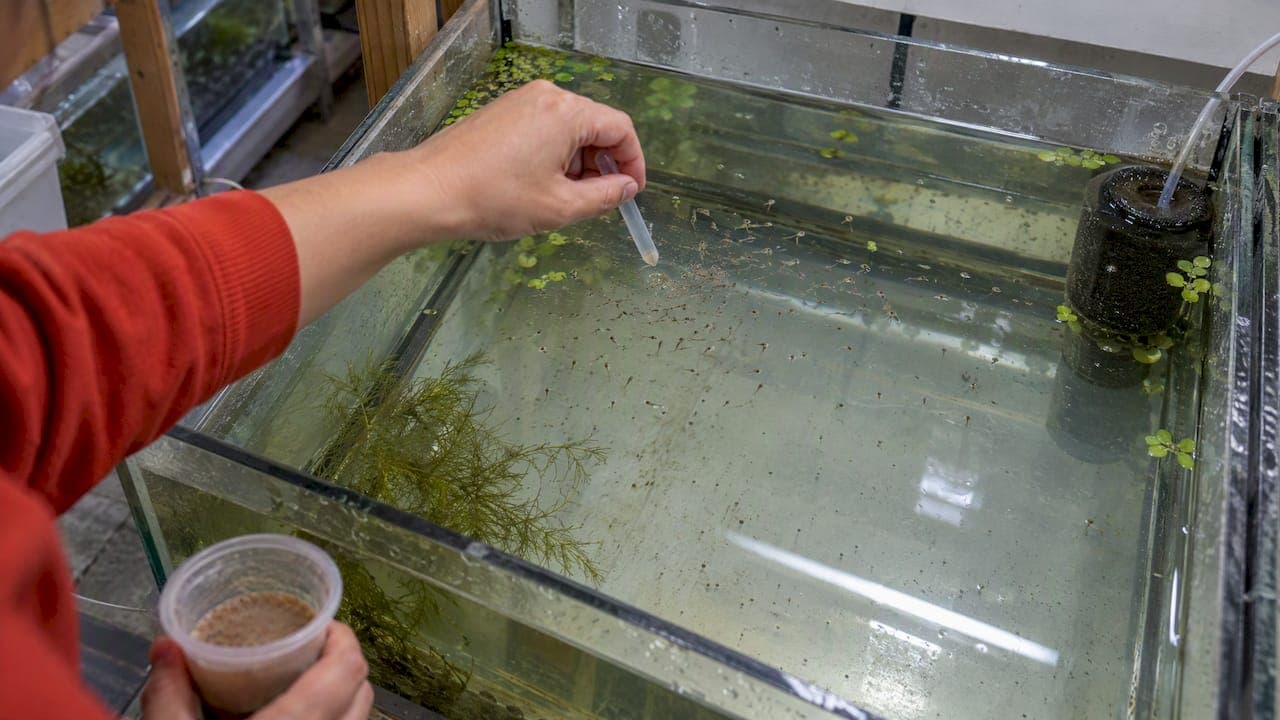
Rotifers, infusoria, or an egg-yolk suspension are the right first foods for newly free-swimming gourami fry, followed by newly hatched Artemia once the fry's mouths grow large enough, then microworms or Daphnia, and finally a prepared fry diet. Feed small amounts often, aim for a high-protein diet in the 45% to 50% range, and let gut fill and growth guide when you move to the next stage.
TL;DR:
- Once fry swim freely and absorb their yolk sacs, prioritize rotifers or egg yolk; one study reported 95.5% survival during days 3 to 5.
- Offer newly hatched Artemia once fry can swallow 400 to 800 micrometer particles, usually after the first week, and check for rounded, full bellies.
- Aim for 45% to 50% crude protein and frequent small meals; a 2026 study found five daily feedings with high protein maximized growth and survival.
- Start prepared food at about 17 to 22 days after hatching, cofeeding it with live prey and reducing live portions gradually as fry accept it.
- Rinse Artemia before feeding and remove uneaten shrimp promptly, since salt transfer and rapid decay can harm water quality in small, lightly filtered fry tanks.
Table of Contents
- When to start feeding and the first foods gourami fry need
- Choosing live feeds as fry grow: rotifers, Artemia, Moina, and more
- Matching food particle size to your fry's mouth gape
- How often to feed and how much protein gourami fry need
- Weaning gourami fry onto prepared fry foods
- Culturing starter feeds and backup options when supplies run short
- Can gourami fry react poorly to certain live feeds?
- Keeping live brine shrimp nutritious until feeding time
- Water quality considerations when feeding live brine shrimp
- Farmed microalgae-fed brine shrimp versus wild-harvested shrimp
- Fitting farmed live brine shrimp into your gourami fry feeding plan
- Why consistent feed quality shapes a breeding season
- Get consistent live brine shrimp for your fry's critical weeks
- FAQ
- Sources
When to start feeding and the first foods gourami fry need
Gourami fry are ready for their first meal once they are free swimming and have absorbed their yolk sac, which typically happens within 3 to 5 days of hatching for many gourami species. Before that point, the yolk sac supplies all the nutrition they need, and offering food too early just fouls the water.
Once fry are swimming horizontally and searching the water column, offer one of these starter foods right away:
- Infusoria cultures, which provide tiny, slow-moving protozoa sized for the smallest mouths.
- Freshwater rotifers, particularly Brachionus species, a standard hatchery starter feed.
- A thin egg-yolk suspension squeezed through cloth into the tank.
- Greenwater, which doubles as food and as a way to keep light diffuse for shy fry.
A 2026 study on dwarf gourami larvae found that feeding rotifers or egg yolk during the critical 3 to 5 day post-hatch window produced survival of 95.5%, compared with just 58.6% for infusoria and 77.3% for Spirulina. That gap is wide enough to shape your whole early feeding plan: rotifers and egg yolk deserve priority over infusoria alone whenever you can source or culture them.
Keep portions tiny and feed two to three times a day during this window, siphoning out uneaten food before it clouds the water. Fry at this stage have no margin for poor water quality, so little and often beats one large feeding.

Choosing live feeds as fry grow: rotifers, Artemia, Moina, and more
Rotifers remain the right choice immediately after first feeding because their small size and slow movement match tiny fry mouths and weak swimming ability. As fry grow over the following one to two weeks, newly hatched Artemia nauplii become appropriate once gape size allows, offering a meatier, higher-protein meal that most gourami species accept readily.
Moina, microworms, and Daphnia extend the live-feed sequence once fry are a bit larger:
- Microworms are easy to culture, slow-moving, and a good bridge feed for fry transitioning off Artemia nauplii.
- Daphnia offer a slightly larger, nutrient-dense option that also helps condition water less than other live feeds.
- Moina, when enriched, has shown strong results in comparative trials: enriched Moina produced the highest growth and survival rates for giant gourami larvae compared with unenriched Artemia in a direct comparison.
Enrichment matters at every stage. Gut-loading live feed with microalgae or a commercial enricher before you offer it to fry raises the nutritional value fry actually receive, since Artemia and rotifers are only as nutritious as what they last ate.
Pro Tip: Enrich Artemia nauplii with microalgae for several hours right before feeding, since their nutrient content drops fast once they've used up their own yolk reserves.
Sourcing is the practical question most hobbyists face next. Culturing rotifers, Moina, or microworms at home takes a modest setup and ongoing attention, while live Artemia can be hatched from cysts in a day. For hobbyists who want a dependable supply without maintaining a culture, farmed live brine shrimp raised on a consistent microalgae diet offer a steady alternative to home culturing or wild-harvested sources.
Matching food particle size to your fry's mouth gape
Gourami fry hatch at roughly 2.5 to 3 millimeters long, which means their mouth gape is tiny, often under 300 micrometers at first feeding. That single fact explains most early feeding failures: food that looks small to us is still far too large for a fry that size to ingest.
Use these micron ranges as a practical guide:
- Infusoria and rotifers measure roughly 50 to 300 micrometers, making them appropriate from first feeding through the first several days.
- Newly hatched Artemia nauplii run about 400 to 800 micrometers depending on the batch and hatch time, so introduce them only once fry have grown enough to handle that size, typically after the first week or so.
- Microworms and small Daphnia fit the next size step up, suited to fry that are already taking Artemia comfortably.
Two simple checks keep you on track. Look at a fry's belly under light after feeding: a visibly full, rounded gut means the food size and amount are working. If you crush flake or pellet food for older fry, sieve it through a fine mesh to remove oversized fragments that can cause choking or get ignored entirely. Adjust particle size gradually rather than jumping a full stage at once.
How often to feed and how much protein gourami fry need
Feed gourami fry small meals several times a day rather than one or two large feedings, and aim for a diet with roughly 45% to 50% crude protein to support the rapid growth and labyrinth organ development typical of this stage, a target reflected in fisheries feeding guidance.
Frequency has a measurable effect on outcomes. A 2026 study on intensive rearing systems found that five feedings per day, combined with a high-protein ration, maximized growth and survival metrics compared with less frequent feeding schedules. That result lines up with what most experienced gourami breeders already practice: little and often, especially in the first few weeks.
Portion control matters as much as frequency:
- Feed only what fry can finish within a few minutes, aiming for a visibly full but not distended gut.
- Watch for leftover food settling on the substrate within 10 minutes, a sign you're overfeeding.
- Cloudy water or a film on the surface signals it's time to cut portions and increase water changes.
- Increase feeding frequency and portion size gradually as water warms, since fry metabolism and appetite rise with temperature.
Growth rate is your best feedback signal. Fry that are visibly lengthening and filling out week over week are getting enough; stalled growth alongside clear water usually means it's time to feed more, not less.
Weaning gourami fry onto prepared fry foods
Begin introducing prepared food once fry are reliably taking Artemia or microworms, typically two to three weeks after first feeding for dwarf gourami species and somewhat later for larger gourami varieties. A gradual, staged approach avoids the mortality spike that comes from switching too abruptly.
- Start co-feeding by offering a small amount of rehydrated powder or microcapsule diet alongside the usual live feed, once or twice a day, for a 5 to 10 day window.
- Make the prepared food appealing by dusting live prey like microworms with a thin coat of dry powder, or rehydrating commercial fry powders just enough to suspend them in the water column where fry naturally forage.
- Watch for acceptance cues, such as fry actively chasing and swallowing the prepared particles rather than just mouthing and spitting them out.
- Reduce the live-feed share gradually over the co-feeding window, dropping it by roughly a fifth every couple of days as prepared-food acceptance increases.
Research on microcapsule diets in gourami larvae found that uptake becomes reliably effective once larvae reach about 17 to 22 days post-hatch, which is a useful benchmark if your fry seem slow to accept dry food earlier than that. Dwarf gourami tend to wean faster than larger species like the giant gourami, so adjust your timeline to the species you're raising rather than a fixed calendar.
Pro Tip: If fry ignore prepared food at first, try offering it right after a light live-feed meal, when fry are still actively foraging but not yet full.
Culturing starter feeds and backup options when supplies run short
A small home culture setup covers most of your early feeding needs without much equipment. For rotifers or greenwater, a few gallon jars, a light source, and a starter culture of algae or rotifers are enough to get a usable population within 3 to 5 days, fed daily with a drop of concentrated algae paste.
Hatching Artemia cysts at home takes about 24 to 36 hours in salted water with light aeration and steady light. Decapsulated cysts remove the hard shell that can otherwise irritate fry guts or go uneaten, making them a slightly safer choice for the very first Artemia feedings.
A basic microworm culture needs only a shallow container, a starter culture, and a moist oatmeal or cereal-based medium, producing a harvestable population within about a week. Rinse microworms before feeding to remove culture medium that could cloud the water.
When none of these are ready and fry need to eat now, fall back on:
- A fresh egg-yolk suspension squeezed through fine cloth, used sparingly to limit water fouling.
- Finely crushed and sieved flake food, acceptable only for fry already large enough to handle the particle size.
- A small water change afterward to offset the extra waste load these substitutes tend to create.
Can gourami fry react poorly to certain live feeds?
Gourami fry don't develop allergies in the way mammals do, but they can show clear intolerance to certain live feeds, usually in the form of refusal, bloating, or poor growth rather than a classic allergic reaction. Newly hatched Artemia with unhatched shell fragments or debris is a common culprit, since fry guts are not equipped to process indigestible material at that size.
Watch for these signs of a poor match between fry and a given live feed:
- Fry mouthing food repeatedly without swallowing, which often points to the wrong texture or size rather than true rejection.
- Visible bloating or a distended abdomen after feeding, which can follow overfeeding or an indigestible component in the feed.
- A drop in activity or appetite after introducing a new feed type, worth noting before you rule out other causes like water quality.
If fry consistently reject or react poorly to one live feed, switch to a different type at the same size range, such as moving from Artemia to enriched rotifers or Moina, rather than pushing the same feed. Using a consistent, well-rinsed source, whether home-cultured or farmed, reduces the chance that debris or inconsistent quality is behind a feeding problem.
Keeping live brine shrimp nutritious until feeding time
Live brine shrimp lose nutritional value the moment they're separated from a food source, so how you store and handle them between arrival and feeding affects what your fry actually receive. Keep live Artemia in cool, well-aerated water, ideally in the low to mid 60s Fahrenheit, to slow their metabolism and extend how long they stay nutritionally useful without starving down.
A few handling habits protect feed quality:
- Rinse live brine shrimp in fresh water briefly before feeding to remove residual salt and waste products.
- Feed within a day or two of receiving a live shipment, since nutritional content declines the longer shrimp go without their own food source.
- Avoid overcrowding a holding container, which stresses shrimp and speeds up the decline in their nutritional value.
- Offer a dilute microalgae feed to shrimp you're holding for more than a day, which helps maintain their nutrient profile until you use them.
Handled this way, a single live shipment can supply several feedings of consistently nutritious Artemia rather than one strong feeding followed by progressively weaker ones as the shrimp deplete their own reserves.
Water quality considerations when feeding live brine shrimp
Live brine shrimp are cultured in saltwater, so a small amount of salt transfers into a freshwater fry tank with every feeding unless you rinse them first. For gourami fry, which are freshwater species sensitive to sudden parameter shifts, that rinse step is worth treating as routine rather than optional.

Uneaten brine shrimp die quickly in freshwater and decompose fast, which can spike ammonia in a small fry tank that has little water volume to buffer the change. Feed in amounts fry can finish within a few minutes, and siphon out any shrimp that remain uneaten rather than letting them settle into the substrate.
Because fry tanks typically run with minimal filtration to avoid pulling in the fry themselves, keep an eye on water clarity and do small, frequent water changes rather than large infrequent ones. A consistent small-feeding, quick-siphon routine keeps the benefits of live brine shrimp without the water-quality cost that comes from overfeeding or leaving waste to accumulate.
Farmed microalgae-fed brine shrimp versus wild-harvested shrimp
Farmed brine shrimp raised on a steady microalgae diet offer more consistent nutrition than wild-harvested shrimp, which depend on whatever plankton happens to be available in their natural environment at the time of harvest. Wild shrimp populations go through seasonal boom-and-bust cycles, and shrimp harvested during a lean period can be nutritionally thin or even in a starved state by the time they reach a hobbyist's tank.
Consistent feeding avoids the variability that comes with wild harvest, since every batch eats the same diet rather than whatever plankton bloom happened to be present that week.
For gourami fry specifically, where the difference between a thriving batch and a stalled one often comes down to the nutritional quality of each meal, a consistent protein baseline matters more than it might for a hardier adult fish. Fry fed shrimp of unpredictable quality can show uneven growth within the same clutch, since some individuals end up getting meals with meaningfully less nutritional value than others.
Fitting farmed live brine shrimp into your gourami fry feeding plan
Live brine shrimp from a farmed, microalgae-fed source fit naturally into the same sequence you'd already be following: offer them once fry are large enough for Artemia nauplii, typically after the first week of free swimming, and continue through the weaning window as a reliable protein source alongside Moina, Daphnia, or microworms.
A few practical habits help the transition go smoothly:
- Rinse shipped live shrimp in fresh water before the first feeding to remove transit salt and any debris.
- Hold back a portion in cool, aerated water rather than feeding the entire shipment at once, so later feedings stay just as fresh as the first.
- Use farmed shrimp as the consistent backbone of your rotation, filling gaps on days when a home culture of Moina or microworms runs low.
- Pair live shrimp feedings with your weaning schedule, since a reliable live feed makes it easier to co-feed prepared diets without fry going hungry if a home culture crashes.
Breeders managing multiple spawns at once often find that one predictable live-feed source, rather than juggling several home cultures on inconsistent schedules, simplifies the whole feeding routine during the weeks when fry need the most attention.
Why consistent feed quality shapes a breeding season
Years of watching hobbyists raise fry taught us that the difference between a strong spawn and a disappointing one often comes down to what happens in those first few feeding weeks, not the breeding setup itself. Consistent, microalgae-fed Artemia steady the transitions that otherwise go wrong when live feed quality swings from batch to batch. Match your feed source to how serious your breeding goals are, and the fry will show it.
— Demeter
Get consistent live brine shrimp for your fry's critical weeks
Our brine shrimp are raised on a steady microalgae diet in controlled, land-based systems, so every batch you feed your gourami fry carries the same protein content rather than the variability that comes with wild harvest or an inconsistent home culture.
Ordering options fit different breeding setups:
- A single live brine shrimp order for one spawn or an occasional top-up.
- The Demeter Biosciences membership at $25 per month for breeders who need a recurring shipment timed to their fry's growth.
- A bulk order for hobbyists raising several batches at once or supplying a local club.
Each shipment arrives live and ready to rinse before feeding, so keep a cool, aerated holding container on hand and plan to use shrimp within a day or two for the best nutritional value. Check our live brine shrimp page to find the option that matches your current breeding schedule.
FAQ
Will adult gouramis eat their own fry?
Yes, most gourami species will eat their own fry if given the chance, so separating fry into a dedicated rearing tank shortly after hatching is standard practice. This isn't specific to gourami, as many labyrinth fish and other egg-layers show the same behavior once spawning is finished.
What is the best overall food for adult gouramis?
A varied diet of quality flake or pellet food supplemented with occasional live or frozen foods like brine shrimp or daphnia works well for adult gouramis. For fry specifically, the priority shifts to smaller live foods like rotifers and newly hatched Artemia, detailed in the sections above on starter feeds and particle size.
Which fish are unlikely to eat fish fry?
Species that don't naturally hunt small prey, such as many peaceful algae eaters and bottom-dwelling catfish, are less likely to target fry, though no community tank guarantees complete fry safety. The safest approach for any breeding project remains a separate fry-rearing tank rather than relying on tankmates to leave fry alone.
What should I feed fish fry in general?
Most fish fry, gourami included, need food small enough for their mouth gape at first feeding, typically infusoria, rotifers, or an egg-yolk suspension, before graduating to newly hatched Artemia and then larger live or prepared foods. The exact sequence and timing depend on the species and how fast the fry grow, which is why matching food size to mouth gape matters more than following a fixed calendar.
How much protein should I look for in gourami fry food?
Aim for a crude protein content of roughly 45% to 50% in whatever you feed gourami fry, whether that's live feed, enriched Artemia, or a prepared fry diet. That range supports the rapid growth and organ development fry go through in their first several weeks.
Sources
- FAO/Agris — fry protein recommendations
- Jurnal Teknologi Perikanan dan Kelautan — feeding frequency study (2026)