
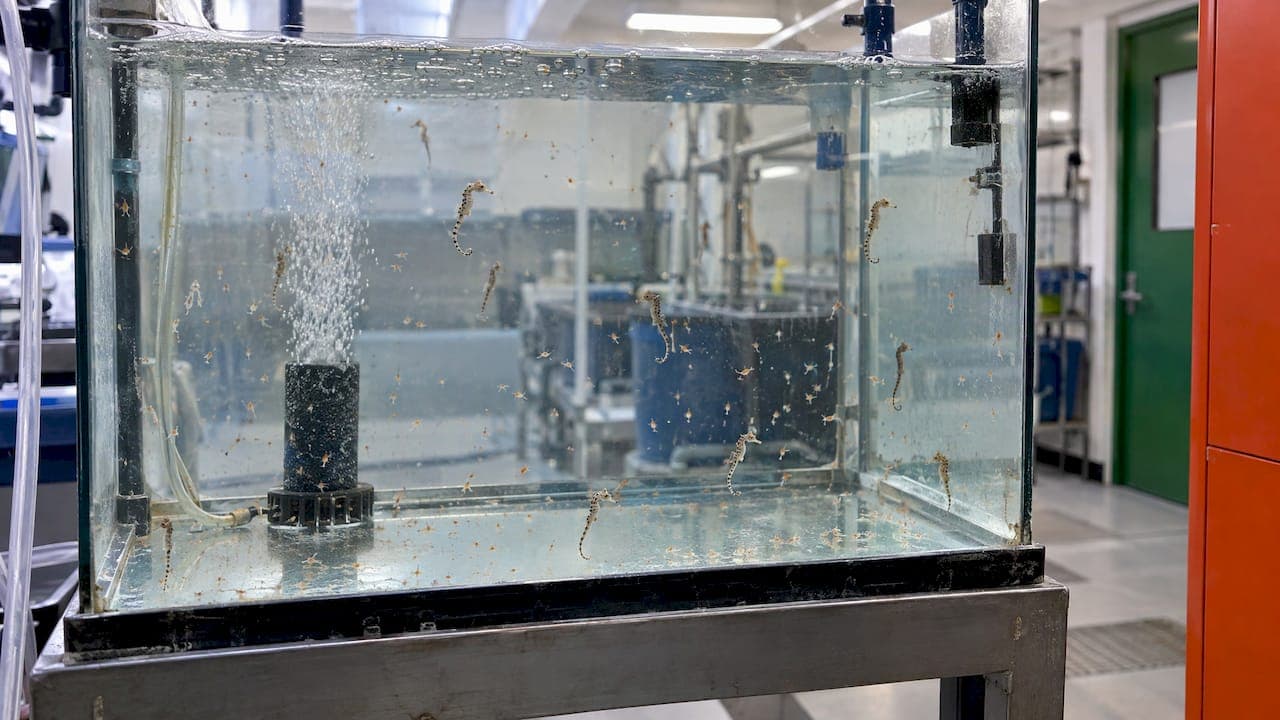
Yes, seahorse fry can eat brine shrimp, but only the right fry, and only the right brine shrimp. Fry born at roughly 10 mm or longer, such as Hippocampus erectus, can usually take newly hatched, enriched Artemia nauplii as a first food. Fry from smaller-bodied species need rotifers or copepods first. Either way, the nauplii must be enriched, fed several times a day, and cleaned out before they go stale.
This guide covers who can eat what, how to prepare nauplii, how many to feed, how to read your fry, and where larger live brine shrimp fit in once your seahorses grow.
TL;DR
- Fry that are at least 10 mm (0.4 inches) at birth can generally eat enriched brine shrimp nauplii right away. Smaller fry need rotifers or copepods first (Seahorse Manual).
- Never feed nauplii straight from the hatching container. Age them 12 to 24 hours, then enrich them for another 12 to 24 hours.
- A published guideline is 5 to 7 feedings a day at 100 to 200 nauplii per fry per day, adjusted to what the fry actually eat.
- Siphon out uneaten shrimp before each feeding. Nauplii lose nutritional value quickly, and leftovers foul the water.
- As juveniles grow, prey size grows with them. That is where larger live brine shrimp become useful.
Table of Contents
- Can seahorse fry eat brine shrimp?
- Why newly hatched brine shrimp need enrichment
- How to hatch and prepare brine shrimp for seahorse fry
- How much and how often to feed seahorse fry
- Are your fry eating enough?
- How many seahorse fry survive?
- Do seahorses eat only live food?
- Where larger live brine shrimp fit
- Order live brine shrimp for growing seahorses
- A simple daily routine for a new brood
- FAQ
- Sources
Can seahorse fry eat brine shrimp?
It depends on how big the fry are at birth. The Seahorse Trust's manual says fry of at least 10 mm are generally able to eat enriched Artemia as a first food (Seahorse Manual, 2010). Northern lined seahorses (H. erectus) are the common example in the hobby, and they are born large enough to start on baby brine shrimp (BBS) immediately.
Species with smaller newborns cannot manage a nauplius yet. They need smaller starter foods, typically rotifers or copepods, until they have grown enough to be weaned onto brine shrimp. Dwarf seahorses sit at the far end of this range. Their fry are tiny, and the first days are the hardest of their lives.
A simple way to decide:
| Fry situation | First food | When brine shrimp enter |
|---|---|---|
| Born about 10 mm or larger (for example H. erectus) | Enriched Artemia nauplii | Day one |
| Born clearly smaller | Rotifers or copepods | After a growth period, once the fry can swallow nauplii |
| Fry ignore nauplii or die with full bellies | Switch to smaller prey | Reintroduce when they have grown |
If you are unsure what your species can handle, research it before the brood arrives. Fry rearing is species-specific, and some species have a pelagic stage that needs special water suspension, while others do fine with simple hitching posts.
Why mouth size matters
Seahorses have no teeth and no jaws to bite with. They draw prey in by bringing the snout close and flexing the cheeks, which produces a rush of water that carries the prey in whole (NOAA Fishery Leaflet on sea horses). Prey that is too big simply cannot go through the snout. Prey that is too small costs more energy to catch than it returns. The match between snout width and prey size is the first thing to check when a brood is not eating.
The same logic runs through all fry feeding. Our guide on matching feed to a 400 to 500 µm gape walks through it for other fish, and the principle carries over.
Why newly hatched brine shrimp need enrichment
Newly hatched brine shrimp are easy to produce and easy for fry to catch, but they lack the essential highly unsaturated fatty acids that marine larvae need: DHA, EPA and ARA. The Seahorse Trust's manual recommends enriching them for that reason, because unenriched feeding can lead to deficiencies, slow growth and poor survival (Seahorse Manual, 2010).
This is backed by trial work. In an Australian thesis on seahorse culture techniques from James Cook University, Hippocampus fed Artemia enriched with HUFA-rich emulsions showed significantly higher survival and greater mean standard length than fry fed unenriched Artemia. The researchers enriched their nauplii with commercial emulsions, including DC DHA Selco (Improvement of Culture Techniques, JCU, 2000).
A practical consequence: if your fry seem to eat well but stall, or fade despite full bellies, suspect the nutrition of the food before you suspect the quantity. For the timing details, see our walkthrough of the brine shrimp enrichment 12 to 24 hour rule.
How to hatch and prepare brine shrimp for seahorse fry
The sequence below follows the guidance in the Seahorse Manual. Keep a rotation of two or three hatching containers so there is always a fresh batch at the right stage.
- Decapsulate the cysts. Removing the hard outer shell improves hatch quality and keeps shell fragments out of the tank. Hatched shells can be swallowed or clog small digestive tracts.
- Hatch in saline water. Use aerated saltwater at the temperature and salinity recommended by your cyst supplier, with strong aeration and light.
- Age the nauplii for 12 to 24 hours. Right after hatching, nauplii have no functioning digestive tract. They cannot take in enrichment until it develops.
- Enrich for another 12 to 24 hours. Use a HUFA-rich emulsion or enrichment medium made for marine larvae, following the product's dosing.
- Rinse and feed. Strain the enriched nauplii, rinse them in clean saltwater and add them to the fry tank.
Nauplii cannot be enriched the moment they hatch for exactly the reason in step 3. The shrimp must have a gut before it can be loaded with fatty acids, a point also made in a long-running hobbyist reference on Artemia.
Keep the food fresh and the water clean
Enriched nauplii do not stay enriched. They burn through their stores, and the manual advises siphoning out uneaten Artemia before each feeding so fry eat nutritious food and the water stays clean (Seahorse Manual, 2010). Dead and dying shrimp sink and break down fast in a small fry tank. Our five-step guide to removing uneaten brine shrimp covers the routine that keeps ammonia from spiking.

How much and how often to feed seahorse fry
The manual's recommendation is to feed 5 to 7 times a day so fry always have live food in front of them. It gives a working rate of 100 to 200 nauplii per fry per day, which works out to roughly 0.05 grams of cysts per seahorse per day (Seahorse Manual, 2010). It also says to adjust based on consumption.
A quick example: 50 fry at 150 nauplii each is 7,500 nauplii a day. Split over six feedings, that is 1,250 per feeding. Treat that as a starting point, then watch how much is left when you siphon.

What about the "3,000 shrimp a day" claim?
You will see much larger numbers online. Some well-known fry-rearing articles say a young seahorse needs thousands of brine shrimp per day, and zoo posts repeat figures near 3,000. Those figures describe how much prey must be available for a fry to find, not how much a keeper should count out per animal. The published guideline above is far lower per fry. In practice, the best approach is to keep prey density high enough that fry never have to search, then clean up what is left. Seahorses are visual hunters and ambush feeders, so a thin, sparse tank means a hungry fry.
Do not use either number as a rigid rule. Start from the manual's range, watch the tank, and raise or lower the amount based on what you see.
Are your fry eating enough?
The Seahorse Manual points to three signs of healthy feeding: you see fry capturing live prey, they are growing, and their coloration stays healthy (Seahorse Manual, 2010). Look for these each day:
- Orange or dark tint in the belly area. This usually means the fry are swallowing brine shrimp.
- Fry actively tracking and striking prey. Hunting behavior is a good sign.
- Steady growth. If you can, measure a few fry weekly.
Troubleshooting follows the same manual:
| What you see | Likely cause | What to do |
|---|---|---|
| Fry ignore the nauplii | Prey too large for the mouth | Switch to rotifers or copepods |
| Fry are full but dying | Food nutritionally insufficient | Enrich properly, check the 12 to 24 hour timing |
| Food is left over after each feeding | Overfeeding or poor acceptance | Reduce amount, siphon before each feeding |
| Slow growth, pale color | Gaps between feedings or weak enrichment | Feed more often, refresh enrichment |
Because the first two weeks are so unforgiving, the schedule matters more than perfection. A written plan helps, and our brine shrimp feeding schedule checklist gives you a format to adapt.
How many seahorse fry survive?
Survival varies enormously by species and by keeper. The Seahorse Trust reports that it bred 15 generations of Knysna seahorses (Hippocampus capensis) with a 90% success rate, while some other species have produced very few survivors from many broods. Its stated goal is a minimum survival rate of 80% of every brood, and it says the problem keeps coming back to nutrition (The Seahorse Trust).
That is the useful takeaway for a hobbyist. Survival is not luck. It tracks food size, food quality and a steady routine. Enriched prey of the right size, fed often, with clean water, is the foundation that every successful program rests on.
Do seahorses eat only live food?
Fry and young seahorses depend on live, actively swimming prey. The NOAA leaflet notes that seahorses take live, moving food. In captivity, adults that were captive-bred often learn to accept frozen food, while wild-caught animals tend to hold out for live. You will see keepers weaning juveniles to frozen mysis at around six weeks, as in many rearing videos, but the timing depends on the individual animals and should not be forced early.
Live food stays valuable well beyond the fry stage. Moving prey triggers feeding and gives the animals good exercise, and it is a reliable way to bring a fussy seahorse into condition.
Where larger live brine shrimp fit
Baby brine shrimp are a first food, not a lifelong one. As juveniles grow, nauplii become too small to be worth the effort of catching, and keepers move to bigger live prey. This is where we come in. We do not sell nauplii or cysts. We farm live brine shrimp at a larger size on land, fed exclusively on Dunaliella microalgae, for aquarium and aquaculture nutrition.
The approach is the same one we explain for other larval fish: match prey size to gape, keep the shrimp fresh, and feed the nutrition you want the animal to receive. Our guide to brine shrimp nutrition for commercial larval fish and our overview of the best live foods for baby fish fry show how the stages line up. If you keep other fry too, the same logic applies to gourami fry and rainbowfish fry.
Our perspective
We farm brine shrimp because feed quality should not depend on the season. Wild-harvested shrimp can vary with what the water offered them, and some are starved before they reach a customer. Ours are raised in controlled, land-based systems and fed only the microalgae Dunaliella, a diet we designed to deliver at least 40% protein and a consistent profile from one shipment to the next.
Seahorse keepers know that consistency is everything. A fry or a juvenile cannot make up for a weak meal by eating more. When you are counting feedings across a day, you want each one to be dependable. That is the problem we set out to solve, and it is why we feed algae and nothing else.
If you are raising seahorses past the nauplius stage, live shrimp that were grown on a clean algal diet are a natural next step. We would rather you start with a single shipment and see how your animals respond.
Demeter
Order live brine shrimp for growing seahorses
Once your juveniles are ready for larger prey, you can order live brine shrimp from us. One-time orders are priced from $17 to $35, and the Demeter Biosciences membership is $25 per month for a recurring monthly shipment, which suits keepers who raise broods through the year. We also sell phytoplankton for $20, and gift cards from $10 to $50 are available. Stores, museums and research programs can ask about our bulk store brine shrimp order.
For the full picture of what goes into our shrimp, see how our brine shrimp are produced.
A simple daily routine for a new brood
Putting it together, here is a routine many keepers adapt for fry that can take nauplii.
- Evening before: start or stagger a new hatch, so fresh nauplii are always about a day ahead.
- Morning: move yesterday's aged nauplii into enrichment. Rinse the batch that finished enrichment.
- Before each feeding: siphon leftover shrimp from the fry tank, then add a measured portion of enriched nauplii.
- Five to seven times a day: repeat, spacing feedings across the light period, and observe bellies and behavior each time.
- Weekly: measure a few fry and write the numbers down. If growth stalls, revisit enrichment and prey size before changing anything else.
This pattern follows the manual's timing: age, enrich, feed, clean, repeat. The point is not complexity. The point is that no step is skipped on a busy day.
FAQ
Can seahorse fry eat baby brine shrimp right after birth?
Only if they are large enough. Fry born at about 10 mm or more, such as H. erectus, can generally eat enriched baby brine shrimp from day one. Smaller fry need rotifers or copepods first and move to brine shrimp later.
How many brine shrimp does a seahorse fry need per day?
The Seahorse Manual suggests 100 to 200 nauplii per fry per day, split across 5 to 7 feedings. Adjust based on what is eaten, and siphon leftovers before the next feeding so the fry always get fresh, enriched food.
Do I have to enrich baby brine shrimp for seahorse fry?
Yes. Newly hatched nauplii lack the DHA, EPA and ARA that marine larvae need. Age them 12 to 24 hours after hatching, then enrich them for another 12 to 24 hours before feeding. Trials with Hippocampus showed higher survival and growth on enriched Artemia.
Do seahorses really eat 3,000 shrimp a day?
That figure describes how much prey needs to be present for young seahorses to feed constantly, not a per-fry count. The published feeding guideline is 100 to 200 nauplii per fry per day. Keep food available all day and watch for leftovers.
Sources
- Seahorse Manual, The Seahorse Trust (2010)
- Improvement of Culture Techniques, James Cook University (2000)
- Sea Horses, NOAA Fishery Leaflet
- The Seahorse Trust: Conservation
- The Complete Guide to Artemia (Brine Shrimp)