
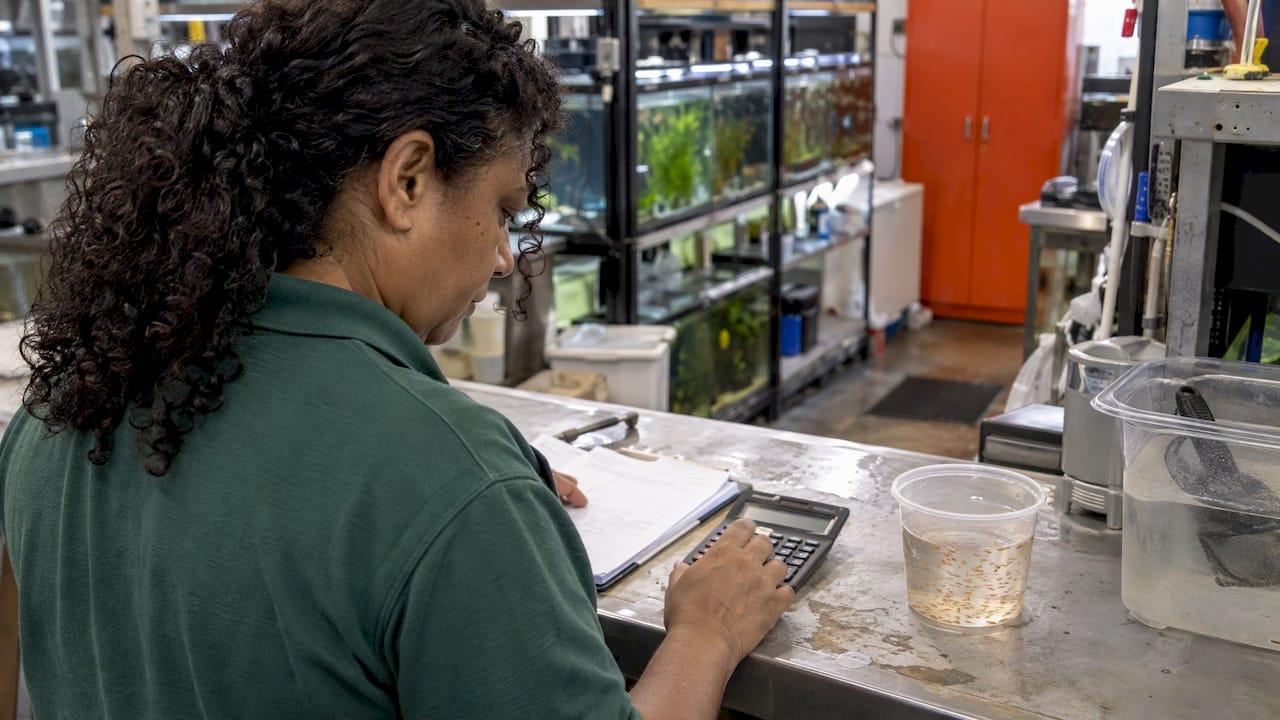
There is no single profit margin for live fish food. Your margin depends on what you pay for product, how much dies or goes unsold, and what shipping and labor cost per order. The method is the same for a fish store, a hatchery or a producer: subtract cost of goods sold from revenue, then subtract operating costs. Live feed rewards operators who keep losses low and prices tied to real costs per unit.
This guide shows how to calculate the margin, which costs move it, what U.S. figures exist for live feeds, and how retailers and fish farms can protect margin when buying live brine shrimp.
TL;DR
- Gross margin is (revenue − cost of goods sold) ÷ revenue × 100. Net margin also subtracts operating costs, interest and taxes.
- In aquaculture, feed, labor and energy make up most expenses, so they decide whether a live feed line earns money.
- Live products add losses and shipping to the cost side. Count what you throw away, not only what you sell.
- Published U.S. cases of live feed or bait production show positive returns when break-even cost sits well below the sale price.
- Buying a consistent, farmed product in planned volumes makes costs easier to forecast, which is what margin work needs.
Table of Contents
- What profit margin means for live fish food
- What costs decide the margin
- What U.S. figures show for live feeds
- How to calculate margin on a live feed line
- Margin from the buyer's side: fish farms and hatcheries
- Where Demeter fits
- Choosing a live feed supplier on margin terms
- FAQ
- Sources
What profit margin means for live fish food
Profit margin is the share of each sales dollar you keep as profit. Investopedia's explanation gives the plain reading: a 35% margin means you net $0.35 from each dollar of sales.
Three versions matter for a live feed business:
| Margin | Formula | What it tells you |
|---|---|---|
| Gross margin | (revenue − COGS) ÷ revenue × 100 | Whether the product itself pays for itself |
| Operating margin | (revenue − COGS − operating expenses) ÷ revenue × 100 | Whether the business covers rent, labor, shipping and marketing |
| Net margin | (revenue − all expenses, including interest and taxes) ÷ revenue × 100 | What the owner actually keeps |
These formulas follow Xero's margin guide. The University of Florida adds a fourth measure useful for producers. In its product cost primer for farmers, contribution margin is sales revenue minus variable costs. That is the money left to pay fixed costs and profit.
For live feed, contribution margin is often the most practical number. It answers a daily question: if I sell one more unit, how much does it add after the costs that rise with each unit?
Margin versus markup
People mix these up and misprice. Margin is profit as a share of the selling price. Markup is profit as a share of cost.
A hypothetical example: a store pays $12 for a unit and sells it for $20. Gross profit is $8. Gross margin is 8 ÷ 20 = 40%. Markup is 8 ÷ 12, about 67%. If you target a 40% margin but only add a 40% markup, you will land near a 29% margin. The numbers here are for illustration only, not figures from any supplier.
What costs decide the margin
The cost side of live feed looks like aquaculture in general, with extra weight on logistics. Missouri Extension's planning guide lists the operating costs of an aquaculture business: stock, feed, labor, chemicals, treatments, oxygen, utilities, repairs, supplies, delivery and interest on operating capital. Fixed costs include management, depreciation, taxes, interest and insurance on real estate and equipment.
How big are those pieces? Missouri's 2022 needs assessment estimated that labor, feed and energy together made up about two-thirds of producers' expenses. Feed averaged 22%, labor 26% and energy 19%, with marketing at 6% and other costs at 25%.

On the processing side, an FAO analysis of fishery industry economics notes that variable costs such as raw materials, labor and packaging can make up about 80% of total production costs in intensive industrial production. Live products are heavy on variable costs, so volume alone does not fix a weak margin.
The cost lines retailers forget
For a fish store or pet retailer reselling live feed, the cost of goods sold is not just the invoice. Add these:
- Freight and packaging per order, split across units actually sold.
- Shrink: units that die, age out or are never sold. A live product with a short shelf life makes shrink a direct hit to gross margin.
- Tank, water and electricity for holding stock.
- Labor to receive, count, bag and restock.
- Payment processing on each sale.
Track each for a month. Divide the total by units sold, and you have your real cost per unit.
The University of Florida primer stresses that assigning indirect costs properly is what makes product cost estimates accurate. It also notes that separating variable from fixed costs helps you predict how total costs and profit change as output grows or shrinks.
What U.S. figures show for live feeds
Published numbers for live fish food specifically are thin, so it helps to look at related U.S. live feed and bait markets. None of the figures below are Demeter prices or a promise for your business. They show how margin works at the producer level.
Live bait shrimp
An Auburn University dissertation on native live bait shrimp, Patricio Paz's 2010 study, reported an average sales price of $73 per 1,000 shrimp. The break-even price that covered all costs was $33.80 per 1,000. On those two figures, the gap is about 54% of the sale price before taxes and owner returns. The study also reported positive net returns over seven years in simulated pond and recirculating systems. A 2008 survey found wild-caught supply did not meet customer demand, especially in June, July and August.
The lesson for margin: the spread between price and full cost per unit is what matters, and steady supply has value to buyers.

Baitfish
NCRAC's baitfish review shows how wide the spread can be by region and scale. It reports a 1992 Minnesota wholesale price of $3.20 per pound for golden shiners, against a break-even of $1.20 per pound in 0.5-acre Minnesota ponds. Arkansas pond studies found break-even between $2.33 and $2.90 per pound. The same review lists factors that limit viability: climate variability, limited water and land, restrictive regulations and variable market demand.
Brine shrimp eggs
At the commodity end, the East Valley Tribune reported that Utah brine shrimp eggs can fetch about $10 to more than $20 per pound. Great Salt Lake harvesters averaged 2.4 million pounds a year over 20 years, roughly a $28 million business at $12 per pound. Harvesters pay $10,000 per permit and a state royalty of 3.75 cents per pound of unprocessed product. The wild harvest carries those fees and a short season. A land-based farm carries different costs, mainly feed, energy and labor.
A caution from producers
Margins are not guaranteed. Missouri's survey found that most producers strongly agreed input costs were rising faster than the prices they charge buyers. Still, 78% felt producers have growing market opportunities, and the producers saw direct-to-consumer channels as key to the future. CEA Consulting's 2018 report describes aquaculture at farm level as high risk and high return. It says feed is over 50% of major costs and that rising feed costs have pushed margins below 10% in most operations worldwide.
That is why the best use of your time is cost control and pricing discipline, not guessing at an industry average.
How to calculate margin on a live feed line
Use one product at a time. Here is a hypothetical worked example for a store selling live feed by the unit.
- Set the selling price. Say $20.
- Add the landed cost per unit. Wholesale price $11, plus freight and packaging share $1.50. Total $12.50.
- Add expected shrink. If 1 in 10 units is never sold, the cost to recover on the nine that sell is $12.50 ÷ 0.9, about $13.89.
- Gross margin: ($20 − $13.89) ÷ $20 = about 31%.
- Subtract operating costs per unit (labor, tank space, payment fees). If they come to $3.00, operating margin is ($20 − $13.89 − $3.00) ÷ $20, about 15%.
Notice what happened. Without the shrink step, gross margin looks like 37.5%. A 10% loss rate cost more than six points of margin. For a live product, cutting losses is often worth more than a price increase.
Levers that move the number
- Order to match sell-through. Smaller, more frequent orders reduce shrink, though freight per unit can rise. Compare both.
- Share freight by consolidating live feed with other items.
- Price by feeding or use, not only by weight, so customers see value in the unit they actually buy. The live brine shrimp cost per feeding breakdown shows how to think about that for hobbyists.
- Offer more than one format. Our guide to stocking three live fish food formats covers how format mix affects retail sales.
- Review quarterly. Input costs move, as Missouri producers reported, so a price set once goes stale.
Margin from the buyer's side: fish farms and hatcheries
If you raise fish, live feed is a cost to manage and a driver of revenue. Better larval survival and growth change your margin more than a few cents saved per unit of feed. Nutrition is the lever, so see our brine shrimp nutrition guide for commercial larval fish and our overview of fatty acids and fish farm productivity.
A useful habit is to cost feed per fish raised to a target size, not per pound purchased. Put survival, growth and feed cost on one sheet, and compare feeds on cost per fish sold.
Our perspective
We built Demeter around a simple idea: margin is easier to protect when the product is the same every time. Our brine shrimp are farmed on land and fed exclusively on Dunaliella microalgae, and our formula is designed to deliver at least 40% protein with consistent nutritional quality. Wild-harvested shrimp vary with season and with how long they went without food in nature. A farmed product removes that variable from your plan.
For a store, consistency means fewer surprises in what you tell customers and what you stock. For a hatchery or a research program, it means the feed you tested last month is the feed you feed this month.
We also think direct relationships matter. Producers in the U.S. say that direct-to-consumer and direct-to-buyer channels are the industry's future, and that is how we sell: straight to hobbyists, stores, museums and farms, with no long chain of middlemen adding handling steps.
Run your own numbers with landed cost, shrink and labor. We expect a steady, farmed supply to make those numbers easier to forecast.
Demeter
Where Demeter fits
We sell farmed live brine shrimp fed on microalgae, and the published prices are simple. Live brine shrimp run from $17 to $35 per order. Live phytoplankton is $20. The Demeter Biosciences membership, a monthly live brine shrimp shipment, is $25 per month, which suits hobbyists and small retailers that want a predictable cost line. Gift cards run from $10 to $50.

For stores, museums and research institutions, we offer bulk packages. Start with the bulk store brine shrimp order page, or see the live brine shrimp product page for single orders. If you feed at scale, our fish meal products are another option to review. For recurring needs, the monthly membership keeps shipments on a schedule.
Choosing a live feed supplier on margin terms
When you compare suppliers, put the same questions to each one, and write the answers beside your cost sheet:
- What is the price per unit delivered, not only at the dock?
- How consistent is the nutrition from shipment to shipment? Our brine shrimp nutritional value guide explains what to look for.
- Is supply steady through summer, when wild supply can run short, as the Auburn survey found for bait shrimp?
- What is the lead time, and can you set a recurring order?
- Does the feed suit your animals' mouth size? Our comparison of daphnia and brine shrimp for hobbyists covers gape size, and our guide to live fish food types covers the wider range.
Then compare suppliers on cost per sale or cost per fish raised, not on the sticker price alone.
FAQ
Is there money in raising fish?
There can be, but margins vary widely by species, scale and costs. U.S. studies on bait shrimp and baitfish show positive returns where break-even cost sits well below sale price. CEA Consulting reports that rising feed costs have pushed margins below 10% in most operations worldwide. Know your cost per unit before you scale.
What is a good profit margin for live fish food?
No single figure applies to every business. Retailers, producers and hatcheries carry different costs, and shrink and freight change the result. Calculate gross and operating margin on your own invoices, then set a target you can hold after losses.
How do I calculate margin on a product that can die before it sells?
Divide your landed cost per unit by the share of units that actually sell. If 90% sell, divide by 0.9. Use that adjusted cost in the gross margin formula. This is the step most live feed sellers skip.
Is it expensive to run an aquarium?
Costs depend on tank size, equipment and what you feed. Live food is a small, recurring line. You can see how it breaks down per feeding in our live brine shrimp cost guide.
Sources
- Profit margin formula: how to calculate your margins (Xero)
- Knowing Your Product Costs: A Primer for Farmers and Food Entrepreneurs (University of Florida)
- Understanding Profit Margin (Investopedia)
- Planning for an Aquaculture Business in Missouri (MU Extension)
- Growing Missouri's Aquaculture Industry: Needs Assessment (MU Extension)
- Economic engineering applied to the fishery industry (FAO)
- Native live bait shrimp production dissertation (Auburn University)
- Baitfish culture in the North Central Region (NCRAC)
- Tiny brine shrimp, big business in Utah (East Valley Tribune)
- Offshore Finfish Aquaculture report (CEA Consulting)