
Raising dietary EPA and DHA above 8% of total fatty acids measurably improves Atlantic salmon farm outcomes: 21% less mortality variability, 11% better economic feed conversion ratio (eFCR), and a 27% higher chance of a superior harvest. That single finding, from a large commercial-farm analysis, captures the role of fatty acids in fish farm productivity better than any general nutrition principle. Brett D. Glencross and other leading researchers reinforce the point: precision fatty-acid nutrition outperforms broad minimum-requirement approaches, especially when ratios are tuned to species and life stage.
Three things to do right now:
- Check your supplier's EPA+DHA spec as a percentage of total fatty acids, not just crude fat.
- Consider algal-sourced lipids or microalgae-fed live brine shrimp for larval and juvenile stages where bioavailability matters most.
- Run a short on-farm trial (6–12 weeks) using FCR, specific growth rate, and mortality as your decision metrics.
Demeterbioscience's Dunaliella-fed live brine shrimp are designed to deliver exactly this kind of consistent, measurable n-3 LC-PUFA profile at the life stages where it counts.
Table of Contents
- How do fatty acids drive fish farm productivity?
- Which fatty acids matter most, and what ratios should you target?
- Where do you actually get EPA and DHA for your feed?
- How to build a feeding strategy around fatty-acid targets
- What should you expect from a reputable microalgae-fed brine shrimp supplier?
- How do you verify a supplier's fatty-acid claims?
- How to run a simple on-farm trial to test your fatty-acid intervention
- Do the economics actually work?
- Key Takeaways
- Why microalgae-fed live feed is worth the extra logistics
- Demeterbioscience's Dunaliella-fed brine shrimp: what to request
- Useful sources
How do fatty acids drive fish farm productivity?
Fatty acids are not just fuel. They are structural and signaling lipids that determine cell membrane fluidity, regulate inflammation, and support neural and retinal development. Get the supply wrong and you see it in the numbers: slower growth, higher FCR, and fish that buckle under pathogen pressure.

Long-chain polyunsaturated fatty acids (LC-PUFAs), specifically EPA (20:5n-3) and DHA (22:6n-3), sit at the center of this. EPA drives anti-inflammatory eicosanoid production and competes directly with the pro-inflammatory arachidonic acid (ARA, 20:4n-6) pathway. DHA concentrates in neural tissue and the retina, making it critical during larval development when sensory systems are forming. Larvae and juveniles need proportionally more LC-PUFA than grow-out fish because their tissues are building from scratch, not maintaining existing structure.
The practical consequence: inadequate LC-PUFA in salmonid diets reduces feed conversion, growth, and survival, and increases sensitivity to stressors and pathogens. Stress and disease are the two largest drivers of mass mortality on commercial farms.
Fatty-acid supply chain for farm outcomes: Dietary EPA + DHA → membrane integrity + immune signaling → stress resistance + pathogen defense → lower mortality + better FCR → higher harvest quality and fillet omega-3 for human consumers.
Dietary lipid composition also shapes gut microbiota. Specific fatty-acid profiles can promote beneficial bacterial populations and suppress opportunistic pathogens, adding an indirect probiotic effect that shows up in health markers like superoxide dismutase (SOD) and malondialdehyde (MDA).
Which fatty acids matter most, and what ratios should you target?
Not all fatty acids pull equal weight. Here are the five you need to track on every supplier spec sheet:
- EPA (20:5n-3): The primary anti-inflammatory LC-PUFA. Ideally higher than ARA and, in salmonids, maintained at an EPA:DHA ratio near 1.5:1 to support the anti-inflammatory response. Limited in most plant-oil alternatives.
- DHA (22:6n-3): Critical for neural and retinal development in larvae; deposits preferentially in muscle tissue. In Atlantic salmon muscle, DHA deposits at roughly four times the rate of EPA relative to dietary supply.
- ARA (20:4n-6): A pro-inflammatory precursor that must stay in balance with EPA. In juvenile fat greenling, ARA/EPA ratios of 0.47–1.01 improved digestive enzyme activity, increased intestinal villus length, and lowered FCR. Too much ARA relative to EPA tips the immune balance toward chronic inflammation.
- Total n-3 LC-PUFAs: Requirements range from 10–25 g/kg of aquafeed depending on species, age, and farming conditions. For Atlantic salmon, EPA+DHA above 8% of total fatty acids is the threshold linked to commercial farm benefits.
- n-3/n-6 ratio: A skewed ratio toward n-6 (common when vegetable oils replace fish oil) reduces robustness and fillet quality. Salmonids fed diets devoid of LC-PUFA but with a 3:1 ALA:LA ratio still synthesize omega-3 LC-PUFA at a 27:1 ratio against omega-6 LC-PUFA, which shows how hard the fish work to correct an imbalance.
Species specificity matters. For golden pompano (Trachinotus ovatus), the optimal n-3 LC-PUFA range is 0.64%–2.10% with a DHA/EPA ratio near 1.4. That is far lower than salmonid requirements. One-size-fits-all fatty-acid targets are a procurement mistake.
Stat to bookmark: Diets with EPA+DHA above 8% of total fatty acids produced an 11% improvement in eFCR, a 21% reduction in mortality variability, and a 27% higher chance of superior harvest quality in commercial Atlantic salmon farms.
Where do you actually get EPA and DHA for your feed?
Aquaculture consumes the majority of global EPA+DHA supplies, and fish oil supply cannot keep pace with demand. That gap is the central supply problem in the industry right now.
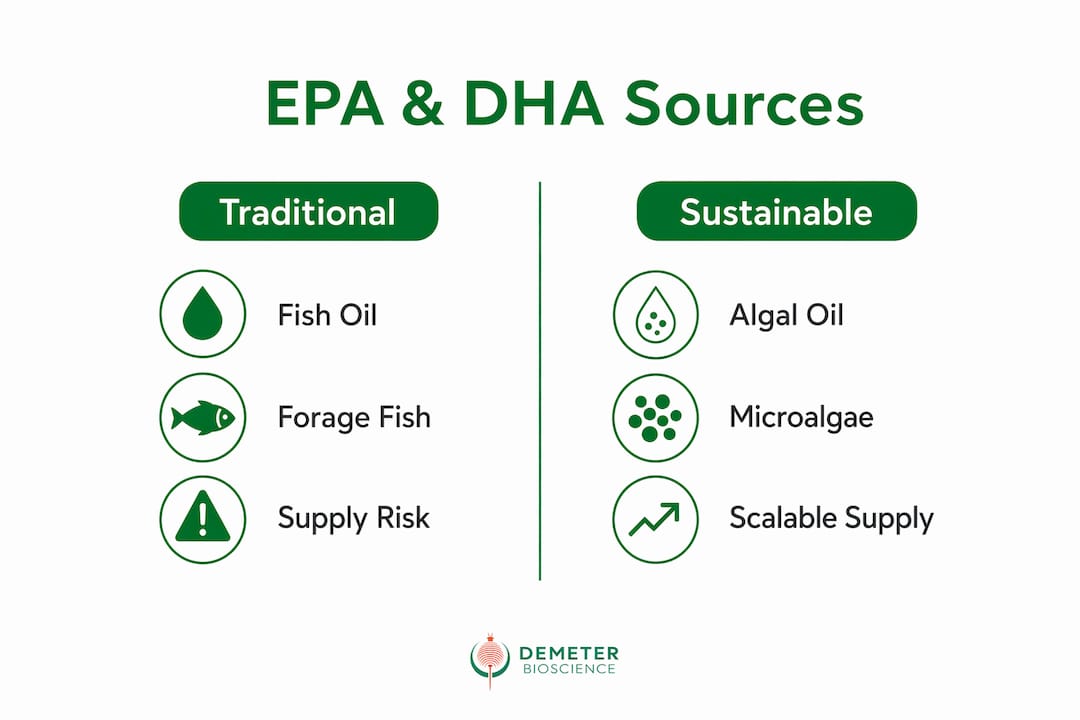
Fish oil remains the gold standard for LC-PUFA delivery, but supply constraints and price volatility make full reliance on it increasingly impractical. Vegetable oils can replace fish oil in grow-out diets without wrecking growth, but they are high in n-6 PUFA and contain no EPA or DHA. Replacing fish oil with vegetable oils dilutes the omega-3 profile of the final fillet, which matters both for fish health and for the human consumer.
Algal oils solve the EPA+DHA problem without the forage-fish dependency. Algae supply EPA and DHA and represent a scalable, lower-trophic alternative. They are where fish get their omega-3s in the first place.
Microalgae-fed live brine shrimp take this a step further for larval and early-juvenile stages. Brine shrimp fed on Dunaliella carry the algal fatty-acid profile directly into the gut of the fish, with the bioavailability advantage of a live, moving prey item. For hatchery operators, this is often the most practical route to rapid tissue enrichment in the first weeks of life. Demeterbioscience's microalgae-fed brine shrimp are cultivated on Dunaliella in land-based systems, which avoids the seasonal variability and nutritional starvation common in wild-harvested brine shrimp.
Pro Tip: Use algal oil in formulated feeds for grow-out fish where logistics favor a shelf-stable ingredient. Switch to live, Dunaliella-fed brine shrimp for larval and early-juvenile pulses where immediate gut uptake and microbiome stimulation matter more than storage convenience.
| Source | EPA+DHA delivery | Oxidation risk | Handling complexity |
|---|---|---|---|
| Fish oil | High | Moderate | Low |
| Vegetable oil | None | Low | Low |
| Algal oil | High | Moderate | Low |
| Microalgae-fed live brine shrimp | High (bioavailable) | Low (fresh) | Moderate |
How to build a feeding strategy around fatty-acid targets
- Assess baseline tissue fatty acids. Pull a small muscle or liver sample from your current stock and send it to an analytical lab for GC-FID fatty-acid profiling. You need to know where you are starting before you can measure improvement.
- Identify your high-impact life stages. Broodstock, larvae, and early juveniles have the highest LC-PUFA demand. Target these windows first.
- Choose your supplementation source. For larval and early-juvenile stages, live Dunaliella-fed brine shrimp deliver EPA+DHA with high bioavailability. For grow-out, algal oil in formulated feed is more practical.
- Adjust ration timing. Feed live brine shrimp during the first 2–4 weeks post-hatch, then transition to formulated diets supplemented with algal oil as fish grow.
- Control oxidation. Store formulated feeds in cool, dark conditions and use natural antioxidants (vitamin E, rosemary extract) in lipid-rich diets. For live feeds, keep holding times short and water quality high.
Pro Tip: A short pulse of microalgae-fed live brine shrimp during the larval window can enrich fish tissue with EPA+DHA faster than any formulated diet, because the live prey stimulates feeding behavior and delivers lipids in phospholipid form, which larvae absorb more efficiently than triglyceride-bound fats.
Nutritional quality directly affects fish growth rate and FCR, so the cost of a live-feed pulse at the larval stage is almost always recovered in faster time-to-size and lower early mortality.
What should you expect from a reputable microalgae-fed brine shrimp supplier?
Controlled, Dunaliella-fed brine shrimp deliver consistent fatty-acid profiles that wild-harvested brine shrimp simply cannot match. Wild harvest is seasonal, nutritionally variable, and often reflects a starvation state in the natural population.
Demeterbioscience cultivates brine shrimp in land-based systems fed exclusively on Dunaliella, guaranteeing at least 40% protein content and a stable lipid profile across batches. Their product specifications cover bulk and subscription ordering, with direct-to-consumer shipping options designed for hatcheries and aquaculture operations.
What a controlled cultivation system delivers: Consistent feedstock (Dunaliella) + land-based isolation from wild pathogens + defined feeding schedule = predictable EPA/DHA content, batch-to-batch, with no seasonal dip in nutritional quality.
Buyer checklist: what to request from any live brine shrimp supplier
- EPA and DHA as a percentage of total fatty acids (not just crude fat)
- DHA/EPA ratio and total n-3 LC-PUFA content
- Analytical method used (GC-FID or GC-MS)
- Feedstock identity (Dunaliella or other algal species)
- Pathogen testing records
- Batch holding time and shipping conditions
How do you verify a supplier's fatty-acid claims?
Before placing a bulk order, send this to any supplier:
"Please provide a recent certificate of analysis showing EPA and DHA as a percentage of total fatty acids, the analytical method used (GC-FID or GC-MS), the algal feedstock species, and your pathogen testing protocol for the most recent production batch."
Red flags to watch for:
- EPA+DHA reported only as "omega-3" with no species breakdown
- No analytical method stated (makes the number unverifiable)
- "Wild-harvested" claims with no traceability or seasonal nutritional data
- Vague feedstock descriptions ("natural algae") with no species identification
- Holding times longer than 48 hours without controlled temperature documentation
Sourcing sustainable aquatic feed products requires the same due diligence you would apply to any pharmaceutical-grade input. Fatty-acid claims without lab methods are marketing, not nutrition.
How to run a simple on-farm trial to test your fatty-acid intervention
A 6–12 week trial with two groups is enough to detect meaningful differences in FCR and growth rate.
Trial setup: Divide stock into a control group (current diet) and a treatment group (diet with adjusted EPA+DHA or live brine shrimp pulse). Match tank size, stocking density, and water temperature. Minimum 30 fish per group for statistical reliability.
| Metric | How to measure | Sampling frequency | Decision threshold |
|---|---|---|---|
| FCR (feed conversion ratio) | Total feed fed / biomass gained | Weekly | Improvement of >5% vs. control |
| SGR (specific growth rate) | % body weight gain per day | Bi-weekly | SGR increase |
| Cumulative mortality | Count and record all deaths | Daily | >10% difference between groups |
| Fillet EPA+DHA | GC-FID on muscle sample | Start and end of trial | Increase in treatment group |
| SOD / MDA (oxidative stress) | Lab assay on liver sample | Start and end of trial | Lower MDA, higher SOD in treatment |
Interpret early signals conservatively. FCR and mortality differences in the first two weeks can reflect handling stress rather than nutrition. Wait for week 4 before drawing conclusions. If FCR improves by week 8 and fillet EPA+DHA is measurably higher at trial end, the intervention is working.
Do the economics actually work?
The short answer: yes, at most commercial scales. The longer answer requires knowing your current FCR and mortality rate.
- An 11% improvement in eFCR in Atlantic salmon directly reduces feed cost per kilogram of harvest, which is typically the largest variable cost on a farm.
- A 21% reduction in mortality variability means fewer catastrophic loss events, which are the hardest costs to absorb and the hardest to predict.
- A 27% higher chance of superior harvest quality translates into better market pricing, particularly for premium fresh and sushi-grade markets.
On the sustainability side, algal oil and microalgae-fed live feeds reduce dependence on forage fish, which face increasing regulatory and supply pressure. Land-based algal production also carries a lower land and freshwater footprint than the soy and canola oils it competes with. Demeterbioscience's microalgae carbon cycle approach reflects this: Dunaliella cultivation sequesters carbon and produces oxygen, adding an environmental credit that conventional marine-ingredient supply chains cannot claim.
A simple way to frame the ROI: if a live brine shrimp pulse during the larval window costs an additional $X per batch but reduces early-stage mortality by even 5%, the recovered biomass almost always exceeds the feed cost. Add the downstream FCR improvement and the math gets more compelling.
Key Takeaways
Fatty-acid precision nutrition, specifically maintaining EPA+DHA above 8% of total dietary fatty acids and matching ratios to species and life stage, is the single highest-leverage nutritional intervention available to aquaculture feed buyers.
| Point | Details |
|---|---|
| EPA+DHA threshold matters | Diets with EPA+DHA above 8% of total fatty acids improved eFCR by 11%, cut mortality variability by 21%, and increased the chance of superior harvest by 27% in commercial Atlantic salmon farms. |
| Species-specific ratios | Golden pompano needs a DHA/EPA ratio near 1.4; fat greenling performs best at ARA/EPA ratios of 0.47–1.01. Never apply salmonid targets to marine species. |
| Larval stages are highest priority | Larvae and juveniles need proportionally more LC-PUFA; a live brine shrimp pulse in the first 2–4 weeks post-hatch delivers EPA+DHA in phospholipid form for maximum absorption. |
| Demand lab methods from suppliers | Request GC-FID or GC-MS certificates showing EPA and DHA as a percentage of total fatty acids, plus feedstock identity and pathogen testing records. |
| Demeterbioscience for consistent supply | Dunaliella-fed, land-based brine shrimp from Demeterbioscience deliver batch-consistent EPA+DHA profiles without the seasonal variability of wild-harvested alternatives. |
Why microalgae-fed live feed is worth the extra logistics
The conventional wisdom in aquaculture nutrition is that formulated diets are good enough for most life stages and that live feeds are a hatchery-only luxury. That framing undersells what a well-specified live feed actually does.
The evidence from species studies and commercial-farm data points to the same conclusion: the life stages where fatty-acid supply is most constrained are exactly the stages where live, microalgae-fed brine shrimp have the clearest advantage. Phospholipid-bound EPA and DHA from a live prey item absorbs faster and deposits more efficiently in larval tissue than the same fatty acids delivered in a triglyceride matrix. The gut microbiome benefit is real too. Targeted lipid profiles from Dunaliella-fed brine shrimp promote beneficial bacterial populations in the larval gut, which shows up later as better stress resistance and lower early mortality.
The practical trade-off is logistics: live feeds require cold chain management and short holding times. But for a hatchery running 4–6 week larval cycles, that is a manageable constraint, and the nutritional payoff justifies it. Request a lab certificate before your first order, run a small trial against your current protocol, and let the FCR and mortality data make the decision.
Demeterbioscience's Dunaliella-fed brine shrimp: what to request
If you are ready to source a consistent, lab-verified live feed for your next larval or juvenile cycle, Demeterbioscience's live brine shrimp are cultivated on Dunaliella in land-based systems with defined feeding schedules and pathogen controls. For larger operations, bulk ordering is available with subscription options.
When you place an inquiry, request the following:
- EPA and DHA as a percentage of total fatty acids (GC-FID or GC-MS method)
- Proximate analysis (protein, lipid, moisture)
- Feedstock confirmation (Dunaliella species and feeding schedule)
- Shipping window and recommended holding conditions on arrival
Contact Demeterbioscience directly for bulk spec sheets and technical questions at demeterbioscience.com/contact.html.
Useful sources
| Source | What it covers |
|---|---|
| Glencross et al., Frontiers in Marine Science | Big-data commercial-farm analysis: EPA+DHA thresholds, eFCR, mortality variability, and harvest quality in Atlantic salmon |
| Frontiers in Animal Science: LC-PUFA ratios in salmonids | Review of EPA, DHA, ARA, and n-3/n-6 balance requirements; implications for fish welfare and fillet quality |
| Trachinotus ovatus fatty-acid study, PMC (2023) | Species-specific n-3 LC-PUFA and DHA/EPA ratio requirements for golden pompano |
| Fat greenling ARA/EPA study, MDPI (2025) | ARA/EPA ratio effects on digestive enzyme activity, intestinal morphology, and FCR in juvenile fat greenling |
| Omega-3 futures in aquaculture, Taylor & Francis | Global LC-PUFA supply and demand analysis; species synthesis capacity and life-stage requirements |
| Algal omega-3 alternatives review, PMC | Algal oil as a scalable EPA+DHA source; forage-fish dependency reduction |
| Demeterbioscience: microalgae as fish feed | Supplier overview of Dunaliella feedstock, land-based cultivation, and nutritional consistency |
| Demeterbioscience: brine shrimp product page | Product attributes, ordering options, and spec request starting point |