

Feed quality is the single most controllable variable in your production system, yet it remains the most misunderstood. Understanding why nutritional quality affects fish growth rate goes far beyond checking the crude protein percentage on a feed label. The actual growth response depends on amino acid profiles, lipid composition, digestibility coefficients, and how those nutrients interact with your fish's metabolic machinery at every life stage. Get this right, and you compress grow-out time, cut feed costs, and raise healthier stock. Get it wrong, and no amount of water quality management will compensate.
Table of Contents
- Key Takeaways
- Why nutritional quality affects fish growth rate
- How diet quality directly impacts growth and health
- Early life nutrition and long-term growth outcomes
- Practical strategies to maximize growth through feed quality
- Monitoring growth challenges tied to nutrition
- My perspective on what most farms get wrong
- How Demeterbioscience supports fish growth through feed quality
- FAQ
Key Takeaways
| Point | Details |
|---|---|
| Crude protein is not enough | Digestibility and amino acid balance determine actual growth response, not raw protein percentage. |
| Early nutrition shapes lifetime growth | Suboptimal larval or juvenile diets cause epigenetic changes that permanently reduce growth potential. |
| Anti-nutritional factors cost you silently | Plant-based ingredients with unmanaged ANFs damage gut integrity and trigger immune stress that suppresses growth. |
| Protein-to-energy ratio is the control dial | Balancing digestible protein against available energy determines whether protein goes to muscle or gets burned as fuel. |
| Feed processing changes the equation | Fermentation and targeted additives remove ANFs, improve gut microbiota, and measurably improve feed conversion ratios. |
Why nutritional quality affects fish growth rate
Fish growth is fundamentally a protein accretion process. Muscle and tissue are built from amino acids, and those amino acids must arrive in the right proportions, at the right time, in a form the fish can actually absorb. That last part is where most feed programs fall short.
The core nutrients and their roles break down like this:
- Protein and amino acids: Dietary protein supplies the building blocks for muscle synthesis. But not all protein sources are equal. The digestible amino acid profile, particularly the balance of essential amino acids like lysine, methionine, and threonine, determines how efficiently the fish converts feed into body mass. A feed with 40% crude protein from a poorly digestible plant source can underperform a 35% crude protein feed built on highly bioavailable ingredients.
- Lipids as energy and structure: Lipids serve two functions. They provide dense energy that spares dietary protein from being burned as fuel, and they supply essential fatty acids like EPA and DHA that regulate inflammation, immune function, and cell membrane integrity. Optimal growth in juvenile goldfish occurs at 400 g/kg protein and 80 g/kg lipid, where lipids spare protein for tissue synthesis rather than energy metabolism.
- Carbohydrates: Fish have limited capacity to metabolize carbohydrates compared to terrestrial animals. Excess dietary starch elevates blood glucose, suppresses appetite, and diverts metabolic resources away from growth. Carbohydrates work best as a low-cost energy supplement, not a primary energy source.
- Vitamins and minerals: Deficiencies in vitamin C, vitamin E, or trace minerals like zinc and selenium impair immune function, bone development, and antioxidant defense. These micronutrients do not drive growth directly, but their absence creates a ceiling that no amount of protein can overcome.
The protein-to-energy ratio concept ties all of this together. When digestible energy in the diet is too low, fish catabolize dietary protein for fuel instead of depositing it as muscle. When energy is too high, fish reduce feed intake and growth stalls. Digestible nutrient formulations are consistently more predictive of growth outcomes than crude nutrient estimates, because bioavailability determines what actually reaches the tissue.
How diet quality directly impacts growth and health
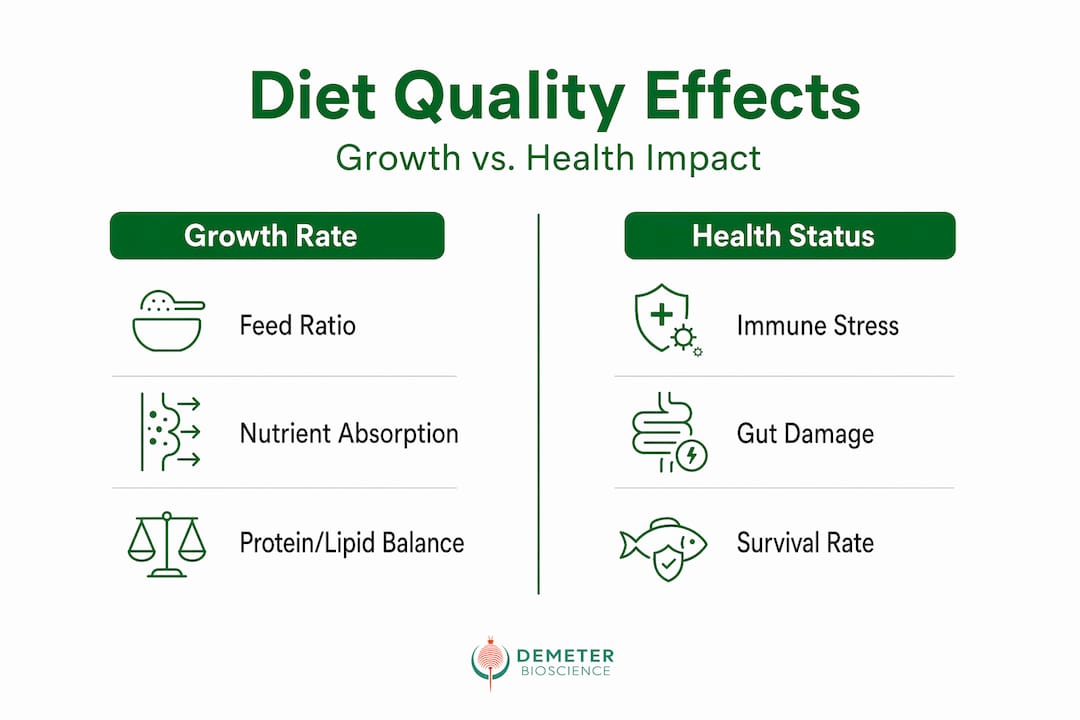
The gap between a good diet and a mediocre one shows up first in feed conversion ratio, then in growth rate, and eventually in disease susceptibility. Research across multiple species makes the mechanisms clear.
| Diet quality factor | Effect on growth | Effect on health |
|---|---|---|
| Optimal protein/lipid ratio | Maximum weight gain and specific growth rate | Improved protein retention and antioxidant status |
| Excess anti-nutritional factors | Reduced feed intake and growth retardation | Gut damage, elevated IFN-γ, immune stress |
| Fermented feed ingredients | Improved FCR and digestive enzyme activity | Enhanced gut microbiota and antioxidant capacity |
| Suboptimal early nutrition | Permanent growth reduction via epigenetic changes | Metabolic dysfunction and disease vulnerability |
Anti-nutritional factors in plant proteins reduce nutrient digestibility and cause gut damage, triggering immune stress cycles that suppress growth through systemic effects. This is not a minor inconvenience. Trypsin inhibitors, lectins, and phytates found in soy and canola meals can damage the gut epithelium, increase intestinal permeability, and elevate inflammatory markers. The fish spends metabolic energy fighting inflammation instead of building muscle.
Feed processing changes this picture substantially. Fermented rice polishings at 200 g/kg dietary inclusion improved feed conversion ratio, gut morphology, and antioxidant status in Nile tilapia. The fermentation process breaks down ANFs, pre-digests complex carbohydrates, and enriches the ingredient with beneficial microbial metabolites. Pushing inclusion beyond 400 g/kg reversed those gains, which illustrates a principle you will encounter repeatedly: dose and balance matter as much as ingredient selection.
Diet quality also interacts with water quality in ways that compound the growth effect. Properly formulated diets reduce fecal waste load in recirculating systems, which lowers ammonia and nitrite concentrations and reduces the chronic stress that suppresses the growth hormone axis. In intensive systems, this feedback loop is significant.

Pro Tip: When diagnosing slow growth, check your feed conversion ratio before you adjust stocking density or water flow. A deteriorating FCR almost always points to a nutritional problem before it points to an environmental one.
Early life nutrition and long-term growth outcomes
Here is where aquaculture nutrition gets genuinely fascinating, and where most farm programs leave money on the table. The diets you feed larvae and juveniles do not just affect growth during those stages. They reprogram the fish's metabolic machinery for life.
Suboptimal early-life nutrition creates irreversible metabolic consequences through epigenetic regulation, including permanent growth retardation mediated by gene expression changes. This means that a larval feeding period managed with cheap, low-quality feed can compromise the growth potential of every fish in that cohort for the entire production cycle, regardless of how good the grower feed is.
The key mechanisms at work during early life stages include:
- Epigenetic programming: DNA methylation patterns established during embryonic and larval development regulate gene expression for metabolic enzymes, hormone receptors, and immune pathways. A nutritionally deficient early diet can silence growth-promoting genes in ways that persist through adulthood.
- Maternal diet effects: The nutritional status of broodstock directly influences egg composition and offspring nutrient utilization capacity. Broodstock fed diets deficient in essential fatty acids or specific micronutrients produce larvae with compromised metabolic efficiency from the moment they hatch.
- Digestive enzyme priming: Early exposure to specific nutrients primes the production of digestive enzymes. Larvae fed high-quality, digestible protein sources develop stronger enzymatic capacity, which improves nutrient absorption efficiency throughout the grow-out phase.
- Immune system calibration: Early nutrition shapes the development of mucosal immunity in the gut. Fish with well-nourished early immune systems show lower baseline inflammation, which frees metabolic resources for growth rather than defense.
The practical implication is straightforward: invest in feed quality most aggressively during the larval and juvenile stages, when the return on nutritional investment is highest and the biological windows for programming are open. Cutting costs at this stage is one of the most expensive decisions you can make per kilogram of final product.
Practical strategies to maximize growth through feed quality
Translating nutritional science into farm practice requires a systematic approach. These steps reflect what the research consistently supports:
- Formulate on digestible nutrients, not crude values. Biofloc particles under 48 µm are richer in amino acids, and digestible nutrient values are better predictors of growth than crude protein percentages. Work with ingredient suppliers who can provide digestibility coefficients for your target species.
- Match protein and energy to species and life stage. Carnivorous species like salmon and trout require higher protein and lipid levels than omnivores like tilapia and carp. Juvenile fish generally need higher protein-to-energy ratios than adults. Applying a single formulation across life stages wastes both nutrients and money.
- Incorporate fermented or processed ingredients strategically. Fermentation of plant-based ingredients removes ANFs, enhances gut microbiota, and improves nutrient uptake, leading to better feed conversion and growth. The key word is strategically. Inclusion rates matter, and exceeding the optimal level can reverse the benefit.
- Evaluate functional additives at the right dose. Low doses of Phyllanthus emblica at 5 g/kg produced the highest weight gain in red tilapia, while higher doses improved immunity but reduced growth. Every additive has a dose-response curve. Test it for your species and system before scaling.
- Consider alternative protein sources for sustainability and performance. Shrimp head meal at roughly 16% inclusion in digestible-based diets improved protein retention, lipid mobilization, and immune function in Nile tilapia. Novel ingredients like this can reduce dependence on fishmeal while maintaining or improving growth performance.
Pro Tip: Before reformulating a diet, run a digestive enzyme activity assay on your current stock. Low protease or amylase activity is a direct signal that your fish are not extracting full nutritional value from their feed, and it points you toward the right intervention.
Monitoring growth challenges tied to nutrition
Recognizing nutritional problems early prevents the compounding losses that come from weeks of suboptimal performance. The indicators are measurable if you know what to track.
- Feed conversion ratio trends: An FCR that rises over time without changes in feeding rate, water temperature, or stocking density almost always signals a nutritional issue, either ingredient variability in the feed batch, an ANF problem, or a mismatch between life stage requirements and current formulation.
- Behavioral and physical signs: Reduced feed intake, increased aggression at feeding, abnormal swimming, and pale or eroded fins are all early signals of nutritional stress. Skeletal deformities, particularly in larvae and juveniles, often indicate deficiencies in phosphorus, vitamin C, or essential fatty acids.
- Digestive enzyme activity: Measuring protease, lipase, and amylase activity in gut samples gives you a direct read on how well fish are processing their feed. Low enzyme activity relative to feed composition means nutrients are passing through rather than being absorbed.
- Health markers: Elevated cortisol, reduced hematocrit, and changes in white blood cell counts all reflect the systemic stress that poor nutrition creates. These markers often deteriorate before growth rate visibly declines, giving you an early warning window.
Compensatory growth after feed restriction depends on high-quality refeeding. If you use feed restriction as a management tool, the quality of the refeeding diet determines whether fish recover fully or carry a metabolic deficit into the next growth phase. For intensive aquaculture systems, integrating nutritional monitoring with water quality management is not optional. The two systems are interdependent.
My perspective on what most farms get wrong
I've spent years working with aquaculture producers who are genuinely committed to their fish, and the most common mistake I see is treating feed as a commodity rather than a biological input. Farmers will invest heavily in aeration, filtration, and genetics, then buy the cheapest feed that meets a minimum crude protein spec. That disconnect is where growth potential gets lost.
What I've learned is that the gap between crude nutrient content and actual bioavailability is where the real performance difference lives. A feed that tests at 38% crude protein but delivers 90% digestible amino acid availability will outperform a 42% crude protein feed with 65% digestibility every time. The fish does not care what the label says. It cares what reaches the bloodstream.
The research on early nutritional programming genuinely changed how I think about larval feed investment. The idea that a few weeks of suboptimal larval nutrition can epigenetically suppress growth for an entire production cycle is not a theoretical concern. It shows up in cohort-level growth variance that farmers often attribute to genetics or water quality when the real cause was set months earlier in the hatchery.
My honest take: the farms that will outperform the rest over the next decade are the ones that treat nutrition as a precision practice rather than a cost center. That means formulating on digestible values, monitoring enzyme activity, investing in early life stage quality, and understanding that every ingredient decision has a downstream biological consequence.
— Demeter
How Demeterbioscience supports fish growth through feed quality
At Demeterbioscience, everything described in this article comes down to one practical question: what are you actually feeding your fish? Our live brine shrimp products are cultivated in controlled, land-based systems and fed exclusively on Dunaliella microalgae, delivering a guaranteed minimum of 40% protein with consistent amino acid profiles and essential fatty acid content. Unlike wild-harvested brine shrimp, which suffer from seasonal nutritional variability and starvation conditions, our farmed product gives you a predictable, high-digestibility feed input that supports the growth rates your formulations are designed to achieve. Explore our fish meal products and our full range of brine shrimp options to find the right nutritional foundation for your system. Contact our team to discuss your specific species and production goals.
FAQ
Why does feed quality matter more than feed quantity for fish growth?
Fish growth depends on the bioavailability of specific amino acids and fatty acids, not just caloric intake. A high-quantity diet built on poorly digestible ingredients can produce worse growth outcomes than a lower-quantity diet with superior nutrient availability.
How do anti-nutritional factors affect fish growth rate?
Anti-nutritional factors in plant-based ingredients damage gut epithelial integrity, trigger immune stress responses, and reduce nutrient absorption. The result is slower growth, higher feed conversion ratios, and increased disease susceptibility.
What is nutritional programming in fish?
Nutritional programming refers to the lasting metabolic and epigenetic changes caused by early-life diets. Suboptimal larval nutrition can permanently reduce growth potential by altering gene expression for metabolism and hormone response.
How can fermentation improve fish feed performance?
Fermentation breaks down anti-nutritional factors, pre-digests complex molecules, and enriches feed with beneficial microbial metabolites. At optimal inclusion levels, fermented ingredients improve gut morphology, digestive enzyme activity, and feed conversion ratio.
What is the best indicator that a fish diet is underperforming nutritionally?
A rising feed conversion ratio combined with normal water quality and stocking parameters is the clearest early signal. Measuring digestive enzyme activity in gut samples provides a more direct confirmation of whether nutrient extraction is occurring as expected.