
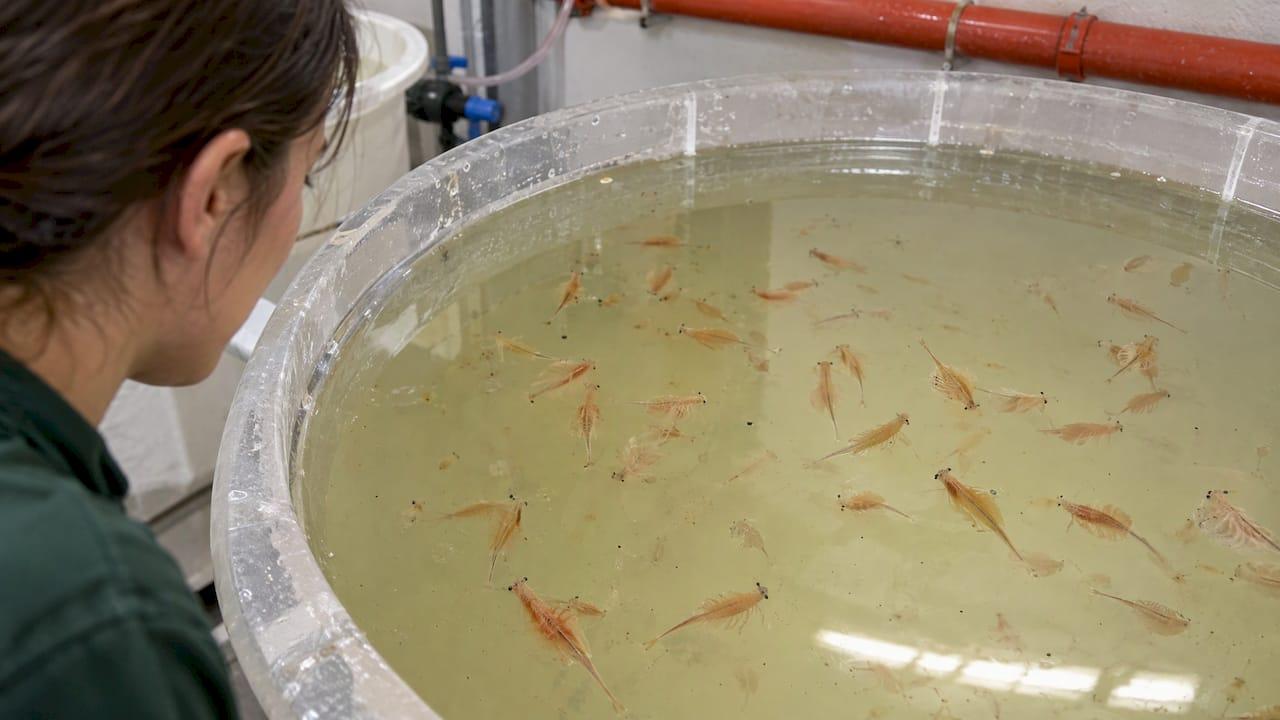
Microalgae-fed brine shrimp are Artemia raised on a controlled diet of live algae instead of whatever they find in a wild salt lake or a pond. The diet matters because brine shrimp are filter feeders: their body chemistry, including protein and fatty acids, follows what they eat. This guide covers what these shrimp eat at each life stage, what the research says about algae choice, how long feeding or enrichment takes, and how to put them to work in a home tank or a hatchery.
TL;DR
- Brine shrimp filter particles of roughly 5 to 50 microns, so single-celled algae are a natural fit for their diet.
- Fatty acid content depends on the algae. In one 2022 study, Artemia fed Dunaliella salina had the highest DHA of the diets tested.
- Freshness counts: newly hatched shrimp are most nutritious right away, and unfed nauplii lose value within a day or two.
- Our shrimp are farmed on land and fed only Dunaliella, and we design them for at least 40% protein with consistent quality.
- Live shipments run $17 to $35 one-off, or $25 per month on a membership.
Table of Contents
- What "microalgae-fed" actually means
- How brine shrimp eat: particle size and life stages
- What the research says about algae choice and nutrition
- Timing: the freshness window
- Our perspective
- How to use microalgae-fed brine shrimp
- Get farmed, microalgae-fed shrimp delivered
- FAQ
- Sources
What "microalgae-fed" actually means
Brine shrimp (Artemia) live in salt lakes and evaporation ponds. Wild populations eat what the water offers: algae, bacteria and detritus. When algae blooms fade or salinity swings, the animals can go hungry, and their nutritional profile moves with the season.
A microalgae-fed, or controlled-diet, brine shrimp is the opposite approach. The grower decides the food, keeps the water stable, and harvests animals that have been eating the same thing for their whole lives. The idea is simple: if the diet is consistent, the nutrition in the animal is consistent.
That is how we run Demeter Biosciences. Our brine shrimp are cultivated in land-based, organic, sustainable systems and fed exclusively on the algae Dunaliella. Our aim is a product with at least 40% protein content, batch after batch, without the seasonal variability of natural ecosystems. You can read more about how we raise them on our brine shrimp product page.

Why hobbyists and hatcheries care
For a hobbyist, a brine shrimp is a package of food that moves, which triggers feeding in picky fish, fry and invertebrates. For a hatchery, it is a delivery vehicle for protein and lipids. In both cases, what the shrimp ate before reaching your fish is part of what your fish eats. A shrimp that has been grazing on algae carries those nutrients in its gut and tissues, which is the reason people talk about "gut loading."
How brine shrimp eat: particle size and life stages
Brine shrimp are non-selective filter feeders. A University of California Museum of Paleontology lesson notes that they feed on particles between 5 and 50 microns, and that feeding is not even necessary if microscopic algae grow in their container. Single-celled microalgae sit squarely inside that range, which is why algae are the natural diet.
Newly hatched nauplii
A freshly hatched nauplius does not eat. According to Texas A&M's SRAC publication on Artemia production, the mouth and anus are not fully developed, so the animal lives off its yolk sac. About 12 hours after hatching it molts into Instar II and starts filter feeding on microalgae, bacteria and detritus. The nauplius can survive on stored reserves for up to 5 days, but its calories and protein decline over that time.
This is the reason you cannot gut load a shrimp that has just hatched: it has nothing to load until the second instar. Reefs.com's aquarium invertebrate series makes the same point, explaining that the gut is incomplete in Instar I and feeding begins at Instar II.
Growing juveniles and adults
Filtering efficiency changes as the animal grows. A 2024 Aquaculture International study on Artemia franciscana found that body length had the greatest effect on filter-feeding rate, followed by temperature, particle size and stocking density. Larger shrimp handle larger particles, and crowding lowers the feeding rate per animal.
In practice, that means:
- Small juveniles do best on the smaller microalgae cells.
- Warm, uncrowded water supports faster feeding.
- Adults are efficient enough that a short exposure to a nutrient-rich food shows up in their tissues. The Reefs.com article says live adults can be significantly enriched in 1 to 2 hours, because they become more efficient feeders as they grow.
Size of the shrimp as food
A 2022 review in Frontiers in Marine Science lists newly hatched Artemia nauplii at 400 to 500 microns, and 500 to 700 microns once enriched, cultured at 28°C and 25 to 33 ppt salinity. That size range is why nauplii suit many fish fry, while grown shrimp suit larger mouths. If you keep small fish, our guide to feeding pipefish fry brine shrimp shows how size and timing work together.
What the research says about algae choice and nutrition
Not all microalgae do the same job. Researchers have compared diets for decades, and the results show a trade-off between growth, survival and fatty acid profile. Here is what the evidence supports.
Protein and baseline composition
The SRAC publication reports that Artemia composition is generally in the range of 51 to 55 percent protein, 14 to 15 percent carbohydrate and 13 to 19 percent fat, with 3 to 15 percent n-3 HUFA. It also states that the food the parent animals eat strongly influences the fatty acid content of their cysts. In other words, diet is not a side detail. It shapes the product.
Fatty acids: DHA and EPA
A 2022 study from the Journal of Science and Management compared four microalgae fed to Artemia franciscana. Shrimp fed Dunaliella salina had the highest DHA, at 10.37% of dry weight, against 1.84% for Tetraselmis chuii, 3.86% for Chaetoceros calcitrans and 3.79% for Nannochloropsis oculata. EPA did not differ significantly between diets. Good growth and survival appeared with the Chaetoceros and Tetraselmis diets, which shows that the best algae depends on what you want to maximize.

Other algae lead in other categories. A 2007 study of enriched nauplii found that Nannochloropsis salina gave the highest EPA, at 25.80%, with arachidonic acid at 9.50% and DHA at 4.18%. A 2023 study from India found the highest DHA, 3.69%, in nauplii enriched with Isochrysis galbana for 7 hours. Different species, different strengths.
The bigger picture
A 2025 review in Reviews in Aquaculture describes microalgae as a robust strategy for enriching Artemia, because algae supply omega-3 fatty acids, carotenoids, essential amino acids, quality protein and vitamins. The species it lists as commonly used include Spirulina, Chlorella vulgaris, Dunaliella salina, Nannochloropsis and Isochrysis.
For a deeper look at specific species, see our guides to algae types fed to brine shrimp and algae in the brine shrimp diet.
Live algae versus other controlled diets
Controlled diet does not have to mean live algae only. A 1999 Colombian Journal of Zoology study tested eight diets, including live Tetraselmis suecica and Chaetoceros calcitrans, dried Spirulina, and soybean and wheat meals. Its mixed meal diets gave strong production, and the 100% soya meal diet produced organisms 68% longer than the C. calcitrans diet at day 10, though survival was higher on C. calcitrans. Another 1999 study found that an inert diet gave growth similar to Chaetoceros, but lipid content rose and protein content fell compared with the algae-fed animals.
That last result is the one to keep in mind. When protein is the goal, the diet is a lever. Our approach, one algae fed exclusively, is built around holding that lever steady.
| Diet or approach | What the studies reported | Takeaway |
|---|---|---|
| Dunaliella salina | Highest DHA (10.37% dry weight) in a 2022 comparison | Strong for DHA |
| Nannochloropsis salina | Highest EPA (25.80%) in enriched nauplii, 2007 | Strong for EPA |
| Chaetoceros and Tetraselmis | Better growth and survival in the 2022 comparison | Strong for production |
| Isochrysis galbana | Highest DHA (3.69%) at 7 hours in a 2023 trial | Short enrichment window |
| Soy and wheat meals | Longer animals at day 10 in a 1999 trial | Growth focused |
Timing: the freshness window
Diet is half of the story. The other half is how soon the shrimp reach the fish.
The SRAC publication stresses that the goal is to use Artemia as soon as possible after hatching, because that is when they are most nutritious, and that larval fish performance is directly related to the HUFA level of the Artemia fed. Tropical Fish Hobbyist Magazine, citing Hoff and Snell, reports that shrimp not fed by the end of the second instar, about 24 hours after hatching, may lose up to a fifth of their body weight and over a quarter of their nutritional value.
How long enrichment takes
If you do enrich shrimp yourself, the published windows vary with the method and the age of the animals:
- A Southern Regional Aquaculture Center-affiliated manual for freshwater ornamental fish, from CTSA, specifies nauplii at 300 to 400 per milliliter for at least 6 hours before feeding, and notes overnight enrichment is common but yields larger nauplii.
- The 2025 review says most protocols use 2 to 6 hours.
- For newly hatched shrimp at the second instar, Reefs.com suggests at least 12 hours for decent enrichment.
The CTSA manual also shows why the effort pays off: newly hatched Artemia had 7.0 mg total fatty acids per 100 mg dry weight and no detectable DHA, and the figure rose to 10.3 mg after 12 hours of enrichment. Our own walk-through of the 12 to 24 hour enrichment rule turns these numbers into a routine.
A farmed, algae-fed shrimp that has been eating the same diet for its entire life skips much of that step, because the nutrition is built in before it ships.
Our perspective
We started Demeter Biosciences because we saw how uneven wild brine shrimp can be. A wild population depends on the season, the lake and the luck of the bloom. When food runs short, the animals starve, and what reaches the fish tank reflects that.
Our answer is to take the variable out. We raise brine shrimp on land, in organic, sustainable systems, and we feed them exclusively on the algae Dunaliella. The target is at least 40% protein in the product, with the same quality from one shipment to the next. Dunaliella is also a microalga with a strong fatty acid story: in published research, Artemia fed on it showed the highest DHA among the algae compared.
We believe the future of aquatic feeds lies in microalgae, for the animals and for the environment. Microalgae grow without farmland, and a controlled land-based system gives us a steady supply that does not depend on harvesting natural ecosystems.
If you keep fish, run a fish store or manage an exhibit, the practical benefit is simple: you get live food you can plan around. Fresh, consistent, and raised with care.
Demeter
How to use microalgae-fed brine shrimp
Whether you are feeding a reef, a planted freshwater tank or a hatchery, the routine is similar.
- Feed soon after delivery. Live shrimp are at their best when fresh, so plan the first feeding for the day they arrive.
- Match the portion to the fish. Feed what the fish finish in a few minutes. For a general rule on amounts and timing, see our feeding amount and 24-hour plan.
- Keep a schedule. A written routine prevents both overfeeding and gaps. Our feeding schedule checklist is a starting point.
- Target the feeding. For corals, fry and shy eaters, deliver food near the animals. Our guide to target feeding explains how.
- Pair with other foods. Variety supports a healthy fish. Phytoplankton suits filter feeders and corals, while shrimp suit fish that hunt moving prey.
If you hatch your own
Some hobbyists keep hatching cysts at home. The UCMP lesson advises feeding no more than will disappear and leave the water clear in two days, once or twice a week, for shrimp you are growing out. Many keepers combine home hatching with farmed shrimp for convenience and consistency. Our article on brine shrimp for freshwater fish compares both routes, and the one on brine shrimp meal nutrition helps hatcheries judge feed value.
Get farmed, microalgae-fed shrimp delivered
We ship live brine shrimp directly to hobbyists, and we supply bulk orders to fish stores, museums and research institutions. Live brine shrimp run from $17 to $35 per order. If you want a steady supply, the monthly membership is $25 per month and delivers a live shipment each month.
For filter feeders and corals, we also offer live phytoplankton at $20, and gift cards from $10 to $50 make an easy present for a fellow aquarist. Stores and institutions can start with our bulk store order page, and you can browse everything on the main shop page.
FAQ
Do brine shrimp need to be fed?
Yes, if you are keeping them alive for more than a day or two. Newly hatched nauplii live off their yolk sac and begin filter feeding about 12 hours after hatching, and the reserves last up to 5 days at the most. After that, they need particles in the 5 to 50 micron range, such as microalgae or fine yeast.
What microalgae can brine shrimp eat?
Brine shrimp filter a wide range of single-celled algae. Research has used Dunaliella, Tetraselmis, Chaetoceros, Nannochloropsis, Isochrysis and Spirulina. The best choice depends on whether you want growth, survival or a particular fatty acid. We feed our shrimp Dunaliella exclusively.
How long does it take to enrich brine shrimp with algae?
It depends on age and method. Many protocols use 2 to 6 hours, one manual calls for at least 6 hours, and enriching newly hatched second-instar shrimp may take 12 hours or more. Adults take up nutrients faster, in as little as 1 to 2 hours.
Why choose farmed brine shrimp over wild-harvested?
Farmed shrimp are raised in a controlled setting on a set diet, so the nutrition does not swing with the seasons. Our system is land-based and organic, and we design it for at least 40% protein and consistent quality.
Can I feed brine shrimp to any fish?
Most fish that eat small live prey take brine shrimp readily, from freshwater community fish to fry and many marine species. Match the size of the shrimp to the mouth of the fish, and feed an amount that is eaten within a few minutes.
Sources
- Observing Brine Shrimp, UC Museum of Paleontology
- Artemia Production for Marine Larval Fish Culture, Texas A&M SRAC Publication No. 702
- Aquarium Invertebrates: Nutritional Value of Live Foods, Reefs.com
- Effects of temperature and particle size on the filter-feeding rate of Artemia, Aquaculture International
- Recent Trends in Live Feeds for Marine Larviculture, Frontiers in Marine Science
- Fatty Acids Profiles and Growth Performances of Artemia, Journal of Science and Management
- Variation in fatty acid composition of Artemia salina, PubMed
- Journal of Krishi Vigyan, CMFRI, 2023
- Artemia Enrichment Strategies, Reviews in Aquaculture
- Influence of different diets on length and biomass of Artemia, Colombian Journal of Zoology
- Controlled production of Artemia biomass using an inert diet, Aquacultural Engineering
- How to Hatch Brine Shrimp, Tropical Fish Hobbyist Magazine
- Enrichment of Artemia for Use in Freshwater Ornamental Fish Production, CTSA