
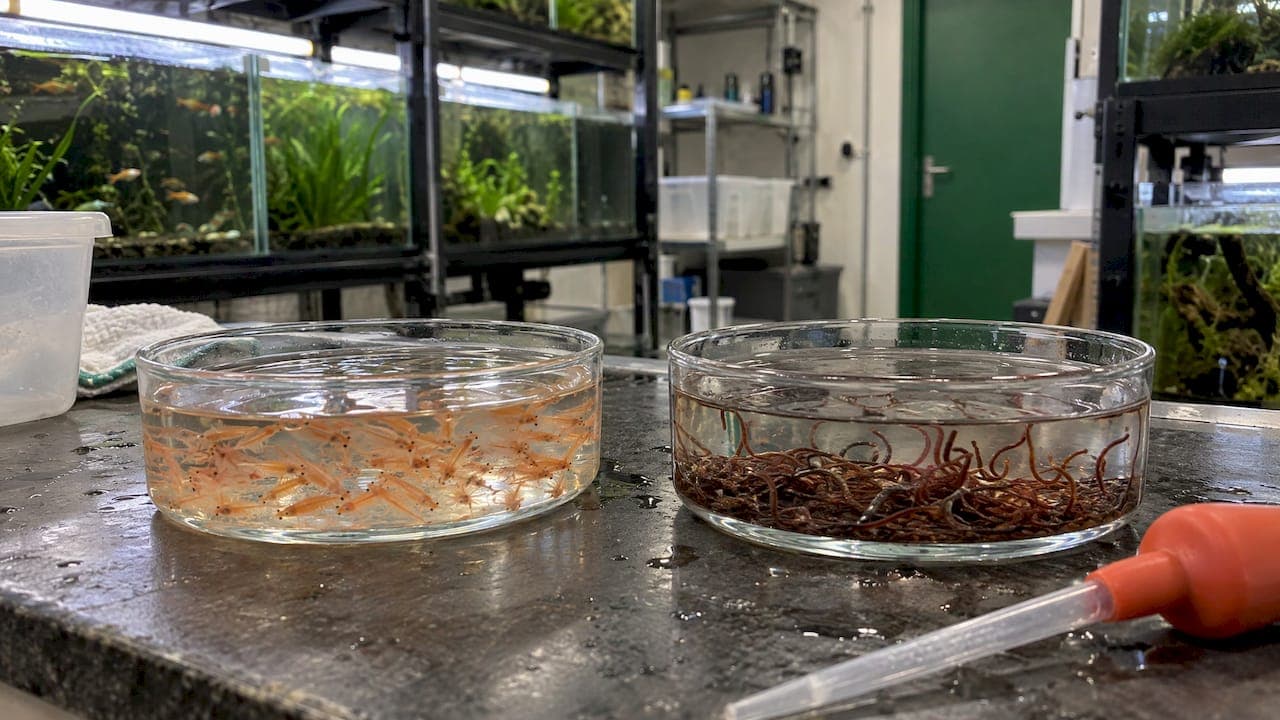
Brine shrimp and blackworms do different jobs. Brine shrimp are a clean, small, easy-to-offer food that suits fry and most community fish. Blackworms are a rich, wriggling treat that bottom feeders and conditioning fish love, but they depend heavily on where they were raised and how they were handled. Tubifex, often confused with blackworms, are a different animal with a different risk profile. Below is how they compare, and how to use each one well.
TL;DR
- Brine shrimp are the easier everyday live food: small, accepted by most fish, and less likely to carry parasites harmful to freshwater fish because they live in strong salt water.
- Blackworms and tubifex are two different species. Both can be excellent foods, but safety depends on the production environment, rinsing and sanitation.
- Newly hatched brine shrimp are a classic starter food for fry. Worms suit larger fish and bottom dwellers.
- Variety beats any single food. Rotate brine shrimp with worms or other foods rather than relying on one.
- Feed in small amounts. Uneaten worms and heavy feeding both foul the water.
Table of Contents
- Brine shrimp, blackworms and tubifex at a glance
- What each food actually is
- Nutrition: what the numbers say
- Safety and water quality
- Which fish and life stages suit each food
- Can either be a staple?
- How to choose
- Our perspective on brine shrimp
- Get farmed live brine shrimp from Demeter
- FAQ
- Sources
Brine shrimp, blackworms and tubifex at a glance
| Brine shrimp | Blackworms | Tubifex | |
|---|---|---|---|
| What it is | Small saltwater crustacean (Artemia) | Freshwater worm, Lumbriculus variegatus | Freshwater worm, Tubifex species |
| Preferred habitat | Strong salt water | Cold, well-oxygenated water | Warm, nutrient-rich, low-oxygen water |
| Best for | Fry, community fish, most freshwater and marine fish | Bottom dwellers, killifish, conditioning | Larvae, killifish, finicky eaters |
| Main concern | Nutrition depends on feeding and enrichment | Source and sanitation | Disease risk if poorly sourced |
| Parasite risk to freshwater fish | Low | Depends on source | Higher, rinse carefully |
The habitat and species details come from the American Killifish Association's guidance on worms, which separates cold-water blackworms from tubifex that prefer warmer, lower-oxygen conditions. Shrimp and Snail Breeder makes the same point from the species side: they are different animals, so do not assume identical size, life cycle or nutrition.
What each food actually is
Brine shrimp
Brine shrimp are tiny crustaceans. Adults reach about a quarter inch long, and they are sold live, frozen, freeze-dried and as hatchable eggs. Newly hatched nauplii are small enough for a wide range of fry. Adults are a chunkier meal for juveniles and adult fish.
Blackworms
Blackworms are slender freshwater worms that thrive in cold, oxygen-rich water. Many hobbyists buy them by the portion, keep them cool, and feed them to bottom dwellers, discus, killifish and other fish that like movement. Shrimp and Snail Breeder describes them as generally suitable for bottom-dwelling fish.
Tubifex
Tubifex are thinner, redder worms that live in warm, nutrient-rich mud. Fish accept them eagerly, and they are protein-rich. They also have a long-standing reputation for passing on disease when raised or held poorly. Many shops and forums use "tubifex" and "blackworm" loosely, so ask what you are actually buying.
Nutrition: what the numbers say
Neither food has one fixed nutritional profile. Both are shaped by what the animal ate and how it was kept.
Worms. Tubificid worms are reported at roughly 65% protein, 14% lipid and 15% ash on a dry-weight basis. A 2025 Aquaculture International review shows how much the culture substrate matters: worms grown on rice-mill sludge came in at 28.81% crude protein and 13.64% crude lipid, while another feed mixture produced 66.26% protein and 12.79% fat. The same review notes that temperature, moisture, water flow, oxygen and pH all affect worm growth and survival. In plain terms, a worm is only as good as its pond, tub or sludge.
Brine shrimp. The Spruce Pets notes that brine shrimp texture and flavor vary with what they were fed and how they were frozen. Newly hatched nauplii live off yolk reserves and become less nutritious as those run out. Rob Toonen's aquarium nutrition guide explains that nauplii can be enriched once they reach the feeding stage, generally needing at least about 12 hours for useful HUFA loading, while adults can be enriched in about one to two hours. The shrimp work as delivery vehicles: enrichment works because they ingest the nutrients.
That last point is why the diet of the shrimp matters. Our own shrimp are raised on Dunaliella microalgae, and we design our system to deliver at least 40% protein with consistent quality from batch to batch. If you want to go deeper on enrichment, see our live feed enrichment protocol.

Safety and water quality
This is where the two foods differ most.
Why brine shrimp are the low-risk option
The American Killifish Association reports that brine shrimp are widely used live or frozen, accepted by most killifish, and less likely to carry parasites that harm freshwater fish because they live in strong salt water. The Spruce Pets says the same: brine shrimp do not carry parasites that might spread to freshwater fish.
What to do with worms
Worms can be a wonderful food when handled correctly. The practical rules from the sources:
- Buy from a store you trust. The Spruce Pets advises buying tubifex from a reputable store and rejecting worms held in cloudy water.
- Rinse often. It recommends rinsing three to four times daily in dechlorinated water until the water stays clear, refrigerating them, and holding them back from fish until clean.
- Use flowing cold water. The AKA says holding tubifex under flowing cold water can wash away gut contents and detritus.
- Know the history. The AKA notes a long-standing concern that blackworms, redworms and tubifex may be raised in stagnant water or polluted mud, and that heavy feeding increases waste, so rigorous water changes and tank cleaning matter.
- Skip them in saltwater tanks. Toonen cautions that freshwater worms may die quickly in salt water and decay if uneaten, and their nutrition for marine fish is poorly documented.
The AKA's core point is that safety depends more on the production environment, handling and sanitation than on the name on the bag. Ornamental Fish International's biosecurity code backs up the same habit for any live animal food: understand where your supplier gets its stock and favor shorter supply chains. It also stresses that good water chemistry helps prevent disease outbreaks.
Storage
Worms need cold, clean, regularly rinsed holding. Live brine shrimp need their own care, and we cover that in how long live brine shrimp stay fresh.
Which fish and life stages suit each food
Fry and larvae
Brine shrimp are the standard first live food. The Spruce Pets, citing the American Killifish Association, identifies newly hatched brine shrimp as a suitable starter for many fish fry because they are small and can be hatched at home. Worms also have a place with young stages: the Aquaculture International review says live tubifex are commonly used for larvae and other young fish, since small mouths and immature digestive systems can make artificial feeds hard to use. For hobby fry, though, the smaller and cleaner nauplii are the simpler route. Our guide on brine shrimp nutrition for larval fish goes into commercial setups.
Community fish
Tetras, rasboras, guppies, barbs, many cichlids and most small to mid-sized freshwater fish take brine shrimp readily. Adults are an easy size for them. If you keep freshwater fish, our post on brine shrimp for freshwater fish covers hatching versus buying farmed shrimp.
Bottom dwellers, killifish and picky eaters
Blackworms and tubifex shine here. AquariumWorld says live tubifex and blackworms are high-protein foods that can help bring fish into breeding condition and stimulate finicky fish to feed. The AKA calls them excellent foods for killifish while stressing that a varied, balanced diet is necessary.

Marine and reef tanks
Brine shrimp work in both fresh and salt water. Freshwater worms do not belong in a reef or marine tank, per Toonen's caution above. If you keep a reef, see hatching or buying brine shrimp for reef tanks.
Can either be a staple?
AquariumWorld calls brine shrimp an excellent staple food for most fish, and also notes that broader guidance favors variety. A reasonable approach:
- Use brine shrimp as a regular live or frozen item in the rotation, alongside a quality prepared food.
- Offer worms as an occasional rich meal, such as once or twice a week for fish that like them, from a source you trust.
- Feed only what the fish finish in a couple of minutes. Extra worms that burrow into gravel and die, or extra shrimp that go uneaten, add to the waste load.
- Watch the water. The more you feed live foods, the more important regular water changes become.
There is no single formula that fits every species, so adjust for the fish you keep. If you have a fish with a medical problem, a veterinarian experienced with fish is the right person to consult before changing the diet.
How to choose
Pick by the job you need done:
- Raising fry: newly hatched brine shrimp.
- Daily variety for community fish: brine shrimp, live or frozen.
- Conditioning bottom feeders or killifish: brine shrimp plus an occasional worm meal from a well-sourced supply.
- Saltwater or reef tank: brine shrimp, never freshwater worms.
- Lowest-hassle live food: brine shrimp, because there is no daily rinsing routine.
If live versus frozen is your next question, see our comparison of live and frozen brine shrimp. For a broader tour of options, our guide to live fish food types covers daphnia, microworms and more, and the brine shrimp vs bloodworms article covers the other common worm-like food.
Our perspective on brine shrimp
We grow brine shrimp on land, in controlled tanks, and feed them only the microalgae Dunaliella. We do that because a brine shrimp is a package for whatever it ate. Wild-harvested shrimp can swing with the seasons and can be starving when they are collected. Ours are raised to give your fish a consistent meal.
Our system is designed to deliver at least 40% protein, batch after batch. That consistency is the point. When the shrimp are fed well, your fish get a food that is small enough for fry, accepted by most species, and simple to keep on hand, with none of the rinsing routine that worms demand.
We think of brine shrimp as the backbone of a live-food routine. Other foods can be layered on top for variety, but a dependable, well-fed shrimp is the part you can build around, from first-feeding fry to adult community fish.
Demeter
Get farmed live brine shrimp from Demeter
If brine shrimp fit your tank, you can order farmed live brine shrimp from us, priced at $17 to $35 depending on the option. For regular feeding, the monthly membership is $25 per month and brings a live shipment each month. We also offer live phytoplankton at $20, and gift cards from $10 to $50. Stores, museums and research groups can look at our bulk store order.
You can see everything in one place on our featured products page, or read more about what makes our brine shrimp different.
FAQ
Are blackworms and tubifex the same thing?
No. Blackworms are Lumbriculus variegatus and tubifex are Tubifex species, so they differ in size, life cycle and likely nutrition. Blackworms prefer cold, well-oxygenated water, while tubifex prefer warmer, nutrient-rich, lower-oxygen conditions. Sellers sometimes mix the names, so ask what you are getting.
Can fish eat brine shrimp every day?
Most freshwater and marine fish accept brine shrimp readily, and sources describe them as a good staple. Even so, guidance favors a varied diet, so rotate them with other foods. Feed only what the fish clear quickly, and keep up with water changes.
Which is safer for freshwater fish, brine shrimp or worms?
Brine shrimp carry a lower parasite risk because they live in strong salt water. Worms can be fine when they come from a clean, well-managed source and are rinsed until the water runs clear, but they carry a higher risk of introducing disease if the source is poor.
Which is better for fry?
Newly hatched brine shrimp are the usual first live food for many fry because they are tiny and easy to hatch or buy. Worms are used with larvae in aquaculture, but for most hobby fry the smaller nauplii are the practical starting point.
Can I feed blackworms to a saltwater tank?
It is not recommended. Freshwater worms can die quickly in salt water and decay if uneaten, and their nutritional value for marine fish is poorly documented. Brine shrimp are the better live food for marine tanks.
Sources
- Food and Feeding: Red, Black and Tubifex Worms, a Safe Food for Killies (American Killifish Association)
- The AKA Beginners Guide (American Killifish Association)
- Benefits of Feeding Live Food to Your Fish (The Spruce Pets)
- Update on terrestrial and aquatic worms (Aquaculture International, 2025)
- Worms: A potential feed source for cultured aquatic animals (Global Seafood Alliance)
- Nutritional Value of Live Foods for the Coral Reef Aquarium, Part 2 (Reefs.com)
- 15+ Live Food Options for Aquarium Fish (Shrimp and Snail Breeder)
- Biosecurity and the ornamental aquatic industry (Ornamental Fish International, 2023)
- Fish Food and Feeding (Mastering Freshwater Aquarium Ecosystems)