
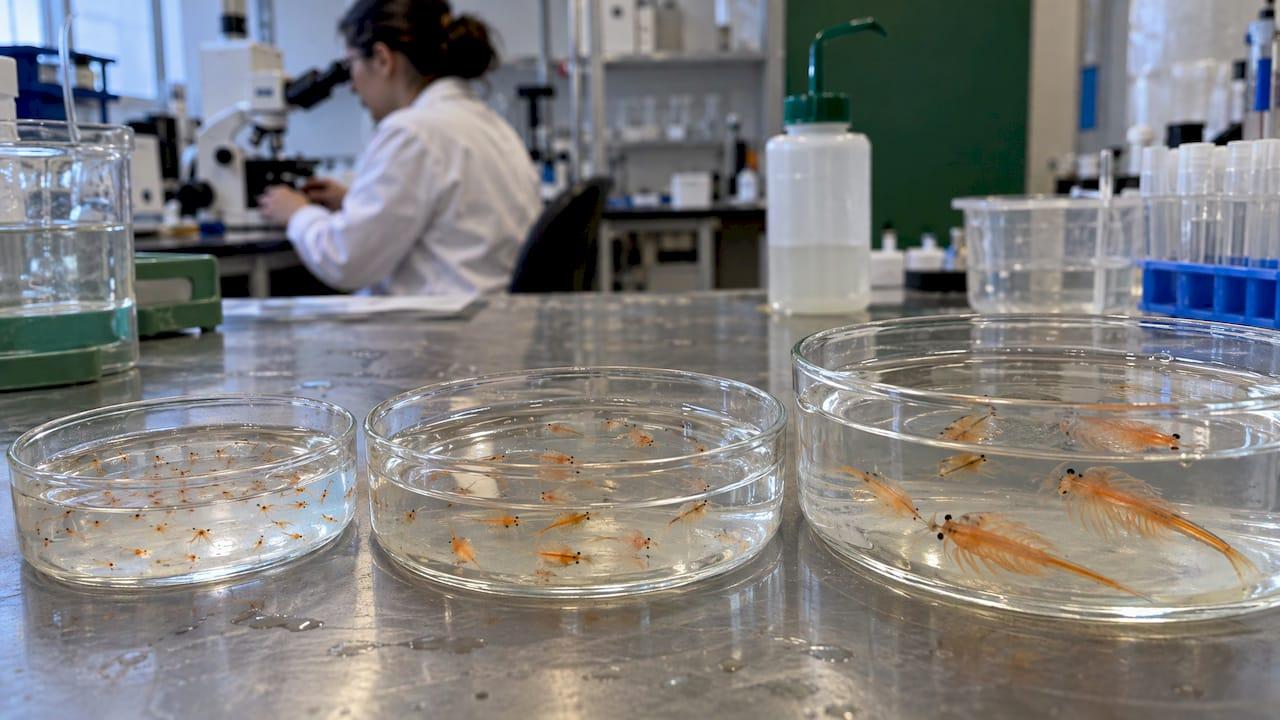
Brine shrimp (Artemia) go from a speck of about 0.4 to 0.5 mm to a shrimp of 8 to 12 mm in a few weeks, and the size you feed decides who can eat it and how much nutrition it carries. Newly hatched nauplii suit small fry. Juveniles and adults suit larger fish, seahorses and anemones. If you want the right size on the day you feed, the most reliable route is live brine shrimp raised and shipped by us, instead of timing your own hatch.
This guide gives the measurements by life stage, the growth timeline, and a practical way to match shrimp size to the mouth you are feeding.
TL;DR
- Cysts (dry eggs) are 0.2 to 0.3 mm; newly hatched nauplii are about 0.4 to 0.5 mm.
- Adults are 8 to 10 mm (males) and 10 to 12 mm (females), and can reach 15 to 20 mm in ideal conditions.
- Nauplii reach adult size in roughly 1 to 3 weeks, depending on feeding and temperature.
- Nauplii are too large for many first-feeding marine fish larvae, so match shrimp size to mouth size, not to habit.
- Brine shrimp need salt water: newly hatched nauplii die within hours in fresh water.
Table of Contents
- Brine shrimp size at each life stage
- How fast brine shrimp grow
- Match shrimp size to the mouth you are feeding
- Why two batches of brine shrimp are rarely the same size
- Salt water and size: can brine shrimp live in freshwater?
- Choosing a size for your setup
- Live brine shrimp from Demeter Biosciences
- Our view on brine shrimp size
- FAQ
- Sources
Brine shrimp size at each life stage
Brine shrimp change shape and size through a series of molts. Researchers classify the stages as nauplii, juveniles and adult males and females, and the Oregon Department of Fish and Wildlife's brine shrimp report puts adults at 8 to 10 mm.
| Stage | Typical size | What it means for feeding |
|---|---|---|
| Dry cyst | 0.2 to 0.3 mm | Hard shell, not digestible; it is only the egg |
| Instar I nauplius | About 0.4 to 0.5 mm (400 to 500 µm) | Smallest live feed, with the most energy |
| Instar II and later nauplii | Growing with each molt | Still small, but feeding on algae from here |
| Juvenile | Roughly 2 to 6 mm | Fits many juvenile fish and small invertebrates |
| Adult male | 8 to 10 mm | Whole prey for mid-sized fish |
| Adult female | 10 to 12 mm | Largest common size; up to 15 to 20 mm when conditions are ideal |
The cyst and nauplius figures come from the FAO manual on Artemia production, which gives cysts as 0.2 to 0.3 mm and free-swimming nauplii as 0.45 mm. Adult lengths and the 400 to 500 µm nauplius figure appear in the 2023 CMFRI training manual, which also notes that an adult is about 20 times longer than a nauplius and about 500 times larger in biomass. For a US reference, NOAA's old fishery leaflet on brine describes adults as about one-third of an inch, which is right in the middle of the 8 to 10 mm range.
A micron (µm) is one thousandth of a millimeter. So 450 µm is 0.45 mm, a little under 0.02 inches. That is why a nauplius looks like a moving orange dot to the eye.

How fast brine shrimp grow
Size depends on age, and age depends mostly on temperature and food. These are the published timings:
- Hatch: Cysts hatch into free-swimming nauplii in 24 to 36 hours, per the FAO manual. The Coastal Tropical Aquaculture (CTSA) gourami manual says instar I nauplii appear in 14 to 18 hours at 25 to 30°C.
- Time to adult: The FAO manual gives 1 to 3 weeks to reach full size depending on feeding. Mississippi State's SRAC fact sheet says the nauplius reaches adulthood in about 8 days after 15 molts under good conditions.
- Growth rate: In a Colombian-journal feeding study, Artemia franciscana grew about thirteen-fold in length over 10 days on mixed-meal diets, from an initial 493 µm.
- Lifespan: The Oregon report says adults can live several months in optimal conditions and reproduce up to 300 nauplii or cysts every 4 days.
The pattern is simple. In the first two days you are working with a nearly fixed size. After that, every day of feeding adds length, and the range of sizes in a hatching tank widens quickly. A culture started on the same day contains shrimp of different sizes by the end of the second week.
Match shrimp size to the mouth you are feeding
The useful question is not how big brine shrimp get, but how big the animal eating them is. A fish, fry or invertebrate can usually take prey up to about the width of its open mouth (its gape). If the prey is much larger, it is ignored or spat out.
Here is a practical way to use the size table:
- Newly hatched fry of freshwater and small tropical fish. Instar I nauplii at 0.4 to 0.5 mm are the classic first live food. NOAA's leaflet notes baby brine shrimp became a standard food for young tropical fish once they pass the microscopic stage.
- First-feeding marine larvae. Be careful. Texas A&M's extension guide reports that newly hatched nauplii are about 450 µm wide, usually too large for most first-feeding marine fish larvae, which are typically fed rotifers first and nauplii afterward. Only a few larger larvae can take them at first feeding.
- Growing juvenile fish, seahorse fry and small corals. Nauplii a few days old, or juveniles, give a bigger bite while staying soft and easy to swallow. Our guide to seahorse fry and brine shrimp covers quantities for this stage.
- Adult small and mid-sized fish, anemones and filter feeders. Grown-out shrimp of 8 to 12 mm are whole prey. The feeding schedule matters more than the size at this point, and our feeding schedule checklist helps with timing.
If you are weighing brine shrimp against another live feed of a similar size, our comparison of Daphnia and brine shrimp for 400 to 500 µm mouths walks through the match.
Why the smallest size is also the richest
Size and nutrition move together. The University of Florida IFAS aquaculture curriculum explains that nauplii at the earliest stage have the highest energy content, which is why they are the most widely used form in aquaculture. The CTSA manual makes the same point about harvest timing: instar I nauplii carry more nutritional value than later stages, so harvesting at the smallest size matters when feeding fry.
Mississippi State's fact sheet adds that nauplii live on their yolk reserves for up to about 5 days, or through instar V, and that their calories and protein diminish over time. In practice, hatchery managers aim to feed as soon as possible after hatching. Our guide to brine shrimp life stages explains the feeding window for hobbyists, and our Artemia nauplii overview covers the biology behind it.
Grown-out shrimp have their own advantage. A 2024 fisheries journal study reports on-grown Artemia at 49.7 to 62.5% protein, and notes that on-grown Artemia is the preferred live food for ornamental fish, which were more colorful when fed it. Because Artemia filter whatever is in the water, what they ate shapes what your fish receive. That is why we feed ours only the microalga Dunaliella, with the aim of at least 40% protein and consistent quality from one shipment to the next.
Why two batches of brine shrimp are rarely the same size
If your hatch looks different from a friend's, there are several reasons.
Strain and origin. The nauplius size is not identical worldwide. An Australian rainbowfish feeding guide says freshly hatched nauplii are mostly under 500 µm but can range from 400 to 800 µm depending on origin, with the San Francisco Bay variety believed to be the smallest. Roughly 90% of the world's commercial cyst harvest comes from Utah's Great Salt Lake, according to the SRAC fact sheet, so many US hobbyists buy a similar strain, but a cyst from another source may produce a larger nauplius.

Temperature. Warmer water shortens the time to hatch and to each molt. The CTSA manual advises holding the hatching container at a constant temperature so harvest time lines up with the feeding schedule.
Hatch spread. Not all cysts hatch at once. The same manual notes the hatch follows a bell curve and recommends several test runs, noting temperature and time, so you harvest the most nauplii at the right size. Hatches that run long include early nauplii that have already molted and grown.
Diet. Starved shrimp stay small and lose nutritional value. Well-fed shrimp grow fast, which is why a controlled feeding system matters for consistent size.
How size is measured. Researchers measure length by photographing samples through a microscope with a length scale, as in the 2024 journal study above. At home, you can place a few shrimp on a ruler printed in millimeters and compare. A small sieve also separates sizes, and our article on 100 to 130 µm sieves and 22 to 36 hour harvest timing covers that method.
Salt water and size: can brine shrimp live in freshwater?
Brine shrimp are a salt water animal. NOAA's leaflet states that newly hatched shrimp cannot live more than 12 hours in fresh water, and the rainbowfish guide says nauplii usually die after 30 to 60 minutes. That does not stop them from being a good food for freshwater fish. It means the shrimp are alive and moving for only a short time after you add them, and they do not grow in a freshwater tank.
For a freshwater aquarium, feed an amount your fish eat within a few minutes. For a reef or marine tank, brine shrimp can live longer in the water, and our article on brine shrimp in a refugium explains how to hatch them for food instead of building a colony.
Choosing a size for your setup
Aquarium hobbyists. Decide who is eating first. For small fry, feed newly hatched nauplii. For juveniles and adults of larger species, let shrimp grow a few days or feed adults. Our feeding amount guide gives the 24-hour approach.
Local fish stores and pet retailers. Customers ask about size, so keep a simple chart by life stage on the counter. A steady supply of live shrimp helps you answer with a product that stays consistent between orders.
Aquaculture farms and hatcheries. Size is a production variable. Track hatch temperature, harvest time and the size at which each species accepts the feed. Our nutrition guide for commercial larval fish covers the feed side.
Museums and research institutions. Exhibits and experiments benefit from a predictable size and life stage on a given date. Bulk orders can be arranged through our bulk store brine shrimp order page.
Live brine shrimp from Demeter Biosciences
We farm live brine shrimp in land-based, organic and sustainable systems, feeding them exclusively Dunaliella so that protein content is at least 40% and quality stays consistent. Live brine shrimp cost $17 to $35 as a one-off order. Our membership delivers a monthly live brine shrimp shipment for $25 per month. We also sell live phytoplankton at $20 and gift cards from $10 to $50.
Stores, museums and research groups can order in volume through the bulk order page, or reach us through the contact page.
Our view on brine shrimp size
Most size questions we hear come down to one thing: the shrimp in the tank were not what the animal eating them needed. A hatch that runs a day long gives you a mix of sizes and a drop in the energy that makes nauplii worth feeding.
That is why we grow our brine shrimp in a controlled, land-based system and feed them only Dunaliella. Wild-harvested shrimp are exposed to seasonal swings and to starvation in natural ecosystems. We design our system to avoid both, so each shipment aims at the same protein floor of at least 40%.
Our advice is to pick the size from the mouth, feed fresh, and keep the routine steady. Live shrimp from a source you can order again and again takes the guesswork out of it.
Demeter
FAQ
How big are brine shrimp?
Adults are usually 8 to 10 mm (males) and 10 to 12 mm (females), roughly one-third to one-half inch. In ideal conditions they can reach 15 to 20 mm. Newly hatched nauplii are only about 0.4 to 0.5 mm.
How long does it take for brine shrimp to reach adult size?
It depends on food and temperature. The FAO manual gives 1 to 3 weeks, and the SRAC fact sheet describes adulthood in about 8 days after 15 molts under good conditions. Underfed shrimp grow slower and stay smaller.
What size brine shrimp should I feed my fish fry?
For many freshwater and tropical fry, newly hatched nauplii at about 0.45 mm are right. Many first-feeding marine larvae cannot take them yet and are usually fed rotifers first. Check the mouth size of your species, then step up in size as the fry grow.
Can brine shrimp live in freshwater?
No, not for long. Newly hatched shrimp survive only about 30 to 60 minutes up to 12 hours in fresh water, according to NOAA and an Australian rainbowfish guide. Feed only what your fish eat quickly.
Sources
- Oregon Department of Fish and Wildlife: Developmental Fisheries Progress Report, Brine Shrimp
- FAO: Manual on Artemia Production in Salt Ponds
- CMFRI Training Manual No. 36: Artemia Culture Techniques
- NOAA Fishery Leaflet 527: Brine
- CTSA: A Manual for Commercial Production of the Gourami
- Influence of different diets on length and biomass of Artemia franciscana
- Texas A&M: Choosing an Appropriate Live Feed for Larviculture of Marine Fish
- University of Florida IFAS: Dancing with Brine Shrimp
- Mississippi State SRAC: Artemia Production for Marine Larval Fish Culture
- Survival, growth, and biomass of brine shrimp (Artemia franciscana), 2024
- Home of the Rainbowfish: Foods and Feeding, Brine Shrimp