
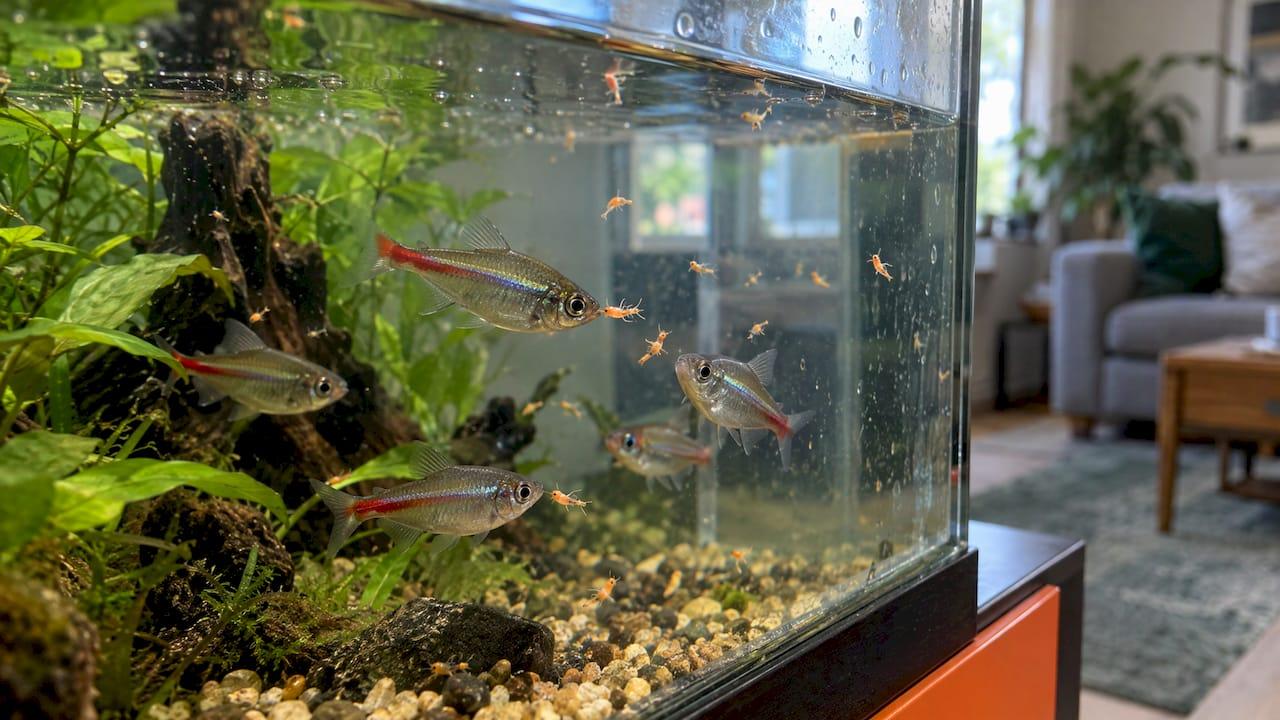
Marine fish flakes and pellets are built for saltwater species, so they should not be the staple diet of freshwater fish. The saltwater food that does belong in a freshwater tank is live brine shrimp, a marine animal that freshwater fish eat readily and that supplies the protein and fats they need. This guide explains why the two cases differ, how to feed either one, and what to look for in a live brine shrimp supplier. It is written for hobbyists, fish stores, farms and institutions that feed freshwater fish.
TL;DR
- Marine-formulated flakes and pellets are tuned to saltwater species, and freshwater fish handle salt and fatty acids differently, so they should not be a daily diet.
- Brine shrimp is a saltwater food that suits freshwater fish well, because it is whole prey and not a processed marine formula.
- Feed 0.5 to 1.0% of body weight per day for maintenance, and avoid overfeeding, the most common mistake.
- Our live brine shrimp is raised in land-based systems on Dunaliella algae, with at least 40% protein.
- Retailers, museums and research groups can order in bulk, and hobbyists can order one-off or monthly.
Table of Contents
- Why "saltwater food" is two different questions
- Why freshwater and saltwater fish are built differently
- What actually goes wrong with marine flakes in a freshwater tank
- When a one-off feeding is fine
- The saltwater food that does belong in a freshwater tank: brine shrimp
- How to feed a freshwater tank well
- If you run a store, farm or exhibit
- Our view: why we raise brine shrimp the way we do
- Getting live brine shrimp for a freshwater tank
- A simple weekly plan
- FAQ
- Sources
Why "saltwater food" is two different questions
When people search for saltwater food for freshwater fish, they usually mean one of two things.
The first is a bag of marine flakes or pellets from the saltwater aisle. Someone ran out of tropical flakes, or bought a mixed lot of fish food, and wonders whether the marine version will do.
The second is a food that comes from the sea but is not a formulated product at all: brine shrimp, krill, mysis, fishmeal. These are marine animals, yet they are routine ingredients and live foods for freshwater species. Fishmeal, for example, is made from marine fish and is a major protein source in feeds for many farmed freshwater fish.
The answer to the first question is mostly no, at least as a staple. The answer to the second is yes, and brine shrimp is the clearest example. The rest of this article explains why both answers hold.

Why freshwater and saltwater fish are built differently
The difference starts with water balance. A federal review of fish salinity tolerance explains that freshwater fish actively take up ions and excrete large volumes of dilute urine to counter passive salt loss and water gain, while seawater fish do the opposite: they secrete ions and retain water. Two groups of animals with opposite water-handling systems do not have identical dietary needs, and the food made for one is tuned to its own physiology.
A second difference is fatty acids. According to an academic chapter on fish lipids, freshwater fish generally need linoleic acid, linolenic acid, or both, while marine fish need EPA and DHA. The same chapter notes that many freshwater fish can convert linolenic acid into EPA and DHA, a conversion that is less straightforward in marine fish. NOAA research on marine fish feeds makes the other side of the point: DHA and EPA are essential for marine fish because they cannot make them themselves, so marine formulas are designed around supplying them.

In practical terms, a marine formula is balanced for a different animal. It may be perfectly good food for a tang or a clownfish and still be a poor fit as the only food for a tetra, a livebearer or a cichlid.
What actually goes wrong with marine flakes in a freshwater tank
No single feeding will harm a healthy fish. The trouble comes from making it routine. Three things tend to show up.
Nutrient balance that does not match the fish
Fish diets are protein-heavy and specific. The University of Florida's extension service notes that fry and fingerling foods frequently exceed 50% crude protein, grow-out diets approach or exceed 40%, and maintenance diets may contain 25 to 35%. A food formulated for a carnivorous reef fish may sit well above what an herbivorous or omnivorous freshwater fish needs. NOAA Fisheries makes the same point about species: herbivorous fish do best on feeds built on plant proteins, while carnivores traditionally got 30 to 50% fishmeal and oil. Matching the formula to the feeding style of the fish matters more than matching it to the water.
Chronic imbalance shows up slowly
The Merck Veterinary Manual lists what inadequate nutrition does in aquarium fish: poor growth, deformities, a depressed immune system, hepatic lipidosis (fatty liver) and impaired metabolism. These problems build over weeks and months, which is why a mismatched staple food is easy to miss until a fish is already off its growth curve or has a pale, swollen look.
Texture and size
Merck also notes that flaked feeds may be too large for small-mouthed fish, which is why they should be crushed, and that surface feeders need floating feeds while bottom-dwellers need rapidly sinking items. Marine products are shaped for marine feeding habits. A sinking pellet sized for a wrasse is not designed with a corydoras in mind.
When a one-off feeding is fine
If you are out of your usual food, one meal of marine flakes will not hurt a healthy adult fish. Feed a small pinch, remove what is not eaten within a few minutes, and go back to a freshwater formula at the next feeding. The risk is in the habit, not the single meal.
Treat any marine-formulated product as a stopgap, never as the plan. If you keep both freshwater and saltwater tanks, store the foods in clearly labeled containers so the wrong one does not end up in the wrong tank by default.
The saltwater food that does belong in a freshwater tank: brine shrimp
Brine shrimp (Artemia) live in salt water, and freshwater fish eat them without trouble. This works because the fish are eating prey, not a salt-water formulation. A live or recently hatched brine shrimp is a whole animal with protein, lipids and pigments inside it, and freshwater fish evolved to eat small crustaceans of this kind. Researchers who raise freshwater model fish use it routinely: a study of platyfish and medaka fed commercial flakes, live Artemia nauplii and beef liver paste on a set schedule.
For the nutrition side, UF/IFAS explains that fish need long-chain fatty acids that terrestrial tissue lacks, supplied by fish meal, shrimp meal and fishery by-products, and that crustacean by-products provide carotenoid pigments that enhance color. Brine shrimp is a small crustacean, which is why it is a go-to food for color and conditioning, for fry, and for fish that refuse dry food.
There is a second benefit for freshwater keepers. Merck recommends offering frozen or live feeds alongside dry foods as part of a varied diet, and lists brine shrimp among the common frozen options. Variety is the most reliable protection against a diet that is slightly off in one nutrient.
Not all brine shrimp is equal
What a brine shrimp contains depends on what it ate. Wild-harvested animals can go through seasonal swings and periods of starvation, and a shrimp that has gone hungry carries less in its body than one that has fed steadily. Our shrimp are raised on land in organic, sustainable systems and fed only the microalga Dunaliella, with at least 40% protein as our standard. You can read more on how our brine shrimp is produced and in our guide to why fish food quality affects livestock health.
How to feed a freshwater tank well
Whichever foods you use, the routine matters as much as the product. This is the approach most extension and veterinary sources agree on.
- Pick the base food for the fish, not the water. Use a freshwater formula matched to feeding style: floating for surface feeders, sinking for bottom-dwellers, crushed for small mouths.
- Add a live or frozen item several times a week. Brine shrimp is the easy choice for most community and predatory freshwater species. For help picking, see our guide to choosing live food for freshwater fish and our overview of types of live fish food for aquariums.
- Measure the amount. UF/IFAS says 0.5 to 1.0% of body weight per day is adequate for maintenance, fed at least five days a week, and that overfeeding is the most common mistake. For a tank of small fish, this means a very small amount.
- Remove what is not eaten. Overfeeding hurts the water as well as the fish. A professional paper on aquarium nutrition reports that decomposing food raises organic acids and CO2, fat creates oil films, and hepatic lipidosis is a frequently reported post-mortem finding in aquarium fish.
- Store food correctly. Merck's rules: dry feed in pest-proof containers in low humidity, a room-temperature container discarded two months after opening, frozen commercial feeds discarded after six months, and never refrozen after thawing.
Quick reference by situation
| Situation | Marine flakes or pellets | Live brine shrimp |
|---|---|---|
| Out of usual food, one meal | Acceptable, small pinch | Excellent |
| Daily staple for freshwater fish | Not recommended | Use as a supplement to a base food |
| Conditioning and color | Marine formulas are built for marine species | Crustacean pigments support color |
| Fry and picky eaters | Particle size can be too large | Small prey that fish take readily |
| Small-mouthed species | Crush first | Suited to small mouths |
If you run a store, farm or exhibit
The same logic scales up. A retailer who stocks a marine formula next to freshwater fish should label it clearly for the right tank, because customers make exactly the substitution this article describes. Our guide on stocking three live fish food formats covers how stores put live food on the shelf, and the retail guide to premium fish food categories helps when arranging the aisle by tank type.
For farms and research groups, diet consistency is the working concern. NOAA Fisheries notes that fish nutritionists must account for about 40 essential nutrients, and that fishmeal and fish oil come close to a perfect balance of them. A feed live prey with a steady, measured protein level removes one variable from a trial or a production run. Museums and public aquariums with mixed exhibits benefit for the same reason: one live food works across tanks.
Our view: why we raise brine shrimp the way we do
We started from a simple observation: the question is never really whether a food comes from salt water. It is what is inside it, and whether that stays the same from one shipment to the next.
Wild-harvested brine shrimp depend on the season and on what the lake provides, and in natural settings the animals can go hungry. We raise ours on land, in organic and sustainable systems, feeding them only on the microalga Dunaliella, so each batch is built to carry at least 40% protein.
For a freshwater keeper, that makes brine shrimp the easy answer to the saltwater food question. It is a marine animal that fits a freshwater diet, and you can feed it without mixing up formulas. For retailers, institutions and farms, consistent quality is the point: you know what you are putting in the tank.
We also believe in the larger picture. Microalgae turn light into protein with a small footprint, and we think that is where aquatic nutrition is heading.
Demeter
Getting live brine shrimp for a freshwater tank
Our live brine shrimp is available as a one-off order at $17 to $35. If you feed regularly, the Demeter Biosciences membership delivers a monthly live brine shrimp shipment for $25 per month.
Stores, museums and research institutions can use the bulk store brine shrimp order page. You can also give a gift card ($10 to $50) to another keeper. Once your shrimp arrive, our guides on storing live brine shrimp for 48 to 72 hours and how long live brine shrimp stay fresh explain how to keep them ready to feed.
A simple weekly plan
Here is one way to put it together for a typical community tank of small tropical fish.
- Base food, five to six days a week: a freshwater flake or pellet sized for the smallest mouth in the tank, in an amount the fish finish within a couple of minutes.
- Live brine shrimp, two to three days a week: replace part of the base meal, not add to it. This keeps the total amount in line with the body-weight guideline.
- One lighter day: a day with a very small meal, or none, helps keep the water clean. Healthy adults tolerate this well.
- Bottom-dwellers: make sure sinking food reaches them. Merck advises that bottom feeders such as loricariids and corydoras need targeted feeding rather than living on leftovers.
Adjust by watching the fish. Body shape, color, activity and clear water all tell you whether the amount is right. If a particular species is new to you, check what it eats in nature and choose the base food from that.
FAQ
Can you feed freshwater fish saltwater food?
Marine flakes and pellets should not be the regular diet of freshwater fish, because they are formulated for the nutrient and fatty acid needs of marine species. A single meal in an emergency is fine for a healthy adult. Brine shrimp, which is a saltwater animal, is a good food for most freshwater fish.
Is brine shrimp safe for freshwater fish?
Yes. Freshwater fish eat small crustaceans in nature, and brine shrimp is a standard live food in freshwater aquariums and research labs. Offer it a few times a week alongside a base food and feed only what the fish finish in a few minutes.
Will saltwater food change the salinity of my freshwater tank?
A small, measured feeding does not turn a freshwater tank salty. The larger risk is uneaten food, which decays and degrades water quality, so remove leftovers promptly and avoid overfeeding.
How much should I feed my freshwater fish?
UF/IFAS gives 0.5 to 1.0% of body weight per day as adequate for maintenance. In a home tank, that usually means a small pinch of flakes or a small scoop of live shrimp that the fish finish quickly.
Sources
- Salinity tolerance of fishes, NOAA repository
- Fatty Acids in Fish, IntechOpen
- Evaluating a microalga as an alternative in sablefish feed, NOAA repository
- Fish Nutrition, UF/IFAS FA096
- Feeds for Aquaculture, NOAA Fisheries
- Nutritional Diseases of Fish, Merck Veterinary Manual
- Assessment of Various Standard Fish Diets on Growth, PMC
- Nutritional Considerations for Maintaining Aquarium Fishes, Maslanka