
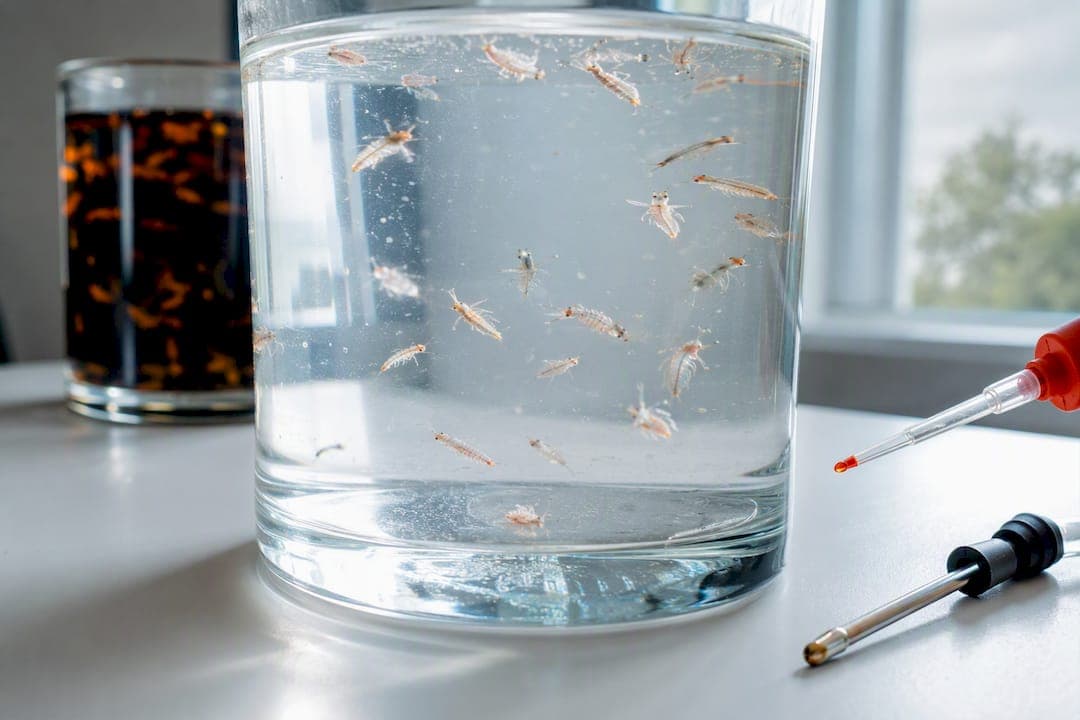
Brine shrimp survive freshwater for roughly 30 minutes to a few hours before osmotic stress kills them, with rare lab reports stretching that window to around eight hours under special conditions. Age, water temperature, and how sudden the salinity drop is all shift that number. For hobbyists, the takeaway is simple: rinse them, feed them fast, and don't expect leftovers to last until the next feeding.
TL;DR:
- Brine shrimp typically survive in freshwater for 30 minutes to a few hours, with rare lab cases reaching up to eight hours under special conditions.
- Survival duration is influenced by age, water temperature, mineral content, salinity levels, and strain differences, all of which can slightly extend or reduce their lifespan.
- The primary cause of death in freshwater is osmotic shock, as water rapidly floods the shrimp's cells, causing rupture and cytolysis, which cannot be prevented by gradual acclimation.
- For feeding, it is best to rinse live nauplii quickly, feed immediately, and remove leftovers within an hour to prevent ammonia buildup and water quality issues.
- Brine shrimp from naturally brackish habitats can tolerate lower salinity levels than ocean water, but true freshwater survival remains extremely limited.
Table of Contents
- What the Research Says About Brine Shrimp Freshwater Survival
- Why Freshwater Kills Brine Shrimp: The Osmotic Shock Explanation
- What Changes How Long Brine Shrimp Survive in Non-Salty Water
- How to Rinse and Feed Brine Shrimp in a Freshwater Tank
- When Brine Shrimp Actually Tolerate Low Salinity Longer
- How We Think About Feeding Brine Shrimp Responsibly
- Where to Get Live Brine Shrimp Fed for Better Nutrition
- Sources
What the Research Says About Brine Shrimp Freshwater Survival
Ask how long do brine shrimp live in freshwater and you'll get a fairly consistent answer across extension offices, care sheets, and lab papers: not long. The IFAS Extension care sheet puts survival at 30 minutes to a few hours, with some individual reports reaching up to eight hours depending on the strain and the specific water conditions. That upper figure is the exception, not the expectation.
Most sources cluster around a tighter window. Aquaculture literature examining Artemia performance in diluted water repeatedly reports survival times in the 30 to 60 minute range once salinity drops to true freshwater levels. That's why hatcheries running low salinity larviculture systems don't treat a single shrimp population as a standing food source. They plan repeat feedings every couple of hours instead.
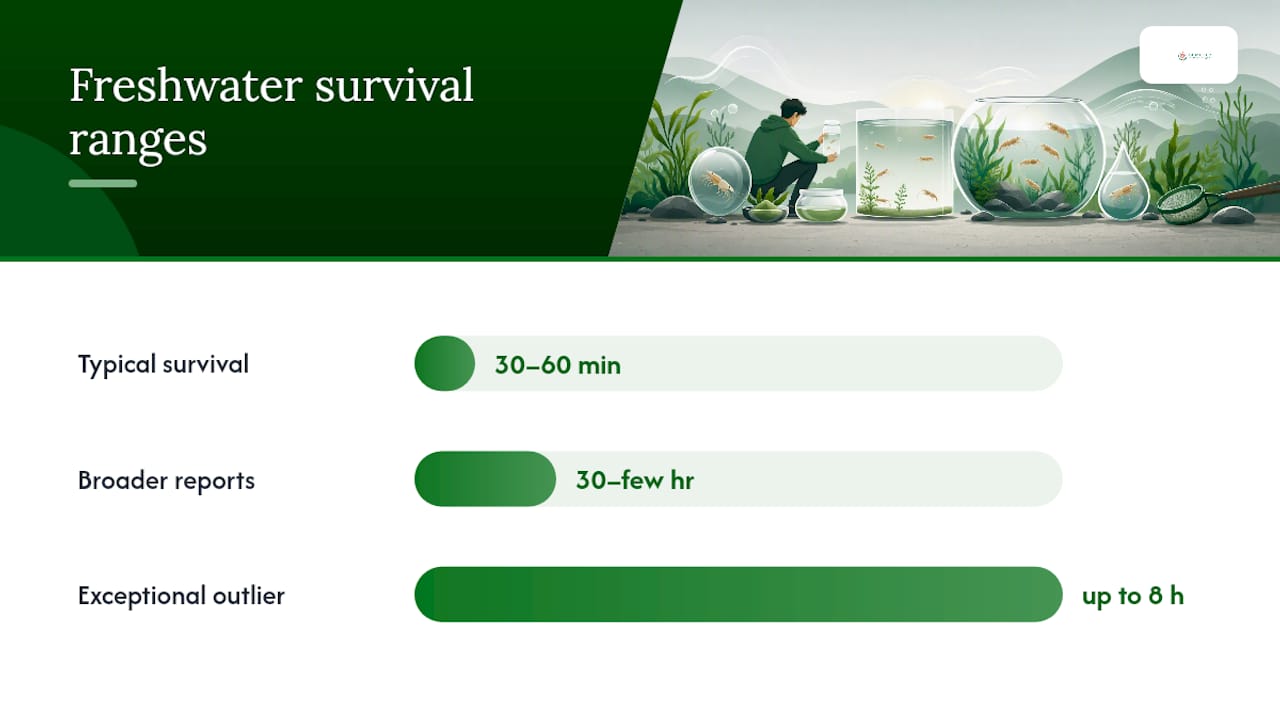
The Carolina Biological care sheet lands in the same neighborhood, noting survival of 30 minutes or longer once nauplii hit fresh water, and it's the source most classroom and hobby guides lean on for feeding instructions.
Here's the number that matters most for feeding schedules: brine shrimp introduced into a freshwater tank are, for practical purposes, a one-shot meal. You're not stocking a live culture in there.
A few points worth holding onto:
- Typical freshwater survival: 30 minutes to a few hours
- Documented outlier survival under specific lab conditions is longer, but exceptional.
- Practical feeding window for hobbyists: treat it as minutes, not hours
- Wild salinity tolerance range for brine shrimp overall: 25 to 330 grams per liter, a huge span that makes zero salinity the real outlier
If you're feeding freshwater fish, this isn't a flaw in the animal. It's baked into what brine shrimp are.
Why Freshwater Kills Brine Shrimp: The Osmotic Shock Explanation
Brine shrimp are obligate halophiles, meaning they evolved to live in salty water and their bodies are built around that assumption. Osmosis is the process by which water moves across a membrane from a less concentrated solution toward a more concentrated one, trying to even things out. A brine shrimp's internal fluids carry more dissolved salt than freshwater does, so when you drop one into a freshwater tank, water rushes into its body faster than its cells can pump it back out.
That influx causes the cells to swell and eventually rupture, a process called cytolysis. Brine shrimp do have some capacity for osmoregulation, using specialized gill structures to manage salt and water balance, but that system is calibrated for saline environments. Freshwater overwhelms it almost immediately rather than gradually.
This matters for a common hobbyist assumption: that a slow drip acclimation, the kind used for sensitive fish, might buy brine shrimp more time in freshwater. It doesn't work that way here. The problem isn't stress from rapid change. It's a fundamental mismatch between the animal's cellular chemistry and the water itself. Gradual exposure slows the clock slightly but doesn't stop it.
One distinction worth making clear:
- Brine shrimp cysts (the dormant eggs you hatch at home) are shelf stable for years and can survive drying out and complete dormancy
- Hatched nauplii have none of that resilience once they're swimming in the wrong water
Pro Tip: Don't confuse cyst hardiness with nauplii fragility. The eggs in your hatching kit can sit in a cupboard for years. The moment they hatch and hit freshwater, the clock on survival starts running in minutes, not seasons.
What Changes How Long Brine Shrimp Survive in Non-Salty Water
The 30 minute to few hour range isn't fixed. Several variables push it up or down, and understanding them helps you plan feedings more precisely.
- Age and life stage. Freshly hatched nauplii, the tiny larval stage most hobbyists feed, tend to be more fragile than older instars. A brine shrimp that's molted a few times has slightly more developed osmoregulatory tissue, though it still won't last in true freshwater for long.
- Water temperature. Cooler water slows metabolic rate and, with it, the speed of osmotic water uptake. A tank sitting at 68°F will generally buy a shrimp a few extra minutes compared to one at 82°F, though this is a minor effect, not a fix.
- Dissolved minerals and water hardness. Water with some general hardness, carrying calcium and magnesium ions, is gentler on brine shrimp than pure, mineral-free freshwater. This is part of why survival estimates vary between reports: "freshwater" in a hard-water region isn't chemically identical to soft or reverse-osmosis water.
- Starting salinity and acclimation gap. A shrimp moved from full-strength brine straight into freshwater faces a bigger gradient, and a faster shock, than one moved from a partially diluted saline solution. This is central to understanding brine shrimp adaptations to freshwater research, covered below.
- Strain differences. Not all Artemia populations respond identically. Some strains show measurably better tolerance to low salinity than others, which is part of why lab results vary from one study to the next.
How to Rinse and Feed Brine Shrimp in a Freshwater Tank
Since freshwater survival is brief, technique matters more than timing precision. Here's the sequence that gets the most nutritional value to your fish while keeping water quality stable.
- Collect what you need, not more. Use a fine mesh brine shrimp net or a pipette for small quantities, and estimate portions your fish will finish in a few minutes rather than culturing a surplus.
- Rinse briefly under running freshwater. A five to ten second rinse removes residual salt and metabolic waste without needing longer exposure. This step protects freshwater fish from a sudden salt load and from the buildup of ammonia that saltwater brine shrimp carry with them.
- Feed immediately. Don't let rinsed nauplii sit around waiting for a feeding schedule. Drop them in within minutes of rinsing, while they're still active and nutritionally intact.
- Feed small and often if needed. For fry or picky eaters, smaller feedings every two to three hours beat one large dump that goes uneaten and fouls the water.
- Watch for leftovers. Uneaten shrimp die quickly in freshwater and start decomposing, which spikes ammonia in a small tank. Siphon out anything that survives more than an hour.
- Keep aeration steady. Good oxygenation in the feeding container slows die off slightly and keeps your fish's food supply lively until it goes in the tank.
Pro Tip: Rinse right before feeding, not in advance. Rinsed nauplii sitting in a cup for twenty minutes have already burned through much of their brief freshwater survival window before your fish even see them.
When Brine Shrimp Actually Tolerate Low Salinity Longer
Not every low-salt scenario ends in a rapid die off, and this is where research gets genuinely interesting for anyone working in aquaculture rather than home aquariums. Studies on Artemia populations from naturally brackish habitats, including work on strains found in diluted sections of Lake Bunyampaka, show measurable survival at salinity levels in the tens of grams per liter, well below the ocean-strength brine most people associate with the species.
That's not the same as true freshwater survival. The FAO's review of Artemia biology draws that line clearly: the species tolerates a wide salinity range, roughly 2.5% to 25%, with strain-dependent performance at the lower end, but that's still salted water, just diluted. Zero salinity is a different problem entirely.
A quick summary of where this research applies:
- Relevant to hatchery and larviculture design, where engineers build diluted saline delivery systems to extend feed viability
- Relevant to strain selection for aquaculture operations working in brackish conditions
- Not relevant to a home aquarium, where the water is freshwater, not diluted brine, and the short survival window still applies
How We Think About Feeding Brine Shrimp Responsibly
Handling live brine shrimp well comes down to respecting what they actually are: a short-lived, high-value feed, not a self-sustaining tank inhabitant. We'd rather see hobbyists rinse quickly, feed in small portions, and toss unused shrimp than watch a batch die slowly in a corner of the tank while ammonia climbs. That's both a welfare issue and a water quality issue, and the two are connected more often than people assume. If you're setting up a feeding routine and want more detail on timing and storage before a feeding, our product handling pages walk through the specifics.
— Demeter
Where to Get Live Brine Shrimp Fed for Better Nutrition
Store-bought or wild-harvested brine shrimp often come from ponds where salinity, temperature, and food supply swing with the seasons, which means the shrimp themselves can arrive nutrient-poor or already stressed. Demeterbioscience raises brine shrimp in controlled, land-based systems on a diet of Dunaliella microalgae, which keeps protein content at 40% or higher and avoids the starvation swings common in wild harvests.
Whether you need a single live shipment for a home tank, a recurring subscription so you're never caught without feed, or a bulk order for a fish store or research collection, the ordering process is built around getting shrimp to you alive and ready to use. When your shipment arrives, unpack it right away, check that the shrimp are active, and follow the same rinse-then-feed approach covered above before anything goes into a freshwater tank. If you're ready to set up your next feeding cycle, you can order live brine shrimp directly and have it timed to your tank's schedule.
Sources
For deeper reading on brine shrimp freshwater survival and handling:
- Brine shrimp care sheet — IFAS Extension
- The Brine Shrimp Artemia Survives in Diluted Water of Lake Bunyampaka (research PDF)