
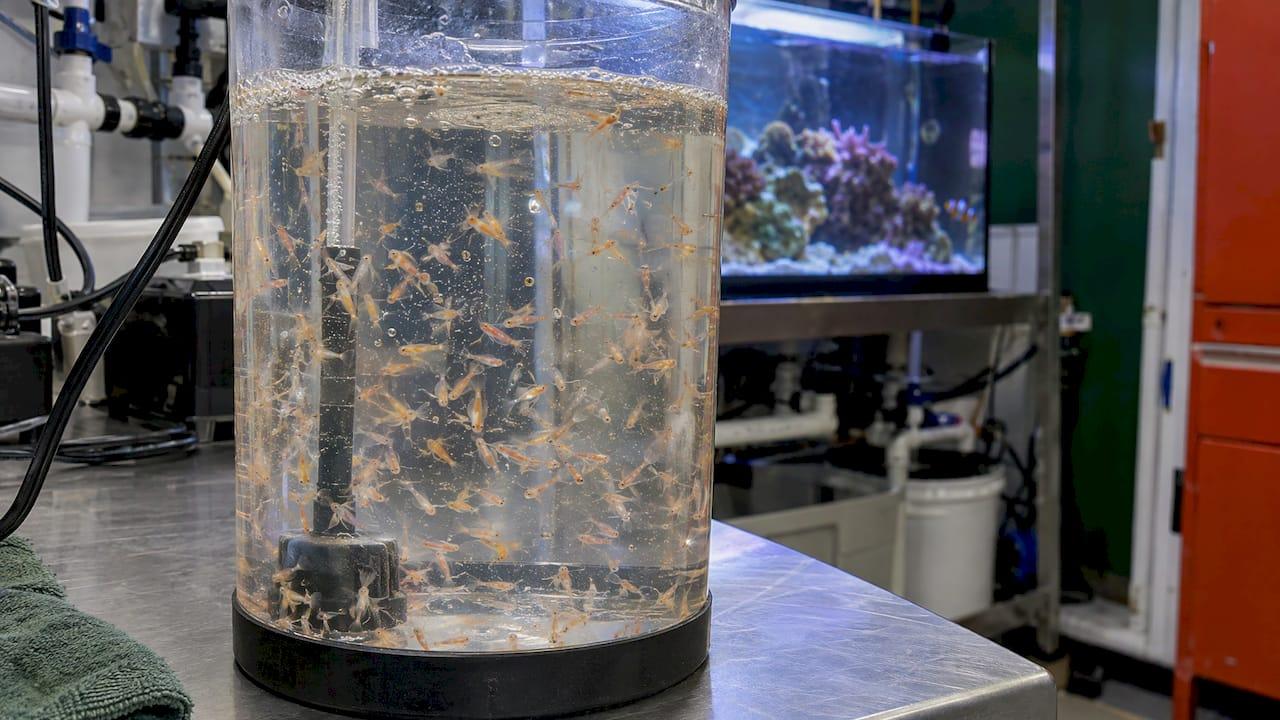
Hold live brine shrimp at roughly 28 to 35 ppt, which is close to full-strength seawater. A UBC hatching protocol says 28 to 32 ppt is needed to keep hatched shrimp alive over 24 hours. It also says the 10 to 12 ppt used for hatching is too low for holding them. Below, you'll see why the two numbers differ, what happens at the extremes and how to adjust salinity before feeding.
TL;DR
- Hold hatched or delivered brine shrimp at about 28 to 35 ppt, not at the lower salinity used for hatching.
- Brine shrimp tolerate a huge salinity range, but tolerating it is not the same as thriving in it.
- Freshwater is a short-term bath at best: newly hatched shrimp die within hours.
- Temperature, aeration and time matter as much as salinity. A well-held batch still loses nutrition each day.
- Feed soon, and match the water you add to the shrimp to your fish's tank rather than dumping a salty culture in.
Table of Contents
- The short answer: hold high, hatch lower
- Why hatching and holding salinity differ
- Salinity numbers at a glance
- What about freshwater and standard aquarium salinity?
- How salinity changes before feeding
- Beyond salinity: what else keeps them healthy
- A simple holding routine
- Our perspective
- Get live shrimp that are ready to hold and feed
- FAQ
- Sources
The short answer: hold high, hatch lower
Two different jobs call for two different salinities. Hatching cysts works in a lower-salinity bath. Keeping the animals alive afterward calls for a stronger one.
The UBC protocol is explicit about this. A salinity of 28 to 32 ppt is needed to keep hatched brine shrimp alive over 24 hours. At the lower concentrations used for hatching, such as 10 to 12 ppt, they will die. That surprises many hobbyists who hatch in a cone, then leave the nauplii in the same water for a day.
The same logic shows up in the research on survival. A 2024 study in Acta Biologica Turcica reported its highest survival, 61.33%, at 35 ppt and its lowest, 27.97%, at 5 ppt. The authors suggest 30 to 40 ppt for optimal results. That is a hatching-focused study, but it points the same way as the holding advice: low salinity costs you animals.
A practical target for most hobbyists is 30 to 35 ppt. That is also close to what many marine aquariums run.

Why hatching and holding salinity differ
Brine shrimp (Artemia) are extremely euryhaline, meaning they handle a very wide range of salt levels. The Southern Regional Aquaculture Center fact sheet on Artemia production puts the range at 3 ppt to 300 ppt. It adds that they can survive short periods in freshwater but cannot reproduce in it.
So why isn't any salinity in that range fine? Tolerating a condition for a few hours is not the same as doing well in it. Several things push the practical sweet spot to a narrower band.
Cysts and nauplii have different needs
Cysts are dormant embryos. They hatch well in a modest salinity bath, and the same fact sheet lists the optimal hatching conditions as about 5 ppt, a temperature above 77°F (28°C is optimum), heavy continuous aeration, constant light and a pH of about 8. The nauplius that emerges is a free-swimming animal that now has to regulate salt and water on its own.
Once hatched, the animal is better off in stronger water, which is why the UBC protocol steps up to 28 to 32 ppt for holding.
Food chains matter more than the shrimp
In wild lakes, salinity is not only about the shrimp's own tolerance. The Natural History Museum of Utah notes that Great Salt Lake shrimp can tolerate salinity from near saturation down to about 3%. It also says that low salinities of 5% or lower, though used in labs, do not suit the shrimp well in the lake. The reasons are changes in the algal community, which is their food, and increased predation.
That is useful for your tank too. Salinity shapes what the shrimp can eat and how well they hold their condition, not just whether they survive the hour.
The strong end is not automatically better
A 2024 Hydrobiologia study of Great Salt Lake Artemia found survival across developmental stages was best at 90 ppt and fell as temperature rose. Food was the most important factor for survival. That is a wild-population result for a specific lake strain. For an aquarium hobbyist, the takeaway is that shrimp tolerate and even favor strong brine. You do not need to go to extremes to hold them for a few days. Stay in the 30 to 35 ppt band, which is easy to measure and easy to match to your fish.
Salinity numbers at a glance
| Situation | Typical salinity | What to expect |
|---|---|---|
| Hatching cysts | About 5 to 12 ppt in the sources above | Good hatch; not a holding salinity |
| Holding hatched or delivered shrimp | 28 to 35 ppt | Shrimp stay alive and active for the holding period |
| Growing a batch toward adulthood | Around 35 to 40 ppt in one published culture method, at 68 to 77°F | Adulthood in about three weeks under favorable conditions |
| Freshwater | 0 ppt | Newly hatched shrimp cannot live more than about 12 hours |
The growing-out figure comes from a step-by-step raising guide that describes one commercial culture method. Treat it as one reference point, not a rule.
What about freshwater and standard aquarium salinity?
Freshwater
A NOAA Fisheries leaflet on brine shrimp states that newly hatched brine shrimp cannot live more than 12 hours in fresh water. It also says they live and reproduce worldwide only in high-salinity water, such as natural salt lakes and evaporation ponds.
That has two consequences:
- Never hold shrimp in dechlorinated tap water.
- Do not count on live shrimp surviving in a freshwater tank. They die and decay, so feed only what your fish will eat quickly.
Our own write-up on how brine shrimp fare in freshwater goes through the timing in more detail, and brine shrimp for freshwater fish covers feeding routines.
Marine aquarium salinity
This is the easy case. Reef and marine tanks run near seawater salinity, which sits inside the holding band. Shrimp can go into a marine system without a big salinity shock, and many keepers use that to their advantage by letting shrimp live for a while in a refugium or sump. If that's your setup, our guides to reef tank brine shrimp and using brine shrimp in a refugium are the next step.
One caution: a feeding that is mostly salt water from a culture container still adds water to your tank. Strain or scoop the shrimp rather than pouring the whole container in.
How salinity changes before feeding
Holding salinity is for the shrimp container. Your fish live in different water. Before feeding, think about the gap between the two.
For marine fish: the gap is small. If you hold shrimp at 30 to 35 ppt, you can usually feed straight from the container with a net or pipette. Leave the culture water behind.
For freshwater fish: the gap is large. A common approach is to strain the shrimp, then rinse them with freshwater just before feeding, which removes most of the salty water that would otherwise enter the tank. Shrimp rinsed this way are alive but won't live long once in the tank, so offer only what your fish can eat in a few minutes.
If you need to bring shrimp down to a different salinity, do it gradually. Sudden moves cause osmotic stress in young animals. Diana Walstad's hatching guide notes that nauplii depend on a temporary neck gland to excrete salt until the adult's gill-based system develops, which takes about 4 to 7 days. Very young shrimp are therefore the least forgiving of abrupt changes.

Beyond salinity: what else keeps them healthy
Salinity is one variable in a short list.
Temperature
Hatching runs warm, and holding runs cooler. Our guide on hatching at 80 to 82°F and holding at 68 to 74°F walks through the reasoning. A cooler holding temperature slows metabolism, so shrimp keep their energy reserves longer.
Aeration
Brine shrimp are well adapted to low oxygen at high salinity. The FAO's Artemia manual describes respiratory pigments that help them cope. Even so, dense, unaerated cultures of nauplii go bad quickly. Gentle aeration, not violent bubbling, is the usual remedy. See our notes on storing live brine shrimp for 48 to 72 hours for cold and aeration details.
Water quality
Brine shrimp are tougher than fish when it comes to ammonia. Walstad reports a 24-hour LC50 of 840 ppm for newly hatched Artemia. That resistance is no reason to let a holding container foul. Change water, remove dead shrimp and shell debris, and keep the density sensible. Our page on brine shrimp water parameters collects the numbers in one place.
Time
Holding salinity does not hold nutrition. The SRAC fact sheet explains that a nauplius lives on yolk and stored reserves for up to about 5 days, but its calorie and protein content diminish in that time. Its author advises using Artemia as feed as soon as possible after hatching, since that is when they are most nutritious. Fish larvae perform in direct relation to the fatty acid content of the shrimp they eat.
That is the reason we write about shelf life so often. See how long live brine shrimp stay fresh for feeding for how to plan feedings.
A simple holding routine
- Mix marine salt to 30 to 35 ppt and check it with a refractometer or a calibrated hydrometer.
- Match the water to the temperature range above before the shrimp go in.
- Add gentle aeration.
- Keep the container covered and out of direct heat.
- Feed shrimp to your fish in small amounts, straining out salty water when feeding freshwater tanks.
- Use the batch quickly and discard any that look weak or sit on the bottom.
Most holding losses come from low salinity, warm water, no aeration or a batch held too long. Fix those four and survival improves.
Our perspective
We grow our brine shrimp on land in controlled systems, fed exclusively on Dunaliella microalgae, and we design them for a consistent nutritional profile of at least 40% protein. That consistency starts with the animals' diet, and it only reaches your fish if you keep them well after they arrive.
In our experience, hobbyists put too much worry on the exact number and too little on the routine. A steady 30 to 35 ppt, a cool container, gentle air and prompt feeding do more than chasing a perfect reading. Wild-harvested shrimp are exposed to seasonal swings and starvation in natural water. A farmed, microalgae-fed animal gives you a better starting point, and good holding keeps it.
That is why we pair our product with plain guidance on salinity, temperature and timing. Your fish get the most from shrimp that are alive, active and fed soon.
Demeter
Get live shrimp that are ready to hold and feed
If you want shrimp you do not have to hatch, our live brine shrimp are farmed and fed on microalgae, with orders priced from $17 to $35. For regular feeding, the Demeter Biosciences membership brings a monthly live shipment for $25 per month. Reef keepers can add live phytoplankton for $20.
Fish stores, museums and research groups can look at our bulk store order. Read more about the animals on our brine shrimp product page.
FAQ
What salinity should I hold live brine shrimp at?
Aim for about 28 to 35 ppt. A hatching protocol from UBC says 28 to 32 ppt is needed to keep hatched shrimp alive over 24 hours, and the lower salinity used for hatching will not do. Marine aquarium salinity falls inside that band.
Can I hold brine shrimp in freshwater?
Not for more than a short time. NOAA reports that newly hatched brine shrimp cannot live more than 12 hours in fresh water. Use freshwater only as a quick rinse before feeding freshwater fish, and offer small portions.
Is the hatching salinity also fine for holding?
No. Hatching is done in a lower-salinity bath, around 5 ppt in one fact sheet and 10 to 12 ppt in another protocol. Hatched shrimp left in that water will die, so move them into stronger water of about 28 to 32 ppt or more.
Does higher salinity mean better survival?
Not necessarily. A study of Great Salt Lake shrimp found best survival at 90 ppt, but that applies to a wild strain under lab conditions. For a home container, 30 to 35 ppt is simple and sufficient. Temperature, oxygen and food matter alongside it.
How long do shrimp stay nutritious while held?
Nauplii can live on stored reserves for up to about 5 days, but their calorie and protein content drops as they do. Feeding soon after hatching or delivery gives your fish the most benefit.
Sources
- UBC: How to prepare a brine shrimp culture in a hatching cone
- SRAC: Artemia Production for Marine Larval Fish Culture
- Acta Biologica Turcica: salinity and survival study
- Natural History Museum of Utah: Brine Shrimp Observation
- Hydrobiologia: Demographic responses of an extremophile crustacean
- NOAA Fisheries Leaflet 527: Brine shrimp
- FAO: Biology and ecology of Artemia
- Build Your Aquarium: How to Raise Brine Shrimp