
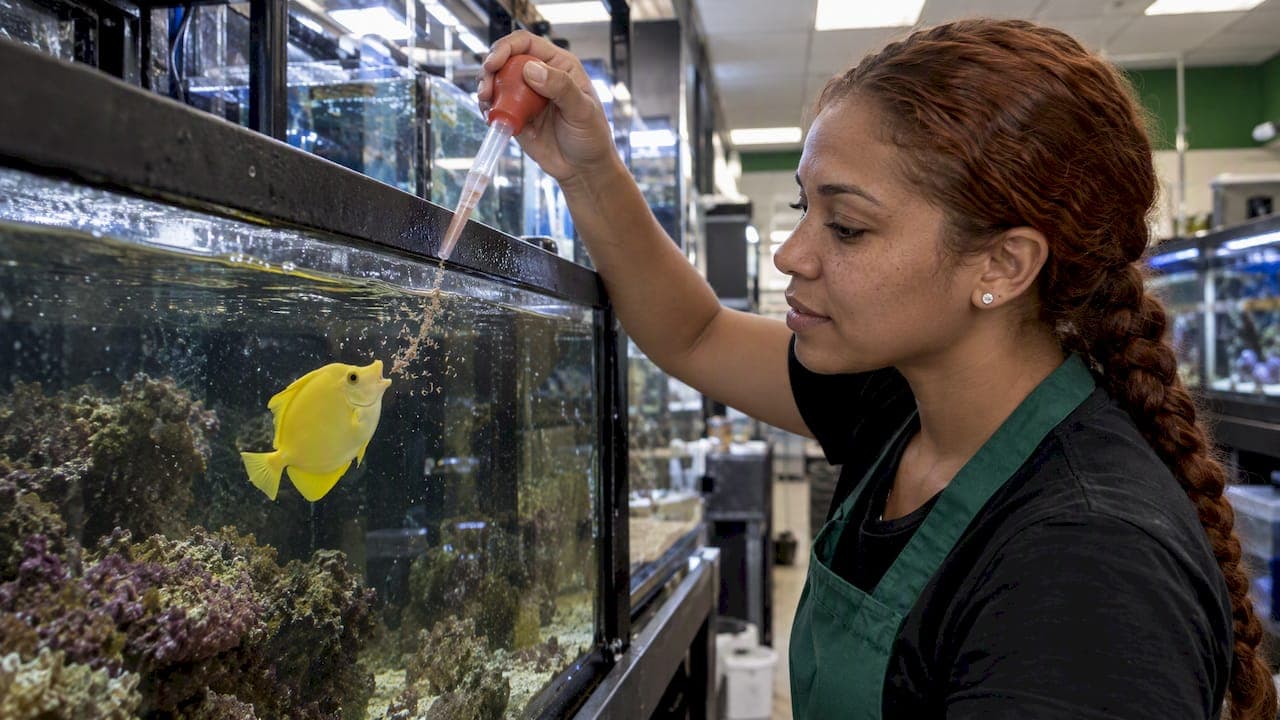
Tangs will eagerly eat brine shrimp, but it should not be the base of their diet. Tangs are algae grazers, and brine shrimp works best as an occasional treat or appetite booster, offered a couple of times a week alongside plenty of marine algae. This guide covers how much to feed, how to prepare it, whether to enrich it, and how to tell your tang is doing well.
TL;DR
- Tangs accept brine shrimp readily, but it is a supplement, not a staple. Build the diet on nori, seaweed and herbivore-specific foods.
- Offer only what the fish finishes in 1 to 2 minutes, roughly 2 to 3 times per week.
- Enrich brine shrimp with a HUFA supplement before feeding. Unenriched adults carry little nutritional value.
- Feeding brine shrimp alone can lead to a hollowed-out look behind the head, a sign of malnutrition.
- Keep animal protein a small share of the total diet, and watch body condition and grazing behavior.
Table of Contents
- Do tangs eat brine shrimp, and should they?
- What brine shrimp does and does not give a tang
- The warning sign of an all-brine-shrimp diet
- Enrich brine shrimp before it goes in the tank
- Live, frozen or freeze-dried?
- How much and how often
- What should make up the rest of the diet
- A sample weekly plan for an adult tang
- How to tell your tang is eating well
- Our perspective: where farmed, microalgae-fed brine shrimp fits
- Get live, microalgae-fed brine shrimp
- FAQ
- Sources
Do tangs eat brine shrimp, and should they?
Yes, they eat it, usually with enthusiasm. That enthusiasm is the trap. A fish that races to the surface for a pinch of brine shrimp is not telling you the food is complete. It is telling you the food is exciting.
Tangs and other surgeonfish are grazers. The Florida Museum notes that ocean surgeonfish feed mainly on green and brown algae, with only a small amount of small invertebrates. For blue tangs, the museum says they feed entirely on algae in the wild. Species differ, so a blue tang needs an even more algae-centered plan than some of its relatives.
A brine shrimp heavy diet fails on fiber and balance. One aquarium care source describes brine shrimp as lacking the fiber and balanced profile herbivorous surgeonfish need. Veterinary guidance also points out that herbivorous fish need more fiber and do better on plant material or herbivore-specific pellets.
So the honest answer is: yes, feed it, but in the role of a treat that adds variety, protein and feeding stimulation.

What brine shrimp does and does not give a tang
Brine shrimp has a reputation as a perfect fish food. In reality its value depends on what you feed.
- Age matters. Newly hatched nauplii and adults are different foods. Adult brine shrimp are largely water, and one reef-aquarium review notes that their nutritional value varies with age, source and cyst quality.
- Fatty acids are the weak spot. The same article explains that the fatty acid profile of Artemia, even after enrichment, tends to be short on n-3 long-chain HUFA, particularly DHA.
- Amino acids can fall short for growth. A tang care guide says adult brine shrimp lack the amino acid profile to sustain a fast-growing surgeonfish, which is one reason it should not carry a juvenile tang.
What you feed the brine shrimp before it reaches the tank decides much of this. A brine shrimp that has been starving is a very different food from one that has been well fed. For a deeper look, see our explainer on brine shrimp nutritional value for aquarists.
The warning sign of an all-brine-shrimp diet
The classic result of feeding mostly brine shrimp is a tang that looks thin behind the head. One tang diet guide says feeding brine shrimp exclusively often leads to a hollowed-out look behind the head, a sign of protein-energy malnutrition. A healthy tang should look plump and filled out.
The cause is simple. The fish fills up on something low in fiber and energy, then ignores the algae it actually needs. If you see this shape, do not add more brine shrimp. Raise the amount of algae and herbivore foods, check that the fish is actually reaching them against tankmates, and see an aquatic veterinarian if the condition does not improve.
Enrich brine shrimp before it goes in the tank
Enrichment turns brine shrimp from a filler into a carrier. The shrimp filter-feed, so whatever you feed them ends up inside them. That is the logic behind enrichment, often called gut-loading.
The reef-aquarium review recommends feeding live brine shrimp a HUFA supplement for 1 to 2 hours for adults, or two 12-hour periods for nauplii. The point is to let the shrimp carry the nutrients inside, rather than just coating the outside.
Two cautions from the research:
- Do not overdo the timing. Artemia can metabolize DHA during enrichment, including converting it back to EPA, which lowers the DHA to EPA ratio and the nutritional value. Longer is not always better.
- Use fresh, clean shrimp. Enrich and feed promptly, then rinse before offering.
Our own write-ups go further on timing and ratios: the brine shrimp enrichment 12 to 24 hour rule and the 2:1 DHA to EPA live feed enrichment protocol.
Live, frozen or freeze-dried?
Each form has a place in a tang feeding plan.
| Form | Strengths | Watch out for |
|---|---|---|
| Live, enriched | Triggers natural feeding, can be nutrient-loaded | Quality depends on how the shrimp were raised and fed |
| Frozen | Easy to portion and rinse | Thaw and rinse first so you do not add excess water and nutrients to the tank |
| Freeze-dried | Convenient, long shelf life | Soak first so it does not expand after being eaten |
A historical NOAA fishery leaflet adds a useful biological point. It states that fish cannot digest intact brine shrimp eggs, while newly hatched shrimp are eaten readily and adults serve as food for larger fish. If you hatch your own, separate the nauplii from unhatched cysts and shells before feeding.
How much and how often
The rule of thumb is simple and conservative.
- Portion: what the tang can finish in about 1 to 2 minutes. One care guide describes a small pinch of frozen brine shrimp or a modest pipette squirt.
- Frequency: about 2 to 3 times per week as a supplement. Daily feedings are better reserved for seaweed and plant-based staples that mimic natural grazing.
- Live food specifically: AlgaGen's 2025 guidance suggests live foods 1 to 2 times per week for most species, rinsed in clean dechlorinated water, with leftovers removed after five minutes.
Because tangs graze all day, some keepers like to turn off the protein skimmer and reduce flow briefly so the food is not pulled away before it is eaten. Turn them back on after feeding.
Overfeeding is the usual mistake. It can cause nutrient spikes, algae growth and poor water quality. In a reef tank with a tang, that means more nuisance algae you then expect the tang to clean up.
For a hobbyist feeding plan built around freshness, our brine shrimp feeding amount guide walks through quantities in more detail.
What should make up the rest of the diet
The base of a tang's diet is marine algae. Practical building blocks:
- Nori and seaweed sheets, offered daily on a clip.
- Herbivore-specific pellets or frozen foods formulated for grazing fish.
- Small amounts of meaty foods, such as mysis, for variety. One guide says animal protein should stay under 20% of total diet to avoid problems such as fatty liver disease. Treat that as a practical ceiling from a care guide rather than a hard rule.
- Live algae-fed foods, as an occasional enrichment item.
Species differences are real. Reef writers have long noted that tangs have varied digestive anatomy, some with thin-walled stomachs and others with muscular, gizzard-like ones, which shapes how they process plant matter. A Tomini tang, for example, does well with several small feedings a day, which can also reduce aggression.
For a wider menu of marine foods, see our saltwater fish diet variety list.
A sample weekly plan for an adult tang
This is an example, not a prescription. Adjust it to your species, tank size and tankmates.
| Day | Main feeding | Extra |
|---|---|---|
| Monday | Nori sheet on a clip | Herbivore pellets |
| Tuesday | Nori sheet | Enriched brine shrimp, a small pinch |
| Wednesday | Seaweed sheet | Herbivore pellets |
| Thursday | Nori sheet | Mysis or other frozen mix |
| Friday | Seaweed sheet | Enriched brine shrimp, a small pinch |
| Saturday | Nori sheet | Herbivore pellets |
| Sunday | Seaweed sheet | Light day, check body condition |
Notice that brine shrimp shows up twice, and only in small portions. The plant matter is there every day.
How to tell your tang is eating well
Look at behavior and shape, not just whether the fish rushes the glass at feeding time.
- Active grazing through the day. A healthy tang picks at rock and clipped algae constantly.
- A plump, filled-out body. Avoid the sunken or hollowed appearance linked to underfeeding.
- Eager response to food. A reduced appetite can signal stress, disease or water-quality problems, so test your water before changing the diet.
If a tang stops eating for more than a day or two, or loses visible condition, an aquatic veterinarian is the right call.
Our perspective: where farmed, microalgae-fed brine shrimp fits
We raise live brine shrimp on land in controlled systems, fed only on the algae Dunaliella, and we aim for at least 40% protein content. We built this because wild-harvested and hatchery brine shrimp can swing in quality with the season and with how long the animals went without food.
We will not tell you brine shrimp should replace algae for a tang. It should not. What we do believe is that if you feed brine shrimp, it matters what the shrimp ate. A shrimp that has eaten well and is fed promptly brings more to the tank than one that has been sitting hungry in a shipping bag or a bin. That is why we pair our live shrimp with the advice here: small portions, a couple of times a week, rinsed, and alongside nori and herbivore foods.
For tang keepers, we see our shrimp as the protein and variety step in a plant-first plan.
— Demeter
Get live, microalgae-fed brine shrimp
If you want live brine shrimp for your tang's weekly treat day, our live brine shrimp is priced from $17 to $35 for a one-off order. If you feed regularly, the monthly live brine shrimp membership is $25 per month. We also sell phytoplankton at $20 on our featured products page, and gift cards from $10 to $50.
Running a local fish store or an aquarium exhibit? Our bulk store brine shrimp order is set up for retail and institutional packages.
FAQ
Can a tang live on brine shrimp alone?
No. Tangs are algae grazers, and a brine shrimp only diet is linked to a hollowed-out look behind the head and protein-energy malnutrition. Use brine shrimp as an occasional supplement and keep nori, seaweed and herbivore foods as the daily base.
How often should I feed brine shrimp to my tang?
About 2 to 3 times per week, in a portion the fish finishes within 1 to 2 minutes. Live foods in particular are generally fed once or twice a week. Daily feeding is for plant-based foods.
Do I need to enrich brine shrimp for a tang?
It is strongly recommended. Adult brine shrimp have little nutritional value unenriched, and a 1 to 2 hour feeding of a HUFA supplement lets them carry nutrients to the fish. Do not leave them in the enrichment much longer, since Artemia can metabolize some of the fatty acids you added.
Is frozen or live brine shrimp better for tangs?
Both work. Frozen is easy to portion and rinse, while live shrimp encourage natural feeding and can be nutrient-loaded. Whichever you choose, rinse it, feed a small amount and remove leftovers after about five minutes.
Sources
- Can Tang Eat Brine Shrimp? Is It Nutritious (SpectrumCare)
- Ocean Surgeon, Florida Museum
- Blue Tang, Florida Museum
- Nutritional Value of Live Foods for the Coral Reef Aquarium, Part 2 (Reefs.com)
- What is the Best Food for Tangs?
- Optimizing Artemia Enrichment: A Low DHA/High EPA Protocol
- NOAA Fishery Leaflet 527: Brine Shrimp
- Best Practices for Feeding Live Foods in Aquariums (AlgaGen)
- Saltwater Fish Feeding Guide: Food Types Explained
- Tomini Tang Care Guide