
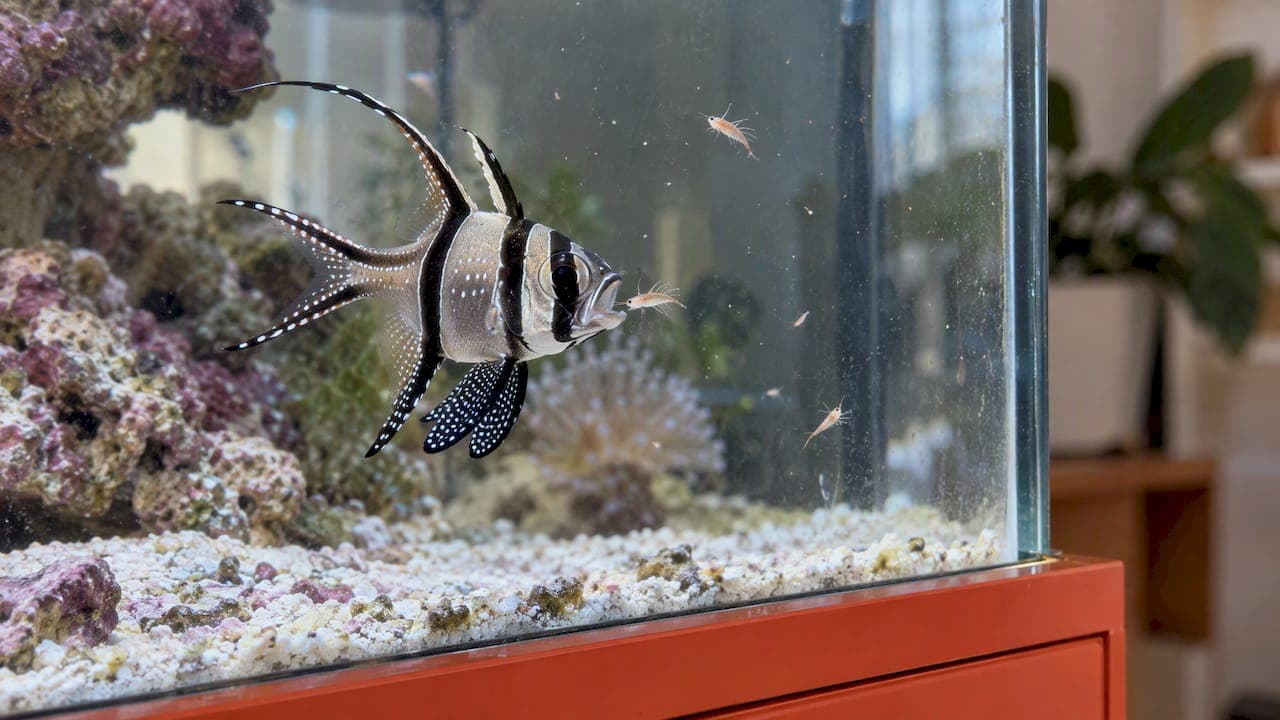
Cardinalfish eat brine shrimp, and they do best on them when the shrimp are the right stage, well fed and part of a varied menu. Newly hatched nauplii suit fry, enriched juvenile or adult brine shrimp suit growing fish, and adults also take frozen brine and other meaty foods. This guide covers Banggai cardinalfish (the species most hobbyists keep) and shows how to choose, prepare and portion brine shrimp so the food adds to your fish's health and does not foul your tank.
TL;DR
- Banggai cardinalfish are carnivorous planktivores, and enriched brine shrimp are one of the meaty foods they accept in captivity.
- Match the stage to the fish: newly hatched nauplii for fry, enriched later-stage or adult brine shrimp for juveniles and adults.
- Brine shrimp that have not been fed or enriched are low in key fatty acids (DHA, EPA and ARA), so enrich them or buy shrimp that were well fed before they reached you.
- Feed only what the fish finish in a few minutes, remove shells and unhatched cysts, and rotate in mysis, copepods and quality pellets.
Table of Contents
- Do cardinalfish eat brine shrimp?
- Which brine shrimp stage fits which fish
- Why enrichment matters
- How to prepare and feed brine shrimp to cardinalfish
- Build a varied menu around brine shrimp
- Will leftover brine shrimp survive in a reef tank?
- Perspective
- Get farmed live brine shrimp for your cardinalfish
- Common mistakes to avoid
- A note on wild populations and captive-bred fish
- FAQ
- Sources
Do cardinalfish eat brine shrimp?
Yes. Banggai cardinalfish (Pterapogon kauderni) are considered carnivores that prefer meaty foods in captivity, including enriched brine shrimp. That fits what we know about their natural diet. NOAA Fisheries notes that they feed primarily on copepods and also eat other planktonic organisms when those are abundant.
So a Banggai is a slow, deliberate picker of small animals drifting past its anemone-free perch in the water column. Live brine shrimp swim, twitch and hang in the water, which is exactly the kind of movement that triggers a feeding response. That is why live brine shrimp are such a reliable way to get a shy new fish eating.
The same logic holds for other cardinalfish kept in reef tanks, such as the pajama and the orchid-type species: they are small-mouthed, nocturnal-leaning predators of zooplankton. The details below are drawn mostly from Banggai culture work, so treat feeding amounts for other species as a starting point and watch how your fish respond.

Which brine shrimp stage fits which fish
The word "brine shrimp" covers several very different foods. The stage you pick matters more than the brand.
| Stage | Approximate role | Best for | Key point |
|---|---|---|---|
| Newly hatched nauplii (Instar I) | Tiny, moving, easy to digest | Fry and very small juveniles | Non-feeding stage, so they cannot be enriched |
| Enriched nauplii (Instar II and later) | Grown on or soaked in a fatty-acid-rich medium | Fry, small juveniles | Better fatty acid profile |
| Juvenile and adult live brine shrimp | Larger, meatier prey | Juveniles, adults | Best when well fed before they reach the tank |
| Frozen brine shrimp | Convenient, stored | Adults, as one item among several | Rotate with mysis and other foods |
The distinction between the first two rows comes from Texas A&M extension guidance on live feeds for marine fish larviculture. It explains that newly hatched Artemia nauplii are a non-feeding stage that cannot be enriched, while Instar II and later stages can ingest enrichment media to improve their fatty acid composition.
Fry and small juveniles
Banggai cardinalfish are unusual. NOAA's status review describes them as lacking a planktonic larval stage: the male broods the eggs in his mouth and releases fully formed juveniles. In a home tank, that means the "fry" you see are already miniature fish with a real appetite, and they can take food a typical marine larva could not.
For breeders, newly hatched brine shrimp are a practical first food. One hobbyist's breeding write-up says newly hatched brine shrimp are ideal for fry because their movement stimulates feeding and their size matches the fry's mouth. The same author fed fry twice a day with 1- to 2-day-old nauplii. An older rearing report in a breeders' registry also records newly hatched Artemia offered three times daily as the first food, followed by pureed fresh shrimp a few days later. These are individual hobby accounts, so use them as a schedule to adapt, not a rule.
Two cautions apply to young fish:
- Newly hatched Artemia nauplii are about 450 microns wide. The Texas A&M guidance says that is usually too large for most first-feeding marine fish larvae. Banggai juveniles are far larger than a true marine larva, so that limit rarely bites them, but it is why rotifers or copepods matter if you ever raise a species with a planktonic larval phase.
- Newly hatched marine larvae of this species are described in university extension material as precocial, and readily take enriched rotifers as a first-feed item. If you can culture rotifers or copepods, they make a strong companion to brine shrimp.
Juveniles and adults
As the fish grow, shift toward larger, enriched brine shrimp and add other meaty foods. The same breeding write-up says adults may accept live or frozen brine shrimp. Aquaculture documentation also describes Banggais as planktivores that can be transitioned from live food to frozen mysis shrimp or quality prepared pellets as they mature.
Why enrichment matters
Brine shrimp are a convenient live food, but what they contain depends on what they ate. Texas A&M's extension guidance states that brine shrimp that have not been enriched are nutritionally deficient for most developing marine fish larvae, with insufficient DHA, EPA and ARA, which are essential fatty acids. A hobby breeder who reared Banggais reaches the same practical conclusion: unenriched brine shrimp lack essential fatty acids and other nutrients, and relying on them alone can lead to stunted growth or poor survival.
The takeaway is not to avoid brine shrimp. It is to feed them well before they reach your fish. There are three routes:
- Enrich them yourself. Let hatched nauplii grow past the first non-feeding stage, then give them an enrichment medium or microalgae for a set time before feeding out. Our 12 to 24 hour enrichment rule walks through the timing, and the DHA:EPA enrichment protocol goes deeper for hatcheries and serious hobbyists.
- Buy shrimp that were fed a nutritious diet. Brine shrimp raised on microalgae arrive already carrying that nutrition, so there is less to do at home.
- Rely on wild prey where it exists. The Banggai production manual notes that in large outdoor cage systems where natural zooplankton is abundant, enrichment of brine shrimp is not necessary because the fish supplement their diet with wild prey. A glass tank is not that kind of system, and intensive indoor setups need strict enrichment protocols.
A quick note on fright behavior: some breeders blame a lack of fatty acids in baby brine shrimp for odd symptoms in young cardinalfish. That is a hobbyist theory from forum threads, not something we can point to as established, so the safe approach is simply the one above: vary the diet and enrich.
How to prepare and feed brine shrimp to cardinalfish
Prepare the shrimp
- Separate nauplii from eggs and shells. The API brine shrimp lesson says to take care to separate newly hatched nauplii from unhatched eggs and empty shells to prevent intestinal blockages in small fry. Turn off aeration, let shells float and cysts sink, and siphon the middle layer, or use a light at the bottom of the container to draw nauplii down.
- Rinse and collect in suitable water. The same lesson says to collect nauplii in aquarium water or treated tap water. Rinsing in a fine net first keeps hatching salt and debris out of the tank.
- Keep shells out of the system. Cyst hatching and molting produce shells and exoskeletons that, per the Texas A&M guidance, can deteriorate water quality if not removed.
- Enrich if needed. If the shrimp are past the first stage and you are hatching your own, give them their enrichment window before feeding out.
If you would rather skip the hatchery step, our guide on hatching versus buying brine shrimp for a reef tank compares the effort and the results.
Dose and deliver
The rule is simple: feed only enough for the fish to consume. Uneaten brine shrimp die, and the API lesson warns that dead shrimp foul the water in small aquariums. Banggais are slow and methodical, so give them a few minutes and watch.
For fry, the Banggai manual says small-scale setups such as drip feeders or net cages placed in the main aquarium help minimize food loss and make feeding consistent. A breeder's net cage or a small feeding station also stops fast tank mates from taking every shrimp first.

How often
A workable starting point drawn from the hobby reports above:
- Fry and small juveniles: two to three small feedings a day of fresh, 1- to 2-day-old nauplii, as in the breeding account and the rearing report.
- Adults: once or twice daily, with brine shrimp as one of several foods, not the only one.
If you want a ready template, our brine shrimp feeding schedule checklist lays out a repeatable routine, and our dedicated cardinalfish brine shrimp guide covers the species-specific details.
Build a varied menu around brine shrimp
Brine shrimp work best as part of a rotation. Aquaculture documentation stresses moving fish to broader, more balanced diets as they mature to prevent problems linked to monotonous feeding, and the breeding write-up says brine shrimp can be supplemented with other live foods such as copepods or rotifers, with fry moved onto prepared foods as they grow.
A sample weekly rotation for adult Banggais:
| Day | Main food | Notes |
|---|---|---|
| Mon | Live enriched brine shrimp | Morning feed, small portion |
| Tue | Frozen mysis shrimp | Thaw in tank water, target the fish with a pipette |
| Wed | Live brine shrimp | Evening feed |
| Thu | Quality carnivore pellet | Small sinking or slow-sinking size |
| Fri | Live brine shrimp or copepods | Whatever you can culture or source |
| Sat | Frozen mysis | Skip if fish are plump |
| Sun | Light day | One small feed, or none for adults |
Adjust to your fish's body condition. A healthy Banggai has a gently rounded belly, not a sunken one or a swollen one.
Will leftover brine shrimp survive in a reef tank?
Brine shrimp are a freshwater-tolerant, high-salinity species, and in a typical reef aquarium they do not become a self-sustaining population. Uneaten ones die and add waste, so you must size feedings to what the fish eat. In a tank with a sump or refugium, dead shrimp can also end up in the filter. If you run a refugium and want a steady food supply, see our piece on hatching brine shrimp for food in a refugium instead of trying to keep a colony.
Perspective
We raise brine shrimp on land, in controlled systems, and feed them only the microalgae Dunaliella. We designed the process around one idea: a live food is only as good as what the live food ate. Wild-harvested brine shrimp depend on seasons and on whatever the water supplies, and they can be starving by the time they are collected. Ours are grown for consistency.
For cardinalfish keepers, that matters most at the two moments we hear about: getting a new Banggai to start eating, and raising juveniles that need real nutrition in every bite. Our formula is designed to deliver at least 40% protein, so the shrimp you drop in the tank are not empty calories. You still rotate foods, you still feed small portions, and you still remove shells. But you start from a food that was fed on purpose.
If you keep a few fish, a single order and a feeding routine are enough. If you keep many tanks, a monthly subscription takes the guesswork out of resupply.
Demeter
Get farmed live brine shrimp for your cardinalfish
If you want to skip the hatching bench, our live brine shrimp are priced from $17 to $35 per order. If cardinalfish are one of several species you feed, the Demeter Biosciences membership delivers a monthly live brine shrimp shipment for $25 per month. Our phytoplankton is $20 and is a useful way to keep copepods and other tank life fed.

Running a local fish store, a museum exhibit or a research tank? Our bulk store brine shrimp order is set up for repeat buyers. Not sure what to pick? A gift card ($10 to $50) lets a fellow hobbyist choose. You can also read how our product is made on the brine shrimp product page.
Common mistakes to avoid
- Feeding only unenriched brine shrimp. This is the main nutritional trap, per both the Texas A&M guidance and the breeding write-up. Rotate and enrich.
- Pouring in the whole hatch. Overfeeding fouls the water. Offer small amounts and add more only when the fish are still hunting.
- Letting shells and cysts into the tank. Separate them first, because they can cause blockages in small fry.
- Skipping the transition. As fish grow, move them toward mysis, other meaty foods and pellets rather than keeping them on brine shrimp alone.
- Competing tank mates. Fast eaters will steal food from slow, careful cardinalfish. Feed at a spot where the Banggais can reach it first, or use a feeding cage for fry.
A note on wild populations and captive-bred fish
The Banggai cardinalfish is a species of conservation concern in the wild, and its collection has been debated for years. The good news for hobbyists is that it is one of the most commonly produced marine ornamental fish in aquaculture, so captive-bred fish are widely available. Captive-bred fish are used to prepared and frozen foods, which can make the first weeks easier. Wild-caught fish often need live food to start eating, and brine shrimp that were fed well are a good tool for that.
FAQ
Can Banggai cardinalfish eat brine shrimp every day?
They can, but a diet of only brine shrimp is not ideal. Feed enriched brine shrimp as one of several foods and rotate in frozen mysis, copepods and a quality carnivore pellet. Keep each feeding to what the fish finish in a few minutes.
Are baby brine shrimp or adult brine shrimp better for cardinalfish?
It depends on the fish's size. Newly hatched nauplii suit fry and very small juveniles, while enriched later-stage or adult brine shrimp suit larger juveniles and adults. Newly hatched nauplii cannot be enriched, so pair them with other foods to cover nutrition.
Do I need to enrich brine shrimp for cardinalfish?
Yes, in a typical aquarium. Brine shrimp that have not been fed or enriched are low in DHA, EPA and ARA, which can slow growth in young fish. Enrich them for the recommended window, or buy brine shrimp that were fed a nutritious diet before shipping.
Can cardinalfish eat frozen brine shrimp?
Adults generally accept frozen brine shrimp, and many keepers use it alongside frozen mysis. Thaw it in a little tank water and feed small amounts. Live shrimp are usually better for coaxing a new or shy fish to start eating.
How do I keep uneaten brine shrimp from fouling my tank?
Feed small portions, watch the fish eat, and remove shells and unhatched cysts before feeding. Dead brine shrimp can foul water in small aquariums, so siphon any that the fish have missed once feeding is over.
Sources
- Banggai Cardinalfish Are Full Of Personality To Quickly Fall In Love With (Reef Builders)
- Banggai Cardinalfish | NOAA Fisheries
- Choosing an Appropriate Live Feed for Larviculture of Marine Fish (Texas A&M AgriLife Extension)
- Breeding the Banggai Cardinalfish: My Success (And Mistakes)
- Manual for the Production of the Banggai Cardinalfish
- ESA status review report: Banggai cardinalfish (NOAA)
- The Breeders Registry: Pterapogon kauderni spawning report
- API Lesson 7: Brine Shrimp