
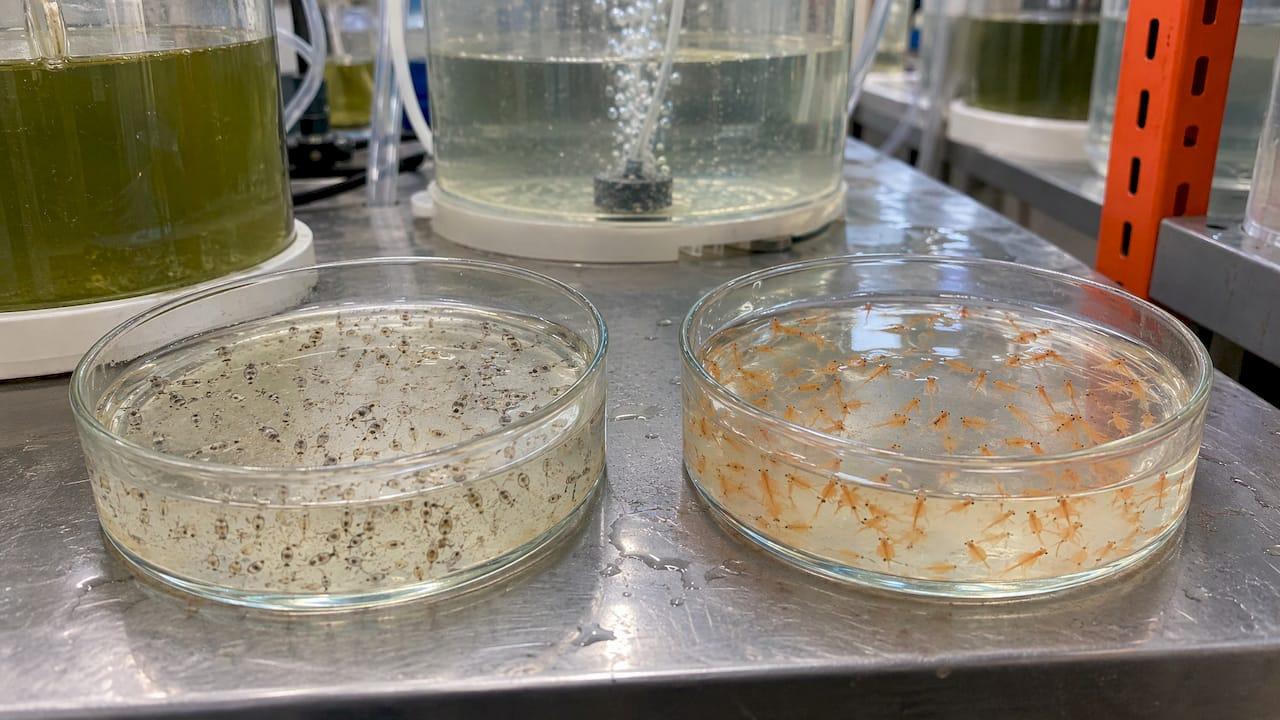
Move larvae from rotifers to Artemia only when they can reliably catch and swallow the larger prey, then overlap the two feeds over several days rather than switching in one step. For marine fish studied in U.S. hatcheries, that usually means starting low-density Artemia somewhere between day 6 and day 9 after hatch, and finishing the rotifer taper by about day 12. Slow-developing species such as Atlantic cod need far longer. The rest of this guide gives the timing, the densities researchers used, the hatching details that keep nauplii nutritious, and a troubleshooting list for a transition that stalls.
TL;DR
- Judge readiness by larval development and prey capture, not the calendar. Florida pompano, hybrid striped bass and largemouth bass accept Artemia within roughly the first 6 to 9 days, while Atlantic cod larvae transferred on day 5 mostly failed.
- Overlap the feeds. Introduce Artemia at a low density, raise it as you taper rotifers, and finish the taper in about 4 to 5 days in the protocols below.
- Feed first-instar nauplii soon after hatching, because they live on their own reserves and lose value as they age.
- Count residual prey in the tank at least twice daily. Leftover Artemia on day one of the switch tells you the larvae are not ready.
- Warmer water is not free: in one trial, survival was 46.6% at 18°C (64°F) and 30.2% at 26°C (79°F), regardless of how long rotifers were fed.
Table of Contents
- Why the switch happens at all
- When larvae are ready: timing by species
- How to overlap the two feeds
- Hatching and preparing Artemia for the transition
- Should you enrich the Artemia?
- Species and system differences
- Troubleshooting a stalled transition
- Live brine shrimp and phytoplankton from Demeter Biosciences
- FAQ
- Sources
Why the switch happens at all
Marine and many freshwater larvae hatch with a mouth too small for anything but rotifers or similar tiny prey. Rotifers are microscopic, slow swimmers that are easy to culture in bulk, which is why they carry the first days of feeding. As the larva grows, a rotifer becomes a poor return for the energy spent catching it. Artemia nauplii (newly hatched brine shrimp) are bigger, so each strike delivers more food.
The cost of staying on rotifers too long is real. In a hybrid striped bass trial published in 2020, minimizing the days larvae were fed rotifers maximized growth, and Artemia proved suitable for larvae as young as six days old. The cost of switching too early is just as real, as the cod data below show. Your job is to find the window between them for your species and temperature.
If you want the background on what Artemia nauplii are and how they fit into larval feeding, our guides on Artemia nauplii biology, hatching and feeding and live food in fish breeding cover it from the ground up.
When larvae are ready: timing by species
Published protocols differ by species, so treat the table as a range of tested starting points, not a rule. DPH means days post hatch.
| Species | Rotifers | Artemia introduced | Rotifers finished | Source |
|---|---|---|---|---|
| Florida pompano | 2.5/mL per feeding, four times daily, 3 to 6 DPH | First-instar at 0.5 to 1.0/mL from 7 DPH | Reduced 7 to 11 DPH, greenwater off by 12 DPH | Weirich et al., 2021 |
| Hybrid striped bass | 60/mL/tank/day | 12/mL/tank/day, three feedings daily | Treatments of 2 to 12 days of rotifers | Fuller, 2020 |
| Largemouth bass | 5/mL at start | 2/mL at start, 5/mL at 8 DPH | Cut by 1/mL per day from 8 DPH, gone by 12 DPH | Auburn University thesis |
| Atlantic cod | 1.5/mL rising to 10/mL by 12 DPH | 1/mL rising to 5/mL by 18 DPH | Withdrawn over five days after the transfer age | Shields et al., 2003 |
The pattern is clear. Fast-developing warm-water species can take Artemia within the first week. Cold-water species with a long larval phase, like cod, cannot.
The cod warning
The cod study transferred larvae to Artemia on day 5, 15 or 25 after hatch. Larvae moved on day 5 did not ingest Artemia within 24 hours, and survival to day 36 was under 1%, with swimbladder over-inflation and heavy mortality around metamorphosis. The day-25 group did best, with mean survival of 18.1% to day 40 and the lowest mortality after transfer to the nursery. The authors advised withholding Artemia until metamorphosis was complete.

The lesson for any species: if your larvae are slow to develop, trust the study on your species, not the schedule for a faster one.
Signs your larvae are ready
The research gives ages, but on the tank you need signals. Use these:
- Gut contents. Look under a scope or hand lens for orange or pink nauplii in the gut within an hour or two of the first Artemia feeding.
- Residual counts. If Artemia counts stay high at the next check while rotifer counts fall, larvae are eating rotifers and ignoring Artemia.
- Developmental stage. Many species are ready around flexion, when the tail develops. In Florida pompano, flexion is typically seen at 14 DPH, by which point Artemia is already a main feed and microparticulate diets start to join it.
- Mouth size. Match prey to the gape. Our comparison of Daphnia and brine shrimp against a 400 to 500 µm gape shows how that works for hobbyists.
How to overlap the two feeds
A clean overlap has four moves. The Florida pompano protocol is a good model: Artemia goes up as rotifers go down, and enriched second-instar Artemia arrives at 10 DPH, with rotifers and greenwater discontinued by 12 DPH.
- Start Artemia while rotifers are still at full density. The first Artemia feeding is a test. Use a low density (0.5 to 2 per mL in the studies above) so unused nauplii do not foul the tank.
- Check consumption after the first feeding. Count residual prey. If larvae are eating Artemia, raise the dose over the next days. If not, hold the density and keep rotifers going.
- Taper rotifers in steps. The largemouth bass protocol cut rotifers by 1 per mL per day while Artemia rose from 2 to 5 per mL. The cod study withdrew rotifers progressively over five days.
- Finish and confirm. Once rotifers are gone, check gut fullness and growth for two to three days. Only then move on to weaning onto dry feed.
Feeding frequency and density
More feedings at lower density keep prey fresh and spread. The hybrid striped bass trial used three feedings per day at 12 Artemia per mL per tank per day. The pompano protocol used four rotifer feedings per day early on. The Auburn largemouth bass work fed six times daily. Residual prey should be counted and replenished to the target, as the cod study did twice a day.
Do not read these numbers as a universal dose. They are what each team tested on its species, system and temperature. Start from the closest species, then adjust to what your counts show.
Watch for too much and too little
Prey density is a balance. A Southern Regional Aquaculture Center guide notes that too little rotifer feeding slows growth and increases size variation, while overfeeding can impair assimilation. The same logic applies to Artemia: uneven feeding produces a few large larvae that outcompete the rest.
Hatching and preparing Artemia for the transition
The transition only works if the nauplii going in are fresh and clean. First-instar nauplii cannot feed; they live on their yolk reserves, so they should be fed as soon as possible after hatching. Second-instar metanauplii begin feeding and, according to the same FAO guidance, can burn through 25 to 30% of their energy reserves within 24 hours if left unfed.
Hatching conditions
Virginia Cooperative Extension's 2019 Artemia guide gives these targets for hatching:
- Cyst density: about 2 g/L for non-decapsulated cysts, about 5 g/L for decapsulated cysts.
- pH between 8.0 and 9.0.
- Temperature between 26 and 30°C (79 to 86°F).
- Dissolved oxygen above 4 mg/L.
- Typical incubation of 18 to 24 hours.
All of these are in the Virginia Cooperative Extension Artemia culture guide. The same guide advises checking hatch progress under a microscope and harvesting promptly, because nauplii grow and lose nutritional quality if left in the hatcher too long. Our 18 to 36 hour hatch protocol for zebrafish shows a lab version of the same routine.
Harvest, rinse, feed
Separate the nauplii from hatching waste, then collect and rinse them before they go in the tank. Per the FAO's guidance on using nauplii and metanauplii, this removes debris and keeps water quality stable during a stage when larvae are sensitive. Feed straight away. If you need to hold nauplii briefly, the Virginia Cooperative Extension marine finfish guide describes enrichment and cold storage below 7°C (45°F) for up to 24 hours to slow metabolism.

Should you enrich the Artemia?
Enrichment means feeding Artemia nutrients, usually fatty acids, before they go to the larvae. It is standard practice for many marine species, and the pompano protocol introduced enriched second-instar Artemia at 10 DPH.
The evidence on the timing is nuanced. In the cod study, enriched and fresh-hatched Artemia did not differ significantly in survival or growth at the tested transition ages, and day-15 and day-25 groups reached similar day-40 size, 13.8 mm and 3.8 mg dry weight. The authors recommended withholding Artemia until metamorphosis, then feeding enriched Artemia directly. In the Auburn largemouth bass work, rotifers produced better early morphometric development and faster yolk conversion, but neither rotifers nor Artemia enrichment significantly changed final weight or survival by 25 DPH.
Practical reading: get the timing right first, then enrich to suit your species and life stage.
Species and system differences
Temperature changes the picture. In the hybrid striped bass trial, survival was 46.6% at 18°C and 30.2% at 26°C, while the number of days fed rotifers did not significantly change survival at either temperature. Warm water speeds development, but it is not automatically better for survival.
System and species also matter:
- Florida pompano. Hatchery survival from stocked larvae is reported at 9 to 27%, and Artemia was discontinued at 20 DPH once microparticulate feeding was established.
- Zebrafish. A 2018 U.S. study fed rotifers at 200 to 400 per mL from 6 to 12 days post-fertilization, then compared Artemia nauplii at 10 per mL with continued rotifers. Survival did not differ significantly between diets, and survival through the rotifer-only period was 75.6 ± 10.5%.
- Atlantic cod. Wait for metamorphosis, as above.
For aquarium hobbyists breeding small marine fish, the same logic applies: find a documented protocol for the closest species, then confirm with gut checks.
Troubleshooting a stalled transition
| Symptom | Likely cause | What to do |
|---|---|---|
| Artemia counts stay high, larvae look thin | Larvae too young or too small for Artemia | Return to rotifer feeding, retry in a day or two at lower Artemia density |
| Swimbladder over-inflation, mortality at metamorphosis | Artemia introduced before development was complete (seen in cod moved on day 5) | Delay the transfer for this species |
| Wide size variation | Underfeeding, so dominant larvae take most prey | Raise prey density, add feedings, keep counts on target |
| Poor growth despite full guts | Nauplii held too long, losing nutritional value | Harvest sooner, feed right after rinsing |
| Fouled water, cloudy tank | Excess unconsumed Artemia | Cut dose and rinse nauplii before feeding |
The cod work stresses the routine that catches most of these problems: check residual prey twice daily and replenish to target. The SRAC guide also advises moving from live to dry feed gradually, over roughly three days to two weeks, so keep the same patience once Artemia is done.
Our view: the feed behind the transition
A rotifer to Artemia switch is a handoff between prey sizes, and the quality of the second prey matters as much as the timing. Larvae that finally accept Artemia are growing fast, and they need prey that delivers consistent nutrition at every feeding.
That is why we raise live brine shrimp in controlled, land-based systems and feed them only the microalga Dunaliella. Our brine shrimp are produced for at least 40% protein, and we do this so you are not exposed to the seasonal swings and starvation conditions of wild-harvested shrimp. We designed our production around the idea that hatcheries, stores and hobbyists should get the same nutritional quality in every shipment.
Once your larvae are past the transition, farmed live brine shrimp are a dependable live feed for growing fish. If you want to see how we approach it, read about land-based brine shrimp farming for hatcheries and the role of brine shrimp in larval fish rearing.
Demeter
Live brine shrimp and phytoplankton from Demeter Biosciences
Once your larvae are eating Artemia, you need a steady live feed supply. Demeter Biosciences sells farmed live brine shrimp for $17 to $35 per order, raised on Dunaliella with at least 40% protein. If you prefer a recurring supply, the monthly membership is $25 per month. Live phytoplankton is $20, and stores, museums and research programs can order through the bulk store order page.
If you are giving someone a start in the hobby, a gift card runs from $10 to $50.
FAQ
How many days after hatch should I start Artemia?
It depends on the species. Florida pompano protocols start first-instar Artemia at 7 DPH, and hybrid striped bass accepted Artemia at six days old. Atlantic cod larvae moved on day 5 failed to eat Artemia and mostly died, so a slow-developing species needs to be moved later. Confirm with gut checks after the first feeding.
How long should rotifers and Artemia overlap?
The protocols above overlap them for about four to five days. The largemouth bass trial cut rotifers by 1 per mL per day starting at 8 DPH and finished by 12 DPH, and the cod study withdrew rotifers progressively over five days. Longer overlaps cost more culture effort, and the hybrid striped bass study found that shorter rotifer feeding maximized growth.
Do I have to enrich Artemia before feeding?
Not always at the first feeding. In the cod study, enriched and fresh-hatched Artemia gave similar survival and growth at the transition ages tested, and in the largemouth bass thesis enrichment did not significantly change final weight or survival by 25 DPH. Many hatcheries still introduce enriched second-instar Artemia a few days in, as in the pompano protocol.
How fresh do nauplii need to be?
Feed first-instar nauplii soon after hatching, because they cannot feed and rely on their own reserves. Harvest promptly at the end of the 18 to 24 hour incubation, since nauplii left too long in the hatcher grow larger and lose nutritional quality. If you must hold them, cold storage below 7°C (45°F) for up to 24 hours is described in the Virginia Cooperative Extension guide.
Does water temperature change the transition?
Yes, it changes development speed and survival. In the hybrid striped bass trial, survival was 46.6% at 18°C and 30.2% at 26°C, and rotifer duration did not change survival at either. Use a protocol tested near your own temperature and adjust timing to what your larvae show.
Sources
- The status of Florida pompano as a candidate for aquaculture, Weirich et al., 2021
- Effects of diet transition regimen on survival, growth and metamorphosis in Atlantic cod, Shields et al., 2003
- Minimizing Time Fed Rotifers Maximizes Hybrid Striped Bass growth, Fuller, 2020
- Auburn University thesis on largemouth bass larval feeding
- Contested Paradigm in Raising Zebrafish, 2018
- FAO: Use of nauplii and meta-nauplii
- Virginia Cooperative Extension: Artemia Culture for Intensive Finfish and Crustacean Larviculture, 2019
- Virginia Cooperative Extension: Intensive Marine Finfish Larviculture, 2025
- SRAC: Culture of Small Zooplankters for the Feeding of Larval Fish