
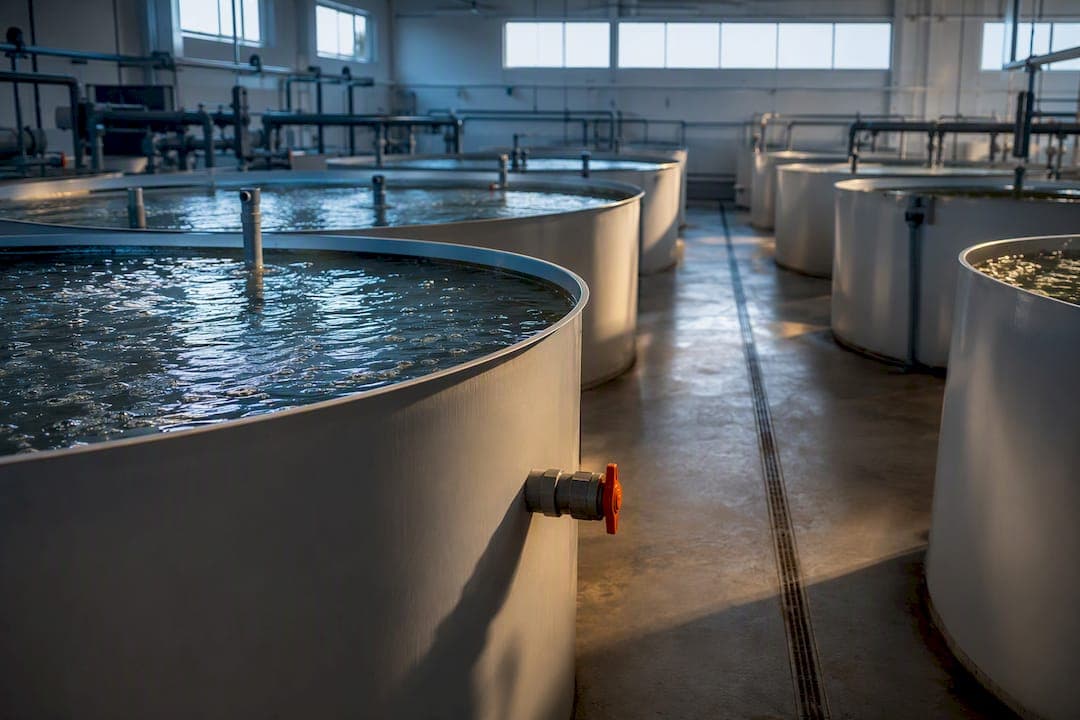
Land-based brine shrimp farming means growing Artemia to adult size in controlled tanks, using microalgae and other feeds instead of relying on wild ponds or seasonal cyst harvests. The payoff is protein consistency: tank-produced ongrown Artemia can reach roughly 58.6% protein on optimized diets year-round, regardless of weather or salt-lake conditions. Demeter Biosciences runs exactly this kind of system, feeding Artemia exclusively on Dunaliella algae.
TL;DR:
- Land-based Artemia farming offers consistent protein content of around 58.6% by controlling water chemistry, diet, and environment year-round.
- Tank systems require precise salinity (25-35 ppt), stable temperatures (25-28°C), and careful waste management to prevent culture crashes.
- Feeding Artemia with microalgae like Dunaliella and Tetraselmis yields higher HUFA levels, while inert feeds like fermented rice bran are viable cost-effective alternatives.
- Harvesting at peak nutrition, immediately after enrichment, ensures the highest protein and fatty acid content, with timing influencing biomass yield and quality.
- Proper cyst sourcing, equipment design, and water-quality monitoring are critical to scaling and maintaining reliable, high-quality Artemia production.
Table of Contents
- What Is Land-Based Artemia Farming vs. Pond or Sea Production?
- How Do You Set Up a Land-Based Artemia Tank System?
- What Should You Feed Artemia for Maximum Protein and HUFA?
- How Long Does It Take and What Yields Can You Expect?
- How Do You Diagnose and Fix a Failing Artemia Culture?
- How Does Waste Management Affect a Land-Based Artemia System?
- How Is Land-Based Artemia Harvested and Processed for Feed?
- Is Land-Based Brine Shrimp Farming Cost-Effective?
- Where Do You Source Quality Brine Shrimp Cysts?
- What Should You Consider When Designing a Land-Based System?
- Our Take: What the Industry Still Gets Wrong About Feed Quality
- Ready to Order Consistent, High-Protein Live Artemia?
- Sources
What Is Land-Based Artemia Farming vs. Pond or Sea Production?
Pond and lake-based Artemia harvesting depends on whatever the water is doing that season. Salinity swings, algae blooms, and bird predation all affect the cysts and biomass collectors pull from places like the Great Salt Lake or coastal salt flats. Quality varies by batch, and supply can vanish for months.
Tank-based systems remove that dependency. Cysts hatch in controlled seawater, nauplii (the first larval stage) get fed a measured microalgae diet, and the population grows into ongrown biomass inside a closed, monitored tank. Operators control temperature, salinity, and feed composition directly, so protein content and fatty-acid profiles stay stable shipment to shipment.
Ongrown Artemia from this kind of system typically ends up used in a few specific ways, including fry feeding in hatcheries where larval fish need live, moving food sized right for their mouths, ornamental live food for aquarium fish that refuse flake or pellet diets, and broodstock and maturation diets where fatty-acid content affects egg quality.
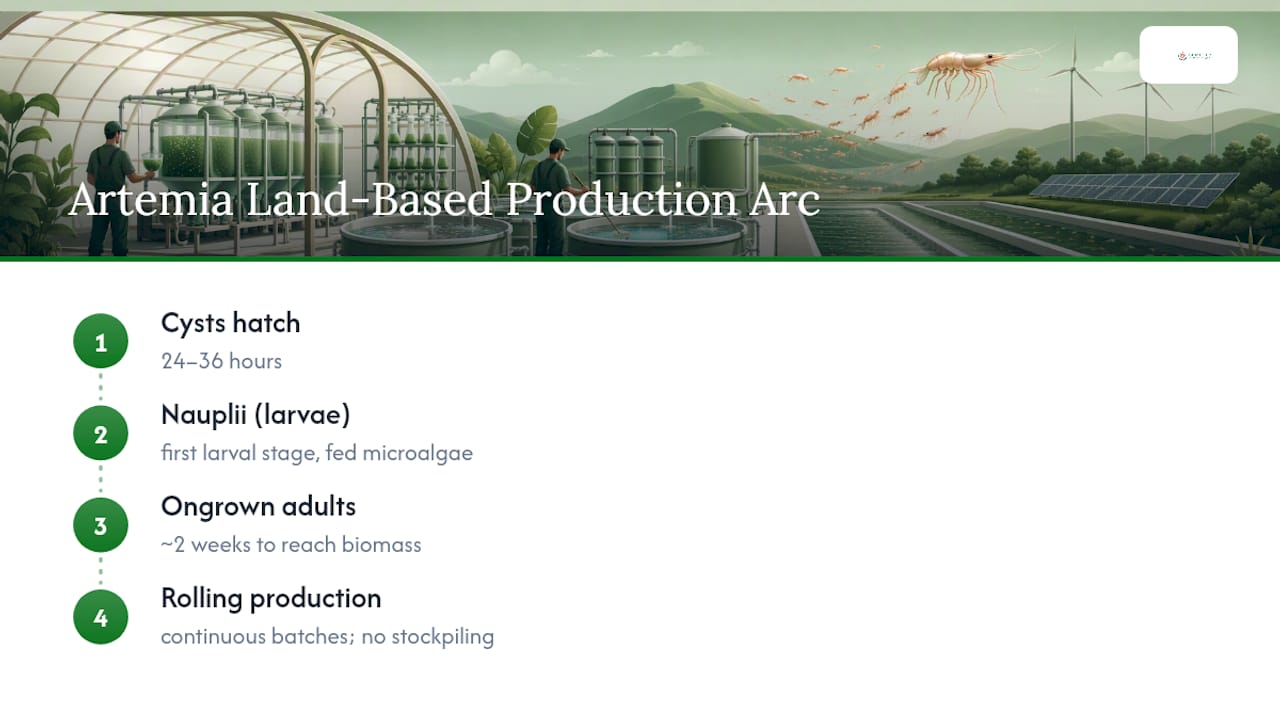
The full production arc runs from cyst hatch to nauplii within 24 to 36 hours, then nauplii to ongrown adult biomass over roughly two weeks under good conditions. That timeline is short enough that a hatchery or fish store can run a rolling production schedule instead of stockpiling frozen or dried backups.
How Do You Set Up a Land-Based Artemia Tank System?
Tank size depends on scale. A hobbyist or small lab can run a 30-liter closed aquarium setup and still produce adult Artemia within 14 days, while commercial operations use cylindrical or conical tanks ranging from a few hundred liters to several cubic meters, often stacked in banks to save floor space.
Water chemistry is where most failures start, so the targets matter more than the tank material. Salinity should sit between 25 and 35 parts per thousand, with temperature held at 25°C to 28°C. Keep pH in the 8.0 to 8.5 range. Ammonia and nitrite should read as close to zero as your test kit can detect, since Artemia tolerate salinity swings far better than they tolerate nitrogen waste. Water clarity matters too: if you can't see feed particles suspended in the water column, your turbidity is too high for the shrimp to feed efficiently.
Filtration and aeration round out the equipment list. Intake screens around 120 microns keep out predatory copepods and insect larvae without blocking the fine particles Artemia need to filter-feed. Constant aeration prevents oxygen crashes, especially during feeding.
- Hatch cysts in a separate incubation cone for 24 to 36 hours.
- Transfer nauplii to the grow-out tank once they've shed their first shell.
- Begin microalgae or inert feed dosing at low volume, increasing as density rises.
- Check salinity, temperature, and ammonia daily; log pH weekly.
- Partial water change (around 20%) on a weekly basis to control waste buildup.
Pro Tip: Run your first culture in a small tank before scaling up. It's far cheaper to learn the water-quality rhythm on a 30-liter setup than to discover a filtration mistake in a 2,000-liter production tank.
What Should You Feed Artemia for Maximum Protein and HUFA?
Microalgae is the foundation of any serious land-based operation. Dunaliella delivers strong protein and beta-carotene content and drives the nutritional consistency that separates farmed Artemia from wild-harvested stock. Chaetoceros and Tetraselmis are common companions in mixed-diet trials, each contributing different fatty-acid profiles that support faster growth or richer HUFA (highly unsaturated fatty acid) content in the final biomass.
Inert feeds fill the gap when live algae culture isn't practical at scale. Options include:
- Palm kernel expeller (PKE), fermented and sieved
- Fermented rice bran
- Baker's yeast, used in small closed systems
Because Artemia are non-selective filter feeders that ingest particles between roughly 1 and 50 microns, any agricultural by-product needs processing first. Incubating PKE for 24 hours and sieving it to 50 microns or smaller improves digestibility and encourages beneficial microbial growth that helps the shrimp thrive.
One study found that Artemia fed processed PKE in a 14-day indoor tank trial reached over 45% protein, with roughly 21% nitrogen-free extract and 9% lipids. That's a meaningful data point for anyone weighing inert feeds against pure microalgae diets on cost.
Enrichment timing matters as much as the ingredient list. Distributing enrichment emulsions gradually throughout the culture period, rather than dumping one large dose near harvest, can raise n-3 HUFA incorporation up to fivefold compared to single-dose enrichment. It also avoids the oxygen crashes that heavy single doses tend to trigger. Feed little and often; your Artemia and your dissolved oxygen levels will both hold steadier.
How Long Does It Take and What Yields Can You Expect?
Under optimized conditions, cyst to ongrown biomass typically runs 11 to 14 days. Small closed systems have hit adult Artemia by day 14, with the first reproductive pairs appearing between days 16 and 23 using nothing more exotic than yeast, spirulina, and weekly water changes.
Yield per volume swings widely based on system design and stocking density:
- Super-intensive tank systems can hold several thousand animals per liter at peak density
- Wholesale live-weight prices for ongrown Artemia have been cited in the $25 to $100 per kilogram range, depending on production method
- Feed regime shifts yield: dense stocking pushes biomass output up but demands tighter water-quality control
Switching from live microalgae to inert feeds changes the economics more than the biology. Inert feeds usually cost less to produce at scale and store more easily, but they require the fermentation and particle-sizing steps mentioned earlier to keep digestibility and growth rates comparable to a straight microalgae diet.
How Do You Diagnose and Fix a Failing Artemia Culture?
A culture in trouble shows physical signs before it crashes outright. Watch for these:
- Pale or empty guts under a hand lens signal inadequate feeding density.
- Low swimming activity or shrimp clustering near the surface often points to low dissolved oxygen.
- Sudden or rising mortality usually traces back to an ammonia or nitrite spike.
- Cloudy water beyond your normal turbidity target suggests overfeeding or a bacterial bloom.
The fix sequence is almost always the same: do a partial water change first, cut feed volume, boost aeration, then check salinity and pH before assuming something more exotic is wrong. Most crashes trace back to one of those four variables, not a mystery pathogen.
Biosecurity deserves its own line item. Quarantine incoming cysts and any transferred biomass before adding them to an established tank, since microbial contamination from an outside source is one of the more common ways an otherwise stable culture collapses within days.
How Does Waste Management Affect a Land-Based Artemia System?
Every land-based system produces waste: uneaten feed, molted shells, and metabolic byproducts that break down into ammonia and nitrite. Left unmanaged, that waste is exactly what drives the mortality spikes covered above, so waste handling isn't a peripheral concern. It's core to keeping the culture alive.
Some larger facilities route effluent through settling tanks or biofilters before discharge, reducing the nutrient load released into municipal wastewater systems.
The environmental case for land-based production runs deeper than tank hygiene, though. Because the system is closed and inland, it doesn't compete with coastal salt-lake ecosystems for wild cyst harvest, and it doesn't disturb the bird populations and brine flies that depend on those same salt-lake habitats. Microalgae cultivation itself, particularly with species like Dunaliella, consumes carbon dioxide and releases oxygen during growth, adding a modest environmental upside on top of the feed-production benefit.
Compare that to wild harvest, where cyst collection can fluctuate a lake's ecosystem balance in ways that take years to reverse. A tank sitting in a warehouse has essentially no seasonal footprint on a wild habitat, which is a real point in land-based farming's favor even before you get to the nutritional argument.
How Is Land-Based Artemia Harvested and Processed for Feed?
Harvesting ongrown Artemia is mostly mechanical. Operators drain or siphon a portion of the tank through a mesh screen sized to the target harvest stage, letting water and smaller nauplii pass through while retaining the larger, market-ready biomass. Screen size depends on end use: fry feed for very small larval fish calls for a finer mesh than biomass destined for adult ornamental fish.
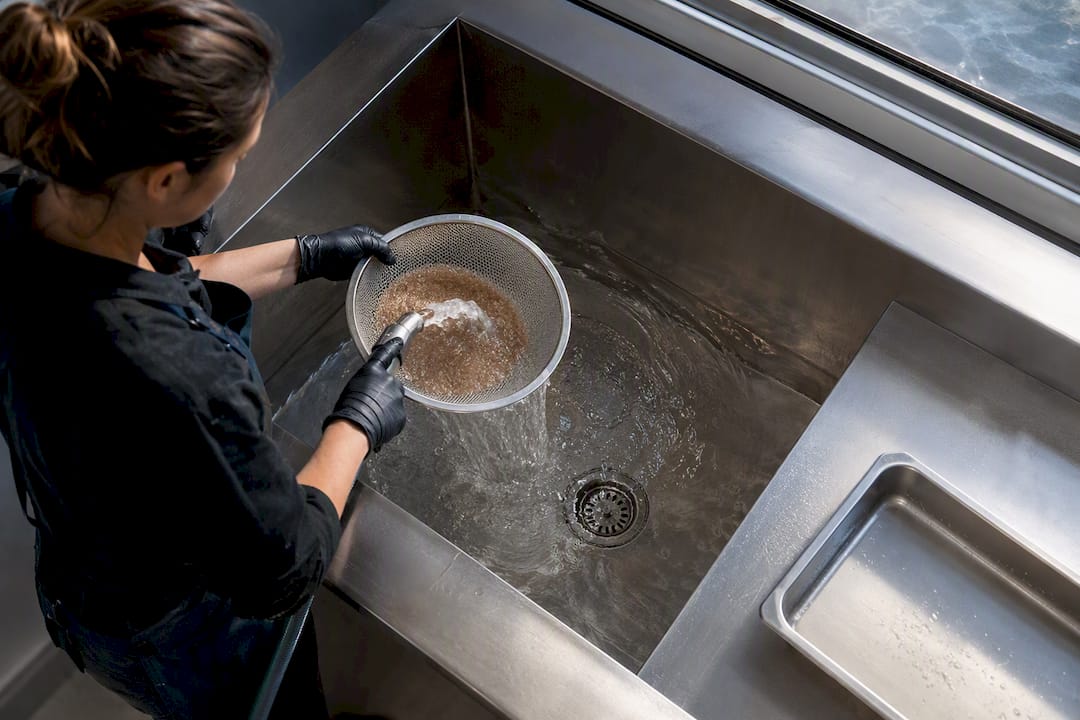
After harvest, biomass typically gets rinsed in clean, temperature-matched water to remove residual feed particles and metabolic waste before packaging. For live-shipment applications, that rinse step also reduces the bacterial load traveling with the shrimp, which matters for shipping survival rates.
Processing branches into two paths depending on the buyer. Live biomass headed to aquarium hobbyists or fish stores gets packed in oxygenated, temperature-controlled bags or containers for same-day or overnight transit. Biomass destined for longer-term storage or fish meal production gets dried, frozen, or otherwise stabilized, though that route sacrifices some of the live-feed nutritional edge that makes fresh ongrown Artemia valuable in the first place.
Timing the harvest window matters nutritionally, too. Artemia harvested at peak ongrown size, right after a full enrichment cycle, carry the highest protein and HUFA content they'll have during their culture life. Harvest too early and you lose biomass yield; harvest too late and molting or reproductive activity starts diverting nutrients away from the tissue profile that makes the shrimp valuable as feed.
Is Land-Based Brine Shrimp Farming Cost-Effective?
Startup costs for land-based Artemia farming scale with ambition. A hobbyist or small research setup can get running with a basic tank, heater, air pump, and cyst supply for a modest investment. Commercial-scale operations face steeper upfront costs: multiple tanks, filtration infrastructure, microalgae culture capacity, and monitoring equipment for salinity, ammonia, and pH.
Ongoing costs break down into feed, water treatment, and labor for monitoring. Microalgae culture (growing your own Dunaliella or Chaetoceros) demands more upfront infrastructure than buying inert feed, but it usually produces a better nutritional outcome and avoids the ongoing purchase cost of processed by-products. Inert feeds like fermented rice bran or PKE cost less per batch but require fermentation and sieving labor, which eats into the savings.
The revenue side depends heavily on end use. A hatchery producing its own Artemia for internal fry-feeding operations is optimizing for supply reliability and cost avoidance rather than direct sales. A supplier selling live or bulk ongrown biomass to fish stores, museums, or other institutions is optimizing for consistent protein content and turnaround time, since buyers pay a premium for shrimp that arrive alive and nutritionally predictable rather than variable batch to batch.
Compared to sourcing wild-harvested cysts or biomass, land-based production trades lower per-unit cost for higher reliability and nutritional control. For any buyer whose downstream animals depend on consistent feed quality, that trade tends to pay for itself.
Where Do You Source Quality Brine Shrimp Cysts?
Cyst quality varies more than most new operators expect. Hatch rate, a measure of what percentage of cysts successfully hatch into nauplii, is the single most important quality parameter, and it can range widely between suppliers and even between batches from the same source depending on storage conditions.
Look for cysts with a documented hatch rate above 80%, ideally with a stated harvest date. Older cysts, or cysts stored improperly, lose viability over time even before the package is opened. Strain matters too: some Artemia strains produce larger nauplii better suited to feeding bigger larval fish, while others are smaller and suited to first-feeding stages.
Storage after purchase determines how long that quality holds. Cysts should be kept dry, cool, and away from light and oxygen exposure. Vacuum-sealed packaging with an inert gas fill extends shelf life considerably compared to a loosely sealed bag left at room temperature. Once you've opened a container, moisture exposure becomes the main threat, so resealing tightly and refrigerating unused portions protects the remaining batch.
For institutions running Artemia production internally rather than buying ongrown biomass directly, cyst sourcing is worth treating as seriously as the water-quality parameters covered earlier. A bad batch of cysts wastes an entire culture cycle before you even find out something's wrong.
What Should You Consider When Designing a Land-Based System?
Tank material affects both cost and durability. Fiberglass and food-grade polyethylene are the most common choices for production tanks, resisting the corrosive effects of saltwater better than untreated metal or standard plastics. Glass works fine for small research or hobbyist setups but becomes impractical past a certain volume due to weight and cost.
Layout decisions depend heavily on available floor space and target scale. Conical-bottom tanks make harvesting easier since biomass and waste settle toward a single drain point, while cylindrical or rectangular tanks maximize volume per square foot of floor space, which matters more in a warehouse-style commercial facility than in a research lab with room to spare.
Scalability is worth planning for from day one, even if you're starting small. A modular design (several small to mid-size tanks rather than one giant tank) makes it easier to isolate problems: if one tank develops a water-quality issue or contamination, it doesn't take down the entire operation. It also lets you stagger harvest cycles, so you're not waiting two weeks between every batch with nothing in the pipeline.
Piping and drainage design deserve attention too. Saltwater is corrosive, and a system designed without saltwater-rated valves and fittings will need expensive rework within a year or two. Planning drainage routes that make partial water changes fast and low-labor pays off every single week of operation, not just once at setup.
Our Take: What the Industry Still Gets Wrong About Feed Quality
Most guidance on Artemia culture treats protein content as a fixed trait of the species rather than a variable outcome of what you feed it. That's backwards, and it's the biggest misconception we run into. Wild-harvested brine shrimp go through starvation cycles tied to lake conditions, and their nutritional value at the moment of harvest is essentially a guess. Land-based, microalgae-fed production removes that guesswork entirely.
Demeter Biosciences built its production system around exclusive Dunaliella feeding specifically because it delivers a documented, consistent protein floor of at least 40%, batch after batch. That consistency matters more to a hatchery manager or museum curator than any single headline protein number, because it means every shipment performs the same way in the tank.
Institutions and stores increasingly need supply they can plan around: monthly subscriptions for hobbyists, bulk institutional packaging for museums and research labs, and direct shipments sized to actual use rather than whatever a wild harvest happened to produce that season.
— Demeter
Ready to Order Consistent, High-Protein Live Artemia?
If you've read this far, you already know the gap between wild-harvested brine shrimp and a controlled, microalgae-fed system. Demeterbioscience closes that gap directly: our Artemia are raised exclusively on Dunaliella algae in land-based tanks, giving you a documented protein floor rather than a seasonal guess.
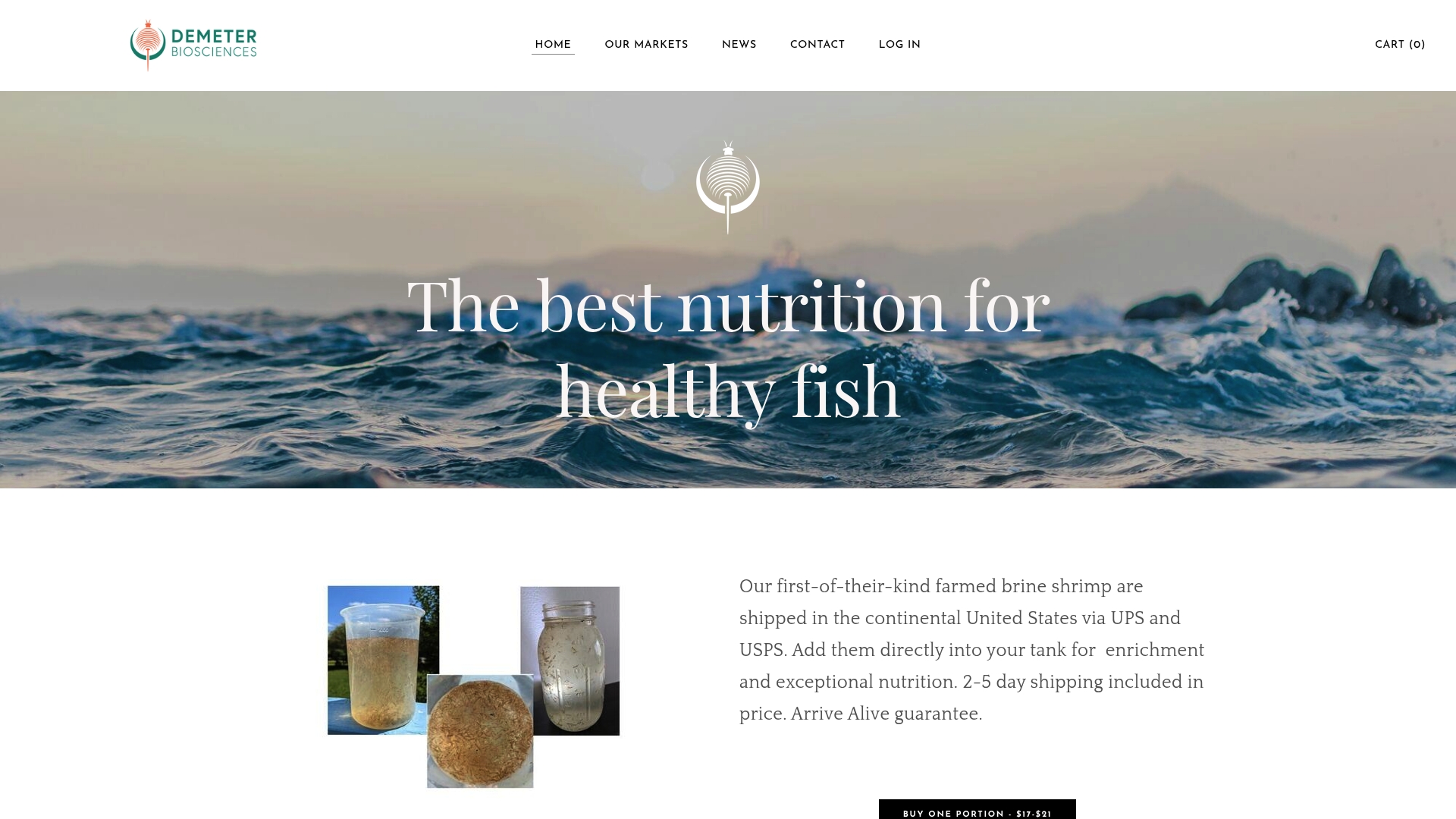
Ordering is straightforward no matter your scale. Aquarium hobbyists can order live brine shrimp as a single shipment or set up a recurring monthly subscription so feeding never runs short. Local fish stores, museums, and research institutions needing larger volumes can place a bulk order sized to their actual usage, with packaging designed to keep biomass alive and nutritionally intact through transit.
Live shipments are timed around harvest to maximize protein and HUFA content on arrival, so ordering a few days ahead of your feeding schedule gets the best results. If you're not sure which package fits your operation, reach out to our team and we'll walk you through the right quantity and shipping cadence for your setup.
Sources
- FAO — Tank production and use of ongrown Artemia
- Palm kernel expeller (PKE)-based feed for brine shrimp Artemia production: effects on growth, biomass, and microbial composition
- Cultivation of Artemia franciscana in a closed, low-cost cultivation system
- Review: environmental stability and monitoring for sustainable Artemia production