
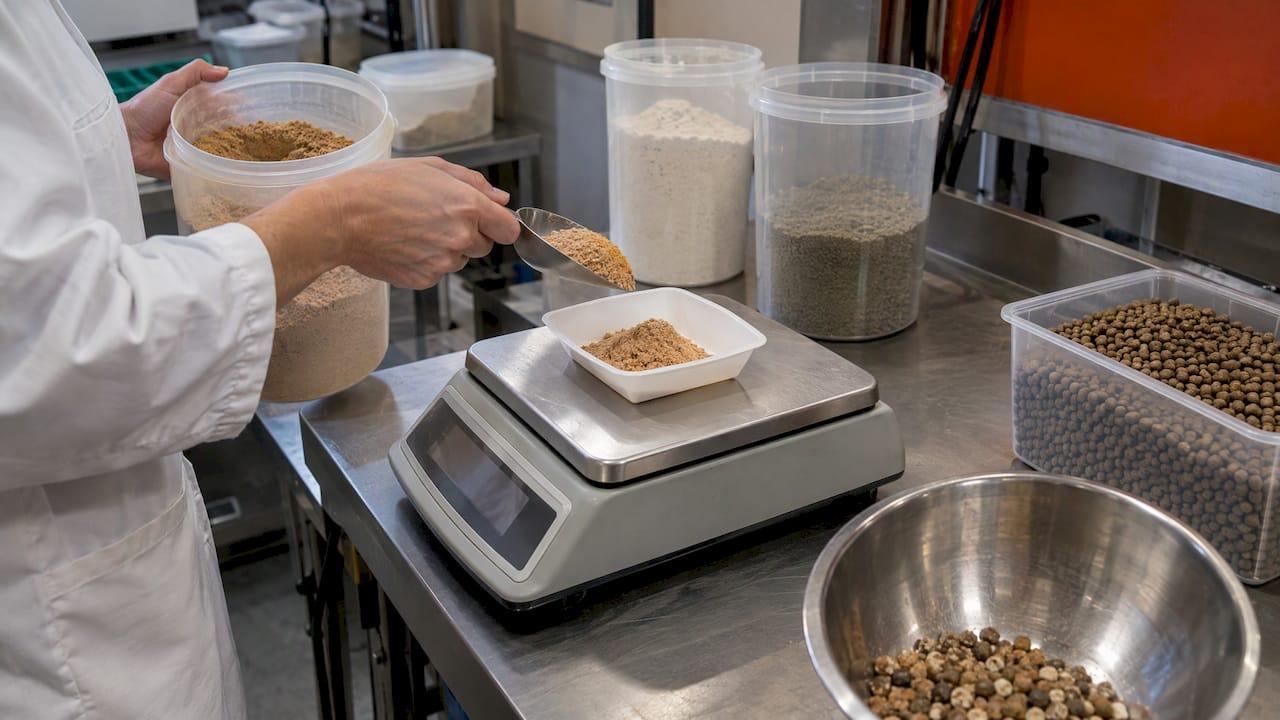
There is no single inclusion rate for brine shrimp meal. The right share depends on the species, the life stage and what the meal replaces, and published research gives ranges, not one number. The practical way to decide is to work out how much protein the meal contributes to your diet, start at the low end of the range for your use, and raise it in steps while you watch growth, survival and feed acceptance. Our own brine shrimp are fed exclusively on the microalgae Dunaliella and are raised to at least 40% protein, which gives you a consistent figure to build that math on.
This guide is for hobbyists mixing their own fry or conditioning foods, local fish stores, hatcheries and farms, and museums or labs running aquatic exhibits.
TL;DR
- An inclusion rate is the percentage of a finished diet, by weight, that comes from one ingredient. It is not a daily feeding amount.
- Reviews of animal-derived alternative proteins report partial or full fish meal replacement across a very wide range, from 2% to 100%, and levels above certain thresholds can be harmful. Start low and step up.
- Protein math comes first: a meal that is at least 40% protein contributes about 4 points of crude protein for every 10% you include.
- Brine shrimp work best alongside other ingredients. Blends can have synergistic effects, and enrichment matters for the fatty acids DHA, EPA and ARA.
- Consistency matters more than any one number: a feed ingredient with a stable protein level lets you hold a rate constant between batches.
Table of Contents
- What an inclusion rate actually means
- What the research shows about rates
- Do the protein math first
- Starting points by use
- Factors that should set your rate
- A simple way to scale up
- Live brine shrimp, meal or both
- Our perspective
- Put it into practice
- FAQ
- Sources
What an inclusion rate actually means
An inclusion rate describes a recipe, not a meal. If a diet is 10% brine shrimp meal, then 100 grams of finished feed contains 10 grams of it, and the rest is other ingredients such as other protein sources, lipids, binders, vitamins and minerals. The rate is always measured against the total diet.
This is different from how much you feed. Feeding rate is how much finished feed an animal gets per day, often a percentage of body weight. Mixing the two up is the most common error when people first work with a new ingredient. You can feed a small amount of a diet that has a high inclusion, or a large amount of a diet with a low inclusion, and the animal receives very different amounts of brine shrimp protein in each case.
Two other terms help:
- Replacement level: the share of an existing ingredient, usually fish meal, that a new ingredient takes over. A diet with 30% replacement swaps out 30% of the fish meal, not 30% of the whole diet.
- Crude protein: the protein content of the diet as measured on the label or in a lab. Most formulation decisions start here.
What the research shows about rates
The published evidence on dry Artemia as a feed ingredient is smaller than the evidence on live Artemia, and it is worth reading closely for what it does and does not tell you.
A 2026 review chapter on Artemia biomass as an alternative protein reports promising results for survival, weight gain, feed conversion ratio and specific growth rate when it replaced fish meal in white-leg shrimp, giant freshwater prawn and tiger prawn. The same chapter notes that Artemia is well established as a live feed in larviculture, and that its role as a protein source in formulated aquafeeds is still open for work across more species and life stages. For you, that means the field is moving and the sensible approach is to run your own stepwise trial rather than copy a number from a different species.
Broodstock work gives a concrete signal. In a 2002 study on shrimp broodstock in Ecuador, dry diets outperformed fresh food for spawning performance and eggs per female in the first experiment. In the second, the diet built around Artemia meal outperformed fresh food for spawning, eggs per female and spermatophore quality. Spermatophores are the sperm packets males transfer to females, so that is a direct measure of reproductive output.
For the wider picture, a 2024 review of alternative protein sources in aquafeed found that inclusion levels ranged from 10% to 80% for plant-derived sources and from 2% to 100% for animal-derived sources in partial or complete fish meal replacement. The effects were generally positive, but levels above certain thresholds could be harmful. That is the central lesson for any new ingredient: a rate that helps at one level can hurt at a higher one, and the threshold depends on the species.

How trials are structured
It helps to see how researchers set up a rate study, because you can copy the design at any scale. A 2025 study in juvenile white-leg shrimp tested replacement of fish meal at 0%, 15%, 30%, 60% and 100% with an alternative protein, using diets formulated to roughly 37% protein over a 60-day trial. The elements to borrow are:
- A control with none of the new ingredient.
- Several graded levels, not one.
- Diets matched on protein so the difference comes from the ingredient, not from a protein gap.
- A trial long enough to see growth, here 60 days.
Do the protein math first
Before you pick a percentage, calculate what the meal contributes. The arithmetic is simple, and the example below is illustrative, not a recommendation.
Suppose your target diet is 40% crude protein and your meal is 40% protein.
| Meal inclusion | Protein contributed by the meal | Protein still needed from other ingredients |
|---|---|---|
| 10% | 4 points | 36 points |
| 25% | 10 points | 30 points |
| 50% | 20 points | 20 points |
| 100% | 40 points | 0 points |
For context, growout shrimp diets typically contain 30% to 50% protein, depending on species and culture strategy. A meal at 40% protein therefore sits inside that band by itself, which is why it can serve as a main protein contributor or as a partner to other ingredients.
The protein figure is where consistency pays off. If the protein level in your meal moves from batch to batch, every inclusion rate you set moves with it, and you end up re-balancing the recipe. Our brine shrimp are raised on a single algal feed in controlled, land-based systems, and we guarantee at least 40% protein, so the contribution in the table holds from one shipment to the next. For a deeper look at turning protein percentages into feeding numbers, see our brine shrimp protein guide.

Starting points by use
The evidence above does not give one rate per species, so treat what follows as a way to structure your own first trial, not as published dosing.
Hobbyists and fry keepers
If you mix your own foods for a home tank, you rarely need to calculate a percentage. The more useful decision is the form: live shrimp for feeding response and movement, or meal as a base for a blended food. For most hobbyists, live brine shrimp are the easiest way to put this protein in front of fish, and you control the amount simply by how many you offer. Our guide to target feeding brine shrimp covers how to get them to the right animals in a community tank, and the refugium guide explains hatching for food rather than for a colony.
If you do mix a meal-based food, start with a modest share, such as the 10% row in the table, and watch whether the fish take it readily.
Fish stores and retailers
Stores usually do not formulate feed. The decision is what to stock and how to tell customers to use it. Live brine shrimp in bulk let you offer a nutrient-dense food with a clear story, and a consistent protein level makes your advice repeatable. Our bulk store order is set up for local fish stores and pet retailers.
Hatcheries and larval rearing
Larvae are where the biology matters most. Newly hatched brine shrimp nauplii are about 450 microns wide, which is usually too large for most first-feeding marine fish larvae, so smaller prey comes first for those species and brine shrimp follow as larvae grow. The same University of Florida publication points out that brine shrimp lack enough DHA, EPA and ARA for most developing marine fish larvae, and that enrichment is needed at the stages where it can be done. Those are fatty acids that support growth and development, and brine shrimp take up what they are fed. Our commercial larval fish nutrition guide goes into the stage-by-stage details.
Broodstock and growout
Broodstock shrimp diets typically combine fresh or frozen supplements with formulated diets, and the Ecuador broodstock results above show why Artemia-based feeding is attractive at this stage. In growout, some formulated diets reduce the need for brine shrimp, but complete substitution is not yet possible. In practice, brine shrimp remain a core part of the feeding program, and a blend is the norm.
Factors that should set your rate
Species and life stage. Larvae, juveniles and broodstock need different things, and the review literature says outright that more work across species and stages is needed. A rate that suits a shrimp broodstock diet is not automatically right for an ornamental fish fry food.
What the meal replaces. Swapping out 20% of a fish meal changes the diet differently than adding the meal on top of a diet that already meets protein needs. Always keep the diet matched on protein and energy when you change an ingredient.
Fatty acid profile. As noted above, DHA, EPA and ARA are limiting for many marine larvae, so plan on enrichment or a complementary lipid source where your species needs it.
Blending. A 2024 review notes that blending protein sources can have synergistic nutritional effects, while inclusion above a certain level can negatively affect growth and metabolic activity. A moderate share of several ingredients is often safer than a large share of one.
Consistency of the ingredient. If the batch changes, your rate changes. This is the case for a controlled source over wild-harvested product, which varies with season and with how well the animals were fed. We raise our shrimp on a fixed algal diet precisely to avoid the starvation and seasonal swings that affect animals taken from natural waters.
A simple way to scale up
- Set your target protein and energy for the species and stage.
- Calculate the meal's protein contribution at three levels, for example 10%, 20% and 30%, using the table method above.
- Rebalance the other ingredients so every test diet has the same protein.
- Run the diets side by side with a control, with the same number of animals per tank and the same feeding schedule.
- Record weight gain, survival, feed conversion and how readily the animals eat. Feed acceptance is easy to see and is often the first sign of a problem.
- Move up one step at a time. If growth stops improving or survival falls, return to the previous level.
Keep your notes by batch. Because our protein level is steady, you can attribute differences to the rate, not to the lot.
Live brine shrimp, meal or both
For feeding response, hobbyists and stores generally get the most from live brine shrimp, which trigger natural hunting behavior and deliver the nutrition fresh. Meal is a tool for formulators who need a dry, storable ingredient. Many programs use both: live shrimp for conditioning and early stages, and a meal in the mixed diet. If you are comparing forms, our guide to brine shrimp versus pellets lays out how each fits a feeding plan, and the brine shrimp meal uses guide and meal nutrition guide cover the dry side.
Our perspective
We built Demeter Biosciences around a simple idea: the value of brine shrimp is set by what the shrimp eat. Wild-harvested animals live through seasons of plenty and of starvation, and their nutrition follows. Ours are raised in land-based, organic and sustainable systems and fed only on the microalgae Dunaliella, so every batch is built to reach at least 40% protein.
That matters most when you are working with inclusion rates. A rate is a promise about a recipe, and a recipe only works if the ingredient stays the same. Starting from a steady protein figure lets you change one thing at a time, compare results honestly and scale up with confidence, whether you run a home tank, a store, a hatchery or an exhibit.
We also think the field is early. Artemia is a proven live feed, and its role in formulated diets is still being mapped across species. We would rather see you run a careful stepwise trial with a consistent ingredient than rely on a rule of thumb.
Demeter
Put it into practice
If you want to start with a consistent product, our live brine shrimp are available from $17 to $35 per order, raised on Dunaliella and built to at least 40% protein. If you feed regularly, the Demeter Biosciences membership is $25 per month for a monthly live shipment, and a gift card ($10 to $50) works for a fellow hobbyist. Stores, museums and institutions can order through the bulk program.
If you also keep corals or filter feeders, we offer live phytoplankton at $20.
FAQ
What is a typical inclusion rate for brine shrimp meal?
There is no single published figure. Reviews of animal-derived alternative proteins report partial or full replacement of fish meal anywhere from 2% to 100%, with the safe level depending on species and stage. Begin with a low share, such as 10%, keep the diet matched on protein, and raise it in steps.
Can brine shrimp meal replace fish meal completely?
Research on Artemia biomass in white-leg shrimp, giant freshwater prawn and tiger prawn shows promising growth and survival results for fish meal replacement, but the work is limited and still expanding. Test partial replacement first, for example at 15%, 30% and 60% against a control, before considering more.
How do I calculate how much protein the meal adds?
Multiply the inclusion rate by the meal's protein percentage. At 10% inclusion of a meal that is 40% protein, the meal adds 4 points of crude protein to the diet. Then adjust the other ingredients so the whole diet reaches your target.
Do I still need live brine shrimp if I use a formulated diet?
Often yes. Some formulated diets reduce the need for brine shrimp, but complete substitution is not yet possible, and broodstock programs typically pair formulated diets with fresh or frozen supplements. Live shrimp also suit early feeding stages where the animals are ready for them.
Sources
- Experimental broodstock diets as partial fresh food substitutes (VLIZ, 2002)
- Brine Shrimp Artemia: A Promising Alternative Protein Source to Fish Meal
- Alternative protein sources in aquafeed: Current scenario (2024)
- Use of Soybean Meal in the Diets of Marine Shrimp (2018)
- Effects of dietary inclusion of mealworm in juvenile Litopenaeus vannamei diets (2025)