
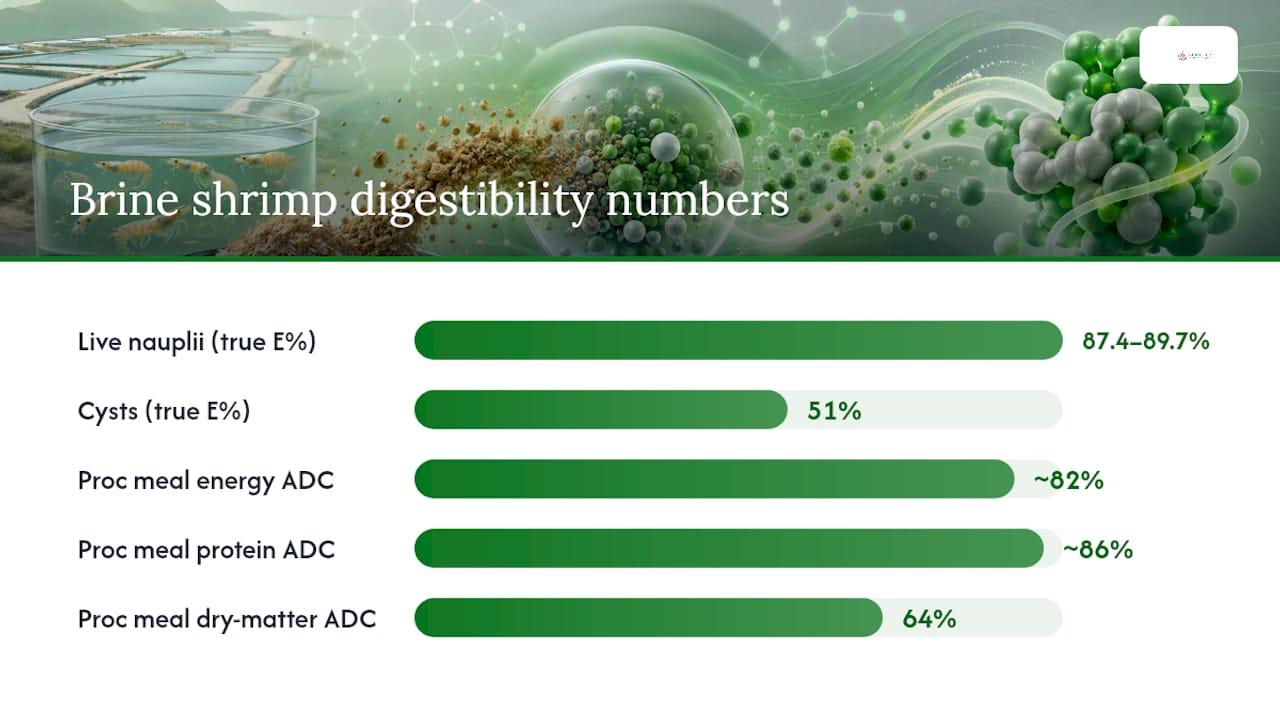
Live Artemia delivers true digestibility of roughly 87.4 to 89.7 percent of gross energy, making it one of the most usable protein and lipid sources available to larval and juvenile aquatic species. Cysts are a different story: gross energy looks impressive on paper, but true digestible energy drops to around 51 percent. Processed meals fall somewhere in between, depending on ash content, decapsulation, and drying method. The number that matters most for formulators is not the label protein percentage. It's the digestible fraction of that protein and energy your target species can actually absorb.
TL;DR:
- Cysts offer only about 51 percent true digestible energy due to their hard shells resisting digestion, unlike live nauplii.
- The digestibility of processed meals varies significantly, with dry matter ADCs ranging from 48.6 to 87 percent, heavily influenced by ash content and processing methods.
- Enrichment timing is critical, with lipid and DHA peaks occurring around 12 hours post-enrichment, affecting nutrient retention.
- Consistent, algae-fed Artemia from controlled sources ensures stable proximate composition and reliable digestible nutrition.
Table of Contents
- Digestibility of Brine Shrimp Meal: The Peer-Reviewed Numbers
- How Form Changes What a Fish Can Actually Use
- What Actually Drives Digestibility Up or Down
- Turning ADC Numbers Into a Feed Formula
- Why Controlled, Algae-Fed Artemia Simplifies This Math
- Where to Go Deeper on the Numbers
- The Digestibility Number Everyone Skips
- Get Consistent Digestible Nutrition, Not Just a Protein Number
- Sources
- FAQ
Digestibility of Brine Shrimp Meal: The Peer-Reviewed Numbers
Formulators need coefficients, not marketing claims. The strongest dataset on brine shrimp digestibility comes from feeding trials measuring what predators actually absorb versus what they consume, and the gap between those two numbers is where most of the useful information lives.
Apparent digestibility coefficient (ADC) measures nutrient absorption without correcting for the animal's own metabolic losses (fecal enzymes, sloughed gut cells). True digestibility corrects for those endogenous losses, usually with an inert marker like chromic oxide or acid-insoluble ash added to a reference diet. True digestibility numbers run higher than apparent ones because they strip out the noise the animal's own body contributes to the fecal sample.
The most-cited figures for live Artemia franciscana come from feeding trials on eared grebes, which found true digestible energy at 87.4 to 89.7 percent, with birds using 82.2 to 94.9 percent of dry mass depending on the prey item tested. Cysts, tested in the same body of research, told a very different story: only 34 percent of dry mass and 51 percent of gross energy proved truly digestible.
That split matters because cysts and live nauplii are chemically similar but structurally very different. The chitinous shell around an encapsulated cyst resists breakdown in a simple gut, and much of the trapped energy simply passes through undigested.
Key figures at a glance:
- Live Artemia nauplii: true digestible energy of 87.4 to 89.7 percent
- Brine shrimp cysts (whole, undecapsulated): true digestible energy near 51 percent
- Processed shrimp meals: apparent energy ADC around 82 percent, protein ADC around 86 percent, but dry matter ADC can drop to 64 percent when ash content is high
- Broader ingredient surveys across shrimp feed trials show dry matter ADCs ranging from 48.6 to 87.0 percent and crude protein ADCs from 55.7 to 92.3 percent, depending on species and processing
That range is wide enough that a single "brine shrimp digestibility number" pulled from one paper without checking the form, species, and trial method is a formulation risk, not a shortcut.
How Form Changes What a Fish Can Actually Use
Nauplii, cysts, and dried meal are not interchangeable ingredients, even when they come from the same population of animals. The differences show up in usable nutrients long before they show up in a proximate analysis panel.
Newly hatched nauplii are the gold standard for first-feeding larvae. Their small size, soft exoskeleton, and swimming behavior make them easy to capture and easy to digest, which is why hatcheries built entire larviculture protocols around a 12 to 48 hour hatch window. Nutritionally, though, a nauplius arriving fresh from a cyst carries only the yolk reserves it hatched with. It has not eaten yet. That is exactly why enrichment protocols exist.
Decapsulated cysts remove the hard chorion shell, which improves digestibility and eliminates the risk of larvae ingesting sharp shell fragments. Decapsulation does not fix the underlying energy problem, though. Even with the shell gone, cyst contents are structured for dormancy, not rapid absorption, and true digestible energy stays well below what live nauplii deliver.
Dried or freeze-dried meal sits in the widest range of all, because processing method drives the outcome more than the raw material does. A gently dried, low-ash meal can post protein ADCs approaching those of live Artemia. A meal contaminated with shell fragments or processed with heavy heat exposure can lose both digestibility and heat-sensitive amino acids.
Practical form selection:
- First-feeding larvae (days 1 to 10 post-hatch): live nauplii, enriched before feeding
- Juveniles transitioning to formulated feed: enriched nauplii or adult Artemia, gradually blended with dry feed
- Broodstock conditioning: enriched adult Artemia for HUFA and carotenoid loading
- Formulated feed protein source: dried meal, selected on published ADC and ash content, not just crude protein percentage
The mistake feed formulators make most often is treating "brine shrimp meal" as one line item on a spec sheet, when the form behind that label swings usable energy by nearly 40 percentage points.
What Actually Drives Digestibility Up or Down
Four levers determine whether a batch of brine shrimp delivers on its nutritional promise: enrichment timing, chitin content, processing quality, and the biological consistency of the source population. Miss any one of them and the ADC numbers from a published study stop applying to your actual feed.
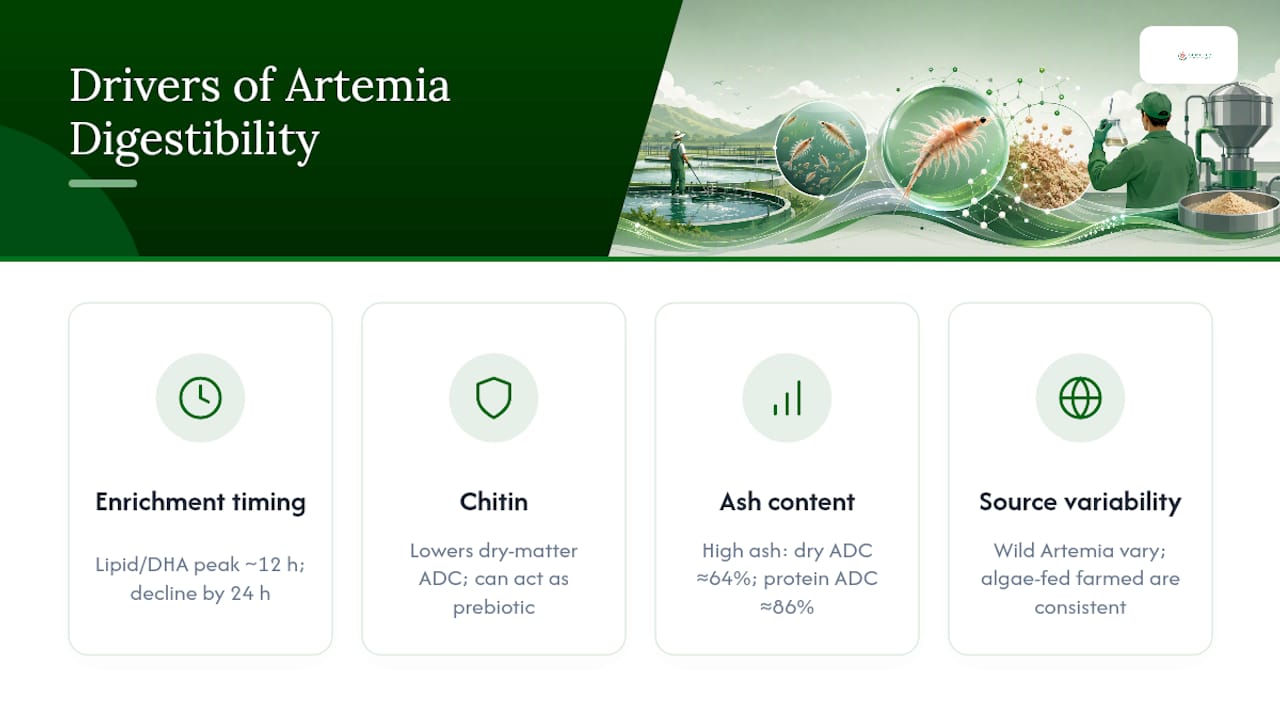
1. Enrichment timing is the single biggest controllable variable. Lipid and DHA content in enriched Artemia peak at roughly 12 hours into an enrichment protocol, then decline by the 24 hour mark as the animals catabolize what they just absorbed. Feed enriched Artemia too early and you miss the nutrient window. Feed it too late and you have burned off the exact fatty acids you paid to load in.
2. Chitin cuts both ways. The chitin in cyst shells and exoskeletons lowers dry matter digestibility, which is part of why whole cysts underperform nauplii on ADC tests. But chitin is not purely a liability. It has been shown to act as a prebiotic that supports gut bacteria and immune function in some species, which means a lower dry matter ADC does not automatically mean a worse feed ingredient overall.
3. Ash content explains most of the ADC variation between meals. Processed shrimp meals with elevated ash, often from shell fragments or mineral contamination during processing, can post dry matter ADCs of 64 percent even while protein ADC stays around 86 percent. Ash content, not protein quality, is usually the reason two meals with similar labels perform differently in a growth trial.
4. Wild-harvested Artemia carry inherent variability that farmed, algae-fed production avoids. Wild populations experience seasonal starvation, salinity swings, and inconsistent algal blooms, all of which shift fatty acid composition before the shrimp ever reach a feed bag. Controlled, algae-fed production systems remove most of that noise by keeping the diet, salinity, and harvest timing constant.
Pro Tip: Don't trust a published enrichment schedule blindly. Validate the 12-hour peak on your own system by sampling enriched Artemia for lipid and fatty-acid content at 0, 6, 12, and 24 hours, since water temperature and enrichment product both shift the curve.
Turning ADC Numbers Into a Feed Formula
Published digestibility coefficients only earn their keep when you use them to calculate digestible protein and digestible energy, not just crude protein on a bag label. Here's how that math actually runs.
1. Start with the proximate analysis. Say a brine shrimp meal comes in at 55 percent crude protein and 18 megajoules per kilogram gross energy on a dry matter basis, values in line with what commercial brine shrimp meal listings typically report.
2. Apply the published or measured ADC. Using the processed shrimp meal figures of roughly 86 percent protein ADC and 82 percent energy ADC, digestible protein works out to about 47.3 percent of dry matter, and digestible energy comes to roughly 14.8 megajoules per kilogram.
3. Check dry matter ADC separately. If dry matter ADC sits at 64 percent because of ash content, that tells you the non-digestible fraction, largely ash and chitin, is diluting the ingredient's contribution to overall feed digestibility even though the digestible protein number still looks strong.
4. Set inclusion rate based on role, not just cost per ton. A meal used as a primary protein source needs a higher, more consistent ADC than one used as a palatability enhancer or partial supplement layered alongside fish meal or soy protein concentrate.
5. Verify with a short growth trial. Track feed conversion ratio, specific growth rate, and survival over four to six weeks against a control diet. If growth lags behind what the ADC math predicted, retest the ingredient. Ash content and moisture can drift between production batches even when the label doesn't change.
That gap between predicted and observed performance is usually where variability in the raw ingredient, not an error in the ADC math, is doing the damage. A meal that tested at 86 percent protein ADC six months ago may not test the same today if the source population, harvest timing, or drying process changed even slightly.
Why Controlled, Algae-Fed Artemia Simplifies This Math
Every calculation above depends on knowing your ingredient's actual composition, not an average pulled from a published study on a different population. That's the practical case for sourcing Artemia from controlled, land-based systems rather than wild harvest.
Demeterbioscience raises Artemia exclusively on Dunaliella microalgae in land-based cultivation systems, targeting a consistent minimum of 40 percent protein content batch to batch. That consistency matters more than the raw percentage. Wild-harvested Artemia swing with the season, sometimes reflecting near-starvation conditions in natural salt lakes that depress both protein and lipid content well below what a formulation was designed around.
What consistent, algae-fed production changes for formulators:
- Fewer surprise retests when a new batch arrives, since proximate composition stays stable across harvests
- ADC-based calculations hold up longer without re-verification
- Enrichment scheduling becomes more predictable because starting nutrient content doesn't shift with the season
Where to Go Deeper on the Numbers
The digestibility figures and enrichment timing data cited throughout this guide come from a small set of peer-reviewed sources worth bookmarking directly.
- Energy content and digestibility of brine shrimp and other prey items for the true digestibility figures on live Artemia and cysts
- Fricke et al. 2022 on shrimp processing remains for processed meal ADC data
- Instituto de Pesca enrichment research for the 12-hour lipid peak finding
The Digestibility Number Everyone Skips
The conventional advice on brine shrimp treats protein percentage as the headline number, and that's backwards. A meal advertising 65 percent crude protein with a depressed protein ADC delivers less usable nitrogen than a meal at 55 percent crude protein with a protein ADC above 85 percent. Formulators who chase the label number instead of the digestible fraction end up overpaying for protein their fish never absorb.
The bigger blind spot is enrichment timing. Most operations enrich on a fixed schedule built around hatchery convenience, not the 12-hour lipid peak the research actually points to. That's a solvable problem, and it's cheaper to fix than switching ingredient suppliers.
If there's one priority worth acting on first, it's sourcing consistency. ADC math only holds up when the ingredient behind it doesn't drift from batch to batch, and that's the real argument for controlled, algae-fed production over wild harvest.
— Demeter
Get Consistent Digestible Nutrition, Not Just a Protein Number
If the math in this guide taught you anything, it's that a protein percentage on a bag means little without a stable ADC behind it, and stability starts with what the Artemia itself was fed. Demeterbioscience raises live brine shrimp on a controlled, land-based system using Dunaliella microalgae exclusively, targeting a consistent 40 percent protein minimum batch after batch, so the digestible protein and energy calculations you run today still hold up on your next reorder.
That consistency is the difference between retesting every shipment and trusting your formulation. Hatcheries and feed operations can order live brine shrimp directly, or set up a monthly membership shipment to keep enrichment schedules and growth trials running on predictable stock. Operations formulating at scale can check bulk ordering options for institutional or hatchery-level volume. Start with a trial order sized to your current feeding trial and compare the growth data against your last wild-harvest batch.
Sources
- Energy content and digestibility of brine shrimp (Artemia franciscana) and other prey items of eared grebes on the Great Salt Lake, Utah
- Energy content and digestibility of brine shrimp (Artemia franciscana) and other prey items — Elsevier DOI
- Brown shrimp processing remains as ingredient for Litopenaeus vannamei feeds: Biochemical characterisation and digestibility (Fricke et al. 2022)
- Study on enrichment timing and nutrient retention in Artemia (Instituto de Pesca)
- Review on chitin/chitosan effects in aquaculture (PMC article)
FAQ
What Is the Best Feed for Brine Shrimp Used in Aquaculture?
Dunaliella and other microalgae species are the standard feed for cultured brine shrimp because they drive stable protein and lipid content without the starvation swings seen in wild populations. Enrichment products layered on top of an algae diet are used specifically to boost lipid and DHA content before feeding to larvae, with peak nutrient levels occurring around 12 hours into the enrichment window.
Is Brine Shrimp Easy to Digest for Larval Fish and Shrimp?
Live brine shrimp nauplii rank among the more digestible live feeds available, with true digestible energy measured at 87.4 to 89.7 percent in feeding trials. Cysts and low-quality dried meals digest far less efficiently, so form and processing matter as much as the species itself.
Is It Safe to Feed Brine Shrimp to Aquarium Fish and Larvae?
Yes, brine shrimp is a standard, well-tolerated feed across ornamental and commercial aquaculture, provided it comes from a clean, controlled source free of contamination. Farmed, algae-fed Artemia from a system like Demeterbioscience's reduces the risk of the seasonal nutrient deficits seen in wild-harvested shrimp.
Does Shrimp Digest More Easily Than Other Common Feed Proteins?
Live Artemia often digests more efficiently than many other feed protein sources because of its small particle size, soft exoskeleton, and high true digestible energy in early life stages. Processed shrimp meals vary more widely, with dry matter ADCs ranging from 48.6 to 87.0 percent depending on ash content and processing quality, so the comparison depends heavily on the specific ingredient form.
How Much Does Live Brine Shrimp From Demeterbioscience Cost?
Current pricing and package details for live brine shrimp and membership options are listed on the Demeterbioscience store. Pricing and package details are listed on the Demeterbioscience store.