
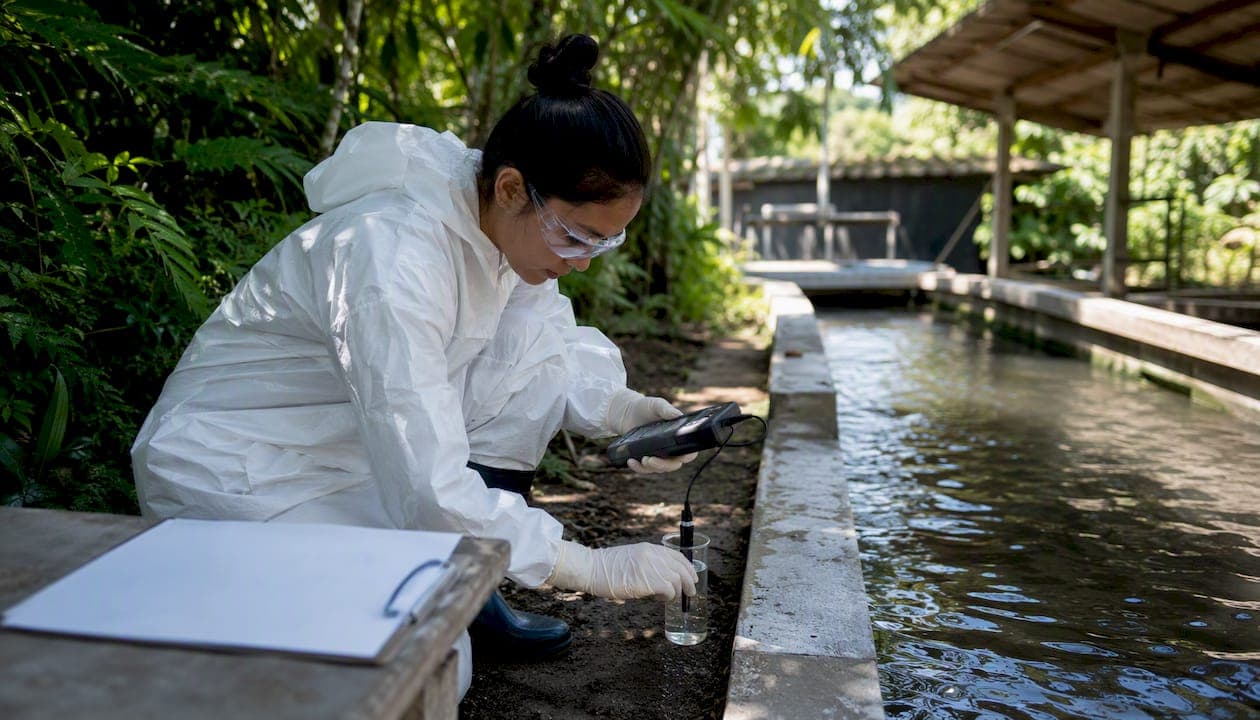
Green aquaculture certification, more precisely called sustainable aquaculture certification, is a voluntary, third-party assurance process where an independent body verifies that a farm or supply chain meets defined environmental, animal welfare, and social standards. The FAO Guidelines for Sustainable Aquaculture (GSA) establish the normative foundation most credible schemes build on, while programs like the Aquaculture Stewardship Council (ASC) and GLOBALG.A.P. IFA aquaculture translate those principles into auditable farm-level requirements.
- What it shows: A certified operation has been independently verified against published standards covering feed sourcing, disease management, antibiotic use, water quality, and labor practices, per IFAS FA233.
- Two assessment types: Certification combines a conformity assessment (on-farm practices) and a chain-of-custody assessment (product traceability from farm to sale), as defined by GLOBALG.A.P.—
- Why organizations pursue it: Market access, retail procurement requirements, and product differentiation drive most U.S. producers to certify, not regulatory mandates.
Table of Contents
- What do certification standards actually assess?
- Which certification programs matter for U.S. producers and buyers?
- What can certification deliver, and where does it fall short?
- How can a U.S. producer pursue green aquaculture certification?
- How should buyers verify certified seafood supply?
- Key Takeaways
- Why certification is more useful than most producers realize
- Demeterbioscience's sustainable live-feed offering
- Useful sources and further reading
What do certification standards actually assess?
Three core criteria groups define what auditors examine: environmental integrity, animal health and welfare, and social responsibility. Each maps to concrete, measurable indicators rather than vague commitments.
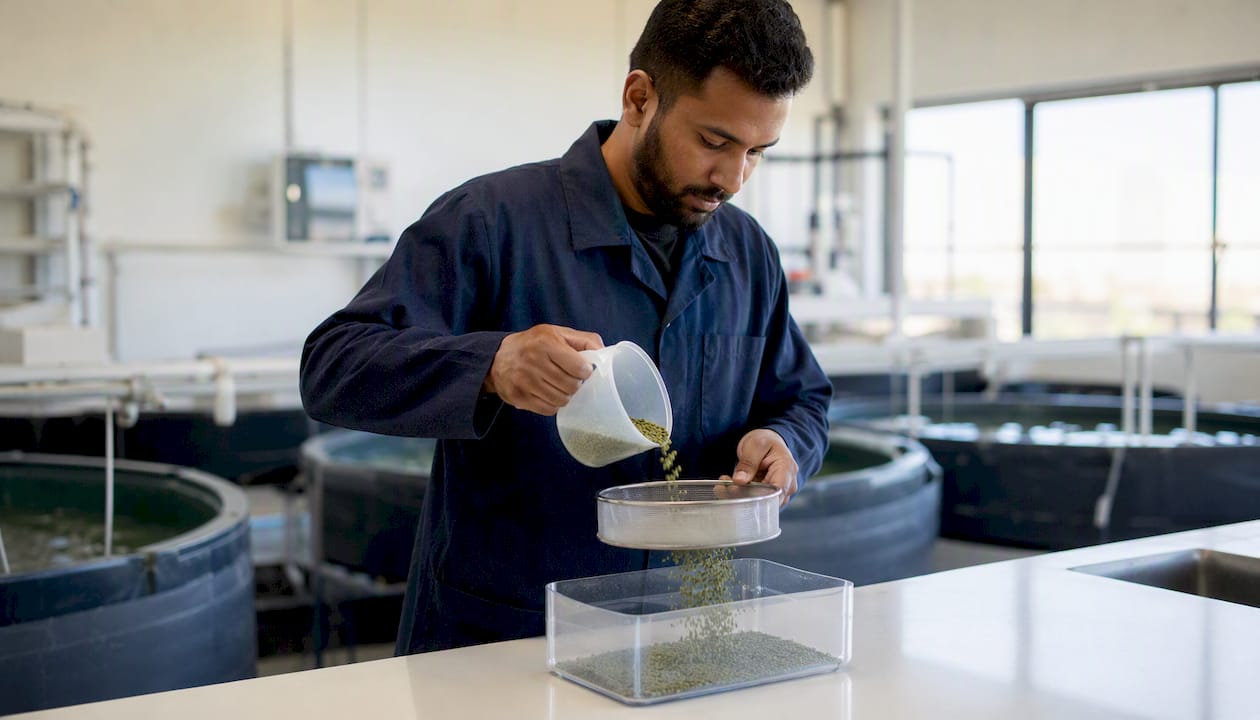
Environmental integrity covers feed sourcing (ingredient traceability, fishmeal reduction targets), effluent control, habitat protection, and greenhouse gas management. Animal health and welfare addresses antibiotic limits, disease prevention protocols, stocking density, and handling practices. Social responsibility requires fair wages, safe working conditions, and non-discrimination policies, as the ASC sustainability label framework makes explicit.
Chain of custody sits alongside these farm-level criteria. It tracks the certified product from the point of harvest through processing, distribution, and retail, so a buyer purchasing "ASC-certified salmon" can confirm the fish actually came from a verified farm. Without chain-of-custody verification, a label is just a claim.
| Criteria Group | Sample Indicators | Why Auditors Focus Here |
|---|---|---|
| Environmental integrity | Feed ingredient sourcing, effluent discharge limits, escape prevention | Reduces ecosystem impact and resource depletion |
| Animal health & welfare | Antibiotic use records, stocking density logs, mortality tracking | Limits disease risk and improves product quality |
| Social responsibility | Labor contracts, wage records, safety training logs | Protects workers and meets institutional procurement rules |
For a deeper look at how environmentally responsible feed sourcing fits into these criteria, the connection between feed inputs and certification compliance is direct.
Which certification programs matter for U.S. producers and buyers?
Three programs dominate U.S. procurement conversations, with FAO guidance providing the normative backdrop all of them reference.
Aquaculture Stewardship Council (ASC)
ASC publishes species-specific farm standards covering environmental and social criteria, requires traceability, and mandates management of escapes, disease, and feed sourcing. Its assurance framework uses accredited CABs and a surveillance cycle described above. Major U.S. retailers and food-service buyers list ASC as a preferred or required certification for farmed seafood.
Best Aquaculture Practices (BAP) / Global Aquaculture Alliance
BAP covers the full supply chain: feed mills, hatcheries, farms, and processing plants. A four-star BAP rating signals that all four facility types in a product's supply chain are certified. This multi-site scope makes BAP particularly relevant for integrated U.S. operations or processors sourcing from multiple farms.
GLOBALG.A.P. IFA Aquaculture
GLOBALG.A.P. operates at farm level and issues a unique GlobalG.A.P. Number (GGN) that buyers and consumers can use to look up producer information directly. Its programs represent producers covering over 2.8 million metric tons of farmed seafood, making it one of the broadest farm-level schemes globally. The GGN traceability database is a practical tool for procurement teams that need supplier verification at scale.
FAO Guidelines for Sustainable Aquaculture (GSA)
The FAO GSA are not a certification scheme themselves. They define what a credible scheme should look like: transparent standards, independent accreditation, third-party certification, and accountability mechanisms. When evaluating any program, the GSA checklist is the most authoritative reference available.
Statistic: GLOBALG.A.P. programs represent producers covering a very large volume of farmed seafood, illustrating the commercial scale that certification now reaches.
What can certification deliver, and where does it fall short?
The benefits are real, but so are the limits. Treating a label as a guarantee rather than a verified baseline is where buyers and producers most often go wrong.
What certification delivers:
- Market access to retailers and institutions that require verified sustainability credentials
- Procurement compliance for buyers operating under responsible sourcing policies
- Improved on-farm management through systematic documentation and corrective-action cycles
- Traceability for buyers, reducing supply chain opacity
- A recognized signal for sustainable aquaculture practices that consumers increasingly expect
What it does not guarantee:
- Schemes vary significantly in scope, rigor, and the species or systems they cover; a Nature Communications analysis confirms that aquaculture sustainability is heterogeneous across production methods
- Certification does not eliminate all environmental or social risk, only verifies that defined thresholds are met at the time of audit
- Cost and complexity create real barriers for small producers; auditor fees, corrective actions, lab testing, and staff time add up
- Voluntary status means uncertified operations can still market products using sustainability language without independent verification
The OECD frames certification as a green growth tool that helps producers expand responsibly within environmental limits, not as a silver bullet. Research on restorative aquaculture also shows that certification and market incentives can encourage practices that go beyond harm reduction toward net positive ecosystem outcomes.
One distinction worth making: green aquaculture certification differs from organic certification. Organic claims in aquaculture are governed by separate USDA National Organic Program rules, with different feed and input requirements. A certified-organic product is not automatically ASC or BAP certified, and vice versa. For more on that distinction, the organic aquatic food production guide covers the key differences.
How can a U.S. producer pursue green aquaculture certification?
The path from current practices to certified status typically runs 12–24 months for a first-time applicant, depending on the scheme and the operation's starting point.
Phase 1: Pre-assessment and gap analysis (1–3 months)
Download the target scheme's standards and self-assess against each criterion. Most programs publish free assessment checklists. Identify which criteria your operation already meets and which require process changes, new documentation, or capital investment. Engaging a consultant familiar with the scheme at this stage saves time later.
Phase 2: Documentation and process changes (3–6 months)
Build or update your record-keeping systems: feed sourcing logs, water quality monitoring records, antibiotic use registers, and labor documentation. Process changes, such as installing effluent treatment or switching feed suppliers, take the most time and money here. Typical cost drivers include auditor fees (which vary by CAB and operation size), lab testing for water and feed samples, corrective action investments, and staff training hours.
Phase 3: Pilot monitoring and record-keeping (2–4 months)
Run your new systems for at least one full production cycle before the formal audit. Auditors want to see a track record, not just a policy document. This phase also lets you catch gaps before a CAB does.
Phase 4: Formal audit and certification (1–2 months)
Contact an accredited CAB approved by your target scheme. Schedule the conformity audit and, if required, the chain-of-custody audit. Address any minor non-conformances within the CAB's specified timeframe. Certificate issuance follows once all corrective actions are closed.
Phase 5: Post-certification surveillance
Budget for annual surveillance audits and the three-year re-certification cycle. Unannounced audits, used by programs like ASC, mean your records must be current at all times, not just before a scheduled visit.
How should buyers verify certified seafood supply?
A label alone is not verification. Buyers, procurement officers, and institutions should confirm both the certificate and the chain-of-custody trail before relying on a certification claim in purchasing decisions.
What to request from suppliers
Ask for a copy of the current certificate (not expired), the name and accreditation status of the CAB that issued it, and the specific scheme and standard version the certificate covers. GLOBALG.A.P. certificates include a GGN that you can verify directly in the GLOBALG.A.P. database. ASC certificates are searchable through the ASC's public certificate database.
How to verify chain-of-custody
Request the supplier's chain-of-custody certificate separately from the farm certificate. These are distinct documents. A processor or distributor handling certified product must hold their own chain-of-custody certification, or the certified status of the raw material does not carry through to the final product you receive.
When to require third-party evidence or site visits
For high-volume or high-risk supply relationships, periodic supplier site visits or third-party social audits add a layer of assurance that certificate review alone cannot provide. Certification verifies a snapshot; ongoing supplier engagement tracks whether practices hold between audit cycles. For practical sourcing guidance, the sustainable aquatic feed sourcing guide covers the questions buyers should ask at each stage of supplier qualification.
Key Takeaways
Green aquaculture certification is a voluntary, third-party process covering environmental, animal welfare, and social criteria, and it functions as a practical management and market-access tool, not a marketing label.
| Point | Details |
|---|---|
| Core definition | Voluntary third-party verification of environmental, welfare, and social standards by an accredited CAB. |
| Two assessment types | Conformity assessment (on-farm practices) and chain-of-custody assessment (product traceability) are both required. |
| U.S. market relevance | Certification drives retail access and institutional procurement compliance; it is not a regulatory requirement in most U.S. contexts. |
| Realistic limits | Schemes vary in rigor; certification verifies a threshold at audit time, not a guarantee of zero risk or uniform sustainability. |
| Demeterbioscience | Demeterbioscience's land-based, microalgae-fed brine shrimp production reflects the documented, traceable inputs that certification frameworks assess. |
Why certification is more useful than most producers realize
The conventional view treats green aquaculture certification as a retail checkbox, something you pursue when a buyer demands it. That framing undersells what the process actually does for an operation.
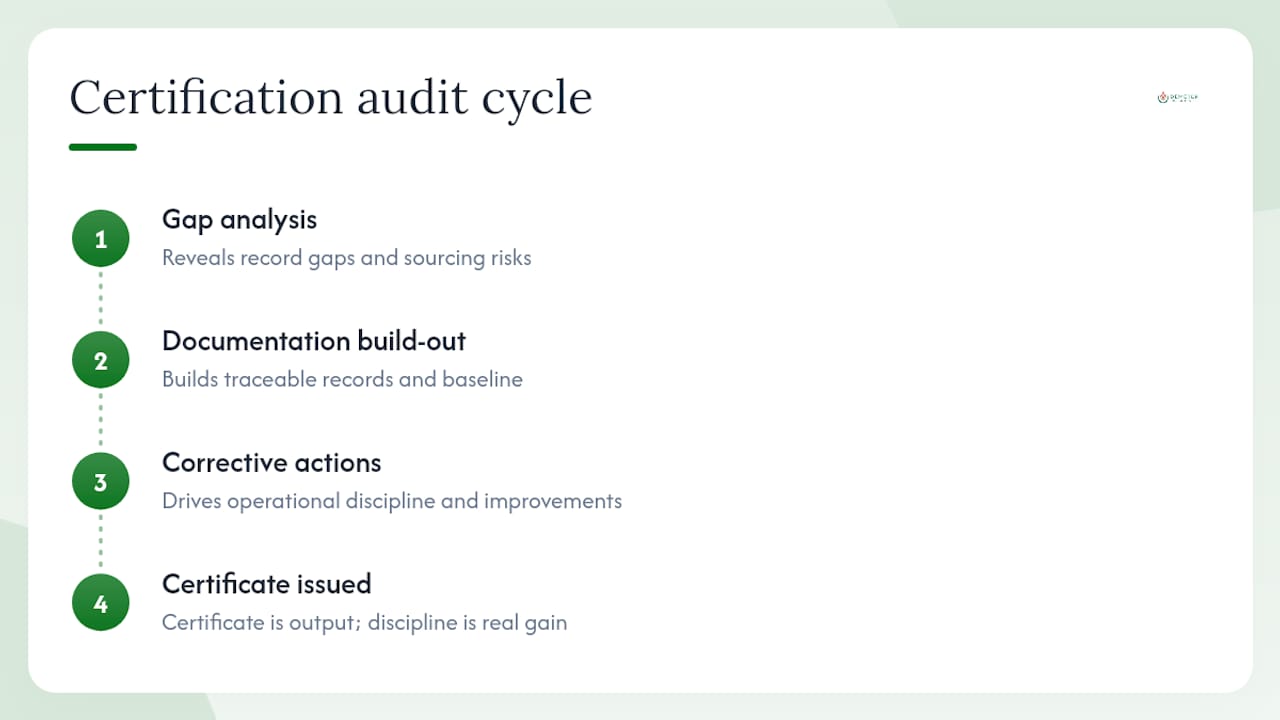
The audit preparation cycle, specifically the gap analysis, documentation build-out, and corrective action work, forces systematic management improvements that most farms would not otherwise prioritize. Producers who have been through a first certification cycle consistently report that the process exposed record-keeping gaps and input sourcing risks they had not previously quantified. The certificate is the output; the operational discipline is the real gain.
The limits are also more specific than critics suggest. Certification does not homogenize all farms into a single sustainability standard, because no single standard fits every species, system, or geography. What it does is create a common language for comparing operations and a documented baseline that buyers, regulators, and researchers can reference. For a sector as diverse as aquaculture, that common language has genuine value.
For Demeterbioscience, the relevance is direct. Land-based, microalgae-fed brine shrimp production already operates with the kind of input control and traceability that certification frameworks reward. Producers and buyers looking to align their supply chains with recognized sustainability criteria can reach out to Demeterbioscience to discuss how traceable live-feed sourcing fits into their certification strategy.
Demeterbioscience's sustainable live-feed offering
Buyers and producers pursuing certified or traceable aquaculture supply chains need feed inputs that meet the same documentation standards they apply to their own operations. Demeterbioscience produces farmed live brine shrimp fed exclusively on Dunaliella microalgae in a controlled, land-based system, delivering at least 40% protein content with consistent, traceable inputs. Every production batch comes from a documented cultivation environment, with no wild-harvest variability and no seasonal gaps in nutritional quality.
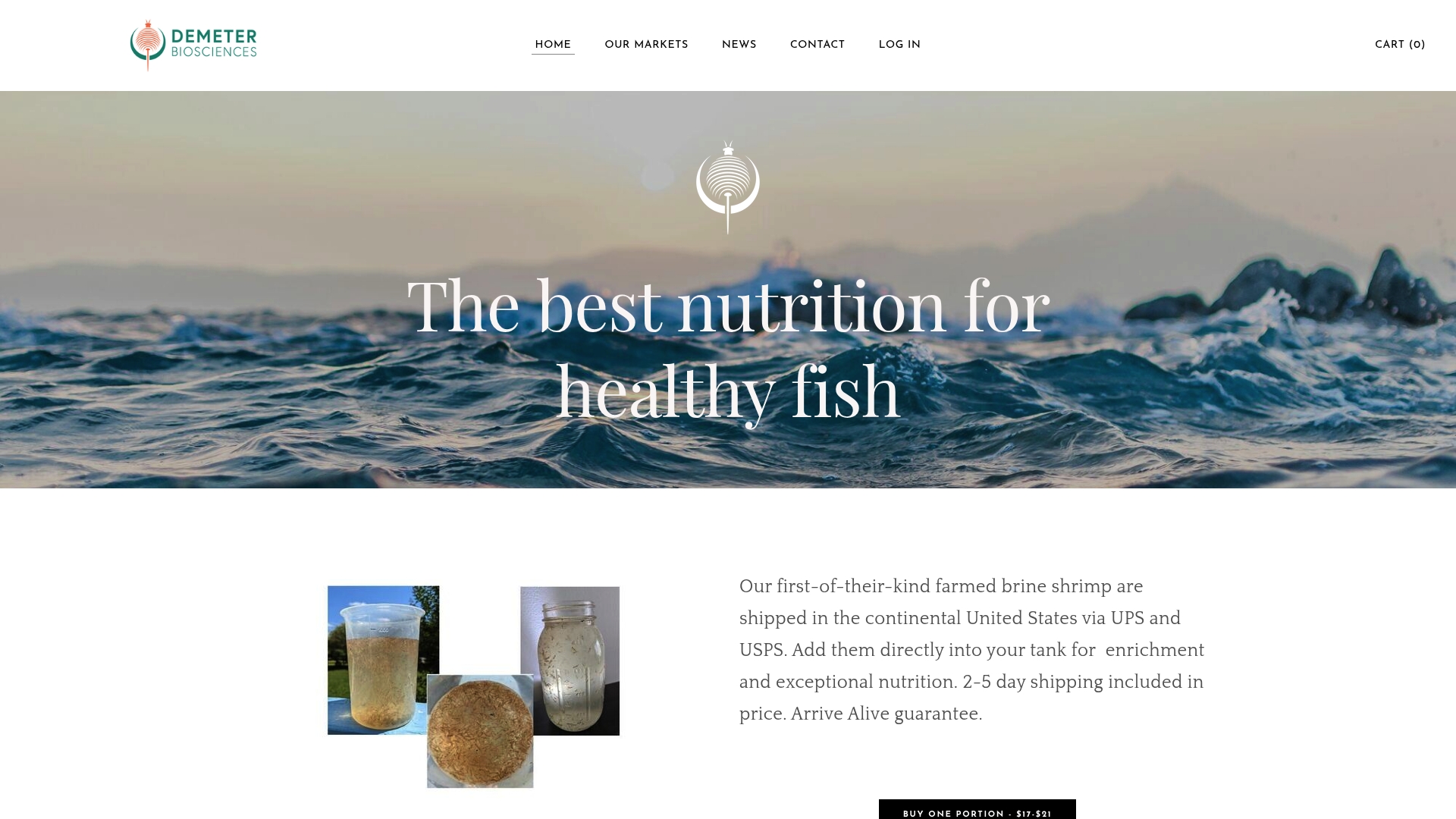
For institutions, retailers, and aquaculture producers who need reliable, sustainably produced live feed, Demeterbioscience offers live brine shrimp direct shipments and bulk orders for stores and research facilities. Demeterbioscience represents Demeter Biosciences, and this article is published by that company. To discuss supply needs or certification-aligned sourcing, contact the team directly.
Useful sources and further reading
- FA233: Third Party Certifications in Aquaculture
- GLOBALG.A.P. - IFA aquaculture
- ASC - About the ASC sustainability label
- FAO - Guidelines for Sustainable Aquaculture (GSA)
- Nature Communications - Environmental, economic, and social sustainability in aquaculture
- OECD - Green growth in fisheries and aquaculture
- Conservation Science and Practice - Restorative aquaculture