
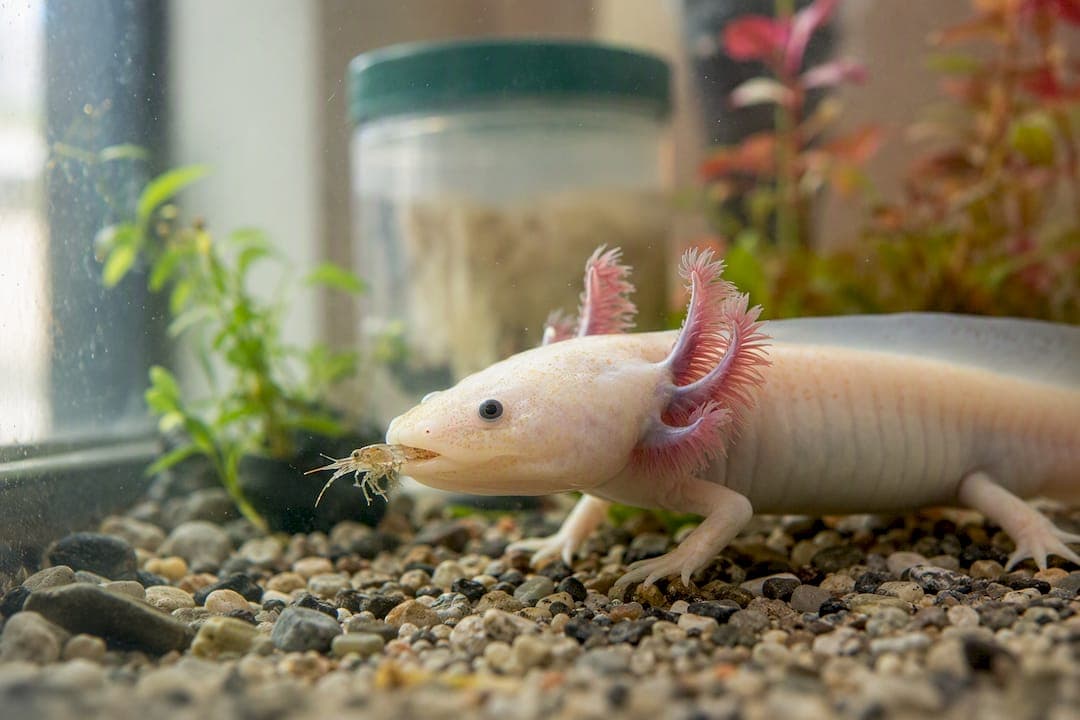
Baby brine shrimp are essential for axolotl hatchlings and largely optional for everyone else. Newly hatched larvae strike almost exclusively at movement, and live baby brine shrimp (BBS) supply that trigger better than anything else you can put in a rearing container. Feed live BBS several times a day until your larvae grow past a small size.
Once axolotls reach a certain growth stage, frozen brine shrimp can be introduced if properly thawed and motion simulated. Younger larvae need live BBS exclusively, juveniles can begin to take thawed frozen shrimp alongside live prey, and adults should have brine shrimp only as an occasional treat rather than a staple.
TL;DR:
- Baby brine shrimp are indispensable for axolotl hatchlings under 20 mm, as live BBS reliably trigger their feeding response due to poor eyesight.
- After reaching 20 to 25 mm, axolotls can gradually begin accepting thawed frozen shrimp alongside live prey, with adults primarily receiving it as an occasional treat.
- Proper preparation involves rinsing live shrimp to remove salt and thawing frozen shrimp gently in tank water, avoiding refreezing leftovers to prevent bacterial growth.
- Maintaining excellent water quality requires siphoning out uneaten shrimp daily and changing water frequently to prevent ammonia spikes, especially in small larval containers.
- Sourcing farmed, microalgae-fed brine shrimp ensures consistent nutrient density, providing better growth support than variable wild-harvested options.
Table of Contents
- Which Life Stages Actually Need Live Brine Shrimp for Axolotls?
- Can Adult Axolotls Eat Brine Shrimp, or Is It Just a Treat?
- How Do You Prepare Live and Frozen Brine Shrimp Correctly?
- How Do You Hatch Baby Brine Shrimp at Home?
- How Often Should You Feed Brine Shrimp, and What About Water Quality?
- How Should You Store and Source Brine Shrimp?
- How Farmed, Microalgae-Fed Brine Shrimp Change the Nutrition Picture
- Can Brine Shrimp Make Axolotls Sick?
- Key Takeaways
- Sources
Which Life Stages Actually Need Live Brine Shrimp for Axolotls?
Age and size, not calendar days, determine what an axolotl will eat. Hatchlings under about 20 mm have poor eyesight and depend on detecting motion, so live baby brine shrimp, daphnia, or microworms are the only foods that reliably get eaten. Anything static gets ignored, and a larva that goes a day or two without a strike can start losing condition fast.
The transition happens in stages:
- Under 20 mm — Live BBS is close to non-negotiable. Frozen and prepared foods sit on the substrate untouched.
- 20 to 25 mm — Front legs start developing, coordination improves, and thawed frozen shrimp can be introduced alongside live prey as a bridge food.
- 40 to 50 mm — Juveniles start taking chopped nightcrawlers, blackworms, and sinking pellets. Brine shrimp should already be sliding into a supporting role rather than the main course.
Feeding brine shrimp as the sole diet past this window creates real gaps. Brine shrimp alone don't carry the nutrient density an axolotl needs as it grows, and prolonged BBS-only feeding is a documented reason for slowed growth and undersized juveniles that never quite catch up to their tank mates.
Can Adult Axolotls Eat Brine Shrimp, or Is It Just a Treat?
Adults can eat brine shrimp without issue, but it should never carry the weight of their diet. According to guidance from Enviroliteracy, adult axolotls need more nutrient-dense foods like earthworms or fortified pellets to meet their complete nutritional needs, and brine shrimp simply doesn't have the caloric density to do that job alone.
Think of it the way you'd think about giving a dog table scraps. Nobody's raising a healthy adult dog on scraps, but a little variety now and then does no harm and can even help with enrichment or picky eaters. Brine shrimp works the same way for adult axolotls: useful as an occasional supplement, a way to stimulate appetite in a reluctant eater, or a treat during handling and health checks, but not the backbone of an adult feeding plan.
How Do You Prepare Live and Frozen Brine Shrimp Correctly?
Movement is the whole game. Axolotls, especially larvae, hunt by detecting motion in the water column, which is exactly why frozen shrimp often gets ignored by anything under 20 mm and why presentation technique matters more with frozen product than with live.
For live brine shrimp:
- Rinse them in fresh dechlorinated water before feeding to remove residual salt and hatch debris, helping protect axolotl health.
- Use a pipette or turkey baster to target-feed larvae directly, which also cuts down on shrimp that scatter uneaten into corners of the tank.
For frozen brine shrimp:
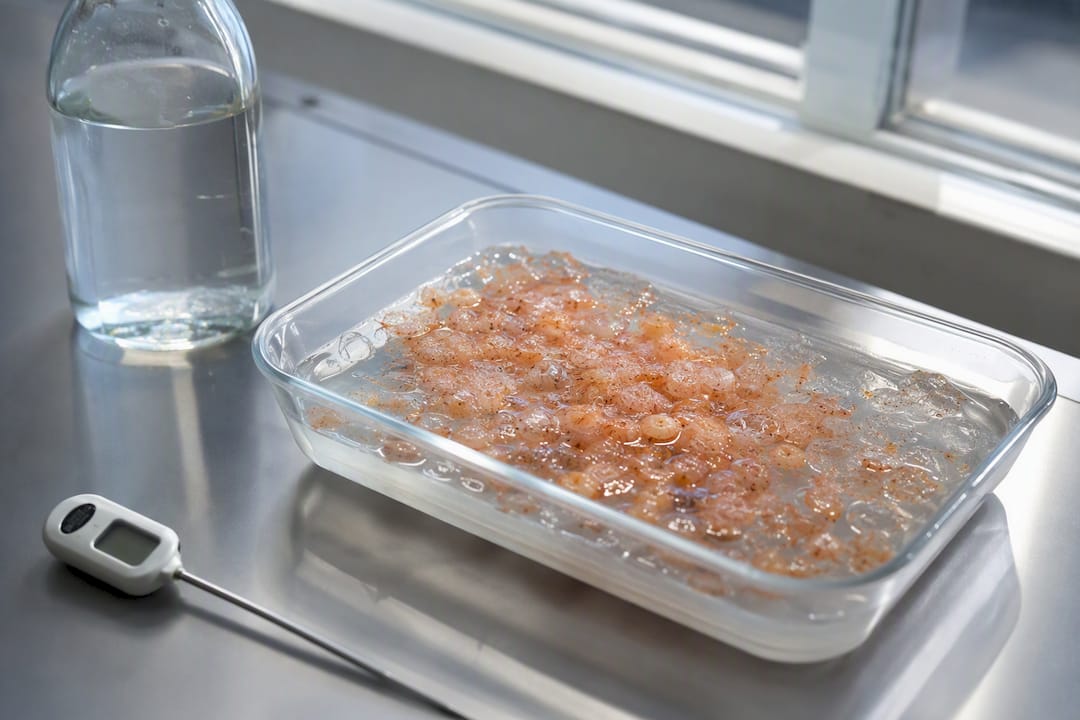
- Thaw the portion in a small cup of tank water rather than under hot tap water, which shocks the shrimp's texture and can shock your axolotl's system too.
- Never refreeze a thawed portion. Bacteria multiply fast once shrimp thaw, and refreezing does nothing to reverse that.
- Squirt the thawed shrimp near your axolotl using a baster to create artificial current and mimic the wriggling motion that triggers a strike.
Pro Tip: Keep a dedicated pipette just for feeding frozen shrimp to older axolotls. The gentle squirt-and-pause motion trains even stubborn juveniles to associate the tool with food, which makes target-feeding far faster within a week or two.
How Do You Hatch Baby Brine Shrimp at Home?
Running your own hatchery removes the single biggest risk in larval rearing: running out of live food on a Tuesday night with no store open. The setup is genuinely simple. You need a hatching container (a repurposed soda bottle or a dedicated hatching cone works fine), airline tubing connected to an air pump, non-iodized salt, and either a warm room or a small heat lamp.
- Dissolve non-iodized salt into dechlorinated water at a concentration close to seawater salinity.
- Add brine shrimp cysts, then run continuous gentle aeration to keep the cysts suspended and oxygenated.
- Maintain water temperature in the mid to high twenties Celsius for most cysts to hatch within about a day, according to husbandry guidance from ExoPetGuides.
- Turn off the aeration and let it sit for 10 to 15 minutes. Shells float, nauplii sink and cluster near the bottom in an orange layer.
- Siphon that orange layer into a fine mesh net or brine shrimp sieve, then rinse thoroughly in fresh dechlorinated water before feeding.
| Parameter | Standard Range |
|---|---|
| Salt concentration | ~25 g per liter |
| Water temperature | mid to high twenties Celsius |
| Hatch time | about a day |
| Aeration | Continuous, gentle |
| Feed within | 24 hours of harvest |
Stagger two or three small hatch jars a day or two apart so you're never caught without a batch, and always feed within 24 hours of harvest since freshly hatched nauplii still carry their yolk sac and lose nutritional value the older they get, a point backed by hobbyist experience shared on the Caudata Forum. You can dig deeper into the biology behind this in our Artemia nauplii hatching guide.
How Often Should You Feed Brine Shrimp, and What About Water Quality?
Feeding frequency scales down as axolotls age. Larvae need live BBS two to three times daily, juveniles do fine on one to two feedings, and adults only need brine shrimp occasionally, if at all. Watch for an orange-tinted belly on larvae after feeding. That's visible proof they've eaten enough, and it's a far better gauge than the clock.
The harder discipline is water management, not feeding. According to the Ambystoma Genetic Stock Center's husbandry guide, uneaten brine shrimp die within hours in freshwater, and lab protocols recommend changing water within 24 hours whenever a meaningful number of shrimp remain uneaten. Dead shrimp decompose fast and spike ammonia in small rearing containers, which is exactly the environment most home larval setups use.
- Siphon out uneaten shrimp the same day you feed, not the next morning.
- Change water daily or every other day in dedicated larval rearing containers.
- Test ammonia and nitrite regularly rather than waiting for visible signs of stress.
- Feed slightly less than you think is needed. It's easier to add more shrimp than to fix an ammonia spike in a two-gallon container.
The math is unforgiving in small volumes: a handful of uneaten shrimp in a full-sized tank barely registers, but the same amount in a shallow rearing tub can crash water quality within a day.
How Should You Store and Source Brine Shrimp?
Frozen brine shrimp should stay solidly frozen until use. Thaw only what you'll feed in that session, and never refreeze leftovers once they've thawed, since bacterial growth accelerates the moment ice crystals melt.
Live brine shrimp are more time-sensitive. Transit conditions matter enormously, keep them aerated and cool, and plan to use them within 24 hours of arrival for the best nutritional value and survival rate.
When evaluating a supplier, check for:
- A clear harvest or hatch date, not a vague "packed on" stamp
- Whether the shrimp were wild-harvested or farmed under controlled conditions
- Claims around gut-loading or algae feeding, which affect nutritional density
- Packaging that shows evidence of temperature control during transit
Red flags include long transit windows with no insulation or cold pack, no harvest date listed anywhere, and inconsistent hatch rates from batch to batch, all signs of an operation that treats brine shrimp as a commodity rather than a nutrition product. For more on comparing live food options generally, see this rundown of live fish food types.
How Farmed, Microalgae-Fed Brine Shrimp Change the Nutrition Picture
Wild-harvested brine shrimp go through boom-and-bust cycles tied to salt lake conditions, which means their nutritional content swings with the season and sometimes with actual starvation in the source population. Demeterbioscience raises brine shrimp on land in controlled systems, feeding them exclusively on Dunaliella microalgae to hit a consistent 40% or higher protein content.
That consistency matters most exactly when it counts: during the first weeks of larval rearing, when nutrient density directly affects growth rate. Demeterbioscience offers three practical paths depending on your setup:
- Single shipments for hobbyists managing a small home hatch
- Subscription plans for breeders who need dependable recurring supply
- Bulk packages for stores, museums, and research institutions
Can Brine Shrimp Make Axolotls Sick?
Brine shrimp themselves are generally safe, but sloppy handling around them creates real risk. The most common issue isn't the shrimp, it's what happens after axolotls don't finish eating them. Decomposing shrimp drive up ammonia fast in small containers, and ammonia exposure in larvae shows up as lethargy, curled gills, or refusal to feed, symptoms owners often mistake for illness when the real problem is water chemistry.
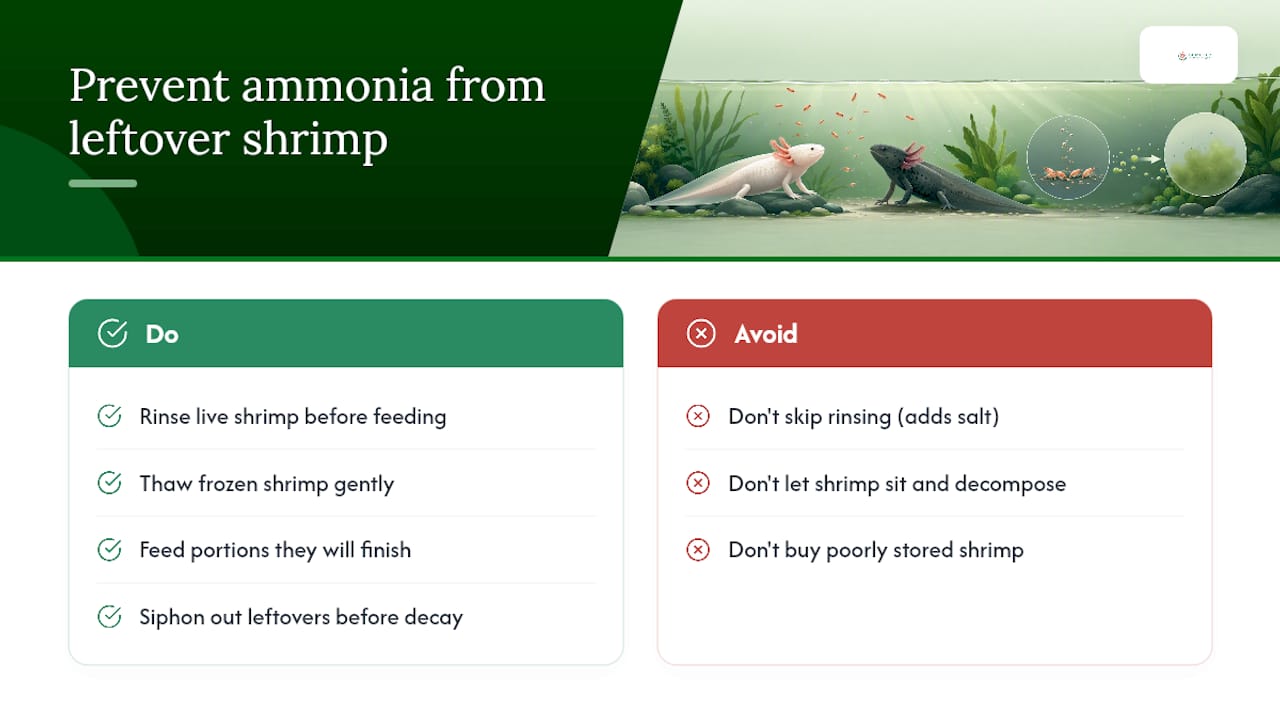
Salt residue is a second concern. Live brine shrimp come from saltwater cultures, and skipping the rinse step introduces salt into a freshwater system. Axolotls have permeable skin adapted to freshwater, and repeated salt exposure can irritate their slime coat and gills over time. Rinsing every batch in dechlorinated water before feeding eliminates this almost entirely.
There's also a contamination angle with low-quality or improperly stored live shrimp. Cultures that sit too long, get handled with dirty equipment, or arrive after a poorly controlled transit can carry bacterial loads that stress a young axolotl's immune system. Buying from a supplier with clear harvest dating and documented culture conditions, and using shrimp promptly rather than letting them sit, cuts this risk substantially.
The mitigation checklist is short: rinse live shrimp, thaw frozen shrimp gently, feed portions your axolotl will actually finish, and siphon out anything left over before it starts to break down.
Practical priorities and mistakes to avoid
Get your live-food rotation running before eggs even hatch. Scrambling to set up a hatchery after larvae emerge is how starvation gaps happen. Water quality beats feeding volume every time, pull leftovers fast rather than overfeeding to be safe. And treat brine shrimp as short-term fuel for growth stages, not a long-term nutrition plan once your axolotl reaches adulthood.
— Demeter
How to Order Live Brine Shrimp From Demeterbioscience
If you're setting up your first home hatch, a single live brine shrimp shipment gets you started without committing to anything ongoing. Breeders running larvae through regular clutches tend to do better on a recurring plan, since timing shipments to your hatch cycle keeps live shrimp on hand exactly when hungry larvae need them, without the scramble of a last-minute order. Stores, museums, and institutions feeding multiple tanks should look at bulk ordering, which is built around volume and consistency rather than one-off convenience.
Whichever option fits your situation, the practical move is to schedule delivery a few days ahead of your expected hatch date rather than after eggs have already dropped. If you're not sure which plan matches your setup, breeder-scale versus institutional-scale needs look very different, reach out to the team before you order and they'll help you land on the right cadence.
Key Takeaways
Live baby brine shrimp are essential for axolotl larvae under 20 mm, while frozen brine shrimp and treat-level feeding suit older juveniles and adults.
| Point | Details |
|---|---|
| Life stage determines the food | Larvae under 20 mm need live BBS; adults treat brine shrimp as an occasional supplement, not a staple. |
| Hatch on a schedule | Use ~25 g salt per liter and mid to high twenties Celsius water to hatch nauplii in about a day, then feed within a day. |
| Water quality comes first | Siphon uneaten shrimp same day and change larval rearing water often to avoid ammonia spikes. |
| Rinse and thaw correctly | Rinse live shrimp to remove salt; thaw frozen shrimp in tank water and never refreeze leftovers. |
| Consistency matters in sourcing | Demeterbioscience's microalgae-fed, farmed brine shrimp offer stable protein content compared to wild-harvested variability. |
Sources
- Guide to axolotl husbandry - Ambystoma Genetic Stock Center
- Can axolotls eat baby brine shrimp? - Enviroliteracy
- Axolotl larvae care guide - ExoPetGuides