
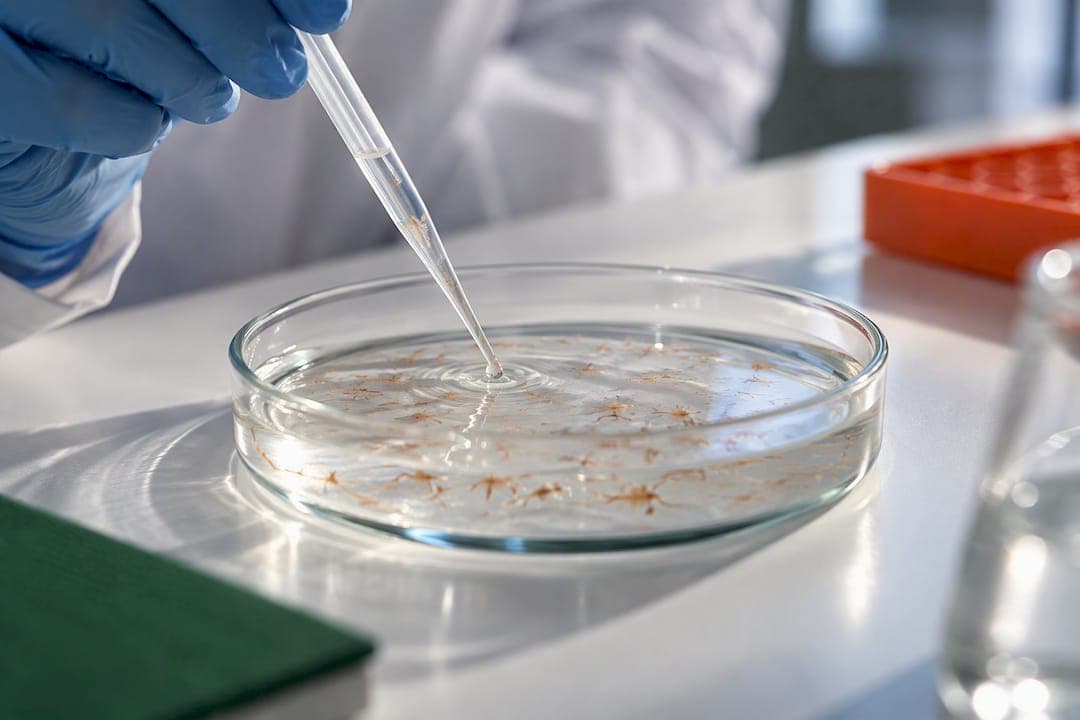
Leucine, arginine, taurine, alanine, and glycine typically dominate the amino acid profile of Artemia, with crude protein ranging roughly between 37% and 71% of dry weight (https://www.intechopen.com/chapters/44382) and digestibility usually above 90%. This profile is not fixed. Life stage, diet, and salinity shift the numbers enough that a batch of instar-I nauplii and a tank of ongrown adults can feed very different nutritional stories to the same fish. If you're formulating a larval diet or interpreting a lab report, the stage and enrichment history matter as much as the species name on the label.
TL;DR:
- The amino acid profile of Artemia varies significantly based on life stage, diet, and salinity, affecting its nutritional value for fish feed.
- Nauplii provide smaller particles with lower essential amino acids, while ongrown Artemia offer higher amino acid density, especially beneficial when particle size is not a constraint.
- Free amino acids in Artemia hemolymph respond rapidly to salinity and feeding changes, making sampling timing critical for accurate interpretation.
- Analytical differences and methodological quirks can cause discrepancies in amino acid data, so it is essential to verify sampling and testing methods before comparison.
- Controlled Artemia from suppliers like Demeterbioscience, fed exclusively on Dunaliella, offer more consistent amino acid and protein profiles than wild-harvested populations.
Table of Contents
- Amino Acids in Brine Shrimp: The Numbers Researchers Actually Cite
- How Amino Acid Levels Shift From Cyst to Adult
- Free Amino Acids in Hemolymph and What Salinity Does to Them
- Reading an Amino Acid Table: Methods, Units, and Common Traps
- Turning Amino Acid Data Into Feeding Decisions
- Enrichment Protocols: Reshaping Amino Acid and Fatty Acid Profiles on Purpose
- Why Demeterbioscience's Dunaliella-Fed Artemia Offer More Predictable Amino Acid Profiles
- Choosing the Right Artemia Prep: A Decision Framework
- Order Amino Acid Consistent, Dunaliella-Fed Brine Shrimp From Demeterbioscience
- Primary Sources Behind This Article's Amino Acid Data
- Sources
- FAQ
Amino Acids in Brine Shrimp: The Numbers Researchers Actually Cite
Most published amino acid tables for Artemia report values one of two ways: as a percentage of total amino acids (% TAA) or as milligrams per 100 grams of dry weight (mg/100g DW). Both conventions show up across the literature, and mixing them up is the single most common error when comparing studies.
Across the studies that have profiled whole-body Artemia, five amino acids consistently rank at or near the top of the list: leucine, arginine, taurine, alanine, and glycine. Leucine and arginine tend to lead among the essential amino acids, which matters because both are limiting factors in many formulated fish feeds. Taurine, alanine, and glycine dominate the nonessential fraction and double as key osmolytes, a role that becomes important later when salinity enters the picture.
Here is a representative snapshot of how the major amino acids typically distribute in whole-body Artemia, expressed as a percentage of total amino acids. Exact figures shift with population, diet, and analytical method, so treat these as a working range rather than a fixed constant.
| Amino acid | Typical role | Relative abundance in whole-body Artemia |
|---|---|---|
| Leucine | Essential | High, often among the top three essential AAs |
| Arginine | Essential | High, frequently the leading essential AA |
| Taurine | Nonessential / osmolyte | High, especially prominent in hemolymph |
| Alanine | Nonessential / osmolyte | High |
| Glycine | Nonessential / osmolyte | Moderate to high |
| Lysine | Essential | Moderate |
| Threonine | Essential | Moderate |
| Tryptophan | Essential | Often underreported or omitted |
A few reporting quirks explain some of the confusion researchers run into when comparing older and newer papers:
- Asparagine and glutamine are frequently hydrolyzed during acid digestion before analysis, so labs report them combined with aspartate and glutamate as "Asx" and "Glx" rather than as separate values.
- Tryptophan is destroyed by standard acid hydrolysis and requires a separate alkaline hydrolysis step, which many older studies skipped entirely, leaving tryptophan absent from otherwise complete tables.
- Crude protein figures calculated from total nitrogen (using the standard 6.25 conversion factor) can overstate true protein content, because Artemia carries non-protein nitrogen in its chitin and other structural components.
That protein range, 37% to 71% of dry weight with digestibility exceeding 90% in poultry and fish trials, sits at the high end of what most animal protein ingredients offer. The width of that range is the real story: it tells you diet and life stage swing crude protein by nearly double, which is exactly why a single "brine shrimp nutrition" number from a hobbyist forum is close to meaningless without knowing what fed the shrimp and when it was harvested.
How Amino Acid Levels Shift From Cyst to Adult
The stage you feed changes what you are actually delivering, and the difference is not subtle. Instar-I nauplii, the newly hatched larvae most hobbyists feed straight out of a hatching cone, run lower in several essential amino acids than ongrown juveniles and adults. FAO's technical guidance on tank-produced ongrown Artemia lays out stage-wise amino acid and fatty acid tables showing that the biomass gained during ongrown culture comes with a meaningfully richer essential amino acid profile, not just more mass.
The biological reason is straightforward. Nauplii hatch carrying whatever nutritional reserves the cyst packed into the embryo, plus a first-instar gut that has not yet processed an external diet. Ongrown Artemia, by contrast, have had days of active feeding and tissue synthesis to build out muscle and other protein-rich structures, which is where the essential amino acids concentrate.
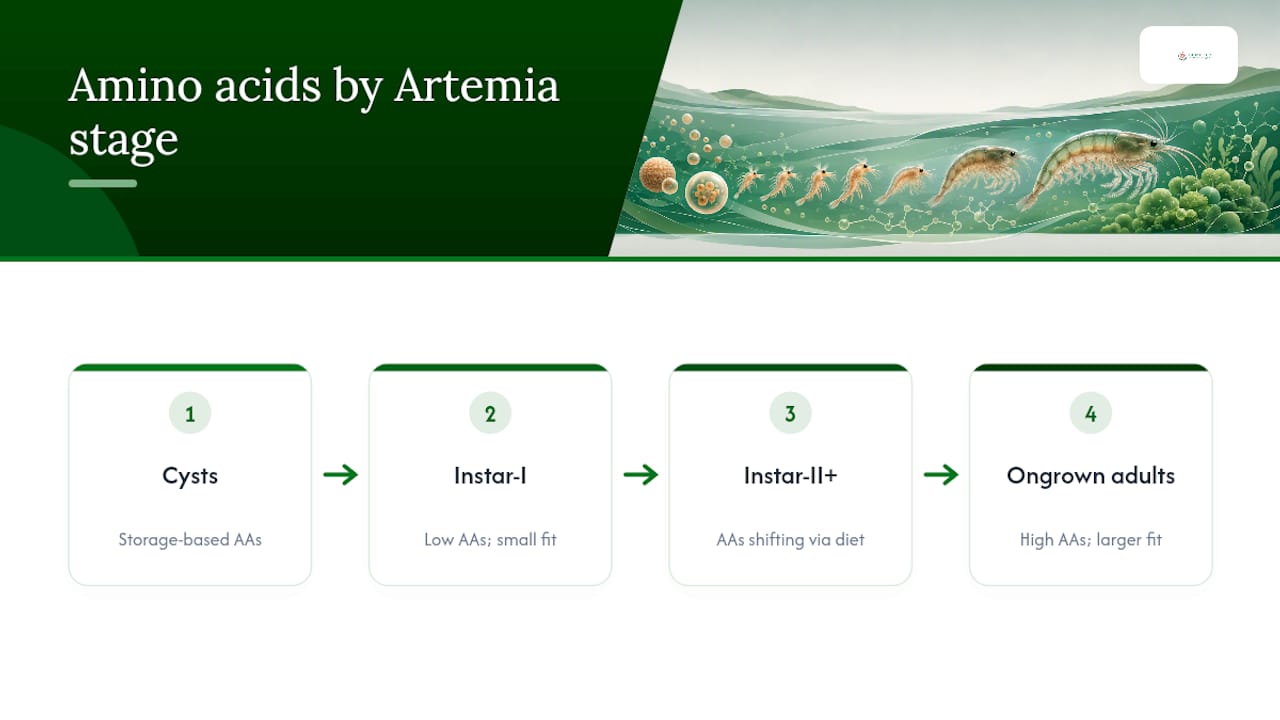
Cysts and dry storage. Amino acid content in dormant cysts reflects maternal investment and storage conditions rather than active feeding, and values here are the least representative of what a live diet will deliver.
Instar-I nauplii (0–24 hours post-hatch). Lipid-rich and convenient for first-feeding larvae with small mouths, but lower in several essential amino acids than later stages; this is the stage most commonly enriched for a short window before feeding.
Instar-II and later nauplii. Beginning to feed externally, amino acid composition starts shifting toward whatever algae or enrichment diet is offered.
Ongrown juveniles and adults. Richer in essential amino acids overall, better suited to larger juvenile fish or broodstock conditioning where amino acid density matters more than particle size.
Pro Tip: If your target species has a mouth gape large enough to take ongrown Artemia, you're often getting a better amino acid return per gram fed than sticking with nauplii out of habit.
The practical rule of thumb that comes out of this research is simple: use nauplii when particle size is the constraint, not when you're chasing amino acid density. If the goal is essential amino acid delivery for growth, ongrown or adult Artemia (or enriched nauplii, covered later) do more work per feeding.
Free Amino Acids in Hemolymph and What Salinity Does to Them
Artemia hemolymph carries a distinct free amino acid pool that behaves less like a nutrient reserve and more like a chemical shock absorber. Eight amino acids, taurine, alanine, threonine, serine, lysine, glycine, arginine, and leucine, together account for roughly 70% of total free amino acids in hemolymph under some experimental conditions. That is a different composition than the whole-body tissue profile, and confusing the two is a common mistake when reading across studies.
The reason those eight amino acids cluster together comes down to function, not coincidence. Free amino acids act as osmolytes, small molecules the animal accumulates or releases to manage internal osmotic pressure as external salinity changes. When salinity rises, Artemia tends to accumulate more free amino acids in hemolymph to match the osmotic pull of the surrounding water; when salinity drops, the pool contracts. Research on salinity treatments in Artemia franciscana found that culture at roughly 110 grams per liter produced the highest ratio of essential to nonessential amino acids by the third day of exposure, a shift fast enough to matter for anyone sampling animals shortly after a salinity change.
Starvation compounds the effect. Studies on hemolymph free amino acid patterns after several days without food show measurable shifts in the same amino acid pool, on top of whatever salinity is doing. Separating a stress response from a genuine dietary or genetic difference requires controlling for both variables at once.
This matters methodologically because free amino acid pools respond within hours to shifts in salinity and feeding state, which means the timing of your sample collection is part of your data, not a footnote. Two hemolymph samples taken from the same population twelve hours apart, one after a salinity bump and one before, can produce genuinely different free amino acid profiles without any change in the underlying population.
Pro Tip: When comparing hemolymph amino acid data across studies, check whether animals were sampled at a consistent time after any salinity or feeding change. If that detail is missing from the methods section, treat the comparison with caution.
Reading an Amino Acid Table: Methods, Units, and Common Traps
Three analytical techniques account for most published Artemia amino acid data: ion-exchange chromatography with post-column ninhydrin detection (the classic amino acid analyzer method), reversed-phase HPLC with pre-column derivatization, and increasingly, mass spectrometry-based approaches for higher sensitivity and throughput. Each has tradeoffs worth knowing before you cite a figure as definitive.
Ninhydrin-based ion-exchange chromatography is the oldest and most widely validated method, and it's still the reference technique many labs calibrate against. It requires acid hydrolysis of the sample first, which is where the tryptophan and Asn/Gln problems described earlier originate. HPLC methods run faster and need smaller sample volumes, but derivatization chemistry can introduce its own artifacts if not tightly controlled. Compositional studies documenting these methods note that comparing values across techniques without accounting for hydrolysis conditions is a frequent source of apparent disagreement between papers studying the same population.
A few practical notes for interpreting any amino acid table you encounter:
- Confirm whether values are % of total amino acids or mg/100g dry weight before comparing across sources; the two units are not interchangeable without knowing total protein content.
- Check whether tryptophan appears in the table at all. Its absence usually signals standard acid hydrolysis was used, not that the animal genuinely lacks tryptophan.
- Look for whether Asn and Gln are reported separately or folded into Asx/Glx totals, since folding them in slightly inflates the apparent aspartate and glutamate values.
- Note the drying method used for dry-weight calculations. Freeze-drying versus oven-drying can alter measured moisture content and shift every downstream percentage.
- For hemolymph work specifically, confirm the sampling window relative to any salinity or feeding manipulation, since these pools move on the order of hours.
None of this means older studies are unreliable. It means a careful reader checks the methods section before treating any single number as a universal constant for the species.
Turning Amino Acid Data Into Feeding Decisions
Digestibility is where amino acid composition actually earns its keep in a feed formulation. Trials in poultry and fish nutrition report apparent digestibility for Artemia-derived protein frequently exceeding 90%, which puts it in the same tier as high-quality fishmeal for practical purposes. High digestibility means the amino acids on paper largely translate into amino acids the animal can actually absorb and use, rather than passing through undigested.
That still leaves the question of limiting amino acids, the ones present in quantities below what a given species needs for optimal growth. For many marine fish larvae, methionine and lysine are the amino acids most likely to fall short relative to requirement, even when total protein looks adequate on paper. Whole-body Artemia generally supplies solid lysine levels, so the more common gap in practice is methionine and, for some species, threonine, particularly when the broodstock or culture diet feeding the Artemia itself was nutritionally thin.
Matching Artemia to species needs comes down to a short set of decisions:
- For larval marine fish with small mouths and high growth demands, prioritize enriched nauplii for the first feeding window, then transition toward ongrown or adult Artemia as gape size allows.
- For species prone to methionine limitation, consider a supplemented microalgae or formulated enrichment diet rather than assuming raw Artemia covers the gap.
- For broodstock conditioning, ongrown or adult Artemia's higher essential amino acid density tends to outperform nauplii-only diets.
- For aquarium fish and invertebrates without documented amino acid requirement data, matching particle size to mouth gape and rotating live and enriched Artemia is the practical default.
Pro Tip: If a target species consistently shows slow growth despite adequate feeding volume, check methionine before assuming the problem is quantity rather than amino acid balance. Live Artemia alone rarely fixes a methionine gap.
Hobbyists managing reef fish or freshwater community tanks don't need lab-grade precision here, but the same logic scales down: bigger fish with higher amino acid demands benefit from ongrown or adult Artemia, while fry and small larvae need the particle size nauplii provide, ideally enriched first. A closer look at how brine shrimp nutrition compares across life stages and preparations can help translate these numbers into a feeding schedule that fits an actual tank.
Enrichment Protocols: Reshaping Amino Acid and Fatty Acid Profiles on Purpose
Enrichment exists because raw Artemia has a well-known gap: it is naturally poor in long-chain polyunsaturated fatty acids like EPA and DHA, the fatty acids most marine fish larvae absolutely require. Amino acid composition can shift too, but the fatty acid gap is usually the primary driver for enrichment protocols, with amino acid changes riding along as a secondary benefit of whatever diet delivers the lipids.
Three enrichment approaches dominate current practice, each suited to a different production scale and timeline.
- Microalgae feeding, using species like Dunaliella, delivers a natural diet that shapes both amino acid and fatty acid profiles gradually over the culture period rather than in a short burst. This approach tends to produce the most consistent, natural-diet composition because the Artemia is metabolizing whole algal cells rather than absorbing an emulsion.
- Oil-emulsion enrichment suspends fish or algal oils in an emulsified form that nauplii filter-feed on directly, typically over a short window of one to twenty-four hours before feeding to larvae. FAO's enrichment guidance frames this short nauplii enrichment as the standard approach for boosting n-3 HUFA content fast, right before the animals are fed to larval fish.
- Dry bioencapsulation uses microencapsulated diets the Artemia ingests, offering more control over exact nutrient dosing than an oil emulsion, at the cost of more preparation complexity for a hobbyist or small hatchery setup.
Timing and scale separate these methods meaningfully. Short-term nauplii enrichment happens fast, often complete within a day, and works well for hatcheries needing a quick nutritional boost right before a feeding event. During-culture enrichment of ongrown Artemia, as FAO's tank production guidance describes, takes place over the full growth period and tends to produce animals with better DHA and EPA retention than a short post-hatch enrichment window, because the fatty acids get incorporated into growing tissue rather than sitting in a transient gut load.
For hobbyists running smaller enrichment batches at home, a few protocol basics carry across most approaches: keep enrichment water temperature in the same range you'd hatch nauplii in, maintain adequate aeration since enrichment emulsions can deplete dissolved oxygen quickly, and don't extend enrichment time indefinitely assuming more is better. A deeper walkthrough of enrichment timing and the 12 to 24 hour window covers the practical side of getting this right at hobbyist scale.
Why Demeterbioscience's Dunaliella-Fed Artemia Offer More Predictable Amino Acid Profiles
Wild-harvested Artemia comes with a built-in problem: the animals are eating whatever algae bloom happens to be available in that lake or salt pond that season, and salt lake productivity swings with weather, temperature, and time of year. That variability shows up directly in amino acid and protein data, because diet is one of the biggest levers on Artemia composition, right alongside life stage and salinity.
Demeterbioscience raises Artemia in land-based, controlled systems on an exclusive diet of Dunaliella microalgae, the same species FAO enrichment guidance references for shaping fatty acid and amino acid outcomes.
For a research lab, that consistency matters as much as the raw numbers. A controlled, single-algae diet removes one major variable from an experimental design, letting a researcher isolate the effect they're actually studying rather than fighting background noise from an unpredictable feed source. For a hobbyist, it means the Artemia going into the tank this month probably resembles the batch from three months ago, instead of tracking whatever a wild harvest delivered that week.
Demeterbioscience offers this supply through direct-to-consumer live shipments, a recurring membership subscription, and bulk ordering for institutions and retailers needing volume. Researchers working on dedicated research missions needing documented feed histories or batch consistency should reach out directly about analytical support for a given order.
— Demeter
Choosing the Right Artemia Prep: A Decision Framework
Cut through the amino acid tables and enrichment options, and the decision usually comes down to a handful of questions asked in the right order.
For researchers, start with sampling protocol before anything else. Fix your sampling time relative to any salinity or feeding manipulation, since free amino acid pools move within hours. Request batch-specific documentation, ideally a certificate of analysis covering feed history and life stage, before treating a shipment as a controlled variable in your design. Match your analytical method (ninhydrin chromatography, HPLC, or mass spectrometry) to what prior literature in your specific comparison used, so your numbers are actually comparable.
For hobbyists and hatchery operators, the checklist is shorter but no less important. Choose life stage based on mouth gape first, amino acid density second. Enrich nauplii in a short window before feeding if your target species needs LC-PUFA, and lean on ongrown Artemia when essential amino acid density matters more than particle size. Store live Artemia cold and feed within the window recommended for your supplier to avoid nutrient degradation before it reaches the tank.
When your project needs something a standard order can't guarantee, whether that's a specific enrichment history, documented feed consistency, or lab-grade analysis paperwork, that's the point to contact a supplier directly rather than guessing from a generic product label. The gap between "probably fine" and "documented and verified" is exactly where research validity and consistent hatchery results live or die.
Order Amino Acid Consistent, Dunaliella-Fed Brine Shrimp From Demeterbioscience
Demeterbioscience is the alternative to wild-harvested or unpredictably sourced Artemia for anyone who needs the amino acid and protein numbers on the label to actually hold up batch after batch. Because every animal is raised in controlled, land-based systems on a single Dunaliella microalgae diet, you're not gambling on seasonal algae blooms or starvation-stressed wild populations to hit a usable protein target.
The lineup covers what most labs, stores, and hobbyists actually need: live brine shrimp shipments priced from $17 to $35 per order for direct-to-consumer feeding, a monthly Demeter Biosciences membership at $25 per month for recurring shipments without reordering every time, and bulk retail packages for museums, research institutions, and local fish stores that need volume. If your feeding program relies on the phytoplankton side of the equation too, Dunaliella phytoplankton is available at $20 per order.
When you place an order, especially for research use, ask what stage and feed history apply to that batch, and request analytical documentation if your project requires it. Start with a live brine shrimp order or set up a subscription if consistent monthly supply fits your feeding schedule better than one-off purchases.
Primary Sources Behind This Article's Amino Acid Data
The amino acid and protein figures throughout this article draw from a small set of peer-reviewed and technical sources, each covering a different piece of the picture.
IntechOpen's chapter on Artemia as a protein ingredient supplies the 37% to 71% crude protein range and the digestibility figures above 90%, drawn from poultry and fish nutrition trials. FAO's technical guidance on tank-produced ongrown Artemia provides the stage-wise amino acid and fatty acid tables and the enrichment timing data referenced in the life-stage and enrichment sections. The study on free amino acid pool modulation in Artemia populations grounds the discussion of population-level FAA and protein shifts under stress. Research on salinity effects in Artemia franciscana supports the essential-to-nonessential amino acid ratio changes tied to culture salinity. Finally, the compositional and methodological study on amino acid analysis informs the measurement caveats around Asn/Gln reporting and tryptophan omission.
Sources
- Artemia, a New Source of Animal Protein Ingredient in Poultry Nutrition | IntechOpen
- Tank production and use of ongrown Artemia — FAO technical resource
- Modulation of the free amino acid pool and protein content in populations of the brine shrimp Artemia spp.
- Effects of different salinities on amino acid profile in Artemia franciscana
- Amino acid and fatty acid composition studies and methods (DOI:10.2478/aopf-2018-0019)
FAQ
Which food has all 9 essential amino acids?
Complete protein sources containing all nine essential amino acids include animal proteins like eggs, fish, and meat, along with a handful of plant sources like soy and quinoa. Brine shrimp qualify too: their whole-body amino acid profile includes all nine essential amino acids, with leucine and arginine typically the most abundant, backed by digestibility data exceeding 90% in feeding trials.
Are brine shrimp nutritious?
Yes. Brine shrimp carry crude protein ranging from 37% to 71% of dry weight with digestibility above 90%, making them one of the more protein-dense live feeds used in aquaculture and the aquarium hobby. Nutritional value varies meaningfully by life stage and diet, with Dunaliella-fed, farmed Artemia from suppliers like Demeterbioscience offering more consistent protein content than wild-harvested populations subject to seasonal algae shortages.
Do brine shrimp have a brain?
Brine shrimp have a simple, decentralized nervous system rather than a brain like vertebrates possess. As Britannica notes, their nervous system is organized around ganglia distributed along the body, sufficient for basic sensory response and movement but far simpler than vertebrate neural structures.
What food contains all 20 amino acids?
No single common food source guarantees measurable amounts of all 20 standard amino acids in significant quantities, since some (like tryptophan) are trace or difficult to detect depending on analytical method. Whole-body Artemia profiles reported in the literature do include most of the 20, though tryptophan is frequently underreported due to standard acid hydrolysis methods destroying it before measurement.
What is the current price for Demeterbioscience's live brine shrimp?
Live brine shrimp shipments from Demeterbioscience run from $17 to $35 per order depending on quantity, with a monthly membership subscription available at $25 per month for recurring shipments. Current pricing and available package sizes are listed on the live brine shrimp product page.