
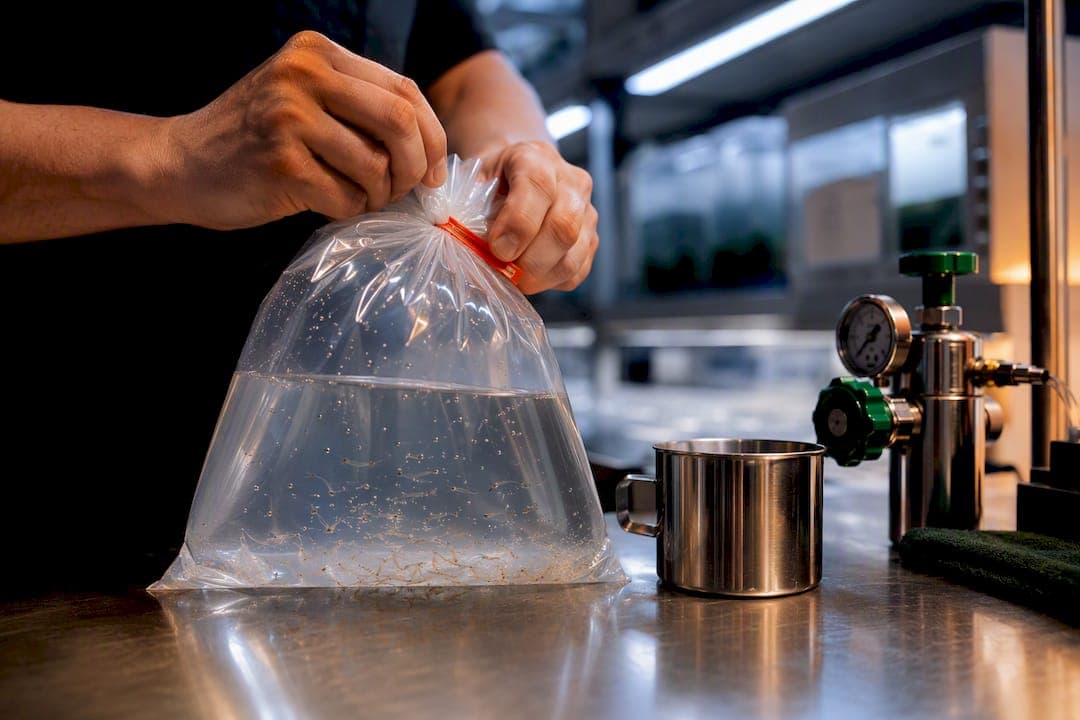
Live brine shrimp survive shipping when you nail four things: fast at least half a day before packing, control temperature swings rather than chase a perfect number, saturate the water with oxygen while keeping biomass low, and ship overnight with no weekend layovers. Most failures trace back to one of three causes: transit that runs too long, too many shrimp crammed into too little water, or a sudden temperature jump the animals cannot buffer against. Get those variables right and the rest of the process is mostly common sense.
TL;DR:
- Ensure shrimp are fasted 12 to 24 hours before packing to reduce ammonia buildup and improve survival during transit.
- Maintain water stability by insuring temperature and pH levels do not fluctuate rapidly, with insulation and buffered water during shipment.
- Use sturdy, insulated packaging with oxygen-saturated water for adult shrimp traveling over several hours, and consider waterless methods for shorter or dormancy shipments.
- Ship overnight on fixed schedules, avoiding weekends or holidays, and clearly label boxes to prevent mishandling and delays.
- Conduct test shipments with temperature loggers and carefully follow first-hour triage steps upon arrival to maximize shrimp survival rates.
Table of Contents
- Preparation and Pre-Shipment Checks for Brine Shrimp Shipping
- Temperature and Oxygen Control During Transit
- Packaging Materials and Shipping Methods That Work
- Scheduling Shipments to Avoid Transit Delays
- Receiving Brine Shrimp: The First-Hour Triage Checklist
- What Demeter Biosciences Has Learned From Thousands of Live Shipments
- Why Testing Beats Guessing on Every Shipment
- Get Reliable Live Brine Shrimp Without the Guesswork
- Sources
- FAQ
Preparation and Pre-Shipment Checks for Brine Shrimp Shipping
Good brine shrimp packaging techniques start hours before you ever touch a bag. Fast the shrimp for 12 to 24 hours before packing. An empty gut means less waste output, and less waste means the ammonia in that closed bag stays low enough that it doesn't poison the water before the box even leaves the building.
Water chemistry matters just as much as the fasting window. Alkalinity tends to crash during transit as carbon dioxide builds up from respiration, so buffering the water beforehand with a small dose of baking soda, or a commercial buffer packet, keeps pH from swinging low and stressing the animals.
Packing density needs to match the life stage and the trip length. Nauplii tolerate higher densities than adults because they respire less and produce less waste per unit volume, but longer shipments should carry lower biomass than shorter or same-day deliveries.
Before sealing anything, strip out shell debris, dead shrimp, and excess algae, since decaying material feeds bacteria that spike ammonia fast. Double-bagging isn't optional if you want to avoid leaks: one bag holds the water, the second protects against punctures from box corners or careless handling in transit.
- Fast shrimp 12 to 24 hours pre-shipment to cut ammonia load.
- Buffer water to stabilize pH against carbon dioxide buildup.
- Reduce density for adults and for any trip over 24 hours.
- Remove debris and double-bag every shipment, no exceptions.
Pro Tip: Weigh out your buffer dose in advance and pre-mix it into a small bottle you carry with your packing supplies. Guessing at buffer amounts under time pressure is how alkalinity crashes happen.
Temperature and Oxygen Control During Transit
Keeping the water within a workable range matters far less than keeping it stable. The rate of change in temperature and pH during transit drives far more stress and mortality than the actual starting number, according to Mississippi State's SRAC shipping guidelines. A bag that drifts from 70°F to 60°F over six hours does less damage than one that swings 10 degrees in twenty minutes.
For adult brine shrimp being held rather than hatched, a moderate, stable range works better than chasing hatch-specific numbers. Nauplii shipments are more temperature-sensitive: optimal hatching sits around 82°F, with reliable hatching above 77°F, per Artemia production guidance from Mississippi State. Our own breakdown of ideal hatching and holding temperatures covers the full range for hobbyists building out a culture routine.
Insulation does the real work here, not the heat or cold pack itself. Never let a pack touch the bag directly. Frozen gel packs against plastic can flash-freeze a thin layer of water and kill shrimp on contact, so buffer packs from bags with a layer of packing peanuts or crumpled paper.
- Fill bags at roughly one-third water to two-thirds air, or enrich with pure oxygen for longer trips.
- Never let a heat or cold pack touch the bag directly.
- Use a foam-insulated box, not just a cardboard shipper, for anything over four hours.
- Test-ship with a temperature logger before scaling up volume.
Well-insulated boxes have been shown to keep internal water temperatures stable during winter cross-country transit despite extreme external cold, according to a study on zebrafish shipping logistics. That's the target range you're aiming for with insulation and pack placement, not a coincidence of good weather.
Dissolved oxygen saturation matters more than the thermometer reading. Oxygen becomes the limiting factor in any sealed bag, and saturating the water before sealing, combined with lower biomass density, does more for survival than any other single variable in the box.

Packaging Materials and Shipping Methods That Work
Two methods dominate brine shrimp packaging techniques: water-filled bags and waterless shipping on moistened media. Each has a place depending on distance and life stage.
For the water-in-bag method:
- Use a heavy-gauge polyethylene bag, at least 2 mid thick, to resist punctures.
- Fill roughly one-third with buffered, oxygenated water and two-thirds with air or pure oxygen.
- Twist the bag closed, fold it over, and secure it with a rubber band or bag-taping tool, not a simple knot.
- Slide that bag into a second bag, oriented so the opening faces the opposite direction, and seal again.
- Place both bags upright inside the insulated box, cushioned on all sides with packing peanuts or paper.
Waterless shipping on moistened wood shavings works for shorter trips and cyst-stage or dormant shipments, where shrimp are packed in slightly damp shavings inside a ventilated container rather than submerged. It cuts weight and reduces the ammonia buildup problem entirely, since there's no standing water to foul, but it demands tighter humidity control. Too dry and the animals desiccate; too wet and you've just built an inefficient water bag.
Choose water-in-bag for adult live shrimp traveling more than a few hours. Reserve the waterless method for short regional trips or cooler weather, when desiccation risk is lower.
Pro Tip: Keep a standing checklist taped inside your packing station: bags, bands, buffer, oxygen tank, peanuts, insulated box, labels. Missing one item under a shipping deadline is how corners get cut.

Scheduling Shipments to Avoid Transit Delays
Timing kills more shipments than bad packing does. Overnight shipping should be the default for any live brine shrimp order, and avoid shipping on a Thursday or Friday that risks a Saturday delivery attempt or a weekend sitting in a warehouse.
Call ahead or flag pickup and delivery windows directly with the carrier when you can, especially for early morning cutoffs that determine whether a box makes the first flight out. A package that misses its window by twenty minutes can sit an extra day.
Label boxes clearly: "Live Animals," "Keep Upright," and "Do Not X-Ray" all change how handlers treat a package in a sorting facility, even if compliance isn't guaranteed. It's a small step that measurably reduces rough handling.
- Ship overnight and avoid Thursday, Friday, or pre-holiday departures.
- Confirm pickup and delivery windows with the carrier directly.
- Label every box with live-animal and handling instructions.
- Run temperature loggers on test shipments to catch problems before they become patterns.
Receiving Brine Shrimp: The First-Hour Triage Checklist
The first hour after a box arrives decides whether a rough trip turns into a loss. Move fast, but move carefully.
- Open the box immediately and check bag integrity before anything else. A punctured or leaking bag needs emergency transfer to a clean container right away.
- Measure water temperature and pH inside the bag, and compare against your tank's parameters. A wide gap means acclimation needs to happen slowly.
- Float the sealed bag in your tank or holding container for 15 to 20 minutes to equalize temperature gradually.
- Add small amounts of tank water to the bag every 5 to 10 minutes over the next 20 to 30 minutes rather than dumping shrimp straight in.
- Aerate the receiving container during acclimation, and if shrimp look sluggish or discolored, move them to a small quarantine tank with fresh aeration instead of the main system.
A brief respite period after transit, giving shrimp 2 to 3 hours of undisturbed rest in stable water, has been shown to meaningfully improve survival and recovery, based on research on live shrimp supply chains. Don't rush straight from box to display tank. Our dead-on-arrival triage guide walks through emergency recovery steps in more detail.
Pro Tip: Photograph the bag and any dead shrimp before you dispose of anything. Suppliers worth ordering from will want that documentation to make a shipping claim right.
What Demeter Biosciences Has Learned From Thousands of Live Shipments
Subscription orders and bulk retail orders get staged differently on our end. Subscription boxes go out on a fixed weekly cadence timed to avoid weekend transit, while bulk orders for stores and institutions get scheduled around the buyer's receiving hours to prevent a pallet sitting unattended after hours.
Cold weather changes the math entirely. Below a certain outdoor temperature, we hold or reroute orders rather than risk a box freezing in an unheated truck overnight. Our winter shipping policy spells out exactly when we pause shipments and what to ask for if you're ordering during a cold snap.
- Subscription shipments follow a fixed weekday cadence to dodge weekend delays.
- Bulk orders coordinate around the buyer's own receiving schedule.
- Cold-weather holds protect shipments from freezing in transit.
- There is support available for customers needing help with first-hour triage.
Why Testing Beats Guessing on Every Shipment
The hobbyists and suppliers who lose the fewest shrimp aren't the ones with the fanciest packaging. They're the ones who run a small test shipment, drop a temperature logger in the box, and actually read the data before scaling up to a full order. Guesswork on pack size or insulation thickness gets expensive fast once you're shipping in volume.
There's also a welfare dimension worth naming plainly: these are living animals, not inert cargo, and treating the shipping process as disposable logistics ignores that reality. Iterating on your protocol isn't just about protecting margins. It's about not needlessly killing animals you had the tools to keep alive.
— Demeter
Get Reliable Live Brine Shrimp Without the Guesswork
Some suppliers raise brine shrimp on organic Dunaliella microalgae in controlled, land-based systems to ensure consistent nutrition and avoid the seasonal starvation swings seen in wild-harvested shrimp shipments.
If everything above sounds like a lot to manage on your own, that's exactly why direct shipping exists. Order live brine shrimp for a one-time shipment, or set up the Demeter Biosciences membership at $25 per month for recurring deliveries timed to avoid weekend transit automatically. Local fish stores and institutional buyers can look at our bulk ordering page for volume pricing. If ordering during winter or needing special handling instructions, customers are encouraged to contact the supplier before checkout to arrange for any necessary shipping precautions. Place your order today and let us handle the packing science.
Sources
- Shipping fish in boxes (SRAC fact sheet)
- Internal temperatures of packaging for overnight cross-country shipping of zebrafish (Danio rerio)
FAQ
How Long Can Brine Shrimp Survive in Shipping?
Well-packed adult brine shrimp typically tolerate about 24 hours in transit when oxygen is saturated, density is kept low, and temperature stays stable. Longer trips sharply increase risk, which is why overnight shipping is the standard recommendation for live orders.
Will Brine Shrimp Hatch in 70 Degree Water?
Hatching slows significantly below 77°F, since reliable hatching requires temperatures above that mark and optimal hatching sits closer to 82°F. At 70°F, cysts may hatch eventually but on a much slower and less predictable timeline.
How Long Does It Take Brine Shrimp to Reach Full Size?
Brine shrimp typically reach adulthood in about 8 days under optimal culture conditions between 77°F and 86°F. Cooler holding temperatures slow that growth timeline considerably.
How Long Will Brine Shrimp Last Once I Receive Them?
Properly acclimated live brine shrimp can be held for a limited time in cold, aerated storage before feeding out, and our storage guide covers the aeration and temperature setup that keeps them alive. Feeding them out sooner rather than later still gives the best nutritional value.
Does Demeter Biosciences Offer Live Brine Shrimp Shipping?
Yes, Demeter Biosciences ships live brine shrimp directly to hobbyists and suppliers, priced between $17 and $35 depending on order size, through its live shrimp product page. A monthly membership option is also available for recurring shipments.