

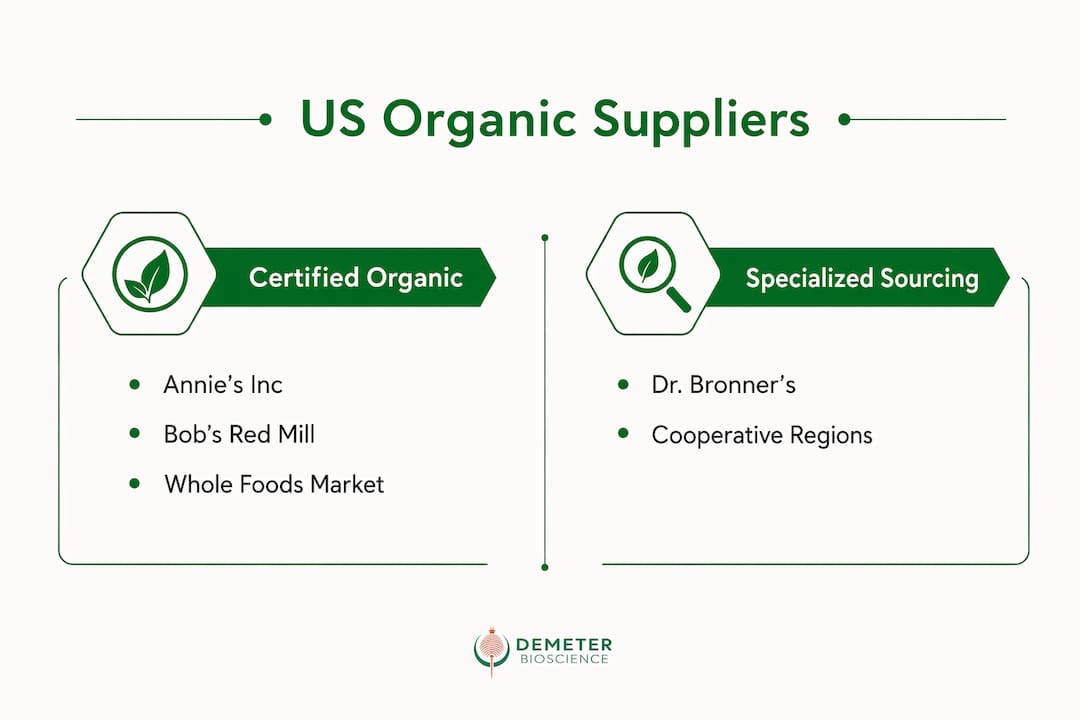
If you're sourcing certified organic food ingredients in Europe and need alternatives to naturebiofoods.eu, the strongest options are Annie's Inc., Bob's Red Mill, Dr. Bronner's, Whole Foods Market, and Cooperative Regions of Organic Producer Pools. Each holds recognized organic certifications, ships to US buyers, and covers distinct product categories worth knowing before you commit to a new supplier.
Here's a quick orientation before the full comparison:
- Annie's Inc. — certified organic grains, snacks, and ingredient blends; broad portfolio for food manufacturers
- Bob's Red Mill — organic whole grains and flours; strong consistency record for baking and grain applications
- Dr. Bronner's — certified organic plant-based oils and botanical extracts; fair trade credentials across global supply chains
- Whole Foods Market — curated certified organic bulk ingredients; accessible entry point for smaller buyers
- Cooperative Regions of Organic Producer Pools — aggregated European organic crops with regional traceability; suited for large-scale, ethically sourced procurement
How do these naturebiofoods.eu alternatives compare for US procurement?
Five certified organic suppliers serve as the primary alternatives to naturebiofoods.eu for US-based businesses, each with distinct strengths across product range, certifications, and logistics.
| Supplier | Company background | Product range | Certifications | US availability | Pricing overview |
|---|---|---|---|---|---|
| Annie's Inc. | US-based; acquired by General Mills in 2014 | Organic grains, snack ingredients, pasta, condiments | USDA Organic, Non-GMO Project | Direct US distribution; European sourcing partnerships | Mid-range; volume discounts available |
| Bob's Red Mill | Oregon-based; employee-owned since 2010 | Organic whole grains, flours, cereals, legumes | USDA Organic, Kosher, Gluten-Free | Nationwide US; exports to Europe and beyond | Competitive bulk pricing; tiered by volume |
| Dr. Bronner's | California-based; global organic raw material sourcing | Organic coconut oil, palm oil, botanical extracts, hemp | USDA Organic, Fair Trade, Regenerative Organic Certified | US and international; direct B2B sourcing available | Premium pricing reflecting fair trade premiums |
| Whole Foods Market | — | Certified organic bulk grains, seeds, nuts, specialty items | USDA Organic, third-party audited | US retail and wholesale; limited direct export | Retail and wholesale tiers; no published MOQ |
| Cooperative Regions of Organic Producer Pools | European cooperative network; aggregates farms across multiple EU regions | Organic grains, oilseeds, pulses, specialty crops | EU Organic Regulation, Naturland, Demeter | Export-ready for US buyers; EU-origin traceability | Negotiated contract pricing; volume-dependent |
Annie's Inc. built its reputation on consumer-facing organic products, but its ingredient supply arm serves food manufacturers needing certified organic grain blends and snack components. General Mills' ownership since 2014 means Annie's benefits from large-scale logistics infrastructure, which translates to more predictable lead times for US buyers.
Bob's Red Mill is the go-to for manufacturers who need organic whole grains and specialty flours with documented batch consistency. The company's employee-owned structure since 2010 has kept quality controls tightly internal. Third-party testing documentation is available on request, which matters when your formulation depends on consistent protein or moisture specs.
Dr. Bronner's operates differently from the others. Its core business is finished personal care products, but the company sources certified organic raw materials globally and has made those supply chains available to B2B partners. If your procurement need is organic coconut oil, hemp seed oil, or botanical extracts, Dr. Bronner's Regenerative Organic Certified credential is one of the most rigorous available, sitting above standard USDA Organic requirements.

Whole Foods Market works best for smaller buyers or specialty food producers who need certified organic bulk ingredients without committing to large minimum order quantities. The trade-off is that Whole Foods is primarily a retailer, not a dedicated ingredient supplier, so contract flexibility and custom sourcing are limited.
Cooperative Regions of Organic Producer Pools fills the gap for buyers who need traceable, EU-origin organic crops at scale. The cooperative model means you're dealing with aggregated supply from multiple farms, which improves volume availability and reduces single-farm risk. Regional traceability systems within these cooperatives often meet or exceed the standards that naturebiofoods.eu built its Rotterdam-based operation around.
How to select the best organic food ingredient supplier for your business needs
Certification is the starting point, not the finish line. A USDA Organic or EU Organic label confirms the production process meets a defined standard, but it says nothing about batch-to-batch functional consistency, which matters when you're formulating a product that depends on specific protein structure or fat profile.
Key selection criteria to evaluate:
- Certification scope: Confirm whether the supplier holds USDA Organic, EU Organic Regulation certification, or both. For US import, USDA NOP equivalency agreements with the EU mean EU-certified products generally qualify, but verify with your customs broker.
- Third-party auditing: Look for annual audits by accredited bodies such as CCOF, Oregon Tilth, or Ecocert. Self-reported compliance is not sufficient for high-volume procurement.
- Traceability systems: Suppliers with farm-level traceability documentation reduce your regulatory exposure. Nature Bio Foods' TraceOrigin system set a high bar; ask prospective alternatives what their equivalent is.
- Minimum order quantities (MOQs): naturebiofoods.eu accepts orders as low as one pallet. Not every alternative matches that flexibility, so confirm MOQs before shortlisting.
- Lead times to US: European suppliers typically quote 4–8 weeks for transatlantic shipment. Confirm whether the supplier holds US-side inventory or ships exclusively from Europe.
- CO2 cleaning and pest control: For grain and seed ingredients, CO2 pressure treatment is the gold standard for infestation control without chemical residue. Ask specifically whether a prospective supplier has this capability.
Pro Tip: Segment your sourcing into two tiers. Reserve certified organic procurement for ingredients on the Environmental Working Group's Dirty Dozen list, where pesticide residue risk is highest. For lower-risk ingredients, clean-label conventional alternatives can reduce your cost base without compromising product safety claims.
Supplier functional consistency deserves as much weight as certification. Third-party testing and documented specifications per lot are the practical tools that protect your formulation integrity when you switch suppliers.
What does the research say about organic ingredient quality and supply consistency?
Organic certification signals a production process standard, not a guaranteed nutritional outcome. A 2019 systematic review found observational evidence linking organic consumption to reduced incidence of certain health conditions, but clinical evidence remains inconclusive. For procurement purposes, the more defensible claim is pesticide residue reduction, which is consistently documented.
The EU imported a substantial volume of organic agri-food products in 2024, with the Netherlands, Germany, and Belgium serving as the top import hubs. That volume tells you the European organic supply chain is mature and capable of handling US-scale demand.
Supply chain quality factors that separate reliable suppliers from risky ones:
- Secure warehousing with controlled temperature and humidity, not just certified storage
- CO2 cleaning facilities that eliminate infestation without pesticide residue
- Documented IPQC (in-process quality control) labs for grain and seed testing
- BRC (British Retail Consortium) or equivalent food safety certification alongside organic credentials
- Logistics partners with cold-chain or climate-controlled container options for sensitive ingredients
Controlled-environment agriculture is gaining ground as a solution to seasonal variability in traditional organic farming. Vertical farming and hydroponics can deliver year-round supply consistency that field-grown organic crops cannot always match. For buyers who have experienced supply gaps from European grain cooperatives during drought years, this is worth factoring into your supplier diversification strategy.
Key Takeaways
The strongest naturebiofoods.eu alternatives for US buyers are suppliers with documented third-party certifications, farm-level traceability, and logistics infrastructure capable of consistent transatlantic delivery.
| Point | Details |
|---|---|
| Certification is necessary but not sufficient | Verify third-party audits and functional ingredient specs alongside USDA or EU Organic labels. |
| EU organic import scale | The EU imported a substantial volume of organic agri-food products in 2024, confirming supply depth. |
| Segment your sourcing | Prioritize certified organic for high-pesticide-risk ingredients; use clean-label conventional for lower-risk items to control costs. |
| CO2 cleaning matters | Ask every prospective grain or seed supplier whether they operate CO2 pressure treatment facilities. |
| Demeterbioscience's niche | For aquatic nutrition specifically, Demeterbioscience offers land-based, organically farmed brine shrimp as a traceable, consistent alternative to wild-harvested supply. |
The case for rethinking where "organic consistency" actually comes from
Most procurement guides treat organic certification as the primary differentiator between suppliers. That framing misses the harder problem: certification tells you how a product was grown, not whether it will perform the same way in your formulation next quarter.
The suppliers that hold up under real procurement pressure are the ones with documented in-process quality controls, not just a certificate on file. Bob's Red Mill's employee-owned structure and internal testing protocols are a practical example of this. Dr. Bronner's Regenerative Organic Certified standard goes further than USDA Organic by requiring soil health and worker fairness audits, which means the supply chain is scrutinized at multiple points, not just at harvest.
The trend toward controlled-environment sourcing is a direct response to the seasonal variability problem that field-grown organic suppliers have never fully solved. Buyers who diversify across cooperative pool suppliers and controlled-environment producers end up with more stable supply than those who rely on a single European source, regardless of how strong that source's certifications are.
Local and direct-farm sourcing can also improve price stability and traceability for smaller buyers, though the administrative overhead is real. The right answer depends on your volume, not a universal principle.
Demeterbioscience offers a different kind of organic sourcing for aquatic nutrition
The suppliers compared above cover grain, seed, oil, and botanical ingredient categories well. For businesses operating in aquaculture or ornamental fish markets, the sourcing challenge is different, and that's where Demeterbioscience addresses a gap none of the above suppliers fill.
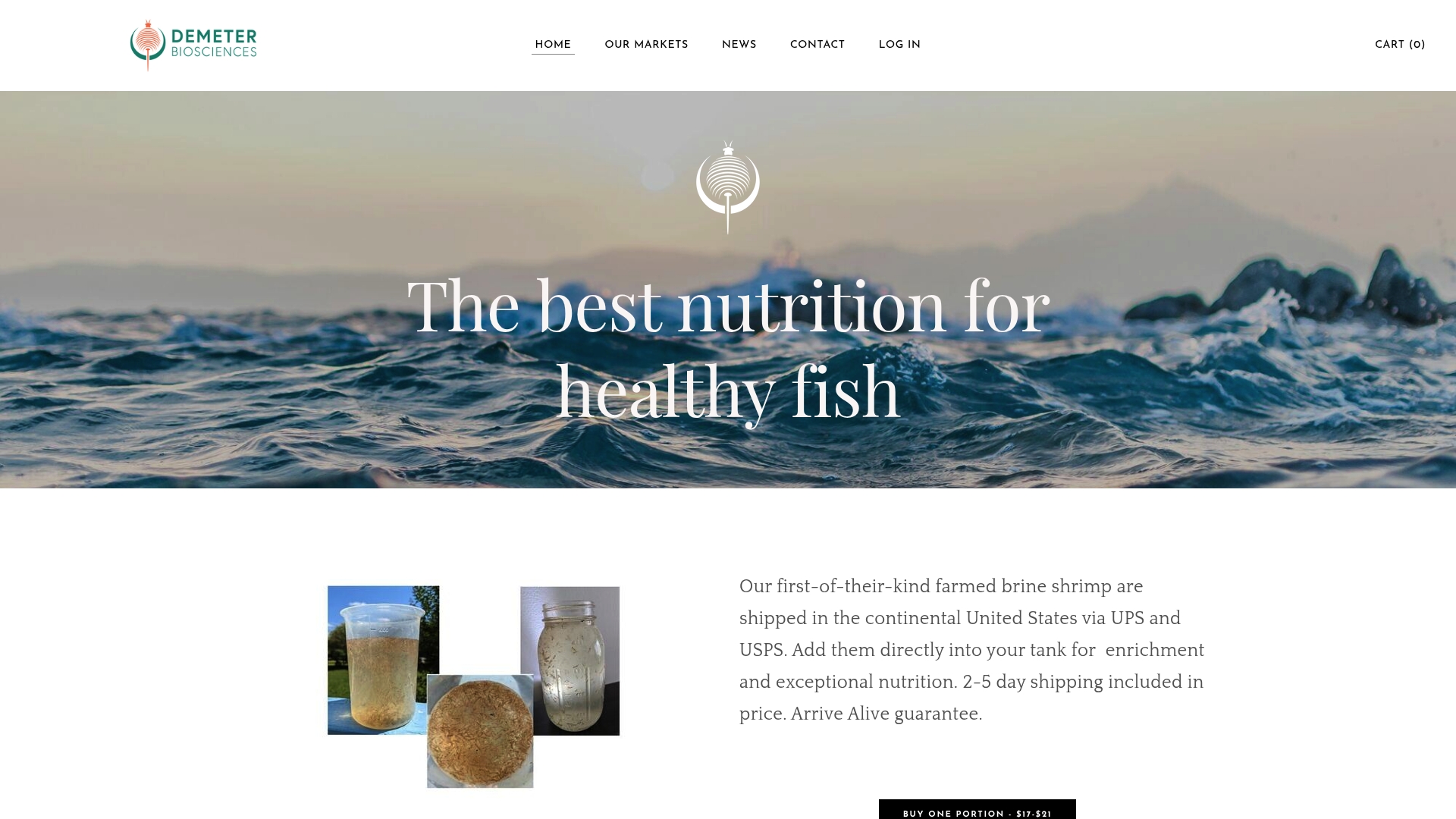
Demeterbioscience farms live brine shrimp in land-based, controlled systems fed exclusively on Dunaliella microalgae, delivering at least 40% protein content with none of the seasonal variability that wild-harvested brine shrimp carry. The production system is fully traceable, avoids the starvation conditions common in natural salt lake ecosystems, and aligns with the same organic and sustainability standards that procurement teams now expect from terrestrial ingredient suppliers.
For institutional buyers, bulk brine shrimp orders are available alongside direct shipment and subscription plans. If your procurement scope includes aquatic nutrition alongside conventional organic food ingredients, Demeterbioscience is worth a direct conversation before you finalize your supplier list.