
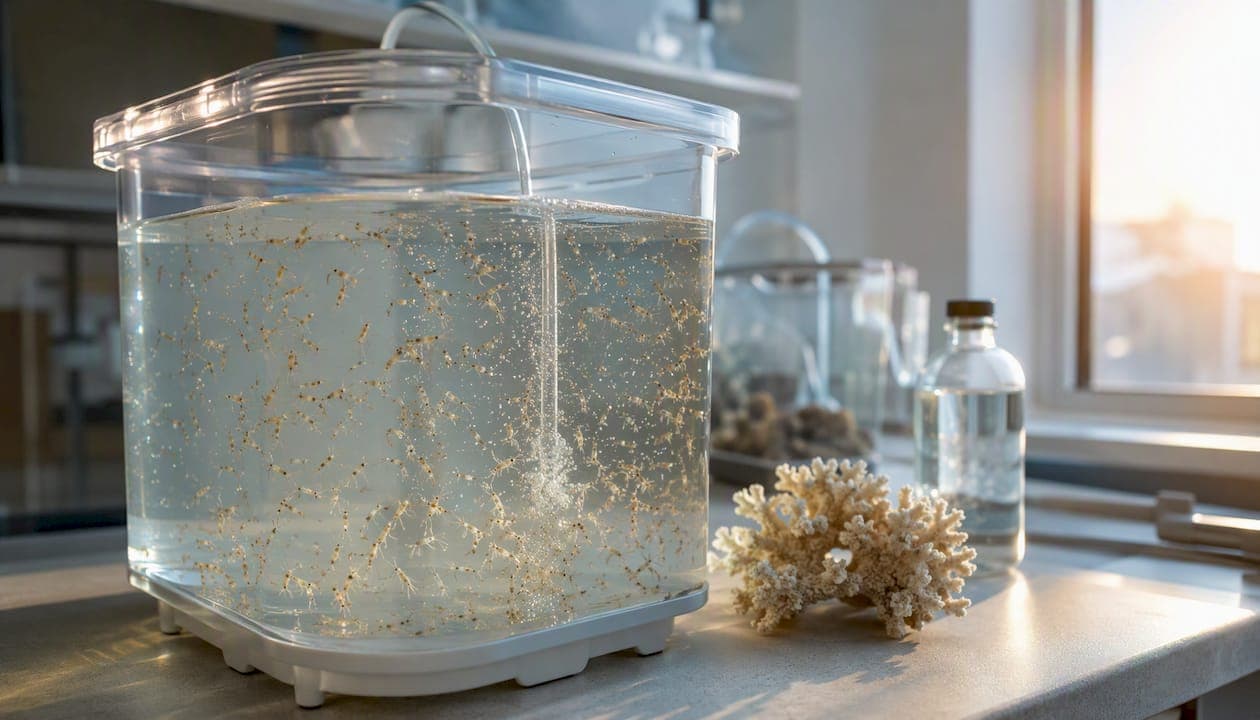
You cannot truly freeze live Artemia and keep them viable. What the aquarium and aquaculture world calls "freezing" live brine shrimp is actually short-term cold storage at 2°C–10°C (35°F–50°F), with continuous aeration and controlled density. Under those conditions, farmed, microalgae-fed Artemia stay alive and nutritionally intact for up to about 24 hours, according to hatchery production guidelines. That window covers same-day holding, overnight shipping, and most institutional transfer scenarios.
The non-negotiable parameters:
- Temperature: 2°C–10°C throughout the hold
- Density: up to ~5,000 Artemia/mL with active aeration
- Oxygenation: continuous, from harvest through delivery
- Maximum hold: ~24 hours under recommended conditions
- Sequence: harvest → rinse → concentrate → cool (never skip the rinse)
Key Takeaways
Cold storage at 2°C–10°C with continuous aeration is the only practical method for keeping live Artemia viable through a shipping or holding window, with a maximum recommended duration of about 24 hours at densities up to ~5,000 Artemia/mL.
| Point | Details |
|---|---|
| Temperature range | Hold at 2°C–10°C throughout; above 10°C accelerates mortality. |
| Maximum hold duration | Up to ~24 hours with aeration and density control. |
| Enrichment timing | Gut-load before cold hold; adults enrich in 1–2 hours, nauplii need 12+ hours. |
| Aeration is non-negotiable | Aerator failure is the leading cause of mass die-off; run redundant systems. |
| Demeterbioscience supply | Farmed, microalgae-fed Artemia, packed for cold-chain shipment. |
Table of Contents
- How to freeze live brine shrimp: the step-by-step cold-storage protocol
- What equipment do you actually need for cold storage and shipping?
- How long can Artemia survive in cold storage and transit?
- Sanitation and disease-vector risk during harvest and storage
- How to revive and acclimate Artemia after cold storage
- Demeterbioscience: farmed, microalgae-fed live Artemia for U.S. buyers
- What actually happens when you freeze live brine shrimp below 0°C
- Freezing techniques and cryoprotectants: what the research shows
- Thawing after cold storage: how to bring animals back safely
- Why cold storage outperforms freezing for live Artemia every time
- Our perspective on cold-chain quality for live Artemia
- Ready to order Demeterbioscience live Artemia for your next hold or shipment?
- Primary sources and further reading
- Sources
How to freeze live brine shrimp: the step-by-step cold-storage protocol
-
Harvest at the right moment. For nauplii, harvest within the first 8–12 hours after hatching for peak yolk-derived nutrition. Adults can be harvested any time they are actively swimming and feeding.
-
Stop aeration and separate layers. After aeration stops, live nauplii concentrate toward a light source within 10–15 minutes. Empty shells float; unhatched cysts sink. Siphon the live nauplii layer into a fine mesh harvest bag (125 µm or finer).
-
Rinse thoroughly. Run dechlorinated saltwater through the harvest bag until the rinse water runs clear. This removes shells, hatch debris, and excess bacteria before cold storage.
-
Concentrate to target density. Transfer rinsed Artemia into a clean, aerated holding container. Aim for no more than 5,000 individuals/mL. Higher densities without proportionally stronger aeration accelerate oxygen depletion and bacterial load.
-
Cool gradually. Lower the container temperature to 2°C–10°C using pre-frozen 1 L water bottles placed alongside the container, not directly in the water. A 2°C–3°C drop per 10 minutes is a safe rate. Faster cooling causes thermal shock.
-
Monitor continuously. Place a digital thermometer probe in the water column, not against the container wall. Check temperature and swimming behavior every 2–4 hours. Sluggish, bottom-clustering Artemia signal oxygen depletion or temperature drift.
-
Enrich before cold hold, not after. Cold storage slows metabolism to near-zero, so gut-loading or HUFA enrichment must happen before the animals go cold, not during the hold.
Pro Tip: Freeze your 1 L water bottles at least 12 hours in advance and keep two to three times as many as you think you need. Rotate bottles every 8–12 hours during transit to maintain a stable temperature band without crashing below 2°C.
What equipment do you actually need for cold storage and shipping?
Aeration and oxygen:
- Small battery-powered or AC air pump with micropore diffusers
- Spare airline tubing and check valves (aerator failure is the leading cause of mass die-off during transit)
- Pure oxygen source (oxygen bag or cylinder) for shipments exceeding 12 hours
Temperature control:
- Insulated cooler (hard-sided foam or polystyrene)
- Pre-frozen 1 L water bottles (plan 2–3 per 8-hour leg of transit)
- Digital thermometer with a submersible probe
Harvest and holding containers:
- 125 µm harvest bag or fine mesh net
- Clean harvest buckets (food-grade, sanitized)
- Aerated holding containers sized to your density target
Consumables and sanitation:
- Dechlorinated saltwater matched to your culture salinity
- Dilute bleach solution or approved aquaculture disinfectant for surface sanitation
- Spare ice bottles and zip-seal bags for secondary containment
| Equipment | Purpose |
|---|---|
| Micropore diffuser | Maximizes oxygen surface area at low flow rates |
| Digital probe thermometer | Accurate water-column temperature, not ambient air |
| 125 µm harvest bag | Retains nauplii while flushing shells and debris |
| Pre-frozen 1 L bottles | Gradual, controllable cooling without direct ice contact |
| Insulated hard cooler | Maintains temperature band during transit |
How long can Artemia survive in cold storage and transit?
Cold storage at 2°C–10°C with aeration keeps Artemia viable for up to about 24 hours at densities up to ~5,000/mL. Nauplii held near 4°C for 24–48 hours show minimal dry-weight loss compared with room-temperature holds, where metabolic losses are dramatically higher, according to practical cold-storage trials.
Adult Artemia generally tolerate cold holds better than nauplii because their larger body mass buffers temperature swings. Nauplii are more sensitive to both oxygen dips and temperature spikes.
| Scenario | Hold time | Key requirement |
|---|---|---|
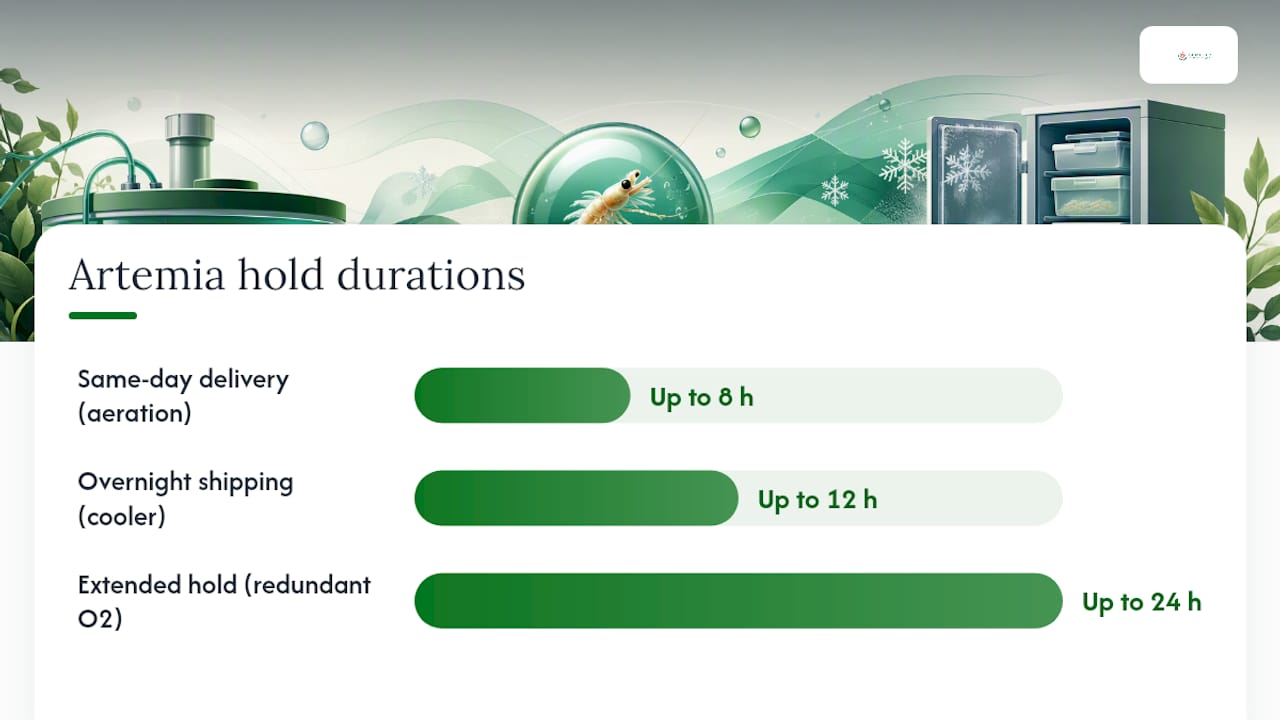
| Same-day local delivery | Up to 8 hours | Aeration, 2°C–10°C |
| Overnight shipping | 12 hours | Insulated cooler, ice bottle rotation |
| Extended institutional hold | Up to 24 hours | Redundant aeration, oxygen supplement |
Signs a shipment is failing: animals clustering at the bottom, milky or cloudy water, strong ammonia odor, or temperature above 12°C. Corrective steps: add a fresh ice bottle, increase aeration immediately, and isolate any visibly dead batches before they degrade water quality for survivors.
Sanitation and disease-vector risk during harvest and storage
Artemia can carry pathogens into larval cultures if harvest hygiene is poor. The two highest-risk points are the harvest container and the rinse step.
- Decapsulation removes the outer shell from cysts using a controlled bleach treatment, eliminating shells that cause packing problems and reducing bacterial load before hatching.
- Rinse every batch until the rinse water runs clear. Residual shell fragments and organic debris fuel bacterial growth during cold holds.
- Sanitize all containers between batches with dilute bleach (100–200 ppm) and rinse thoroughly with dechlorinated water before reuse.
- Monitor dissolved oxygen throughout the hold. Oxygen depletion accelerates bacterial proliferation faster than almost any other variable.
- Cancel the batch if you see visible contamination, a strong sulfur or ammonia odor, or mortality above 10% before the hold ends.
Hatchery sanitation rule: A plugged aerator or valve blocked by shell debris is the most common cause of mass die-off during storage and transport. Remove shells before packing and run redundant aeration whenever possible.
How to revive and acclimate Artemia after cold storage
Immediate checks: When the container arrives or comes out of cold hold, look for active swimming within 2–3 minutes of gentle rewarming. Animals that remain motionless after 5 minutes at room temperature are unlikely to recover.
Rewarming steps:
- Move the container to a room-temperature water bath (not direct heat).
- Allow temperature to rise no faster than 2°C–3°C per 10 minutes.
- Restore aeration immediately if it was interrupted during transport.
- Check salinity before introducing Artemia to a freshwater or brackish system and acclimate by slowly adding target-system water over 20–30 minutes.
Re-enrichment after cold storage:
- Adults: enrich with HUFA or microalgae for 1–2 hours before feeding. Adults filter-feed efficiently and reach meaningful enrichment levels quickly.
- Nauplii: require 12 hours or more for meaningful HUFA uptake. For research-grade nutritional quality, run two 12-hour enrichment cycles with a water change between them. Lipid content tends to peak around the 12-hour mark.
- Spot-sample 10–20 individuals under a loupe or dissecting scope before releasing a batch. Active, forward-swimming animals with visible gut content are ready to feed.
For a detailed brine shrimp feeding schedule tied to enrichment timing, Demeterbioscience's checklist covers both nauplii and adult protocols.
Demeterbioscience: farmed, microalgae-fed live Artemia for U.S. buyers
That nutritional baseline matters when you are cold-storing animals: well-fed Artemia entering cold hold retain more energy reserves and survive the storage window better than starved or wild-harvested animals.
- Single shipments: direct-to-consumer live Artemia, packed for short-term cold holding
- Bulk institutional orders: custom quantities for museums, research institutions, and local fish stores
- Monthly subscriptions: recurring shipments timed to your feeding or research schedule
Pro Tip: Order 24–48 hours before your planned cold hold or experiment. Artemia that arrive and go straight into cold storage without a brief recovery and enrichment window will not perform as well as animals given 1–2 hours to re-acclimate first.
What actually happens when you freeze live brine shrimp below 0°C
True subzero freezing kills live Artemia. Ice crystal formation ruptures cell membranes, and no practical thawing protocol recovers viable, swimming animals from a standard household or commercial freezer. The result is dead brine shrimp, usable only as frozen fish food, which is a different product category entirely.
Cryopreservation of Artemia cysts (dormant eggs) is an established research technique, but it requires controlled-rate freezers, cryoprotectants such as DMSO or glycerol, and liquid nitrogen storage. That process preserves the cyst for later hatching, not the live nauplius or adult for immediate feeding.
Freezing techniques and cryoprotectants: what the research shows
For live Artemia nauplii or adults, no commercially practical cryopreservation protocol currently exists that restores swimming viability after subzero freezing. Research on Artemia cyst cryopreservation uses controlled cooling rates (typically 1°C–2°C per minute to a holding temperature before plunging into liquid nitrogen) and cryoprotectants to reduce intracellular ice formation. These protocols apply to dormant cysts, not to active nauplii or adults.
The practical takeaway for aquaculture and aquarium use: cold storage above 0°C is the only reliable method for keeping live Artemia viable through a shipping or holding window.
Thawing after cold storage: how to bring animals back safely
"Thawing" from cold storage (2°C–10°C) is simply controlled rewarming, not recovery from freezing. The steps in the acclimation section above apply directly. The key risk is thermal shock from rewarming too fast, not ice crystal damage.
If animals arrive in a cooler that drifted below 2°C but stayed above 0°C, they may be cold-stunned rather than dead. Place the container in a room-temperature water bath, restore aeration, and wait 5–10 minutes before assessing survival. Cold-stunned Artemia often recover fully.
Why cold storage outperforms freezing for live Artemia every time
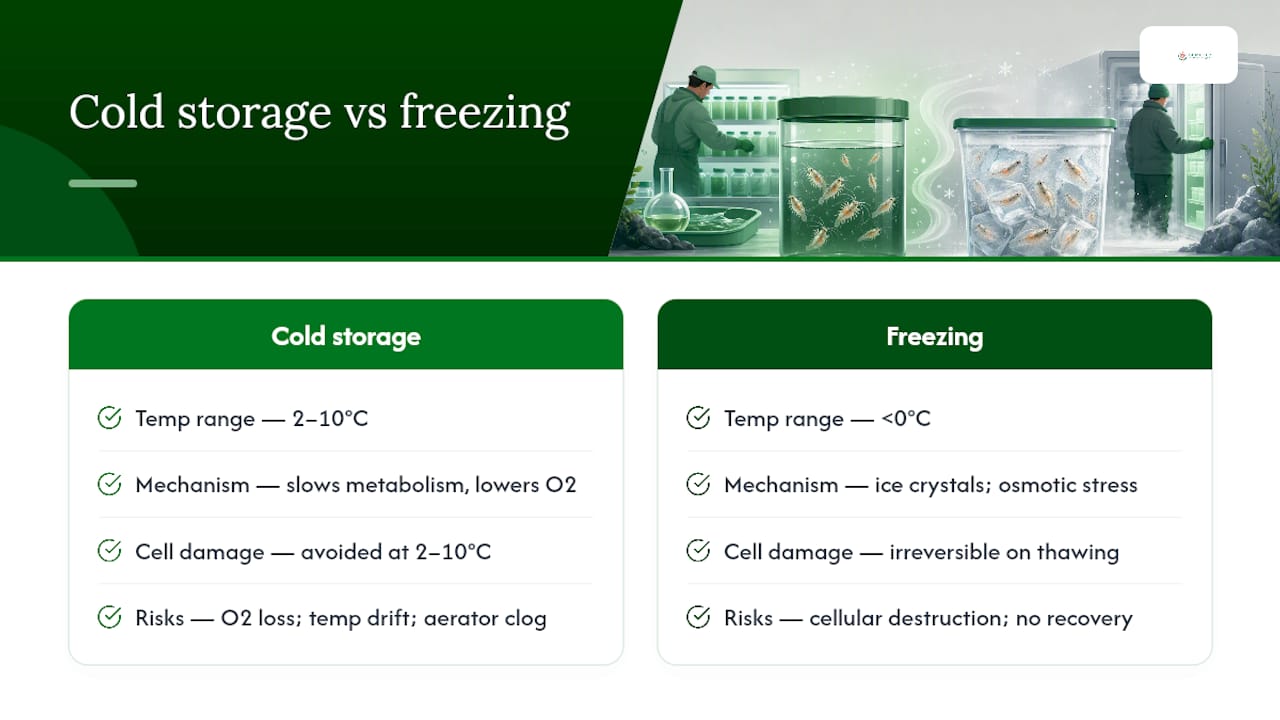
Subzero freezing destroys live Artemia through ice crystal formation and osmotic stress during thawing. Cold storage at 2°C–10°C avoids both. The metabolic slowdown at those temperatures reduces oxygen demand and waste production without crossing the threshold that causes cellular damage. That is why hatchery-grade protocols universally specify cold storage, not freezing, for live feed transport.
The practical risk of cold storage is narrower: oxygen depletion, temperature drift above 10°C, and shell-related aerator blockages. All three are manageable with the equipment and monitoring steps above. Freezing offers no equivalent recovery path once cellular damage occurs.
For a deeper look at how live and frozen brine shrimp differ in nutritional value and feeding outcomes, Demeterbioscience's comparison covers the trade-offs in detail.
Our perspective on cold-chain quality for live Artemia
Cold-chain integrity is where most live Artemia shipments succeed or fail, and it is the part of the process we think about most carefully at Demeterbioscience. Farmed, microalgae-fed Artemia arrive at your facility with a nutritional advantage over wild-harvested animals, but that advantage only holds if the cold-storage window is managed correctly. We pack every shipment with the temperature and aeration specs in this protocol in mind, and our institutional customers can reach us directly at Demeterbioscience's contact page to discuss custom packing, order timing, or protocol questions. Land-based, Dunaliella-fed production gives us consistent batch quality that makes cold-storage outcomes more predictable than wild-sourced alternatives.
Ready to order Demeterbioscience live Artemia for your next hold or shipment?
Demeterbioscience ships farmed, microalgae-fed live Artemia directly to aquarium hobbyists, aquaculture operations, research institutions, and local fish stores across the U.S. Every shipment is packed to support the cold-storage protocol in this article.
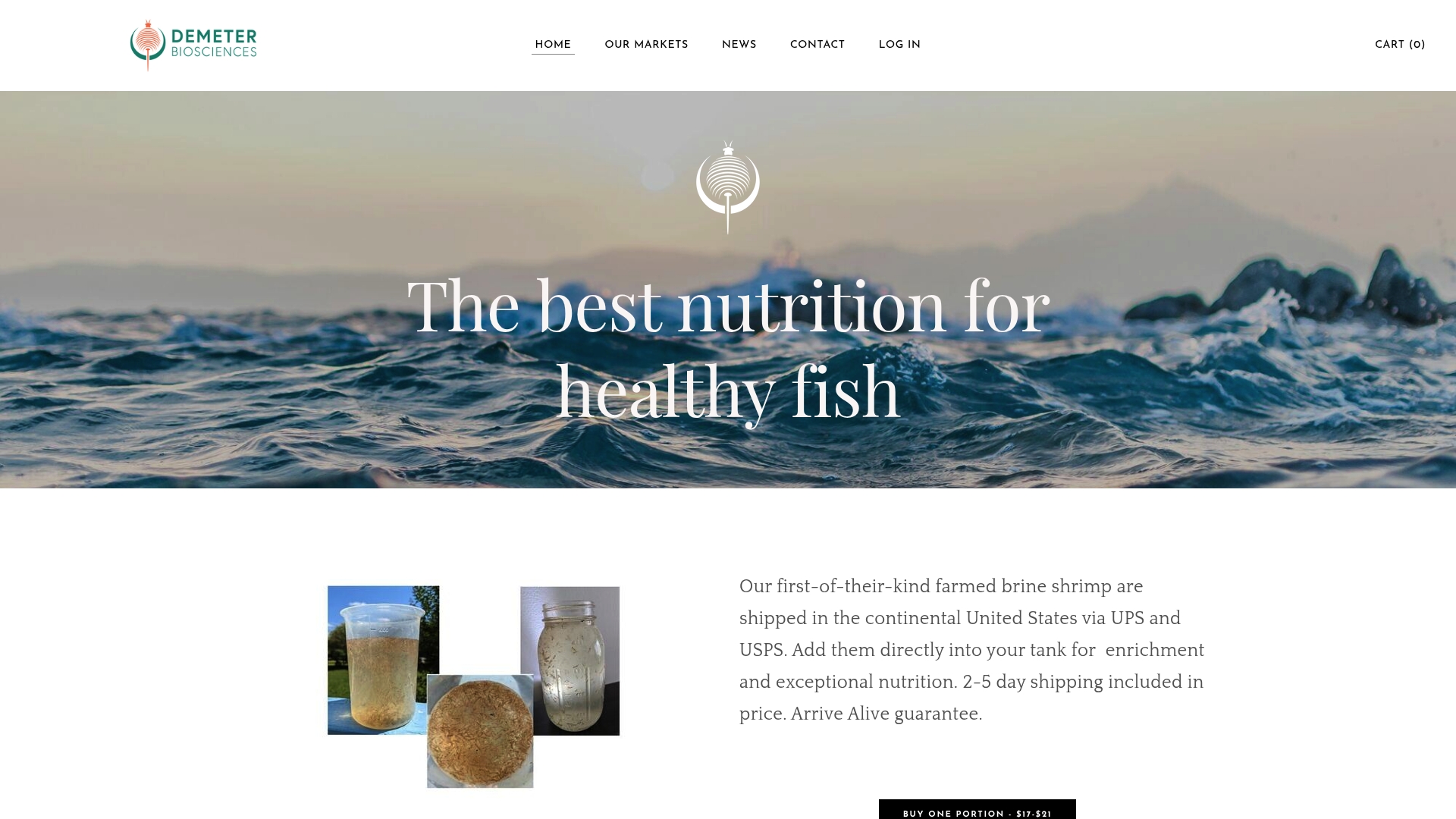
Order a single live brine shrimp shipment for immediate use, or place a bulk institutional order for museums, research labs, or retail. For custom packing requests or subscription timing, contact the team before placing your order so shipment and cold-hold windows align.
Primary sources and further reading
The parameters and procedures in this article draw from the following sources. Institutional readers and hatchery staff should consult the production manual (Lavens & Sorgeloos) for full decapsulation and enrichment protocols, and the Virginia Cooperative Extension guide for cold-storage density and aeration specifications.
- Artemia Culture for Intensive Finfish and Crustacean Larviculture — Virginia Cooperative Extension; primary source for temperature, density, and aeration specs
- Hatching and Growing Brine Shrimp — practical cold-storage dry-weight loss data for nauplii
- Aquarium Invertebrates: Nutritional Value of Live Foods, Part 2 — enrichment timing for adults vs. nauplii
- Study on enrichment protocols for Artemia (Lavens & Sorgeloos referenced) — protein and lipid accumulation timelines
- Baby Brine Shrimp: The Complete Hatching & Feeding Guide — SpawnOS — harvest timing, decapsulation, and hatch parameters
- Artemia delivery system for hatcheries — aeration redundancy and shell-removal for transport systems
- Brine Shrimp Nutrition for Commercial Larval Fish — enrichment methods and nutritional goals for larval fish
For protocol clarification or institutional order support, contact Demeterbioscience directly.
Sources
- Artemia Culture for Intensive Finfish and Crustacean Larviculture
- Aquarium Invertebrates: Nutritional Value Of Live Foods For The Coral Reef Aquarium, Part 2
- Hatching and Growing Brine Shrimp (practical guide/extract)
- Study on enrichment protocols for Artemia (Lavens & Sorgeloos referenced)
- Baby Brine Shrimp (Artemia): The Complete Hatching & Feeding Guide — SpawnOS